Short answer: yes, when the generations match and the wheel is 17 inches or larger. Six-lug 2005-2023 Tacoma wheels in 17 or 18 inches bolt onto a 2010-2024 4Runner, and 2024+ Tacoma wheels bolt onto a 2025+ 4Runner. Cross the generation line and they don't. Every six-lug Tacoma and every 4Runner since 1996 uses the same 6x139.7 bolt pattern, so most answers stop there and add "it depends." What it depends on is three specs nobody lines up for you: the hub bore, the wheel diameter against the 4Runner's front brakes, and the lug nut seat.
I'm Dennis Feldman, and Toyota wheel interchange is one of the questions I answer most. Tacoma take-offs are cheap and plentiful, and they look right on a 4Runner. When the swap fails, the bolt pattern is almost never why. It's a center bore 11 millimeters too small, a 16-inch barrel too close to a caliper, or a lug nut that feels tight and isn't.
Start with the chart. Find your Tacoma wheel in the first column and your 4Runner in the second. The last column tells you what decides it.
Tacoma Wheel |
4Runner |
Fits? |
What Decides It |
|---|---|---|---|
2005-2023, 17 or 18 in. |
2010-2024 (5th gen) |
Yes |
Same 106.1 mm bore and M12 x 1.5 studs. Match the lug nut seat to the wheel. |
2005-2023, 16 in. |
2010-2024 (5th gen) |
No |
The barrel runs too close to the 5th gen's larger front brakes. Toyota never fit this 4Runner with anything under 17 inches. |
1995-2023, six-lug |
1996-2009 (3rd and 4th gen) |
Usually |
Same bore and studs. Test-fit for caliper clearance and offset. |
2024+ |
2025+ (6th gen) |
Yes |
Same platform, 95.1 mm bore, and M14 x 1.5 studs. |
2024+ |
1996-2024 |
No |
A 95.1 mm bore will not slide over a 106.1 mm hub. |
2005-2023 |
2025+ (6th gen) |
Not recommended |
Lug-centric without a hub ring, stud holes drilled for M12, and the wheel sits well outboard of stock. |
Four- or five-lug base 2WD |
Any |
No |
Wrong bolt pattern. Count the lugs first. |
If the chart says no, or you would rather start fresh than buy someone's take-offs, this second table is the spec sheet any wheel has to meet on your 4Runner, Tacoma or not.
Spec |
2010-2024 4Runner |
2025+ 4Runner |
|---|---|---|
Bolt pattern |
6x139.7 (6x5.5) |
6x139.7 (6x5.5) |
Hub bore |
106.1 mm |
95.1 mm |
Stud thread |
M12 x 1.5 |
M14 x 1.5 |
Smallest factory wheel |
17 in. |
17 in. |
Typical factory offset |
About +4 to +15 mm |
About +20 mm (TRD Pro, Trailhunter) to +55 mm |
Aftermarket 6x139.7 wheels |
Bores of 106.1 mm go on hub-centric; larger bores take a hub ring |
Almost all need a hub ring down to 95.1 mm |
Minimum wheel load rating |
Higher axle rating (GAWR) divided by two, plus margin |
Higher axle rating (GAWR) divided by two, plus margin |
Yes. Every six-lug Tacoma and every 4Runner from 1996 on uses 6x139.7, written 6x5.5 in inches: six studs on a circle 139.7 millimeters across. Toyota kept that pattern through every redesign of both trucks, including the move to the TNGA-F platform the 2024 Tacoma and 2025 4Runner now share.
The exception is on the Tacoma side. Some base two-wheel-drive Tacomas, mostly older four-cylinder trucks, left the factory with four- or five-lug hubs, and their wheels fit no 4Runner. Count the lugs before you count anything else.
Bolt pattern is only the first check. It tells you where the studs are, not how big the center hole is, what thread the studs use, or where the mounting face sits. Chevy, GMC, Nissan, and Toyota trucks all use 6x139.7, and their wheels don't interchange. In the 6x139.7 wheel market, about one wheel in five is bored around 78 mm for GM trucks, far too small to go over any Toyota hub. Same pattern, zero fit. Within Toyota, the spec that splits the family is the hub bore, and Toyota changed it in 2024.
Yes, if they are 17 or 18 inches. This is the cleanest swap in the family. The 2016-2023 Tacoma and the 2010-2024 4Runner share the 106.1 mm hub bore and M12 x 1.5 studs, so the wheel centers on the 4Runner's hub exactly as it did on the Tacoma. Toyota treats them as one wheel family: it has listed some TRD accessory wheels for the Tacoma, 4Runner, and FJ Cruiser at once, and 4Runner TRD Pro wheels on a Tacoma is one of the most common trades on the forums.
Second-gen (2005-2015) Tacoma wheels use the same bore and studs, but plenty of those trucks rode on 15-inch or 16-inch wheels. Those fail the diameter test below. The 17-inch and 18-inch alloys are the ones to shop for.
Older 4Runners (1996-2009) also use 106.1 mm and M12, and their smaller front brakes allowed 16-inch factory wheels, so six-lug Tacoma wheels usually fit them. Test-fit one first, because factory offsets drifted over 25 years.
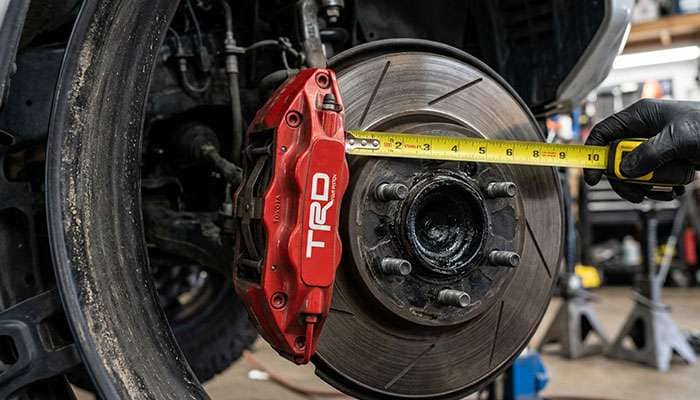
Not on a 2010 or newer 4Runner. This catches more people than anything else, because a 16-inch Tacoma wheel shares the pattern, the bore, and the studs. It threads right on. That is the trap.
When Toyota redesigned the 4Runner for 2010, it gave the truck larger front brakes and stopped offering any factory wheel under 17 inches. Owners report front rotors around 338 mm on most 5th gen trims. A brake that size leaves almost no room inside a 16-inch barrel. Depending on spoke design and offset, the caliper touches the barrel or spokes, or clears by so little that packed mud closes the gap. Owners and fitment guides land on the same rule: 17 inches is the floor.
That rules out a lot of take-offs. The 2016-2023 TRD Off-Road and several TRD Pro years came on 16-inch wheels, and they are among the most common Tacoma wheels for sale. Great wheels for a Tacoma. On a 5th gen 4Runner, expensive paperweights.
The 2025 4Runner is the same story. Every trim leaves the factory on 17 inches or larger, and owners discussing 16s for the new truck mostly conclude they won't clear the stock brakes.
To check a wheel before you buy it, hand-thread three lug nuts snug, spin the wheel, and look through the spokes at the caliper. Most shops want at least an eighth of an inch at the closest point. If it touches or you can't see daylight, it is not your wheel.
Yes. The 2024 Tacoma and 2025 4Runner share the TNGA-F platform, the 6x139.7 pattern, the 95.1 mm hub bore, and M14 x 1.5 studs. 4Runner owners have mounted 17-inch Tacoma TRD Off-Road wheels on a 2025 TRD Sport and report a direct bolt-on.
Check offset by trim. The 2025 4Runner's mainstream wheels run about +55 mm, and its TRD Pro and Trailhunter wheels about +20 mm for a wider stance. Tacoma wheels vary by trim the same way, so a wheel with a much lower number than yours sits farther out and changes how a bigger tire clears at full lock. The 2024 Tacoma SR's 17-inch steel wheels fit too, but they take a different lug nut, covered below.
The 2022+ Tundra shares the same bore and studs, which is why its wheels fit a 2024+ Tacoma, as we covered in will Tundra wheels fit a Tacoma. The same logic carries to the new 4Runner.
No in one direction, and only with compromises in the other. This is the part most answers leave out, and it is why the question needs a year on both sides.
They won't go on. The newer wheel's 95.1 mm center bore cannot slide over the 5th gen's 106.1 mm hub, so it never reaches the mounting face, and its lug holes are sized for M14 studs, not your M12s. Boring the center hole out means machining away the surface that centers a factory wheel, on a truck it was never designed for. I won't do it, and I wouldn't let a customer drive away on it.
Physically, they go on. The 106.1 mm bore slides over the 95.1 mm hub with 11 mm to spare, and that gap is the problem. Without a hub-centric ring, only the lug nuts center the wheel. It can look fine and still run slightly off center, which you feel as a highway-speed shake. Our explainer on hub-centric vs. lug-centric wheels covers why that matters.
The M14 studs also have to pass through holes Toyota drilled for M12. One 6th gen owner reports his old 5th gen wheels accepted them, but that is one wheel on one truck. Then there's offset: a 3rd gen Tacoma wheel near +25 mm sits about 30 mm farther out than a +55 mm 2025 factory wheel, which adds leverage on a new wheel bearing. Could you make it work with rings, the right nuts, and a test-fit? Probably. On a new 4Runner under warranty, I would buy wheels built for the truck.
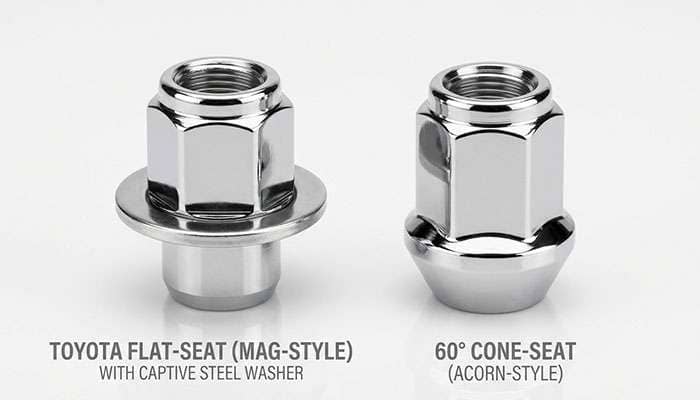
Sometimes, and the split is not Tacoma versus 4Runner. It is alloy versus steel. Within a generation, Toyota's factory alloy wheels on both trucks take the same flat-seat nut with a washer, often called a mag-style nut. Tacoma owners who bolted 4Runner TRD Pro wheels onto alloy-wheeled trucks report reusing their factory nuts.
Toyota's factory steel wheels take a 60-degree cone-seat nut instead. Put Tacoma alloys on a 4Runner that came with steel wheels and you need flat-seat nuts. Put Tacoma steel wheels on a 4Runner that came with alloys and you need cone-seat nuts. One Tacoma owner moving from factory steel wheels to 4Runner TRD Pro alloys had to buy Toyota's washer-style nuts for exactly this reason.
The seat is the only surface that clamps the wheel to the hub. A mismatched seat touches the wheel on a thin ring instead of the full face. It feels tight on the wrench, then the wheel flexes, clamp load drops, and the nuts work loose. Thread follows the generation: M12 x 1.5 through the 2023 Tacoma and 2024 4Runner, M14 x 1.5 after. A wrong thread won't start. A wrong seat will start, tighten, and fool you. Our lug nut seat types guide shows how to tell them apart on the wheel.
On a 5th gen 4Runner, usually the opposite. Tacoma factory wheels from 2005-2023 tend to carry more positive offset than 4Runner wheels, so they tuck farther into the wheel well. Owner-reported numbers: a 2016-2023 Tacoma TRD Off-Road 16x7 is about +25 mm, a 5th gen 4Runner SR5 17x7 about +15 mm, and a 4Runner TRD Pro 17x7 about +4 mm.
A 17-inch Tacoma wheel in the +25 to +30 range sits roughly 10 to 25 mm farther inboard than the 4Runner wheel it replaces. On the stock 265/70R17 you won't notice much beyond a slightly narrower stance. With a bigger tire, that shift moves the sidewall toward the upper control arm at full lock. Planning a size jump? Read will 33s fit a stock 4Runner first, because offset and tire size have to be solved together.
Aftermarket wheels are a different world. About four of every five 6x139.7 wheels on the market run +20 mm or less, and fewer than one in a hundred go above +40. Nearly all of them sit farther out than any Toyota factory wheel. That's a mild change on a 5th gen 4Runner built around +4 to +15. On a 2025 4Runner built around +55, it changes stance, scrub radius, and clearance a lot.
The hardware is usually compatible within a generation, but your 4Runner doesn't know the sensor IDs. U.S. Tacomas and 4Runners of the same era use the same family of 315 MHz Toyota sensors, and the system won't discover new ones on its own. Bolt on take-offs with sensors installed and plan on a TPMS ID registration with a scan tool, or the light stays on. Moving your own sensors into the Tacoma wheels avoids that, since the truck already knows their IDs. Our guide to TPMS sensors for aftermarket wheels covers what carries over.
This is the question nobody asks, and it matters if you load your 4Runner up. Every wheel has a load rating, the most weight it is engineered to carry. Toyota doesn't publish ratings for its factory wheels, so you reason from the vehicle ratings instead.
In the older pairing, the 4Runner is the heavier-rated truck. A 2016-2023 Tacoma 4x4 Double Cab is rated around 5,600 lbs gross vehicle weight (GVWR). Toyota's 2024 brochure lists the 5th gen 4Runner at 6,100 lbs for most trims and 6,300 lbs for the TRD Off-Road and TRD Pro. That is 500 to 700 lbs more rated weight on wheels designed first for the lighter truck.
The newer pairing is closer. One 2024 Tacoma TRD Off-Road spec listing shows a 6,240-lb GVWR, with axle ratings of 3,480 lbs front and 3,275 lbs rear. 2025 4Runner owners report GVWRs from about 6,075 to 6,395 lbs.
The check is the same one the federal tire and rim placard rules under FMVSS 110 are built around. Read the front and rear gross axle weight ratings (GAWR) on your driver door label, take the higher number, and divide by two. That is the minimum each wheel must carry. Add margin for towing, a roof rack and drawers, or trail use. Our wheel load rating guide walks through the math.
For a mostly stock daily driver, Toyota's habit of listing accessory wheels across both trucks says the factory alloys aren't marginal. For an overland build at or near GVWR, a wheel with a published rating is the safer bet. Reputable aftermarket truck wheels are tested to SAE J2530, and most 6x139.7 truck wheels in the market are rated 2,400 lbs or more, with 2,500 lbs the most common figure.
Yes, under the same generation rules, with fewer catches. Every 4Runner wheel since 2010 is 17 inches or larger, so diameter isn't a problem, and the load question points the right way because the wheel came off the heavier-rated truck. Expect it to sit farther out: going from a +25 mm Tacoma wheel to a +4 mm 4Runner TRD Pro wheel moves the tire out about 21 mm, close to an inch.
A wrong wheel rarely fails on the first drive. It fails in steps, and each one costs more than the last.
Stage 1: Vibration. A lug-centric wheel slightly off center shakes the steering wheel at 55 to 70 mph. Most people pay for a rebalance that doesn't fix it.
Stage 2: Tire wear. The shake works into the tread as cupping. The tires get noisy, and cupping doesn't grow back out.
Stage 3: Loose lug nuts. A mismatched seat or an off-center wheel loses clamp load. The nuts back off a little at a time, and the lug holes wear oval.
Stage 4: Studs and bearings. Once the wheel moves on the hub, the studs carry shear loads they were never meant to carry. They stretch, then break. A wheel pushed far outboard adds leverage to the hub bearing on every bump.
Stage 5: Caliper contact or a wheel off the truck. A barrel rubbing the caliper gouges both parts. A wheel with broken studs can leave the truck, and that is no longer a repair bill.
Take-off wheels usually come with used tires, too. Check the date codes, tread, and sidewalls, and read tire sidewall damage: is it safe to drive if anything looks off. Add up the take-offs, hub rings, new nuts, a TPMS registration, and maybe tires, and wheels built for your 4Runner are often closer in cost than they look.
Ten minutes of checking saves a set of wheels you can't use. Go in order and stop at the first failure.
Step 1: Get the years. Confirm which Tacoma the wheels came off and your 4Runner's model year. If one side is 2024+ Tacoma or 2025+ 4Runner and the other is older, recheck the chart.
Step 2: Count the lugs. Six or nothing.
Step 3: Read the diameter. On a 2010 or newer 4Runner, 17 inches is the minimum.
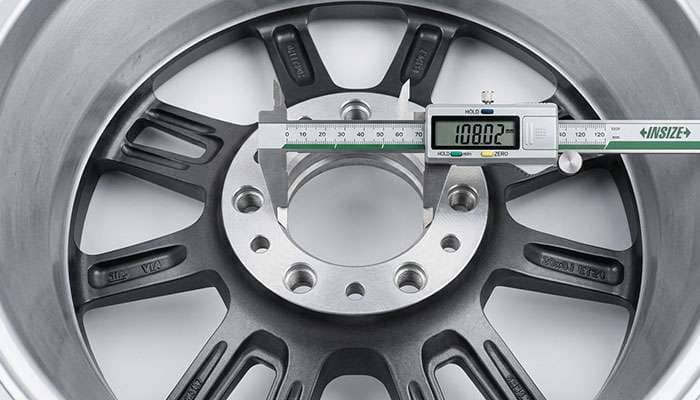
Step 4: Measure the center bore. Use calipers across the center hole: 106.1 mm on a 2010-2024 4Runner, 95.1 mm on a 2025+. Equal is hub-centric, larger needs a hub ring, smaller is a no.
Step 5: Read the back of the wheel. Toyota and most aftermarket makers cast or stamp the size and offset on a spoke or the mounting pad. Compare it to your factory wheel.
Step 6: Look at the lug holes. A flat seat takes Toyota's washer-style nut, a tapered seat takes a cone-seat nut, in M12 or M14 to match your studs.
Step 7: Test-fit one wheel. Spin it and check caliper clearance, then mount it with a tire and turn to full lock both ways.
Step 8: Torque and re-torque. Torque in a star pattern to your owner's manual spec and re-check after the first 50 miles. The Tire Industry Association teaches a re-torque on every install, because the first drive is when a seat settles.
If the take-offs fail any step, or you'd rather skip the guesswork, browse our 6x139.7 wheels and filter for your 4Runner's hub bore and offset range.
Same bolt pattern is where the answer starts, not where it ends. Tacoma wheels fit a 4Runner when the generations match: 2005-2023 Tacoma wheels on a 2010-2024 4Runner, and 2024+ Tacoma wheels on a 2025+ 4Runner. On the 5th gen, the wheel also has to be 17 inches or larger to clear the brakes. Across the 2024 platform change, the hub bore and stud thread no longer line up, and the swap either won't mount or turns lug-centric.
Check the years, the diameter, the bore, and the lug seat, then test-fit one wheel before you mount four. If your 4Runner works hard for a living, check the load rating too. That is how a cheap set of take-offs stays a bargain instead of becoming a wheel bearing and a set of studs.
Within the same generation, yes. Both use a 6x139.7 bolt pattern. 2005-2023 Tacomas and 2010-2024 4Runners share a 106.1 mm hub bore and M12 x 1.5 studs, and 2024+ Tacomas and 2025+ 4Runners share a 95.1 mm bore and M14 x 1.5 studs. On a 2010+ 4Runner, the wheel must be 17 inches or larger.
Yes. Both are built on the TNGA-F platform with a 6x139.7 bolt pattern, a 95.1 mm hub bore, and M14 x 1.5 studs. Owners report 17-inch Tacoma TRD Off-Road wheels bolting directly onto a 2025 4Runner. Compare offsets by trim to keep the stock stance.
Yes, if they are 17 or 18 inches. They share the 106.1 mm bore and M12 studs. The 16-inch TRD Off-Road and TRD Pro wheels from that generation do not clear the 5th gen 4Runner's front brakes.
Generally no. Toyota fitted the 2010-2024 4Runner with larger front brakes and no factory wheel under 17 inches. A 16-inch barrel can contact the caliper. Test-fit any 16-inch wheel by hand before mounting a tire.
Yes, within the same generation. A 5th gen 4Runner wheel fits a 2005-2023 Tacoma, and a 2025+ 4Runner wheel fits a 2024+ Tacoma. 4Runner wheels usually have less offset, so they sit farther out on the Tacoma.
Every 4Runner from 1996 on uses 6x139.7, also written 6x5.5. The hub bore is 106.1 mm through 2024 and 95.1 mm from 2025, and the stud thread changed from M12 x 1.5 to M14 x 1.5 at the same time.