
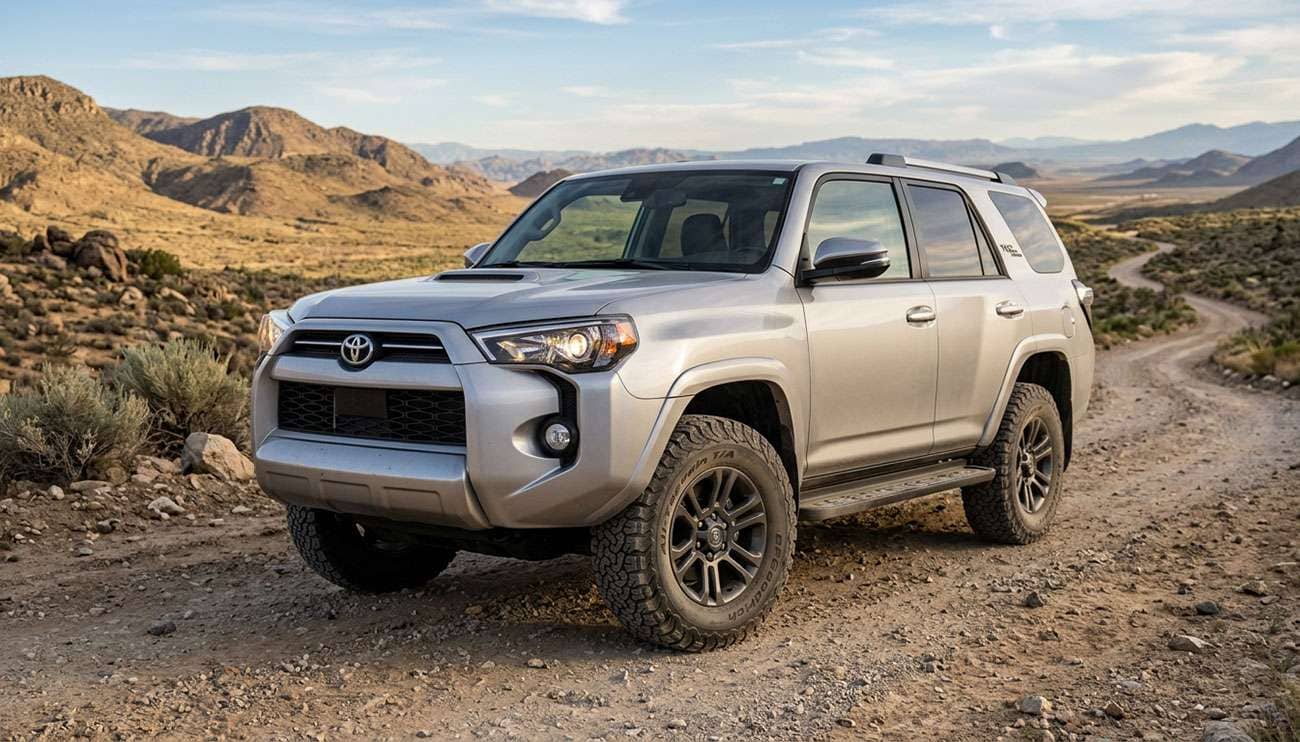
Yes, 33s fit most stock 4Runners, but "33" covers a lot of ground and the answer changes with the generation and the trim. On a 2010-2024 5th gen, a 275/70R17 is the biggest tire that goes on with zero changes. The 285/70R17 everybody calls a 33 fits once the front mud flaps come off, with a little rub at full lock in reverse. On a 2025-and-newer 6th gen, the TRD Pro and Trailhunter take a 33.7-inch tire clean. The part most answers skip is the factory wheel offset, and it's different from one trim to the next.
I've mounted a lot of tires on a lot of 4Runners over the years, and the owners who end up happy are the ones who figure out which truck they have before they fall in love with a tread pattern. So start here.
Your 4Runner |
Factory tire |
Factory wheel offset |
The 33 that fits at stock height |
What it takes |
|---|---|---|---|---|
5th gen SR5, Trail, TRD Off-Road, Limited (2010-2024) |
265/70R17 or 245/60R20 (31.6 in.) |
+15 mm |
275/70R17 with no changes; 285/70R17 with mud flaps off |
Liner push-back, light rub in reverse, often a body mount chop |
5th gen TRD Pro (2015-2024) |
265/70R17 (31.6 in.) |
+4 mm |
285/70R17 |
Same mud flap and liner work; the tire sits 11 mm farther out |
6th gen SR5, TRD Sport, TRD Off-Road, Limited, Platinum (2025+) |
245/70R17, 265/70R18, or 265/55R20 (30.5 to 32.6 in.) |
+55 mm |
285/70R17 or 285/70R18 on +20 to +35 mm aftermarket wheels |
The factory +55 mm wheel is the limiter |
6th gen TRD Pro and Trailhunter (2025+) |
265/70R18 (32.6 in.) |
+20 mm |
285/70R18 (33.7 in.) |
Owners report no rub, even with the mud flaps on |
4th gen (2003-2009) |
265/70R16 or 265/65R17 (about 30.6 in.) |
+30 mm |
None cleanly; 265/70R17 (31.6 in.) is the ceiling |
A 33 needs about 3 in. of front lift plus trimming |
Every 4Runner in that table uses the same 6x139.7 bolt pattern, which is why so many people assume one answer fits them all. It doesn't. The offset column is the one that surprises folks.
Here's the first thing I tell anybody asking about 33s: the number on the tire isn't the number that matters. A metric tire size gives you width and sidewall height, and you have to do the math to get the diameter. Two tires that both get called "33s" can be almost an inch apart in height and more than an inch apart in width. On a 4Runner, width is what finds the body mount and the fender liner first.
Tire size |
Diameter |
Section width |
Construction |
Typical weight |
Where it fits |
|---|---|---|---|---|---|
265/70R17 (5th gen stock) |
31.6 in. |
10.4 in. |
Passenger-type from the factory |
About 47 lb |
Factory fitment |
275/70R17 |
32.2 in. |
10.8 in. |
Mostly LT, load range E |
About 51 lb |
5th gen with no changes |
285/70R17 |
32.7 in. |
11.2 in. |
Mostly LT, load range E |
About 57 lb |
5th gen with mud flaps off; 6th gen on lower-offset wheels |
255/80R17 |
33.1 in. |
10.0 in. |
LT, load range E |
About 56 lb |
A true 33 at close to stock width |
285/75R17 |
33.8 in. |
11.2 in. |
LT, load range E |
About 63 lb |
5th gen only with trimming, often a body mount chop |
285/70R18 |
33.7 in. |
11.2 in. |
Mostly LT, load range E |
About 65 lb |
6th gen TRD Pro and Trailhunter at stock height |
Look at the 285/70R17 for a second. It's the size most people mean when they say "33s on a 4Runner," and it's really 32.7 inches. That's not a knock on it. It's why it fits. If you want a tire that actually measures 33 or better, you're looking at a 255/80R17 or a 285/75R17, and those two behave very differently on the truck. If you're still deciding how big to go in the first place, our 31s vs. 33s vs. 35s comparison lays out the trade-offs by size class.
This is the truck most people are asking about, and it's the one with the most owners behind the answer. Every 5th gen trim left the factory on a 31.6-inch tire, whether it was a 265/70R17 or a 245/60R20. The wheels on the SR5, Trail, TRD Off-Road, and Limited all run +15 mm of offset. Here's how the sizes stack up on that truck at stock height.
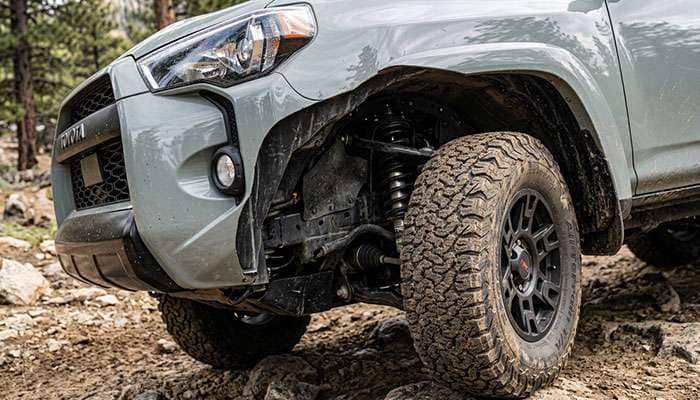
At 32.2 inches and 10.8 inches wide, this is the biggest tire that goes on a stock 5th gen with no trimming and no rub. If you want a taller look and you don't want to pick up a tool, stop here.
At 32.7 inches and 11.2 inches wide, it fits once the front mud flaps come off and the front fender liner is pushed back. Expect some light rub at full lock in reverse, usually on the passenger side when you back out of a driveway. A lot of owners live with that. A lot of others finish the job with a body mount chop, which I'll get to next.
Here's the size I wish more people knew about. At 33.1 inches tall and only 10 inches wide, it's a real 33 that's narrower than the tire the truck came with. The height still means you'll pull the mud flaps and push the liner back, but the narrow tread stays farther from the body mount. The catch is selection: you'll find far fewer tread patterns in 255/80R17 than in 285/70R17.
At 33.8 inches, this is the tall one. Owners who run it on factory suspension report trimming the fender liner, trimming the plastic valance caps on the rocker panels, and pulling the mud flaps, and many chop the body mounts too. It can be done, but you've moved from bolting on tires to modifying the truck.
A 4Runner and a Tacoma share a lot under the skin, and the same width-first logic runs through our breakdown of 33s on a stock Tacoma if you've got one of each in the driveway.
Sometimes, and the tire's width decides it more than its height does. The front body mount on a 5th gen sits just behind the front tire. At full lock, the rear inside shoulder of a wide tire swings right into that bracket.
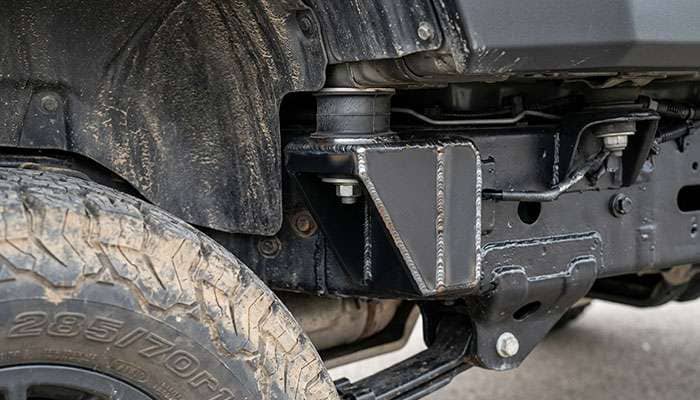
A body mount chop, or BMC, means cutting off the outer part of that bracket and welding a plate over the opening so it stays sealed and strong. It's a permanent change to the frame bracket, and it should be done by someone who welds for a living. Fitment guides put the line at roughly 11 inches of tire width. A 285-wide tire is 11.2 inches, which is exactly why 285/70R17 owners split on whether they need it. A 10-inch 255/80R17 stays under that line.
Here's how I'd think about it. If you rarely turn to full lock off-road and you can live with a light rub backing out of a parking spot, you may never need the chop on a 285/70R17. If you wheel tight trails where you're at full lock over rocks and ruts, the chop is cheaper than what that bracket will do to your sidewall.
This is the variable nobody puts in front of you, and it's the reason two 4Runners with the same bolt pattern can give you two different answers. Offset is the distance from the center of the wheel to the face that bolts to the hub. The more positive the number, the farther the wheel tucks in toward the frame. The lower the number, the farther out the tire sits.
Factory wheel |
Offset |
Where the tire sits vs. the base wheel |
What it means for 33s |
|---|---|---|---|
5th gen SR5, Trail, TRD Off-Road, Limited |
+15 mm |
Baseline |
Wider 33s reach the body mount at full lock |
5th gen TRD Pro |
+4 mm |
11 mm (0.43 in.) farther out |
More room at the body mount, a little closer to the fender and bumper corner |
6th gen SR5, TRD Sport, TRD Off-Road, Limited, Platinum |
+55 mm |
Baseline |
A 285-wide tire sits tight to the suspension; guides steer you to a different wheel |
6th gen TRD Pro and Trailhunter |
+20 mm |
35 mm (1.38 in.) farther out |
Takes a 285/70R18 at stock height with no rub reported |
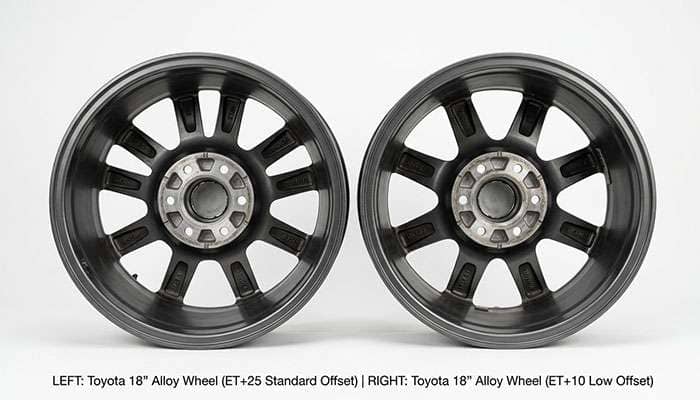
On the 5th gen, the TRD Pro's +4 mm wheel moves the tire only 11 mm outboard, so it's a small head start. On the 6th gen, the gap is 35 mm, well over an inch, and that's the whole ballgame. Toyota built the TRD Pro and Trailhunter to wear bigger rubber, and it put that room in the wheel.
The 2025-and-newer 4Runner moved to a new platform, and the wheel offsets moved with it. So did the stock tire sizes, and they're not all the same height anymore.
These come on 265/70R18s that Toyota calls 33-inch tires. On paper, a 265/70R18 works out to about 32.6 inches, so think of them as a tall 32. Step up to a 285/70R18 at 33.7 inches, and owners and fitment guides report it fits at full lock with no rub, even with the mud flaps still on. That +20 mm factory wheel is doing the work.
These trims all ride on +55 mm wheels, and that's the limiter. The SR5 starts on a 245/70R17 that's only about 30.5 inches tall, so a 33 is a bigger jump on that truck than on any other 4Runner. The TRD Off-Road starts on the same 265/70R18 as the TRD Pro, but on the +55 mm wheel. The 20-inch trims start on 265/55R20s at about 31.5 inches.
Fitment guides for these trims point you to aftermarket wheels in roughly the +20 to +35 mm range for 285/70R17s and 285/70R18s, and to pulling the mud flaps. On the 20-inch trims, a 285/55R20 at 32.3 inches is the no-rub pick, while a 275/60R20 at 33 inches can touch at full lock on the factory wheel. If you're shopping, our 4Runner wheel picks are a good place to start.
Could you use spacers instead of new wheels? A hub-centric spacer does move the tire out the same way a lower offset does. It's a legitimate option when it's done right, and our guide to wheel spacers and tire rub covers when that works and when it only moves the rub somewhere else.
The 2003-2009 4Runner is a different story. The factory sits low in front, and the stock tires were only about 30.6 inches tall on the 16- and 17-inch wheels. Most owners find that a 265/70R17 at 31.6 inches is about as big as it goes without trimming.
For real 33s like a 285/70R17, 4th gen owners typically add about 3 inches of lift up front and 2 in the rear, relocate the fender liner mounts, remove the front mud flaps, trim the bottom corner of the front bumper, and sometimes chop the body mounts. It's a good truck for 33s. It's just not a stock-height 33s truck.
A little rub sounds harmless, and at first it is. The trouble is that rub doesn't stay little. Here's the order it usually goes on a 4Runner, cheapest to most expensive.
Every step on that list costs more than picking the right width and offset in the first place.
Your 4Runner came on passenger-type tires. Most 33-class sizes are LT tires, usually load range E. They're built tougher, and they weigh more. A typical passenger 265/70R17 is around 47 pounds, a typical 285/70R17 around 57, and a typical 285/75R17 around 63. That's 10 to 16 pounds more at each corner. On a 6th gen SR5, which starts on a 245/70R17 at around 34 pounds, the jump is closer to 23 pounds a corner.
LT tires also need the right air pressure to carry what the truck weighs, and it's not always the number on your door placard. The Tire and Rim Association load-and-inflation tables tell you what pressure an LT tire needs to match the capacity of the tire you took off. Our P-metric vs. LT tire breakdown covers what changes in ride and wear.
Going from a 31.6-inch stock tire to a 32.7-inch 285/70R17 puts your speedometer about 3.5 percent low. At an indicated 65 you're doing a little over 67. With a 285/75R17, you're doing about 70. On a 6th gen SR5 going from 30.5 inches to 32.7, it's about 70 as well. Our guide to bigger tires and speedometer error walks through getting it corrected. You'll also feel the extra height and weight when you pull away from a light and at the pump.
Get the truck aligned after the new tires go on, especially if you pushed the liners back or changed wheels. A heavier LT tire that's a hair out of spec wears the edges quickly.
Here's the order I'd go in, and most of it happens before you spend a dime.
So, will 33s fit a stock 4Runner? On a 5th gen, a 275/70R17 goes on with no changes, and the 285/70R17 everybody calls a 33 fits once the mud flaps come off, with a little rub at full lock and a body mount chop for folks who wheel hard. A skinny 255/80R17 gets you a true 33 at stock width. On a 6th gen, the TRD Pro and Trailhunter take a 285/70R18 clean because of their +20 mm wheels, while the other trims need a lower-offset wheel first. And on a 4th gen, plan on some lift. Figure out your generation, read your offset, pick by width, and you'll be happy with your 33s the first time out.
On a stock 5th gen, a 275/70R17 (32.2 inches) fits with no changes, and a 285/70R17 (32.7 inches) fits with the front mud flaps removed. On a 6th gen TRD Pro or Trailhunter, a 285/70R18 (33.7 inches) fits at stock height. Other 6th gen trims need a lower-offset wheel for the same size.
It depends on width more than height. Tires wider than about 11 inches reach the front body mount at full lock on a 5th gen. A 285/70R17 sits right at that line, so some owners chop and some don't. A 285/75R17 often needs it, and a narrow 255/80R17 stays under the line.
Yes, with the front mud flaps removed and the fender liners pushed back. Expect light rub at full lock in reverse, most often on the passenger side. Owners who wheel tight trails usually add a body mount chop.
On the TRD Pro and Trailhunter, yes. Their +20 mm factory wheels let a 285/70R18 clear at full lock with no rub reported. On the SR5, TRD Sport, TRD Off-Road, Limited, and Platinum, the +55 mm factory wheel is the limiter, and fitment guides recommend +20 to +35 mm aftermarket wheels.
Yes. A 285/70R17 on a 5th gen reads about 3.5 percent slow, so an indicated 65 is a little over 67. Most 33-class tires are heavier LT tires, adding roughly 10 to 16 pounds per corner on a 5th gen, which you'll notice in acceleration and fuel economy.
Within the same generation, the bolt pattern matches, so it's a common move. On a 6th gen it makes a big difference, because the TRD Pro wheel's +20 mm offset puts the tire 35 mm farther out than the +55 mm base wheel. On a 5th gen the difference is only 11 mm.



