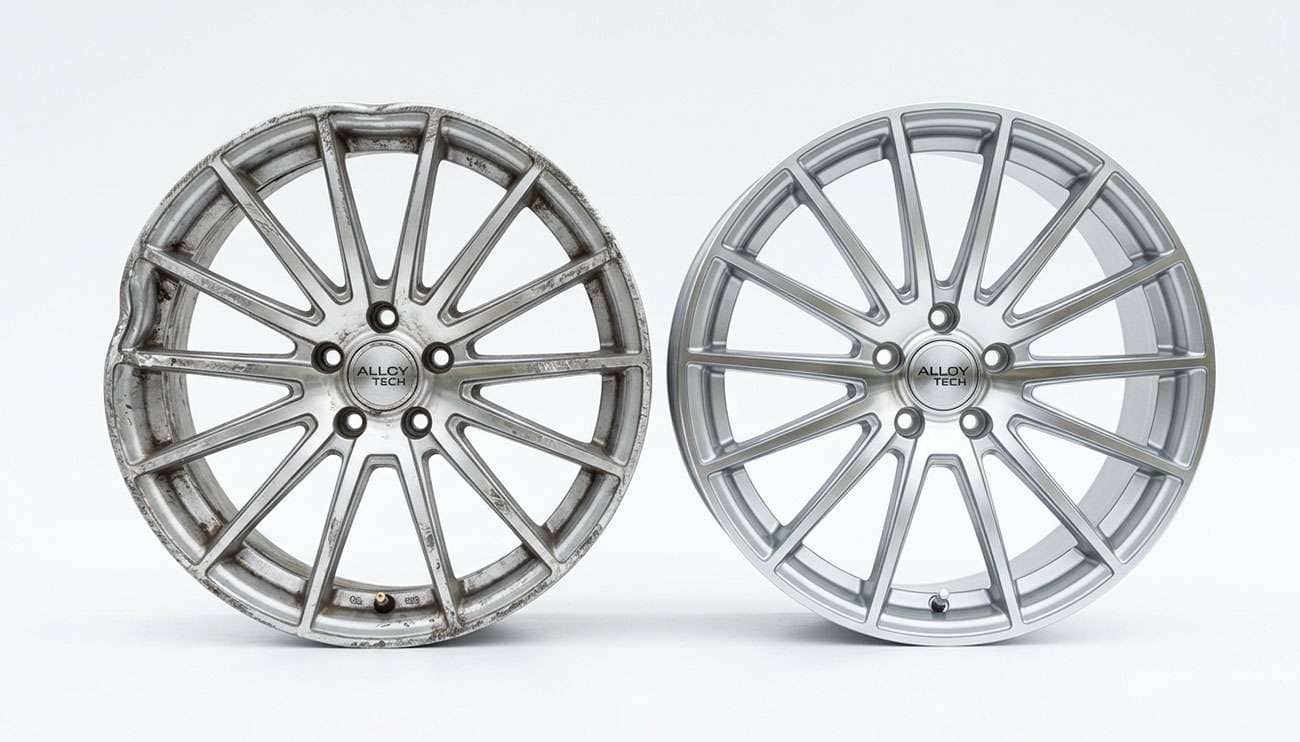
Replacing one rim costs anywhere from about $60 for a steel wheel to more than $2,000 for a dealer wheel on a luxury car, plus roughly $25 to $150 to mount, balance, and service the tire pressure sensor. Most cost guides hand you a range and say "it depends." Here is what it depends on: whether you can still buy an exact match for the wheel you broke, as a single. When you can, you buy one wheel. When you can't, one rim turns into two, or four.
I have been selling wheels in Long Beach since 1971, and I've watched this play out more times than I can count. Somebody clips a curb, cracks one wheel, and figures they're out a couple hundred bucks. Then they learn the finish on their trim level changed two model years ago, or their aftermarket design got discontinued. The rim type sets the range. The match decides where you land in it. Find your row below.
Your situation |
What you end up buying |
Typical cost |
Verdict |
|---|---|---|---|
Steel wheel, still sold for your vehicle |
One steel wheel |
$60 to $200 |
Cheapest fix on the road |
Factory alloy, same part number still available |
One reconditioned factory wheel or one dealer wheel |
$150 to $500 reconditioned; $400 to $1,000+ dealer |
Moderate; reconditioned is the sweet spot |
Factory alloy, finish changed or part number discontinued |
A used match, or a pair of replicas for the axle |
$150 to $1,200 per wheel, times two for replicas |
Gets expensive; shop by part number |
Aftermarket wheel still made in your size, offset, and finish |
One wheel |
About $250 to $450 cast; $900 and up forged |
Moderate; order the exact finish and offset |
Aftermarket wheel discontinued |
A pair for the axle, or a full set |
Two to four times the single price |
This is where one rim becomes four |
Staggered setup (front and rear sizes differ) |
The exact size for that corner |
Rears usually run higher than fronts |
Match the position, not just the design |
Classic or collector wheel |
A reproduction, or a correct original core |
Reproductions are reasonable; correct originals cost what the market bears |
Depends on driving it or showing it |
The $200 to $500 per wheel figure you see quoted everywhere is a fair middle for a mainstream alloy wheel. The part nobody puts in front of you is everything that rides along with it. When you replace a rim, you're also paying somebody to move the tire, deal with the pressure sensor, and often look at what else the impact broke.
Line item |
Typical cost |
When you pay it |
|---|---|---|
The wheel itself |
$60 to $2,500 |
Always |
Mount and balance |
$15 to $45 |
Always |
TPMS service kit |
$5 to $15 |
When you move your old sensor to the new wheel |
New TPMS sensor |
$50 to $100 |
When the sensor broke or its battery is near the end |
Lug nuts |
$20 to $60 a set |
When the new wheel needs a different seat type |
Center cap |
$10 to $60 |
When the cap didn't survive or isn't included |
Alignment check |
$100 to $200 |
After any hit hard enough to bend a wheel |
Replacement tire |
One more tire |
When the sidewall or bead area took the hit too |
Add it up and a "cheap" $250 wheel lands closer to $300 to $350 out the door, before anybody looks at the alignment. On a luxury car with a dealer wheel and a new sensor, one corner can clear $1,500 easily.
The sensor line deserves a closer look. Federal Motor Vehicle Safety Standard 138 required a tire pressure monitoring system on every new passenger car and light truck starting with the 2008 model year, so nearly every car on the road has a sensor inside each wheel. If yours survived, a shop can move it with a fresh service kit. The batteries are sealed in, though, and how long TPMS sensors last usually tops out around five to ten years. If your car is pushing seven or eight, put a new sensor in while the tire is already off.
This is the section that saves you money. A replacement can share the diameter and bolt pattern of your broken wheel and still be the wrong wheel. Six things have to line up, and every one is either stamped on the back of your old wheel or listed in the original equipment spec for your car.
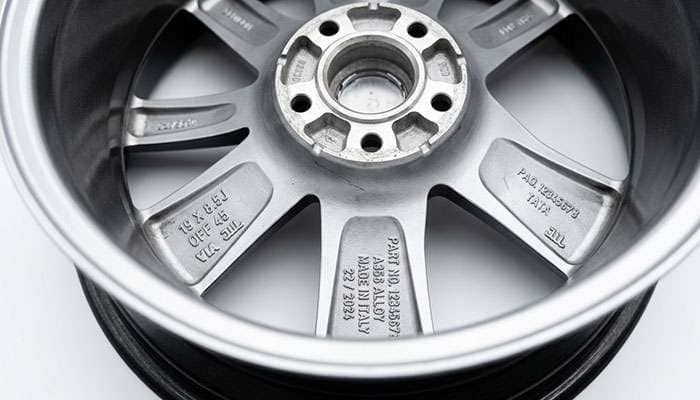
Usually cast into the back of a spoke as something like 18x8J. Width sets how the tire's sidewall stands up. Put a wider wheel on one corner and that tire's profile and contact patch change, so it no longer behaves like the tire across the axle.
Offset, stamped as ET45 or +45, is the distance from the wheel's mounting face to its centerline. It decides where the tire sits relative to the steering axis, and here's the mechanism most people never hear about. The distance between the tire's center and the steering axis, called scrub radius, has to be equal side to side on the front axle. Change the offset on one front wheel and that side gets a different lever arm working on the steering. You feel it as a pull under hard braking. A few millimeters of change on both sides is a fitment choice. A few millimeters different side to side is a handling problem.
The bolt pattern gets the wheel onto the studs. The hub bore centers it. Most factory wheels are hub-centric, while many replica and aftermarket wheels use a larger bore and a hub ring to fill the gap. Skip the ring and the wheel centers on the lug nuts alone, which buys you a vibration no balancer can fix.
Seats come in three common shapes: a 60-degree cone, a rounded ball, and a flat seat with a washer. Run the wrong nut and you get a thin ring of contact instead of a full face, and the nut can back off over time. A lug nut seat type mismatch is one of the quietest ways a wheel job goes wrong, because everything feels tight the day it goes on.
Automakers change wheel finishes between model years and trims, and the part number changes with them. In the aftermarket, more than a third of wheel designs come in two or more finishes, so "the black one" is not an order. You need the exact finish name, and even then, paint and chrome can vary a shade between production runs.
On a pickup, a heavy SUV, or anything that tows, the replacement's load rating has to meet or beat the original's. A light-duty replica that fits the bolt pattern can still be underrated for the truck.
If your car wears factory wheels, you have four places to get a replacement, and they aren't close in price.
The exact match, brand new, and by far the most expensive route. Expect roughly $400 to $700 for a sedan wheel, $500 to $1,000 for a truck or SUV wheel, and $900 to $2,500 for luxury and performance wheels. I've had customers walk in holding a dealer quote north of $900 for one 20-inch machined SUV wheel, asking if that's normal. It is. That doesn't mean you have to pay it.
A reconditioned wheel is a genuine factory casting that's been straightened if needed, inspected, and refinished to the original look. Same part number, offset, seat, and bore, typically 30 to 50 percent below dealer new. For one wheel on a car with three good ones, this is where the money is. Shop by the part number on your wheel, not the year and model, because two wheels that look identical in a photo can be different finishes under shop lights.
Salvage yards move used factory wheels for $50 to $150 on common cars. You get the exact casting at the lowest price, plus whatever happened to it before you. Check for straightening marks, cracks around the spokes and lug holes, and corrosion at the bead seat.
Replicas copy a factory design for 40 to 70 percent less. On one corner of a car with three factory wheels, the finish rarely matches exactly, so most people buy two to keep the axle even. Look on the back for SAE J2530, the Society of Automotive Engineers test standard for aftermarket wheels covering radial fatigue, cornering fatigue, and impact.
Yes, if the exact wheel is still in production. Aftermarket wheels are sold one at a time, so nobody makes you buy four. The catch is the word "exact." Roughly one in seven aftermarket designs offered in a given diameter, width, and bolt pattern comes in more than one offset. Pull the stamps off your broken wheel before you shop, not after.
A typical one-piece cast aftermarket wheel runs about $250 to $450. A 17-inch commonly sits near $300, a 20-inch closer to $400, and 22s climb past $500. One-piece forged wheels start around $900 and run past $1,600, and three-piece forged wheels commonly sit above $2,000. One bright spot for multi-piece owners: the parts bolt together, so a bent outer lip can often be replaced on its own.
Now the bad news. Wheel makers retire designs and finishes every year. When yours is gone, there's no single to buy. You're hunting a used match, buying a pair for that axle, or buying a set. That's the most common way a $350 problem becomes a $1,400 problem, and it's why I tell customers on bad roads to think about buying a fifth wheel with their set.
Not if you can match the one you broke. What matters mechanically is that both wheels on an axle share diameter, width, offset, centering, and seat, so both tires sit in the same place. You end up buying a pair in three situations:
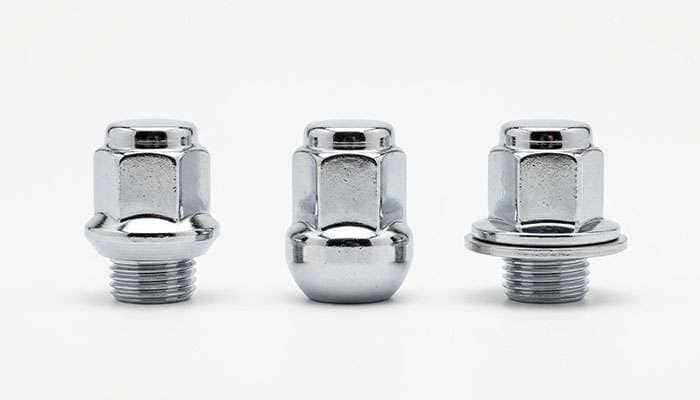
That last one catches people. Say your car came with ball-seat factory nuts and you replace one wheel with a conical-seat aftermarket wheel. That corner needs conical nuts while the other three keep ball-seat nuts. Everything's fine until the next tire rotation, when somebody moves that wheel and grabs whatever nuts are handy. Two seat types on one car is a mistake waiting for a busy Saturday.
On all-wheel-drive vehicles, watch the tire. If the hit ruined it too, many automakers limit how much tread depth can differ between tires, and a new tire next to three worn ones can blow past that limit.
This is home turf for me. With a classic, the first question isn't what the wheel costs. It's whether you're driving the car or showing it.
If you drive it, you're in good shape. Most popular factory steel and styled steel wheels from the muscle car era have been reproduced and are sold one at a time. A bent styled steel wheel on a weekend cruiser is one of the cheapest single-wheel replacements in the hobby.
If you show it, the math changes. Many factory steel wheels from that era carry stamped codes for size, plant, and date, and serious judges check them. Replacing one wheel on a judged car means hunting a correct-dated original core and restoring it, at whatever the market wants that month.
Wire wheels bring their own checklist: spoke count, spline size, and the spinner. Knock-off spinners are side-specific, threaded so the wheel's rotation tightens them, so a left and a right aren't interchangeable. Before you replace a wire wheel, ask whether it can be trued or re-laced with a new rim hoop. On a rare wheel, that's the cheaper path.
One warning on vintage mags: many use shank-style lug nuts with a washer, not cone-seat nuts. The nut is a five-dollar part. The wheel coming off at 50 mph is not.
Sometimes, and usually not for one wheel. Curb and pothole damage usually falls under collision coverage, so your deductible applies first. Theft and vandalism usually fall under comprehensive. With deductibles commonly at $500 to $1,000, a single mainstream wheel often costs less than the deductible, so the claim pays nothing and can still land on your record.
The math flips when the damage is bigger: a wheel, a tire, and a control arm, or a dealer wheel on a luxury car. Whether insurance covers a cracked rim on your policy comes down to your coverage and deductible, so call before you file. And if you bought a road hazard plan that includes wheels, read it now. Plenty of people forget they paid for one.
The most expensive rim replacement I see is the one somebody put off. A damaged wheel climbs a ladder, and every rung adds a part to the bill.
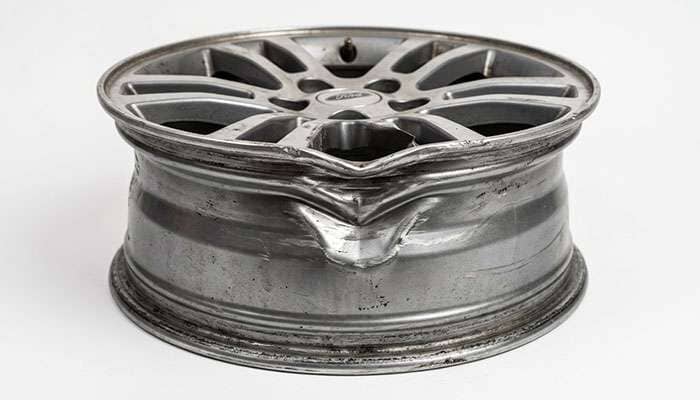
Replace it now and you buy one wheel. Wait, and the same pothole sells you a wheel, a tire, a bearing, and an alignment.
Cosmetic damage and mild bends are often worth fixing, especially on a factory wheel with an expensive replacement. Sort it by damage type:
Damage |
Repair or replace? |
Typical repair cost |
Next move |
|---|---|---|---|
Curb rash on the face or lip |
Repair |
$50 to $150 |
Refinish the damaged area |
Minor inner barrel bend, no crack, holds air |
Usually repair |
About $100 to $150 |
Straighten, then road-force balance |
Slow leak from bead seat corrosion |
Repair |
Low; a cleaning and reseal |
Clean and seal the bead area |
Peeling or pitted chrome |
Either |
$150 to $400 to replate |
Compare against a matching replacement |
Bent face or bent spoke |
Replace |
Not worth it |
Find a match by part number |
Any crack in a spoke, barrel, or lug area |
Replace |
Not recommended for street use |
Replace the wheel, inspect the tire |
Bent wheel plus a bulge in the tire |
Replace both |
Not an option for the tire |
Replace wheel and tire together |
Two rules keep you out of trouble. If a repair quote runs past about 70 percent of a matching replacement, buy the replacement. And cracks are a different animal: heat changes aluminum's temper around a weld, and most wheel makers advise against welding a crack on a street wheel. We cover the full decision in whether it's cheaper to repair or replace a rim.
Here's the order I'd work in if it were my car.
Replacing a rim is cheap when you can buy the exact match as a single, and expensive when you can't. A steel wheel or a reconditioned factory wheel keeps the job in the low hundreds. A dealer wheel, a discontinued aftermarket design, or a staggered rear can push one bent wheel into four figures, because now you're buying a pair or a set. The wheel's type sets the range. The match sets the price. Read the stamps before you shop, and you'll know which side of that line you're on before anybody quotes you a number.
About $60 to $200 for steel, $150 to $500 for a reconditioned factory alloy, $400 to $1,000 or more for a new dealer wheel, and $250 to $450 for a typical aftermarket cast wheel. Add $25 to $150 for mounting, balancing, and TPMS sensor work.
Yes, if the replacement matches the wheel across the axle in diameter, width, offset, centering, and lug seat. If you can't find an exact match, replace both wheels on that axle so the car handles evenly.
A minor inner barrel bend that holds air is usually worth straightening for about $100 to $150. A bent face, bent spoke, or any crack means replacement. If the repair quote passes about 70 percent of a matching replacement, replace it.
Curb and pothole damage usually falls under collision coverage, so your deductible applies first. Since one wheel often costs less than a $500 to $1,000 deductible, many single-rim claims pay nothing. Theft and vandalism usually fall under comprehensive.
Not always. If the sidewall and bead area are undamaged, the shop can move the tire to the new wheel. If the hit caused a bulge, cut, or bead damage, replace the tire too, and on an all-wheel-drive car, keep tread depth within the automaker's limit.
You can if it matches the other wheels in diameter, width, offset, centering, and load rating, but it will look different and may need its own lug nuts. Most owners replace both wheels on that axle to keep the look and handling even.