
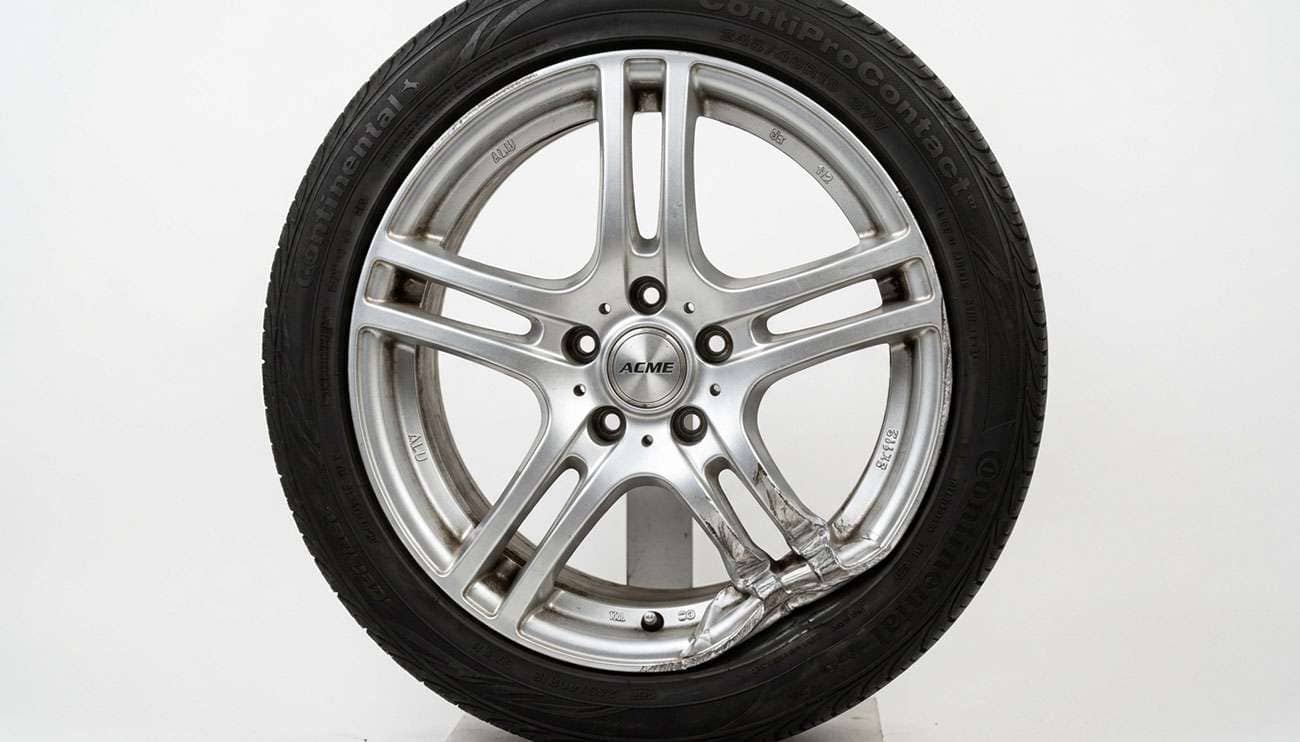
Two things decide it, and neither one is how bad it looks. The first is where the bend is. A bent inner lip is the most common pothole damage there is and it is usually fixable and usually driveable for a short while. A bend in the face or the spokes is a load path, and that wheel comes off the car today. The second is what the wheel is made of, because a steel wheel and a cast aluminum wheel do not behave the same way at all. Here is the whole thing.
I have been looking at bent wheels for a long time, and the frustrating part about this question is that everyone answering it online talks about a "slightly bent" rim versus a "severely bent" rim as though those are feelings you have. They are not. They are a measurement, and it is one a tire shop takes in about ninety seconds. Nobody tells you the number, so you are left guessing between "it is probably fine" and "I am going to die." Let us fix that.
Find your bend. Runout is the measurement of how far out of true the wheel spins, and I will explain how to get that number in the next section, but you can find your row from the location alone if you have to.
Where the Bend Is |
Runout |
Drive It? |
Max Speed |
Straighten or Replace |
|---|---|---|---|---|
Inner lip (inboard flange) |
Under 0.030 inch |
Yes, get it sorted soon |
Normal |
Straighten. Easy job |
Inner lip (inboard flange) |
0.030 to 0.060 inch |
Local only, no highway |
45 mph |
Straighten. Shop this week |
Inner lip (inboard flange) |
Over 0.060 inch |
Short hop to a shop only |
35 mph |
Straighten if steel or forged. Replace if cast |
Outer lip (outboard flange) |
Under 0.030 inch |
Yes |
Normal |
Straighten. Finish may not survive |
Face, spokes, or center |
Any |
No |
0 |
Replace. This is a load path |
Any crack, anywhere |
Any |
No |
0 |
Replace. Do not let anyone weld it |
Bend plus air loss at the bead |
Any |
No |
0 |
Spare or tow. The seal is gone |
Bend plus a bulge in the tire sidewall |
Any |
No |
0 |
Spare or tow. The tire is finished too |
That second-to-last row deserves a word. A pothole big enough to fold your wheel is usually big enough to pinch your tire against the rim at the same time, and that pinch breaks the cords in the sidewall. So when you find a bent rim, look at the tire before you do anything else. If there is a bubble on that sidewall, it does not matter what the wheel measures, because our guide to tire sidewall damage and whether it is safe to drive explains why that tire is done regardless.
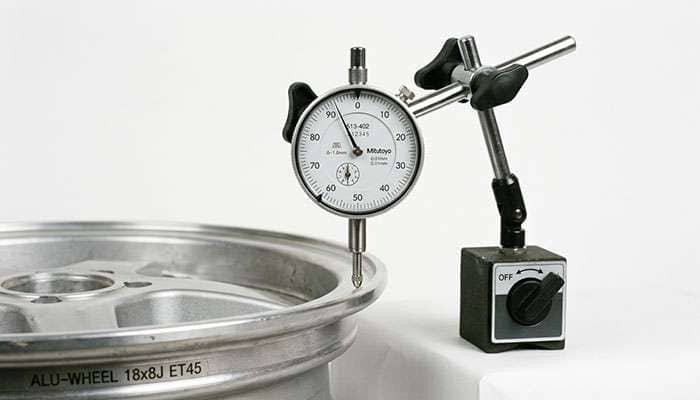
Here is the thing the whole internet is dancing around. "Slightly bent" has an actual definition, it is measured in thousandths of an inch, and any tire shop with a balancer can tell you yours in the time it takes to drink a coffee.
Runout is how far the wheel deviates from spinning perfectly true. There are two flavors and they feel different in the car. Lateral runout is side to side wobble, the wheel weaving like a wonky shopping trolley wheel, and it tends to produce a shimmy you feel in the steering. Radial runout is out of round, the wheel being egg-shaped rather than circular, and it tends to produce a vertical bounce you feel through the seat and the floor. A pothole hit often gives you some of both.
The number that matters: most manufacturers want both lateral and radial runout on an alloy wheel held under about 0.030 inch, and some want tighter than that. Thirty thousandths. For scale, that is roughly the thickness of ten sheets of paper. That is the entire allowance between a wheel that is fine and a wheel that is bent, which tells you something about how little deformation it takes to cause a problem.
Under 0.030 inch and most people feel nothing. Between 0.030 and 0.060 you start getting a vibration that shows up in a speed band, classically somewhere between 40 and 70 mph, and gets worse as you go faster. Past 0.060 you are into a shake you cannot ignore and a wheel that is working its tire hard. The specialists who straighten wheels for a living talk about seeing wheels come in anywhere from thirty thousandths to over a hundred thousandths out of round, and a hundred thousandths is a tenth of an inch of wobble, which is a lot of wheel going somewhere it should not.
Get the number. It converts this whole question from a vibe into a decision, and it is usually free to ask.
Plenty of people come in convinced they have a bent wheel and have a thrown balance weight or a bad tire. The symptoms overlap almost perfectly, which is why guessing is a poor plan.
Vibration at speed, a shimmy in the wheel, a slow leak, uneven tire wear, a pull under braking. Every one of those can be a bent wheel. Every one of those can also be a tire with a belt shifted inside it, a wheel that has simply lost a weight, a bad wheel bearing, or a warped rotor. The symptom tells you something is wrong. It does not tell you what. Our guide to whether steering wheel vibration is your tires or your wheels goes through how to separate them.
A slow leak at the bead, with no nail anywhere, after an impact. That is your tell. When you fold the inner lip, you deform the sealing surface the tire bead presses against, and air starts creeping out around the seam. A tire that will not hold air with no puncture to be found, on a car that hit something a week ago, is a bent wheel until proven otherwise. And that leak is usually on the inner lip where you cannot see it without pulling the wheel, which is why so many people chase it for months.
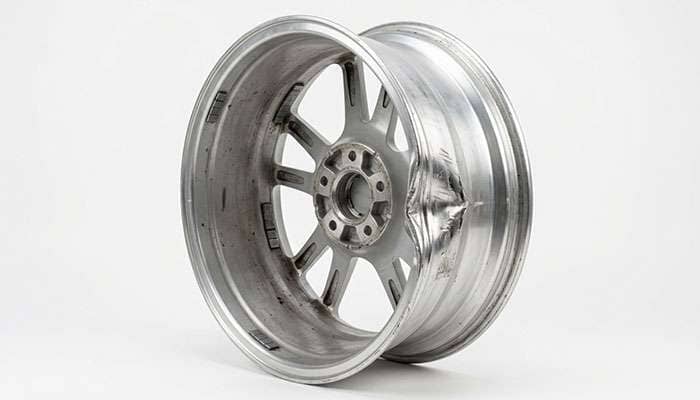
This catches nearly everybody. The inner lip takes the hit far more often than the outer one, because when a tire drops into a pothole the leading edge of the hole strikes the inboard side hardest. And the inner lip is the one you cannot see standing next to the car. Turn the wheel to full lock and get a flashlight on the inboard flange, or better, jack it up, take the wheel off, and look at it properly. People spend a year blaming their tires for a wheel they never looked at.
The definitive test is a road force balancer, which spins the wheel and tire together under load against a roller and measures how the assembly actually behaves rolling down a road rather than just spinning in the air. It separates a bent wheel from a bad tire, and it gives you the runout number in thousandths. If you want to know what that machine is doing and why it is different from a normal spin balance, we wrote up what road force balancing is separately. If you have a mystery vibration, this is the machine that ends the mystery.
Here is where the advice on the internet gets genuinely dangerous, because people give the same answer for every wheel and these things are not the same material doing the same job.
Wheel Type |
How It Fails |
Straightenable? |
Heat Risk |
What I Would Do |
|---|---|---|---|---|
Steel |
Bends and stays bent. Ductile |
Yes, readily |
Minimal |
Straighten it. Cheap and reliable |
Cast aluminum (most alloy wheels) |
Bends a little, then cracks |
Minor bends only |
High. Heat undoes the temper |
Straighten if minor. Replace if not |
Flow formed |
Barrel resists, cast face does not |
Barrel yes, face no |
Moderate to high |
Barrel bend, straighten. Face bend, replace |
Forged aluminum |
Bends without cracking. Ductile |
Yes, best candidate there is |
High. Same temper problem |
Straighten, but only at a real specialist |
Two or three piece |
Usually just the barrel section |
Often replace the section only |
Varies by section |
Ask about a barrel half. Cheaper than a wheel |
A cast wheel is poured. Molten aluminum goes into a mold, cools, and the grain structure that forms is essentially random, with tiny voids and porosity scattered through it that come with the territory. That structure is plenty strong for holding your car up, which is what it was designed for. What it is not is ductile. Bend it and it does not want to flow, it wants to fracture. That is why a cast wheel that takes a hard enough hit cracks instead of folding.
A forged wheel starts as a solid billet and gets squeezed into shape under enormous pressure, which aligns the grain and closes up the porosity. The result is denser, stronger for its weight, and crucially, ductile. It bends and it comes back. That is why a forged wheel is a far better candidate for straightening than a cast one, and it is a large part of what you are paying for. If the differences between these are new to you, our breakdown of cast versus forged versus flow formed wheels covers how each one is made and why it matters.
Steel is easy. It is heavy, it usually wears a plastic hubcap, and a magnet sticks to it. A magnet will not stick to any aluminum wheel. Beyond that, look on the back of the spokes or inside the barrel for a casting mark or a stamp. Cast wheels typically carry a mold number and a slightly rougher inner surface. Forged wheels are usually stamped and noticeably lighter for their size. If it is an OE wheel off a normal car, it is almost certainly cast. Forged is mostly aftermarket, performance, and high-end OE.
This is the part I most want you to take away, because it is the difference between a shop that fixed your wheel and a shop that ruined it while telling you it was fixed.
Almost every aluminum wheel on the road is heat treated to a T6 temper. That is not a coating or a finish, it is a metallurgical condition. The alloy gets solution treated and then artificially aged at a controlled temperature for a controlled time, and that aging process is what precipitates the tiny particles through the metal that give the wheel most of its strength. Take the T6 away and you do not have the same wheel. You have the same shape made of significantly weaker metal.
Now, aluminum does not want to bend back cold. It is stubborn, and pushing a cold cast wheel hard enough to move it is exactly how you crack it. So the standard trick is heat. Warm the bent area and it moves much more willingly. The trouble is that the aging that created the T6 temper happens in a fairly modest temperature range, and if you heat that wheel meaningfully past it and hold it there, you carry on the aging process past where it was supposed to stop. The metallurgists call that over-aging. What it means in your driveway is that the particles doing the strengthening coarsen out and the alloy gives back strength it will not get again.
So a shop can heat your cast wheel, push the bend out, hand it back perfectly round, and it will balance beautifully and look brand new, and it is weaker than it was before you hit the pothole. Nothing about it looks wrong. There is no test you can do in a parking lot. The wheel simply has less margin left in it for the next impact than the factory built in. Our piece on wheel aluminum alloys gets into what the T6 process actually does and why it matters so much for a part that is holding your car off the ground.
Ask them straight: do you use heat, and how much. A good wheel shop will have an answer and will not be annoyed you asked. They will talk about controlled localized heating, keeping it low, working the metal in stages. A shop that says "yeah we just warm it up till it moves" is telling you they have no idea what temperature they are working at, which means they have no idea what they are doing to your wheel. A shop that says they do it cold on a hydraulic machine, on a forged wheel, is telling you something good.
And this is exactly the failure mode of the mobile straightening outfits that will come to your driveway. Somebody with a torch and a hydraulic ram in the back of a van, working by eye, on a cast wheel, in your street. They will get it round. Round is not the same as safe.
I want to address this directly because it is sitting on the first page of Google right now and it is going to hurt somebody.
Search this question and you will find articles recommending you fix a bent rim yourself with a hammer, a block of wood, and a jack. You will find forum threads where somebody says a ten pound sledge and twenty minutes will sort it. That advice is not made up out of nothing, and it is worth understanding why it exists before you follow it.
It is true. For a steel wheel. Steel is ductile, forgiving, cheap, and it has been getting hammered back into shape in farmyards and workshops for a hundred years. The fellow on the tractor forum with a bent rim on his Kubota is getting perfectly sound advice, and the ten pound sledge will genuinely fix it, and he will go back to moving rocks.
Your car almost certainly does not have steel wheels. It has cast aluminum, and everything I just said about cast aluminum applies. It does not want to move, it wants to crack, and hitting it with a hammer is uncontrolled force applied by eye to a brittle part with no way of knowing whether you have started a fracture you cannot see. A crack in an aluminum wheel does not have to be visible to be there, and it does not stay the same size. Fatigue cracks grow, and they grow at the load cycles a wheel sees, which is every rotation of every mile.
The other problem is that a hammer cannot achieve thirty thousandths. You are trying to hit a target the thickness of ten sheets of paper by feel, with a sledgehammer, on a part that springs back. Even if you do not crack it, you will not get it true, and a wheel that is nearly straight still vibrates and still eats tires.
Steel wheel off a trailer, a tractor, or an old truck? Have at it. Alloy wheel off anything you drive on a road? Leave the hammer where it is. This one belongs on the list of things people do to wheels that make it worse, alongside the other entries in our rundown of the most common wheel damage issues.
Some people are going to drive on it anyway, so here is the bill you are running up, in the order you will pay it.
A wheel that is not round is not putting the tire down flat. The contact patch loads and unloads unevenly on every rotation, which produces the cupped or scalloped wear pattern you will find running around the tread if you get down and feel it. That is a tire being scrubbed to death. And if the bend has compromised the bead seal, the tire is also running low, which puts heat into it every mile and cooks the bond between the tread and the belts. You can be replacing a perfectly good tire in a few thousand miles for the sake of a wheel you did not deal with.
Everything the wobble does has to be absorbed by something. That vibration goes up through the hub into the wheel bearing, and bearings do not like being shaken; they like being spun. Then into the tie rod ends, the ball joints, and the bushings, all of which have a fatigue life and all of which are having it spent faster than they should. None of these fail dramatically. They just wear out early and quietly, and the car starts feeling old before its time.
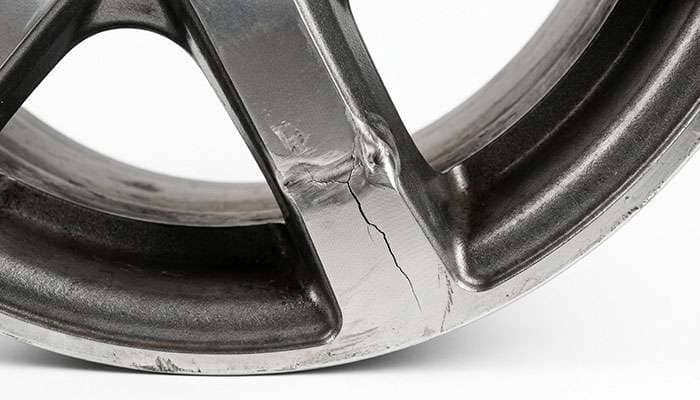
This is the one that stings, because it is where waiting actually costs you money on the exact part you were trying to save. A bend that could have been straightened will propagate. The metal at the bend is already stressed and it is getting worked every single rotation. Aluminum has no fatigue limit worth the name, meaning it does not have a stress level below which it will survive forever the way steel does. Keep cycling it and a crack will start. Once there is a crack, the straightening conversation is over. Nobody straightens a cracked wheel and you should not let anyone weld one, because a weld in a load path on a part holding your car up is not a repair, it is a liability with a nice finish on it.
So the ladder is: a straightening job you could have had for a hundred and fifty to four hundred dollars, then a tire, then a bearing, then the wheel anyway. Every rung is because you did not stop at the one below it. If you are already at the top of it, you can shop wheels at Performance Plus Tire by vehicle and bolt pattern, and if only one is damaged, buy it to match what is on the other three corners.
Assuming it is a candidate for straightening at all, the decision comes down to three questions.
Professional straightening usually runs somewhere between a hundred and fifty and four hundred dollars depending on how bad it is and what the wheel is. Now go and price your wheel. If you have a common OE alloy off a mainstream car, a replacement might be less than the straightening, and then this is not a decision, it is arithmetic. If you have a staggered set of aftermarket wheels where one corner cannot be bought individually, or an OE wheel for something where the dealer wants eight hundred dollars, straightening starts looking very attractive. We put the full math side by side in our guide to whether it is cheaper to repair or replace a rim.
The awkward one. If the wheel is discontinued, or it is one of a set with a finish that has aged, a single new wheel will not match the other three. Sometimes straightening the one you have is the only route to a car that does not look like it is wearing a spare. This is the most common honest reason to straighten rather than replace, and it is a perfectly good one.
This overrides both of the above. An inner lip bend on a forged wheel is a straightforward straighten and I would not hesitate. A cracked wheel or a bend in the face is a replacement no matter what it costs and no matter how badly you want the set to match. There is no price at which a compromised load path becomes a good idea. If a shop tells you they can save a cracked wheel or straighten a bent spoke, walk out, because they have just told you exactly how much they know.
Whatever hit your wheel hit your tire first. Check the sidewall, inner and outer, for a bulge or a bubble. If you find one, stop. Put the spare on. The tire question outranks the wheel question and it is not close.
Turn the wheel to full lock and get a light on the inner lip, or take it off. The inboard flange is where most pothole damage lives and it is the side nobody checks. While you are there, run your eye across the spokes and the face for any crack, however fine. A crack changes the answer completely.
Take it to a shop with a road force balancer and ask for the runout in thousandths. It takes minutes, most shops will do it as part of a balance, and it turns this from an argument into a number. Under thirty thousandths on a lip, you have some breathing room. Over sixty, you do not.
Magnet sticks, it is steel and this is a cheap easy fix. Magnet does not stick, it is aluminum, and now you need to know cast or forged, because that decides whether straightening is a good idea or a gamble.
Ask whether they use heat and how they control it. You are listening for a real answer about controlled localized heating in stages, not "we warm it till it moves." On a cast wheel, this question matters more than the price they quote you.
An impact hard enough to bend a wheel usually knocked the alignment out too, and might have hurt a strut. Get the alignment checked afterwards, otherwise you will straighten the wheel and still chew the tire. And if it was a pothole on a public road, photograph it and check whether your municipality has a claim process, because plenty of them do and almost nobody uses it.
Is it safe to drive with a bent rim? If it is the inner lip, under thirty thousandths of runout, no crack, no leak, and the tire is sound, then yes, for now, and get it straightened. If it is over sixty thousandths, keep it local and slow. If the bend is in the face or the spokes, or there is a crack anywhere, or you are losing air at the bead, then no, and none of the other numbers matter.
The reason every article you have read waffles about "slightly bent" is that none of them wanted to give you the number. The number is about thirty thousandths, it is what the manufacturer allows, it is what a road force balancer measures in a couple of minutes, and it costs you nothing to ask for. Get it and you are not guessing anymore.
And the piece nobody mentions at all: what your wheel is made of decides whether straightening is a repair or a gamble. Steel bends and comes back. Cast aluminum bends a little and then cracks, and the heat used to persuade it to bend takes the temper out of it on the way. Straight is not the same thing as strong. A shop that understands that difference is worth driving past three that do not.
It depends on where the bend is and how far out of true the wheel runs. A bend in the inner lip with runout under about 0.030 inch, no crack, no air loss, and an undamaged tire is generally safe to drive on while you arrange to have it straightened. Between 0.030 and 0.060 inch, keep it local and off the highway. Over 0.060 inch, drive only to a shop and keep it under about 35 mph. If the bend is in the face or spokes, if there is a crack anywhere, or if the bead is leaking air, do not drive it at all.
The common symptoms are vibration at speed, a shimmy in the steering, a slow leak with no puncture, uneven or scalloped tire wear, and a pull under braking. The problem is that every one of those can also be caused by a bad tire, a thrown balance weight, a worn bearing, or a warped rotor, so symptoms alone will not tell you. The strongest clue pointing at the wheel is a bead leak with no nail after an impact. Most pothole damage lands on the inner lip where you cannot see it without turning the wheel to full lock or removing it, and the definitive test is a road force balancer, which gives you the runout in thousandths.
Bends in the lip or flange can often be straightened. Bends in the face, the spokes, or the center cannot, because that is the structural load path, and cracked wheels are always a replacement regardless of location. Material matters too: steel straightens easily and cheaply, forged aluminum is the best straightening candidate because it is ductile, and cast aluminum can only take minor correction before cracking becomes a real risk. Professional straightening typically runs about $150 to $400. If a replacement wheel costs less than that, the decision is arithmetic rather than judgment.
On a steel wheel, yes, and it has been done that way for a century. Steel is ductile and forgiving, so a hammer, a block of wood, and some patience will genuinely straighten a steel rim on a trailer, tractor, or older truck. On the cast aluminum wheels almost every modern car uses, no. Cast aluminum does not want to flow when you bend it, it wants to fracture, and hammering applies uncontrolled force by eye to a brittle part. You can start a crack you cannot see, and fatigue cracks in aluminum grow with every rotation. A hammer also cannot hit a 0.030 inch target, so even a wheel you do not crack will still vibrate.
It can, and this is the risk almost nobody mentions. Aluminum wheels are heat treated to a T6 temper, and that temper is a metallurgical condition responsible for most of the wheel's strength rather than a coating. Because cold aluminum resists bending and tends to crack when forced, shops commonly warm the bent area to make it move. Heating past the alloy's aging range and holding it there over-ages the metal, coarsening the particles that provide the strength, and the wheel gives back strength it will not recover. It comes back perfectly round, balances fine, and is permanently weaker. Ask any shop whether they use heat and how they control it.
There is no fixed mileage, because the damage is cumulative rather than sudden. A minor lip bend under 0.030 inch will not fail tomorrow, but every mile is working the stressed metal at the bend and scrubbing the tire unevenly, and the vibration is being absorbed by your wheel bearing, tie rods, and bushings. The real cost of waiting is that a bend which could have been straightened will eventually propagate into a crack, and once there is a crack the wheel is a replacement. Treat it as weeks rather than months, and if there is any crack, any face damage, or any air loss, treat it as zero miles.



