
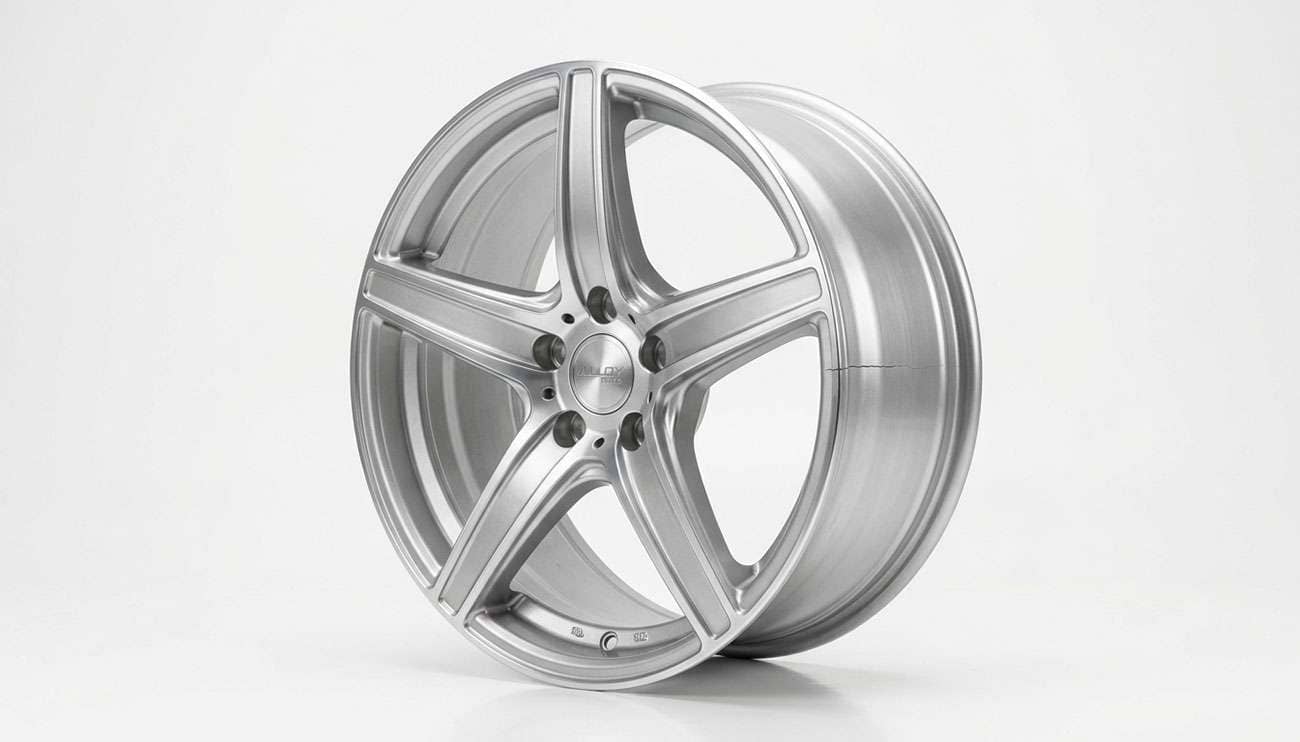
Short answer: yes, if you carry collision or comprehensive. But that is the easy part of the question, and it is not what decides whether you come out of this whole. Your claim gets settled under a clause called like kind and quality, which lets the adjuster write for a used salvage wheel or a machined-down reconditioned wheel instead of a new factory part. And standard coverage indemnifies factory-installed equipment, not the aftermarket wheels you paid for. Every other page on this topic tells you "it depends" and then never tells you what it depends on. It depends on four things: how the wheel cracked, what coverage you carry, whether the wheels came on the car from the factory, and whether the full damage total clears your deductible.
I have written a lot of estimates over the counter for customers who walked in holding a check from their carrier that would not buy one wheel, let alone the set they needed. The check was not wrong. The policy was doing exactly what it says. They just did not know what it said. Find your case in the table below.
How the Wheel Cracked |
Coverage That Applies |
If Wheels Are Factory |
If Wheels Are Aftermarket |
Worth Filing? |
|---|---|---|---|---|
Pothole strike while driving |
Collision |
Paid minus deductible; often coded at-fault |
Paid at OE value only, unless you carry a custom parts endorsement |
Only if total damage clears the deductible by a wide margin |
Curb strike or parking impact |
Collision |
Paid minus deductible; coded at-fault |
OE value only without an endorsement |
Rarely. Single-wheel damage usually lands under the deductible |
Hit by another driver who is at fault |
Their property damage liability |
Paid in full, no deductible, no surcharge to you |
Paid on documented value; bring invoices and part numbers |
Yes, always |
Road debris strike at speed |
Collision at most carriers, comprehensive at some |
Paid minus the applicable deductible |
OE value only without an endorsement |
Depends entirely on which deductible your carrier applies |
Vandalism or attempted theft |
Comprehensive |
Paid minus comp deductible; usually not chargeable |
Endorsement required for full value |
Yes. Comp deductibles run lower and rate impact is smaller |
Crack found with no impact event |
None. Wear and defect are excluded |
Pursue the vehicle manufacturer or an open NHTSA recall |
Pursue the wheel manufacturer warranty |
No. This is a warranty or recall claim, not an insurance claim |
Any cause, liability-only policy |
None for your own vehicle |
Out of pocket |
Out of pocket |
Nothing to file |
Three buckets, and only two of them help you.
Collision pays when your vehicle hits something. That includes another car, a guardrail, a curb, and the road itself. A pothole is legally an impact with an object, so carriers process pothole wheel damage as a collision loss. This is the bucket most cracked rims land in. You pay your collision deductible first.
Comprehensive pays for the things that happen to your car when you are not driving into something. Theft, attempted theft, vandalism, fire, falling objects, storm damage. If somebody tried to pull your wheels in a parking lot and cracked a lug pad doing it, that is a comprehensive loss. Comp deductibles are usually lower than collision deductibles, and most carriers do not surcharge comp claims the way they surcharge at-fault collision claims.
Liability-only pays nothing toward your own vehicle. It exists to cover the damage you cause to other people. If you carry state minimum liability and you crack a wheel in a pothole, that repair is yours. There is no version of this where a liability policy buys you a wheel.
There is a fourth situation that beats all three: the other driver was at fault. Then their property damage liability coverage pays, you have no deductible, and your own loss history stays clean. You also have more leverage to insist on new factory parts, because you are not their policyholder and the duty they owe you is to make you whole.
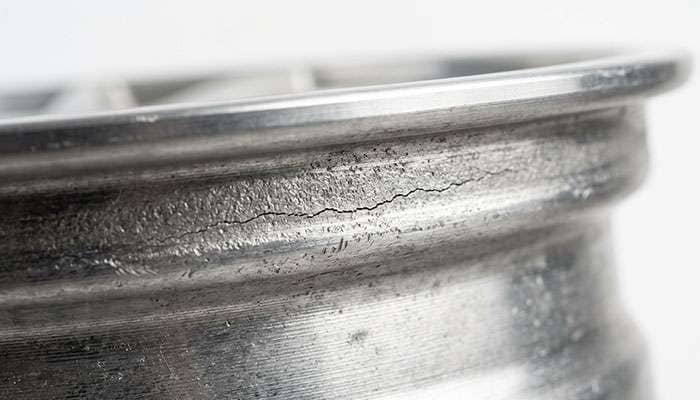
Now the exclusion nobody mentions. If a crack shows up with no impact behind it, no policy in this list covers it. Every auto policy excludes wear, deterioration, and inherent defect. A wheel that cracks from casting porosity or metal fatigue is a manufacturing problem, and your path is the wheel manufacturer's warranty or a safety recall. Those recalls exist. NHTSA has campaign records on aftermarket wheels pulled from the market specifically because surface cracking could progress to the point where the wheel loses air and the tire fails. Before you write off a mystery crack as bad luck, run the wheel part number through the NHTSA recall database.
This is where most of our customers get hurt, and it is the single biggest gap between what people assume and what their policy says.
A standard collision or comprehensive policy indemnifies factory-installed equipment. If your truck rolled off the line on 18-inch alloys and you are running 22s you bought yourself, the carrier owes you an 18-inch factory wheel. Not the 22. They will settle at the depreciated value of the part the vehicle was built with, and that number is frequently a third of what you spent.
The fix is an endorsement, usually called custom parts and equipment coverage or custom equipment coverage depending on the carrier. It is cheap. Typical limits run from $1,000 to $5,000, and some carriers include a small automatic amount, often around $1,000, on policies that already carry comp and collision. Pull your declarations page and look for it by name. If it is not there, it does not exist, and the time to add it is now, not after the impact.
What the endorsement asks for is documentation, and this is where being specific pays. When you declare aftermarket wheels, give them the numbers that identify the part:
Keep the same file for your tire pressure sensors. Aftermarket wheels frequently run programmable or clone sensors rather than the factory units, and those are a separate line item on the estimate. If you are not clear on how your sensors are set up, our breakdown of TPMS sensors for aftermarket wheels will tell you what you are looking at behind the valve stem.
Bent wheels get repaired. Cracked wheels get replaced. That is the general rule at most carriers, and for once the insurance industry and the wheel industry agree.
Here is the metallurgy behind it, because the mechanism matters when you are arguing with an estimate. Most cast alloy wheels are A356 aluminum in a T6 temper. That temper is a heat treatment, and it is what gives the wheel its strength. When somebody welds a crack closed, the heat locally destroys the temper in a ring around the weld. That zone comes back softer than the parent metal. The wheel looks repaired. Structurally, you have traded a visible crack for an invisible weak band, and unless the shop re-heat-treats the entire wheel afterward, which almost nobody does, the strength does not come back.
Wheel manufacturers know this. Structural weld repair voids the warranty at essentially every major brand. That is not a liability dodge. It is the reason the repair is not sanctioned in the first place.
Where the crack sits decides everything. Not all cracks are equal, and a good shop will tell you which one you have:
Wheel construction also changes what kind of damage you get. Cast wheels tend to crack on hard impacts. Forged wheels tend to bend instead, because the grain structure is worked rather than poured, which is one reason forged sets survive rough roads better. If you are deciding what to replace a cracked set with, our comparison of cast, forged, and flow-formed wheels lays out the tradeoffs. And if you are still deciding whether the wheel you have is worth saving at all, we ran the numbers on whether it is cheaper to repair or replace a rim.
Here is the part that decides whether you end up whole, and the part every insurance-industry article on this topic skips.
Auto policies do not promise you a new factory wheel. They promise to restore your vehicle with parts of like kind and quality. LKQ, in the trade. When an estimate gets written, the software queries salvage yard inventory inside a set geographic radius and returns available parts with condition grades and pricing. Your estimate can come back specifying any of four things:
Two of these should worry you, and here is the technical reason why.
Recycled wheels carry an inspection problem that adjusters generally do not understand. Recyclers will tell you a wheel was crack-checked, and they often say "magnafluxed." Magnetic particle inspection requires a ferrous material to work. Aluminum is not ferrous. You cannot magnaflux an aluminum wheel, period. What actually gets used on aluminum is dye penetrant, and dye penetrant only reveals cracks that break the surface. Subsurface porosity, internal fatigue cracking, and damage under a coat of paint or powder do not show up. So a used wheel arriving with a clean inspection tag has been checked for the defects that were easy to find, not for the ones that will fail on you.
Reconditioned wheels come back with less metal than they left with. Straightening a wheel works the aluminum, and machining the face or lip to clean up the surface removes material. The wheel that shows up on your car has a thinner section in the area that was worked and a slightly altered profile. It may be perfectly serviceable. It is also not the part you had before the loss.
You do have leverage. Ask for the estimate line item in writing and read what it specifies. Ask the recycler, through the shop, what nondestructive test method was used and against what standard. Aftermarket wheels sold new in the United States are commonly validated to SAE J2530, which covers radial fatigue, cornering fatigue, and impact testing. A used wheel of unknown history carries no current test certification at all, and saying so out loud changes the conversation.
Several states also restrict non-OEM parts on newer vehicles. The thresholds vary widely, some tied to model years, some to months from the date of manufacture, some to remaining factory warranty. If your car is recent, look up your state's rule before you accept a salvage wheel. And if you are forced onto non-OEM parts on a late-model vehicle, ask whether your state recognizes diminished value claims, because the gap between a proper OEM repair and an LKQ repair is exactly what that claim is for.
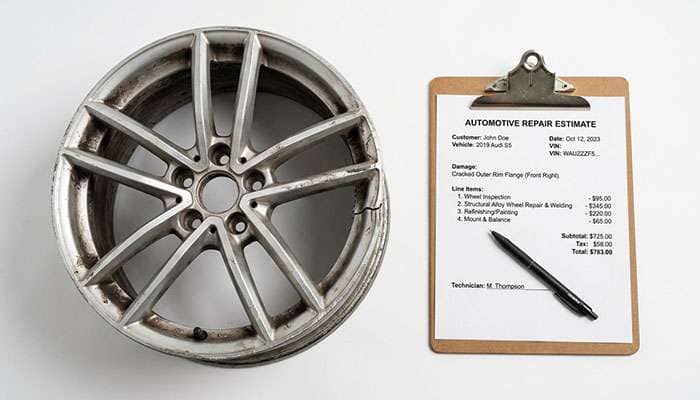
Run the math before you pick up the phone, because the phone call itself is a data point on your record.
Collision deductibles commonly sit at $500 or $1,000. A single replacement wheel on a mainstream sedan or crossover often lands between $250 and $700. On a full-size truck, a luxury sedan, or an EV with an aerodynamic factory wheel, one wheel can clear $1,000 by itself. So the deductible either eats the whole claim or it does not, and which one it does depends on the vehicle sitting in your driveway.
Total Documented Damage |
With a $500 Deductible |
With a $1,000 Deductible |
|---|---|---|
Under $600 |
Do not file. You recover almost nothing and take a claim on your record |
Do not file. Nothing is payable |
$600 to $1,200 |
Marginal. Compare the recovery to three years of likely surcharge |
Do not file |
$1,200 to $2,500 |
File, and insist on a full inspection of tire, sensor, alignment, and suspension |
Marginal to worthwhile. Get a complete estimate first |
Over $2,500 |
File |
File |
Any amount, other driver at fault |
File through their carrier. No deductible applies |
File through their carrier. No deductible applies |
One more factor belongs in that decision. A pothole or curb strike is a single-vehicle collision loss, and a lot of carriers treat single-vehicle collision losses as chargeable at-fault events. Nobody hit you, so the loss attaches to you. A single small claim may cost you very little at renewal. A third small claim in three years is what moves you into a different rating tier, and that cost follows you even if you switch carriers, because the loss shows up in the industry claims database your next insurer pulls.
Here is how a marginal claim becomes a clear one: the wheel is almost never the only thing that got hurt. Whatever hit that wheel hard enough to crack cast aluminum transmitted the same energy into everything attached to it. Document all of it before you decide.
The tire. A pothole edge pinches the sidewall between the rim flange and the pavement. That pinch can break internal cords without leaving a scuff you would notice. The tell is a bulge in the sidewall, which means the casing plies have separated and the tire is holding air on the inner liner alone. That tire is finished regardless of tread depth. If you are not sure what you are looking at, compare against our guide to tire sidewall damage and whether it is safe to drive before you put the car back on the road.
The pressure sensor. The TPMS unit lives at the valve stem, which sits on the part of the wheel that just took the hit. Sheared stems and cracked sensor housings are routine on pothole claims, and a sensor plus relearn is real money on the estimate.
Alignment. A hard strike knocks toe and camber out on that corner. The steering wheel sitting off-center after the impact is the obvious symptom. The quiet one is a car that tracks fine but starts feathering the inside edge of a brand new tire within a few thousand miles.
Suspension. Control arm bushings, tie rod ends, strut and shock assemblies, and wheel bearings all absorb that impact. Bent components do not always announce themselves at low speed. Our checklist of what to check after you hit a pothole covers the inspection sequence in order.
The other wheel on that side. Potholes almost always get both wheels on the same side of the car. Have the rear wheel on the impact side pulled and inspected too. Finding a second crack is common, and it changes the claim total substantially.
Get every one of these on a single written estimate before you call your carrier. An estimate that says "one wheel, $480" gets you nothing under a $500 deductible. The same event written up honestly as wheel, tire, sensor, alignment, and a control arm looks entirely different.
Sometimes. It is harder than it sounds and it is still worth doing, because there is no deductible and no surcharge attached to it. The only thing it costs you is paperwork.
The legal standard in most jurisdictions is not that the pothole existed. It is that the public agency had actual or constructive notice of that specific defect and failed to repair it within a reasonable time. A pothole that opened up last Tuesday will not clear that bar. A pothole that residents have been calling in for four months will.
Governmental immunity statutes and short filing windows are the two things that kill most of these claims. Deadlines are measured in months, not years, and they vary considerably by state. In California, claims against a public entity go through the Government Claims Act, and property damage claims generally must be presented within one year of the incident, with a shorter window for personal injury. Find your state's rule immediately, because missing the presentation deadline ends the claim no matter how strong the facts are.
What to gather at the scene and after:
Expect a partial payment or a denial more often than a full recovery. File anyway if the damage is significant. The agency has no reason to pay a claim nobody submits.
People stall on this decision for weeks while the wheel keeps working. Understand what is happening in the metal during that time.
It starts as a slow leak. A hairline crack in the inner barrel bleeds air past the bead. You top it off every few days and tell yourself you will deal with it. Meanwhile the tire is running underinflated, the sidewall is flexing further through every rotation than it was designed to, and flex generates heat.
Then the crack grows. This is the part that makes aluminum different from steel, and it is the reason "it has been fine for a month" is not evidence of anything. Steel has a fatigue endurance limit, a stress level below which it can cycle essentially forever without accumulating damage. Aluminum has no endurance limit. It accumulates fatigue damage at any stress level, on every single cycle. Your wheel turns roughly 800 times per mile. Every one of those rotations loads and unloads the crack tip, and the crack advances. It does not stabilize. It cannot.
Then the bead seat stops sealing. Once the crack reaches the sealing surface, you are no longer losing air slowly. You are losing it at whatever rate the opening allows, and at highway speed with a hot tire, that rate goes up.
Then the tire comes off the rim. This is the failure NHTSA describes in wheel recall language: cracking progresses to the point where the wheel loses air and the tire fails. A tire that unseats at speed is a loss-of-control event, and the bill stops being about a wheel. Add the destroyed tire, the fender liner and quarter panel the flailing tread takes out, the brake line it can catch, and whatever the car hits after that.
The escalation ladder is short and it only runs one direction: a leak becomes a longer crack, a longer crack becomes a failed seal, a failed seal becomes a blowout. Somewhere on that ladder you were going to buy a wheel anyway. Buying it at the top of the ladder costs you a wheel. Buying it at the bottom costs you a wheel, a tire, bodywork, and possibly a lot more. Our detailed breakdowns of whether a cracked wheel is safe to drive and whether a bent rim is safe to drive go through the specific warning signs for each.
In order:
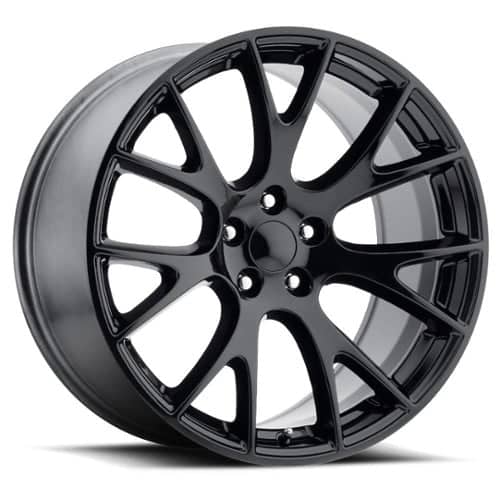
On that last point, this is where a lot of people end up better off than they expected. If your factory wheel is discontinued, backordered, or priced like a dealership part, an OE-style replica in the same size and fitment gets you the factory look at a fraction of the price. The Factory Reproductions FR 70 Hellcat in 20x9, 5x127 with a +30 offset and a 71.5 hub bore runs $260 in gloss black and carries a 1,600-pound-plus load rating. For six-lug trucks and SUVs, the Performance Replicas PR176 in 20x9, 6x139.7 with a +24 offset and 78.1 hub bore is $285.60 in matte black at a 2,200-pound rating.
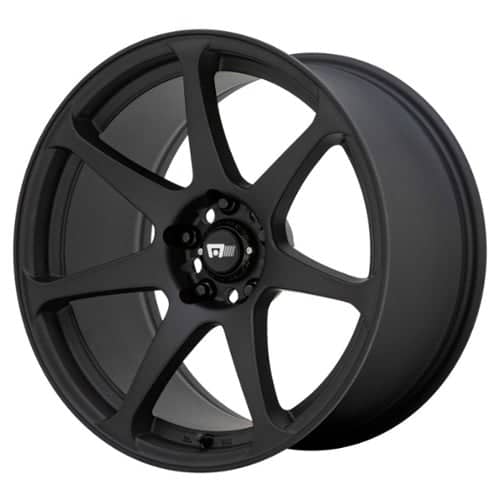
If you would rather put the settlement toward a full set than chase a single matching wheel, that is often the smarter play, especially on a car where the other three wheels already have curb rash or a faded finish. The Konig Hypergram in 17x8, 5x100 with a +40 offset and 73.1 hub bore is $281.50 in matte black. The Motegi MR154 Battle in the same 17x8 size with a 5x100 pattern and +30 offset comes in at $225.25 in matte black with a 1,518-pound load rating. Both are flow-formed constructions that handle rough pavement better than a conventional cast wheel. Whichever direction you go, add a proper lug set, and if you are moving to aftermarket wheels, call your agent about that custom parts endorsement the same week.
Browse the full lineup of OE replica wheels to match your factory fitment, or call our fitment desk at the Long Beach shop with your year, make, model, and current wheel size and we will tell you exactly what bolts on.
Will insurance cover a cracked rim? If you carry collision or comprehensive and there was an impact behind it, yes. But coverage is the low bar. The claim gets settled under a like kind and quality clause that lets an adjuster write for a salvage wheel with an inspection method that cannot detect the defects that matter, and standard coverage pays for the wheels your car was built with, not the ones you bought. Those two clauses decide what you actually get.
So do three things. Read your declarations page today and find out whether you have custom parts and equipment coverage. Document the full damage on one estimate before you call anybody. And whatever you decide about the claim, get off the cracked wheel now, because aluminum does not heal and the crack does not stop growing.
Yes, if you carry collision or comprehensive coverage and the crack came from an impact, theft, or vandalism. Collision applies to potholes, curbs, and object strikes. Comprehensive applies to theft and vandalism. Liability-only policies pay nothing toward your own vehicle. A crack with no impact event is excluded as wear or defect, and belongs to the wheel manufacturer's warranty or a safety recall instead.
Yes, under collision coverage. Carriers treat a pothole strike as an impact with an object, so it is processed as a collision loss and your collision deductible applies. Because nobody else was involved, most carriers code it as a chargeable at-fault event, which can affect your renewal premium. Comprehensive coverage generally does not apply to pothole damage.
Only up to the value of the factory-installed wheels unless you carry a custom parts and equipment endorsement. Standard collision and comprehensive coverage indemnifies the equipment your vehicle came with from the plant. The endorsement is inexpensive, typically covers $1,000 to $5,000, and must be added before the loss with documentation of the wheels, their part numbers, and their fitment specs.
It can. A pothole or curb strike is a single-vehicle collision loss and many carriers treat those as at-fault events subject to surcharge. One small claim may cost little at renewal, but multiple claims within a few years is what moves you into a higher rating tier. That loss history follows you to a new carrier through the industry claims database. Comprehensive claims for theft or vandalism carry less rate impact at most companies.
Most carriers and essentially all wheel manufacturers say no. Cast alloy wheels are heat-treated aluminum, and welding a crack closed destroys that heat treatment in a zone around the weld, leaving a softer band in the metal. The wheel looks repaired but is weaker than it was. Structural weld repair voids manufacturer warranties. Cracks at the spoke-to-hub junction or through the lug pads are never repairable at any price.
You should not drive on one at all. Aluminum has no fatigue endurance limit, meaning the crack advances a little on every wheel rotation regardless of how gently you drive, roughly 800 rotations per mile. It never stabilizes. The progression runs from a slow leak, to a failed bead seal, to rapid air loss and tire separation at speed. Put the spare on or have the vehicle towed.



