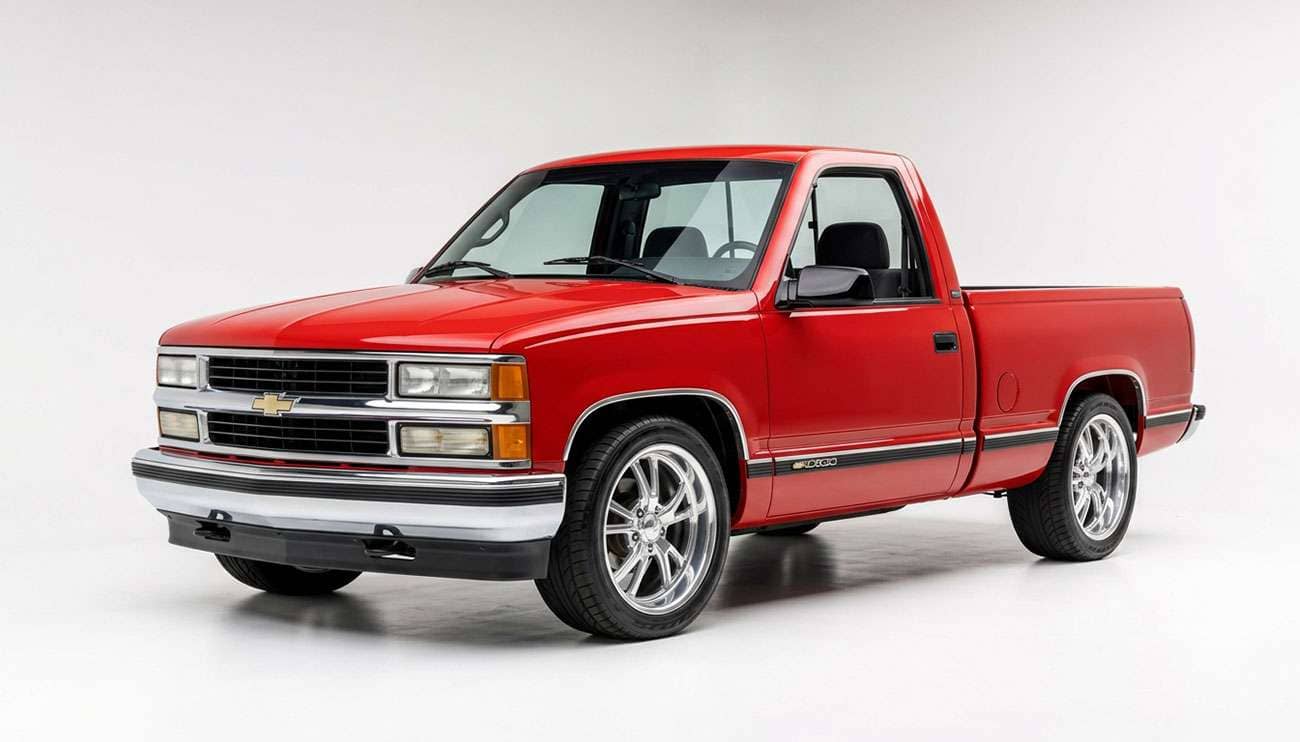
An OBS Chevy does not have one bolt pattern. It has three. Most 2WD C1500s run 5x5 (5x127). Every 4WD K1500, the heavier C1500s, and the light-duty 2500s run 6x5.5 (6x139.7). Heavy-duty 2500s and all 3500s run 8x6.5 (8x165.1). "Check your bolt pattern" is where most guides stop. The variable that decides it is C or K, 1500 or 2500, and light-duty or heavy-duty. After that come two details almost nobody mentions: hub bore and lug thread.
I'm Hank Feldman. I started this shop in 1971, and I was mounting tires on these trucks when they were still new on the dealer lot. Now they are the hottest classic truck going, and the number one mistake I see at the counter is somebody buying a set of wheels for "an OBS" without knowing which OBS they own. Start with this table:
Feature |
Bolt Pattern |
Hub Bore |
Lug Thread |
Factory Wheel Diameter |
|---|---|---|---|---|
C1500 2WD, light half-ton (most) |
5x5 (5x127) |
78.1 mm |
M14x1.5 |
15 in |
C1500 2WD, heavier GVWR |
6x5.5 (6x139.7) |
78.1 mm |
M14x1.5 |
15 in |
K1500 4WD (all) |
6x5.5 (6x139.7) |
78.1 mm |
M14x1.5 |
16 in |
C2500 / K2500 light-duty |
6x5.5 (6x139.7) |
78.1 mm |
M14x1.5 |
16 in |
C2500 / K2500 heavy-duty, all 3500 |
8x6.5 (8x165.1) |
116.7 mm |
9/16-18 |
16 in |
Once you know which row you are in, the next decision is what you want the truck to do. This second table is where most OBS owners land when they are ready to buy:
Feature |
Typical Wheel |
Typical Tire |
What to Watch |
|---|---|---|---|
Factory look, stock height |
15x7 rally or styled steel |
235/75R15 |
Hub bore on reproduction wheels |
Lowered 2WD street truck |
20x8.5 front, 20x10 rear |
255/45R20 front, 295/40R20 rear |
Backspacing and fender lip at full lock |
Stock-height 4x4 |
16x7 or 16x8 |
265/75R16 |
Front bumper and fender liner at lock |
3/4-ton or 1-ton work truck |
16 in or larger, 8-lug |
LT245/75R16 Load Range E |
Lug nut thread and hub-centric rings |
"OBS" means Old Body Style. It is the nickname owners gave the GMT400 Chevy and GMC trucks once the redesigned 1999 Silverado showed up and made them the old body. The pickups ran from the 1988 model year through 1998: C/K 1500, 2500, and 3500, in regular cab, extended cab, and crew cab, with GMC Sierra twins wearing different grilles.
The same family includes the Suburban, the full-size Blazer and Tahoe, and the Yukon. They share the front end, the hubs, and in most cases the bolt patterns with the pickups. Everything in this guide applies to them too, sorted the same way: 2WD or 4WD, half-ton or three-quarter-ton.
The "C" means two-wheel drive. The "K" means four-wheel drive. The number is the weight class: 1500 for half-ton, 2500 for three-quarter-ton, 3500 for one-ton. Those two pieces of the badge decide your wheels more than the year or the trim does. If your truck is older, from 1973-1987, you have a squarebody, and the rules are different. That is covered in our C10 squarebody wheel guide.
Count the lug nuts. That sounds too simple, but on an OBS it gets you most of the way, because each lug count maps to one pattern:
Where people get burned is the 2500. A light-duty C2500 or K2500 rolls on six lugs. A heavy-duty 2500 rolls on eight. Both say 2500 on the fender. The quickest proof is the lug count. The paperwork proof is the Service Parts Identification sticker, usually in the glove box. Look for the C6P option code; that marks the heavy-duty package. Owners also report a gross vehicle weight rating of about 8,600 pounds on HD pickups, on the door jamb sticker.
Do not trust the wheels that are on the truck right now. A 30-year-old pickup has had plenty of chances to get swapped hubs, swapped axles, or a set of adapters. I have seen K1500s on 8-lug wheels and C1500s converted to six lugs. Count the studs on the hub itself with the wheel off, and measure if anything looks unusual.
For deeper detail on each pattern, we have separate guides on the 5x5 bolt pattern, on choosing 6-lug Chevy wheels, and on which vehicles use 8x6.5.
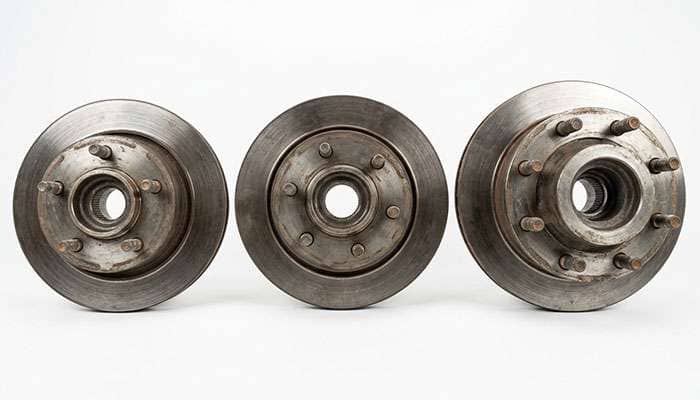
This is the question that sends more OBS owners back to the counter than any other. Two C1500s, same year, same color, parked side by side, and one has five lugs while the other has six.
The reason is weight rating. GM built the lightest 2WD half-tons, mostly regular cabs, with a 5x5 hub and lighter-duty brakes. Heavier-rated C1500s got the six-lug hub, a thicker rotor, and a stronger rear axle. Owners on the GMT400 forums point to the early 1988-1991 regular cab C1500 as the most common five-lug truck, and note that it usually did not come with the heavier brakes.
That matters for more than wheel shopping. Plenty of owners convert a five-lug C1500 to six lugs for the bigger brakes and the wider wheel selection. On the 1988-1991 regular cab trucks, owners report the swap takes spindles, rotors, and calipers from a later six-lug truck, not just rotors. Owners also warn that 2WD six-lug axles are narrower than 4WD axles, so a wheel offset that looks right on a K1500 can sit differently on a converted C1500.
The takeaway: if your C1500 has five lugs, shop 5x5. Do not buy six-lug wheels planning to "convert later." Convert first, measure, then buy.
A bolt pattern only tells you the lugs line up. It does not tell you the wheel will sit on the hub, and it does not tell you the lug nuts will thread on. On an OBS, both of those catch people.
The five- and six-lug OBS hubs measure 78.1 mm. The center hole in the wheel has to be at least that big, or the wheel will not slide on. Here is the trap: 5x5 is shared with the Jeep Wrangler and Gladiator, and a big slice of the 5x5 wheel market is built for them. Across 5x5 aftermarket wheels, roughly four in ten are bored smaller than 78.1 mm, most often 71.5 mm for Jeep. Those wheels bolt to the right pattern and still will not go on an OBS.
Check the center bore on every 5x5 wheel before you buy it. If you are not sure what that number means, our guide on wheel center bore walks through it.
The six-lug side runs the other direction. Most 6x5.5 aftermarket wheels are bored at 106 mm or bigger, sized for later Silverados, Tacomas, and other trucks. Those wheels fit over a 78.1 mm OBS hub with room to spare. That gap means the wheel is centered only by the lug nuts. Use hub-centric rings, 78.1 mm inside, sized to the wheel on the outside.
The eight-lug trucks have the same issue in a bigger size. The OBS heavy-duty hub is 116.7 mm. Most 8x6.5 aftermarket wheels are bored at 125 mm or larger, built for later GM heavy-duty trucks and Rams. They fit, but they need rings.
Five- and six-lug OBS trucks use M14x1.5 lug nuts. The eight-lug OBS trucks are the odd ones: they use 9/16-18 studs, a holdover from the older GM heavy-duty trucks. Later GM heavy-duty pickups went metric. So a set of wheels and lug nuts pulled off a newer 2500HD can bolt to your OBS pattern and still come with nuts that do not fit your studs. Buy lug nuts for the studs on your truck, with the seat type the new wheel calls for.
Knowing the factory size tells you what the speedometer expects and how much room you have to grow. Here is what GM put on these trucks, with the actual calculated diameter:
A word on the heavy trucks. A 2500 or 3500 needs a light truck tire with the load range the truck was built for, usually Load Range E. A passenger-rated tire that happens to come in the right size is not a substitute on a three-quarter-ton. If you are weighing the two constructions on a half-ton, the trade-offs come down to weight, ride, and how much you haul.
The lowered 2WD OBS is the classic street truck of the 1990s, and it is back. Drop spindles up front, a flip kit or lowering springs out back, and a set of 20s. Most of those builds are C1500s, which puts most of them on 5x5. Check the hub bore, as covered above.
The common setup owners report for a dropped C1500 is a 20x8.5 front wheel with about 5.25 to 5.5 inches of backspacing, wrapped in a 255/45R20. That tire calculates to 29.0 inches, close to the factory 235/75R15, so the speedometer stays honest. Out back, owners run a wider 20x10 with about 6 to 6.25 inches of backspacing and a 295/40R20, just over 29 inches tall.
Backspacing is the number that decides whether a lowered OBS rubs. Too little and the tire sticks out and catches the fender lip. Too much and the inside edge finds the control arm or frame. On an aggressive drop, owners say the remaining turning rub is often fixed by rolling the front fender lip. They also note that older drop spindles sit a little wider and were designed around smaller wheels, so check clearance with your exact parts before you order. Our guide to wheels for lowered trucks has style ideas for this build.
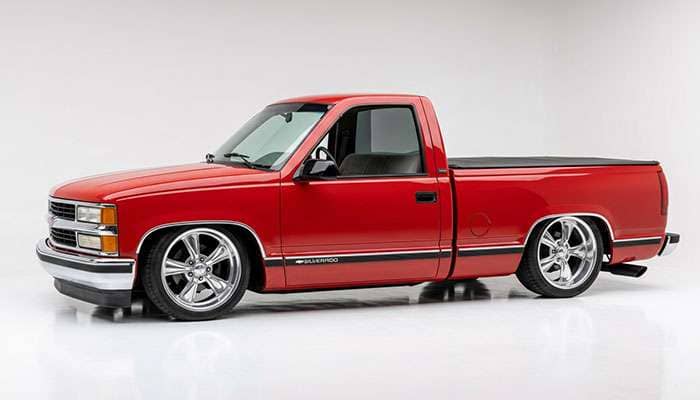
Plenty of OBS trucks wear 22s now. The rule does not change: keep the overall tire diameter near 29 inches on a dropped truck, and pick backspacing for the drop you have. In the 22-inch 5x5 and 6x5.5 wheel market, offsets run all over the map, from deep negative to moderate positive, so you cannot assume a wheel will sit right just because it is the right diameter.
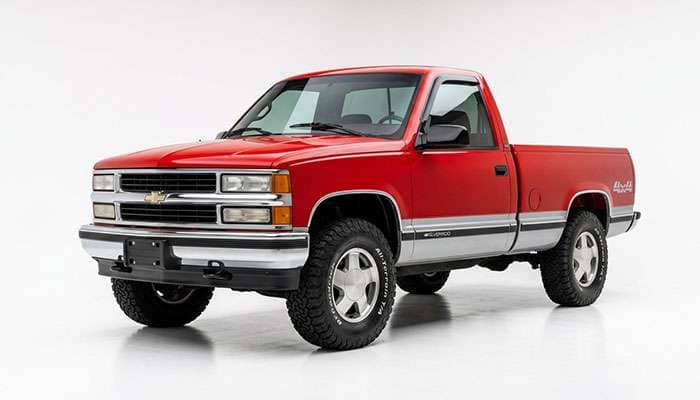
For a stock-height 4WD half-ton, the factory already answered the question. GM put 265/75R16 on the 1992-1998 Z71, and that 31.6-inch tire clears a stock K1500 on a 16-inch wheel. That is the safe, no-surprises upgrade for a K1500 that came on 225/75R16 or 245/75R16.
Going bigger means adjusting the torsion bars or adding a leveling kit, and usually some trimming at the front of the fender liner and bumper. Owners commonly run 285/75R16, about 32.8 inches, after cranking the torsion keys. Remember that cranking torsion bars changes suspension geometry and ride quality, and any change in tire size throws off the speedometer. A 245/75R16 truck moving to 265/75R16 reads about 4 percent slow, so 60 indicated is a little over 62 actual.
These trucks were designed in the late 1980s, and a few wheel styles just look right on them. Here is how I break it down for customers.
The 15-inch rally wheel is the factory look on a lot of OBS half-tons, and it never goes out of style. Our own Hot Rod Hanks 55 Rally comes in 15-inch in both 5x5 and 6x5.5, so it covers the C1500 and the K1500. Pair it with a 235/75R15 for a correct stock-height stance.
For a clean, painted, early street-truck look, a smoothie wheel with a Chevy cap is hard to beat. Boyd Coddington builds its Smoothie with a Chevy cap in 17- and 20-inch sizes in both 5x5 and 6x5.5. The 20-inch version on a lowered C1500 is about as period-correct as it gets for a 1990s mini-truckin'-era build, scaled up.
The polished, multi-spoke look defined the custom OBS in its own day, and it still does. A few wheel makers now build lines specifically for OBS trucks. For more period ideas across classic pickups, see my classic truck wheel picks.
Heavy-duty OBS trucks look right on plain 16-inch steel or polished forged 8-lug wheels. Keep the diameter at 16 inches or bigger; the heavy-duty brakes need the room.
A wheel that "bolted right on" is not the same as a wheel that fits. Here is how the problems stack up when a wheel is on an OBS without being right for it.
Every one of those starts with a wheel that matched the bolt pattern and nothing else. The fix costs nothing up front: confirm the pattern, the bore, the thread, and the backspacing before you pay for the wheels.
The OBS Chevy is one truck body sitting on three different bolt patterns. Most 2WD C1500s are 5x5. K1500s, the heavier C1500s, and light-duty 2500s are 6x5.5. Heavy-duty 2500s and the 3500s are 8x6.5. Get that right, then check the two things the bolt pattern does not tell you: whether the wheel's center bore clears the 78.1 or 116.7 mm hub, and whether your lug nuts match the M14 or 9/16 studs.
After that, it is the fun part. Rally wheels at stock height, smoothies or polished 20s on a dropped C1500, or 265/75R16s on a K1500. These trucks have been around long enough to look good on just about anything, as long as it actually fits.
It depends on the model. Most 2WD C1500s use 5x5 (5x127). K1500s, heavier C1500s, and light-duty 2500s use 6x5.5 (6x139.7). Heavy-duty 2500s and all 3500s use 8x6.5 (8x165.1).
It can be either. Lighter-rated 2WD C1500s came with 5x5 hubs, while heavier-rated C1500s came with 6x5.5 hubs. Count the studs on the hub to be sure.
A heavy-duty 2500 has eight lugs; a light-duty 2500 has six. You can also check the Service Parts Identification sticker in the glove box for the C6P option code, which marks the heavy-duty package.
Often not. Both use 5x5, but many Jeep-spec wheels have a 71.5 mm center bore, and the OBS hub is 78.1 mm. The wheel must have a center bore of at least 78.1 mm to fit.
A common setup is 20x8.5 in front with about 5.25 to 5.5 inches of backspacing and a 255/45R20 tire, and 20x10 in back with about 6 to 6.25 inches of backspacing and a 295/40R20.
A stock-height K1500 fits 265/75R16, about 31.6 inches, the same size GM put on the 1992-1998 Z71. Going bigger usually takes a torsion bar adjustment or leveling kit plus some trimming.