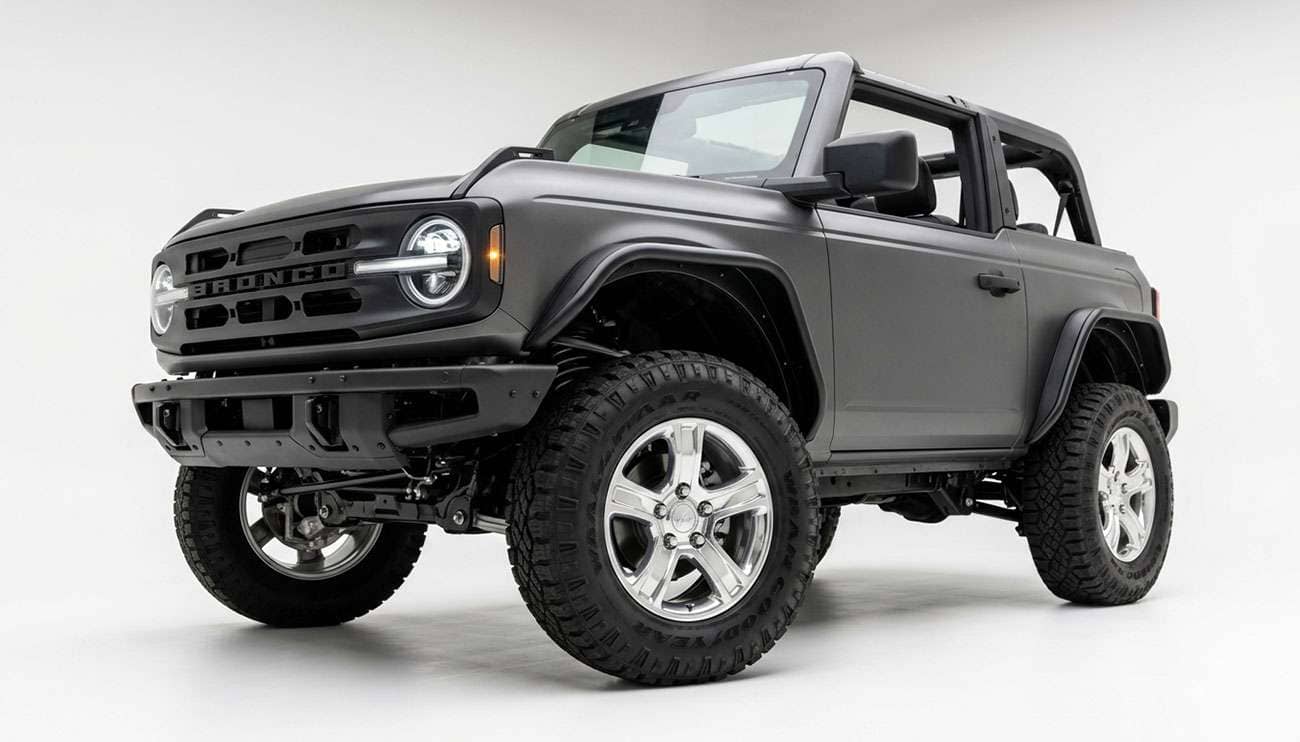
Yes, if your Wrangler is a 2007-or-newer JK or JL and the Grand Cherokee is a 1999-or-newer model. They share the 5x5 pattern and a 71.5 mm hub, so the wheel bolts on. Most answers stop there and skip backspacing. A WK2 wheel runs about +56 offset and 6.7 inches of backspacing, which pulls the tire in toward the control arm, the opposite of what a Wrangler wants. Lug thread also flips by generation, and a TJ can't take these wheels at all.
Grand Cherokee Wheel |
On a JK (2007-2018) |
On a JL (2018+) |
What Decides It |
|---|---|---|---|
ZJ (1993-1998) |
No |
No |
5x4.5 pattern |
WJ (1999-2004) |
Yes, with 1/2-20 nuts |
Test-fit first |
16-inch wheels against JL calipers, snug lug holes on 14 mm studs |
WK (2005-2010) |
Yes, with 1/2-20 nuts |
Test-fit first |
Snug lug holes on 14 mm studs, M14 nuts, offset |
WK2 (2011-2022) |
Yes, with 1/2-20 nuts |
Yes, with M14 nuts |
About +56 offset, tire size |
WL (2022+) |
Yes, with 1/2-20 nuts |
Yes, with M14 nuts |
Read the offset stamp, tire size |
Any 5x5 wheel on a YJ or TJ |
Not applicable |
Not applicable |
YJ and TJ Wranglers are 5x4.5, so 5x5 wheels won't mount |
"Yes" in that chart means the wheel mounts. It doesn't mean it's the right wheel for your tires. The rest of this guide covers the difference.
Since 2007, yes. Every Grand Cherokee from the 1999 WJ on and every Wrangler from the 2007 JK on uses 5x5, which is 5x127 mm. Our full 5x5 bolt pattern guide lists the other vehicles on that circle. Before those years, both Jeeps ran 5x4.5. That covers the 1993-1998 ZJ Grand Cherokee and the 1987-2006 YJ and TJ Wranglers. A 5x5 wheel won't go on a TJ hub, no matter what the listing says about "Jeep fitment."
Spec |
WK2 and WL Grand Cherokee |
JK Wrangler |
JL Wrangler |
|---|---|---|---|
Bolt pattern |
5x127 mm (5x5) |
5x127 mm (5x5) |
5x127 mm (5x5) |
Hub bore |
71.5 mm |
71.5 mm |
71.5 mm |
Lug thread |
M14 x 1.5 |
1/2-20 |
M14 x 1.5 |
Typical factory offset |
+56 on WK2 18x8 and 20x8 wheels |
About +44 |
About +44 Sport and Sahara, +37 Rubicon |
Typical backspacing |
About 6.7 inches on WK2 18x8 |
About 6.0 to 6.25 inches |
About 6.0 inches, 5.7 on Rubicon |
Hub bore is the easy part of this swap. A factory Grand Cherokee wheel is bored for the same 71.5 mm hub as a Wrangler, so it centers correctly with no rings. That alone puts it ahead of many aftermarket wheels, since only about one in four 5x5 wheels on the market is bored at 71.5 mm.
WL wheels need one extra look. Later factory listings don't all match the WK2's +56. At least one 2021-2023 factory 18x8 lists +44.45, which would sit closer to a Wrangler's stock position. Read the stamp on the wheel you're buying and don't assume by year.
The nuts follow the Wrangler's studs, not the wheel's origin. That's the rule to remember, and it's where this swap diverges by generation.
JK studs are 1/2-20. Your JK's own lug nuts thread on, and a WJ or WK wheel was drilled for that same stud size. A WK2 or WL wheel was drilled for a 14 mm stud, so the hole runs about 1.3 mm larger than a JK stud needs. That's not a problem on its own, because a cone seat nut centers on the seat, not on the hole. Don't reuse M14 nuts from the Grand Cherokee. They won't thread onto a JK stud.
JL studs are M14 x 1.5, the same as a WK2 or WL. That makes those wheels the cleanest match on the list. WJ and WK wheels are the catch. They were drilled for 1/2-inch studs, and a 14 mm stud is 1.3 mm bigger. Our guide to whether JK wheels fit a JL covers this same problem: holes that are snug over the stud, or too tight to seat. Slide the wheel on by hand before you buy a set. Never force it on with the lug nuts, and never drill the holes out.
Most factory Jeep wheels use a 60-degree cone seat, and that's a good starting assumption, not a guarantee. Confirm it on the wheel you're holding. Our guide to lug nut seat types shows how to tell them apart. Check thread engagement too, and torque to your Wrangler's owner's manual spec. The Grand Cherokee's 130 ft-lbs (176 Nm) on base models is written for that vehicle's M14 studs, and it does not carry over to a JK's 1/2-20 studs.
This is the real difference between these two Jeeps. The Grand Cherokee is a street-oriented SUV that tucks its tires under the fenders, so its wheels carry high positive offset. A Wrangler owner usually wants the opposite. The table compares each wheel using the same tire, measured against a factory Sport or Sahara wheel.
Wheel |
Offset |
Backspacing |
Tire Position vs. Sport or Sahara Wheel |
|---|---|---|---|
WK2 Grand Cherokee 18x8 |
+56 |
About 6.7 in |
12 mm (0.5 in) farther in |
Wrangler Sport or Sahara 17x7.5 |
+44 |
About 6.0 in |
Baseline |
Wrangler Rubicon 17x7.5 |
+37 |
About 5.7 in |
7 mm (0.3 in) farther out |
Common aftermarket 17x9 |
-12 |
About 4.5 in |
56 mm (2.2 in) farther out |
On a Rubicon, the gap is bigger. Swapping a +37 factory wheel for a +56 Grand Cherokee wheel moves the tire 19 mm (0.75 inch) inboard. Those are the numbers that matter when the tire sits close to the suspension.
The aftermarket tells the same story from the other side. Most 5x5 wheels sit between -25 and +12 offset, and almost none run past +44. Wheels built for Wranglers don't run +56, because moving the tire inboard is the wrong direction on this chassis. A Grand Cherokee wheel works on a stock Jeep with a stock-size tire. It's a poor base for a tire upgrade.
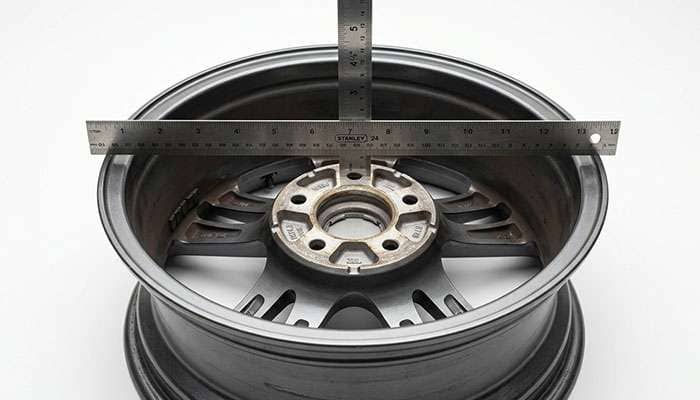
33s are a test-fit, and 35s are a poor idea. The reason is what the tire reaches first. As we covered in will 35s fit a JL with no lift, the inner shoulder can catch the front lower control arm or the frame at full lock under load. That guide lands on about 4.5 to 5.0 inches of backspacing for 35s on a Rubicon. A WK2 wheel at 6.7 inches is close to 2 inches deeper, and that's the wrong side of the problem.
A 33 on a 7.5-inch factory Wrangler wheel is a stock Rubicon setup, so it clears at factory offset. Add 19 mm of inboard shift on a Grand Cherokee wheel and you've used up part of that clearance. Whether it still clears depends on your tire's real width and your suspension. Treat it as unknown until you turn the wheel to full lock with the tire mounted, both directions, with the suspension compressed.
Be honest about the evidence here. JK owners on forums report running stock Grand Cherokee wheels and liking the look, but documented clearance numbers are scarce. Most of what's published is about stock-size tires. If you're planning 33s or larger, spend your money on a wheel with the backspacing built in.
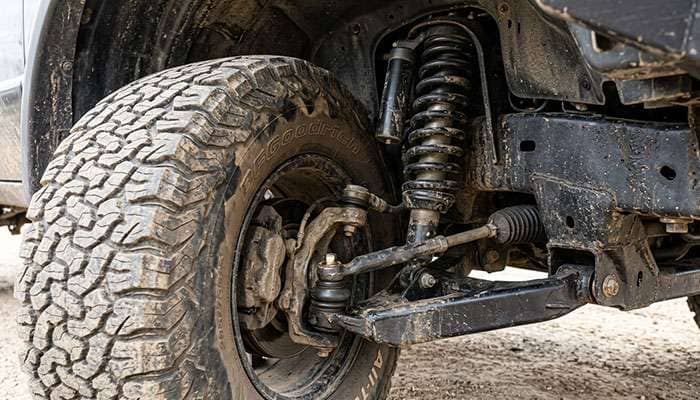
Generally yes, because the Grand Cherokee is the vehicle with the bigger brake problem. Owners report the reverse swap, a JK wheel on a Grand Cherokee, is what needs a spacer to clear the brakes. A wheel built to clear a WK or WK2 front brake has an easy job on a JK, whose front rotors measure 11.9 inches.
JLs narrow the margin. JL front rotors are 12.9 inches on all trims, and rear rotors run 13.4 inches on Sahara and Rubicon models and 14 inches on 4xe and 392 models. Two cases deserve a test-fit:
Spin the bare wheel by hand with the nuts snug before you mount a tire. Look at the spoke backs as well as the barrel, because spoke shape often decides this. Our guide to brake caliper wheel clearance walks through the check.
They can correct the offset, and the math is simple. A 12 mm spacer puts a +56 wheel at the same effective +44 as a Sahara wheel. A 25 mm (1-inch) spacer takes it to about +31, slightly past a Rubicon's +37. Use a hub-centric spacer sized for the 71.5 mm hub, with the right stud thread for your Jeep: 1/2-20 on a JK and M14 x 1.5 on a JL.
Look at the whole cost first, though. You'd be adding a set of four quality spacers to used wheels, plus a joint that needs its own torque checks. Spacers also add leverage on the hub bearings, and the wheel underneath is still only 8 inches wide. For a closer look at what they fix and what they don't, read our guide on whether wheel spacers stop tire rubbing. If you need spacers to make a free set of wheels work, compare that against simply buying 5x5 wheels with the right backspacing.
Yes, if the used wheels come with their tires. Factory Grand Cherokee tires are shorter than Wrangler tires, even across wheel sizes.
On a Rubicon, that 6.7% means your speedometer reads about 64 mph when you're actually doing 60. You also lose about 1.1 inches of ground clearance under the axles, and the engine turns higher at highway speed. Those tires are also highway tires, without the sidewall strength or tread of a factory Wrangler tire. For a trail rig, that's a bigger step back than the offset.
Don't count on it. Sensors depend on the vehicle's receiver, and Jeep's own frequency and part changes make this year-specific. JK models used 315 MHz through 2012 and 433 MHz from 2013, and JLs built from June 2021 on call for a later sensor design. Owners have had some cross-generation luck: one 2015 WK2 owner reported 2013 JK sensors registered after a couple of days of driving. That's a data point, not a rule.
The clean solution is to move your Wrangler's own sensors into the Grand Cherokee wheels, or buy sensors listed for your exact Wrangler. Check that the valve hole accepts them, and have the shop register them after install.
For road load, usually yes. The Grand Cherokee is a heavy SUV, and its wheels were built to carry it. The check is the same one you'd run on any wheel: the rating should be at least half of your heavier axle's GAWR. A JL 4xe, for example, has a 3,550-pound rear GAWR, so it needs at least 1,775 pounds per wheel. Used factory wheels often don't come with a published rating you can look up, so factor that in if your Jeep is loaded with armor or a rooftop tent.
Off-road is where these wheels fall short. Large-diameter street wheels leave less sidewall between the rim and a rock, and 20-inch wheels are the worst case. They were designed for a paved-road SUV, not for aired-down tires and trail hits. If you wheel your Jeep, keep the 17s and leave the 20s on the Grand Cherokee.
This swap sounds like the mirror image, but it's harder. The bolt pattern and hub still match, and the thread works out the same way: nuts follow the vehicle's studs. Brakes are the problem. Grand Cherokee brakes need more room than a Wrangler wheel was shaped for.
Those are owner reports, so test-fit before you trust any of them. Wrangler tires can also rub the fender liner or pinch weld on a Grand Cherokee, and at +37 to +44, the wheel sits farther out than the factory +56. A WK2 owner on 1.5-inch spacers with JK Rubicon wheels also reported light liner rub over bumps while turning.
Most of these failures start small and stay quiet. Here's the order they tend to arrive:
Used Grand Cherokee wheels look like a cheap fix, and sometimes they are. If you end up buying nuts, sensors, spacers, and then a new set of tires, compare that total with a set of 5x5 wheels built for the job.
A Grand Cherokee wheel will bolt onto a JK or JL, and on a stock Jeep with stock-height tires, it can do the job. WK2 and WL wheels pair especially well with a JL, since the thread and hub already match. The catch is that +56 offset. It moves the tire the wrong way for a Wrangler, and it closes off the path to bigger tires.
If the numbers don't work for your Jeep, browse our 5x5 wheels and filter by size and backspacing. If you'd like a second opinion on a used set, call us at 888-926-2689 with your Wrangler's year and trim and the stamp from the back of the wheel.
Yes on a 2007-or-newer JK or JL, using wheels from a 1999-or-newer Grand Cherokee. They share the 5x5 pattern and a 71.5 mm hub. The wheels have more backspacing than a Wrangler wheel, so they suit stock-size tires better than 33s or 35s. They won't fit a YJ or TJ, which use 5x4.5.
Yes, with 1/2-20 lug nuts matched to the wheel's seat. WK2 and WL wheels are drilled for 14 mm studs, so the holes run slightly larger than a JK stud, but a cone seat nut centers the wheel. Check tire clearance, because the higher offset moves the tire inboard.
WK2 and WL wheels fit a JL, and both use M14 x 1.5 studs. WJ and WK wheels were drilled for 1/2-inch studs, so test-fit them over the JL's 14 mm studs first. If the wheel won't slide on by hand, don't use it.
It depends on the years. WJ, WK, WK2, and WL Grand Cherokees and JK and JL Wranglers all use 5x5 (5x127 mm). ZJ Grand Cherokees and YJ and TJ Wranglers use 5x4.5 (5x114.3 mm).
Sometimes, but brake clearance is the limit. Owners report needing spacers to clear front brakes on WK and WK2 models, especially with heavy-duty brakes, and factory WL tire sizes start at 18 inches. Test-fit a bare wheel before you commit.
Not to mount them. A spacer only helps restore the offset, and a 12 mm spacer brings a +56 wheel to about +44. If you need spacers to clear a bigger tire, a 5x5 wheel with less backspacing is usually the better buy.