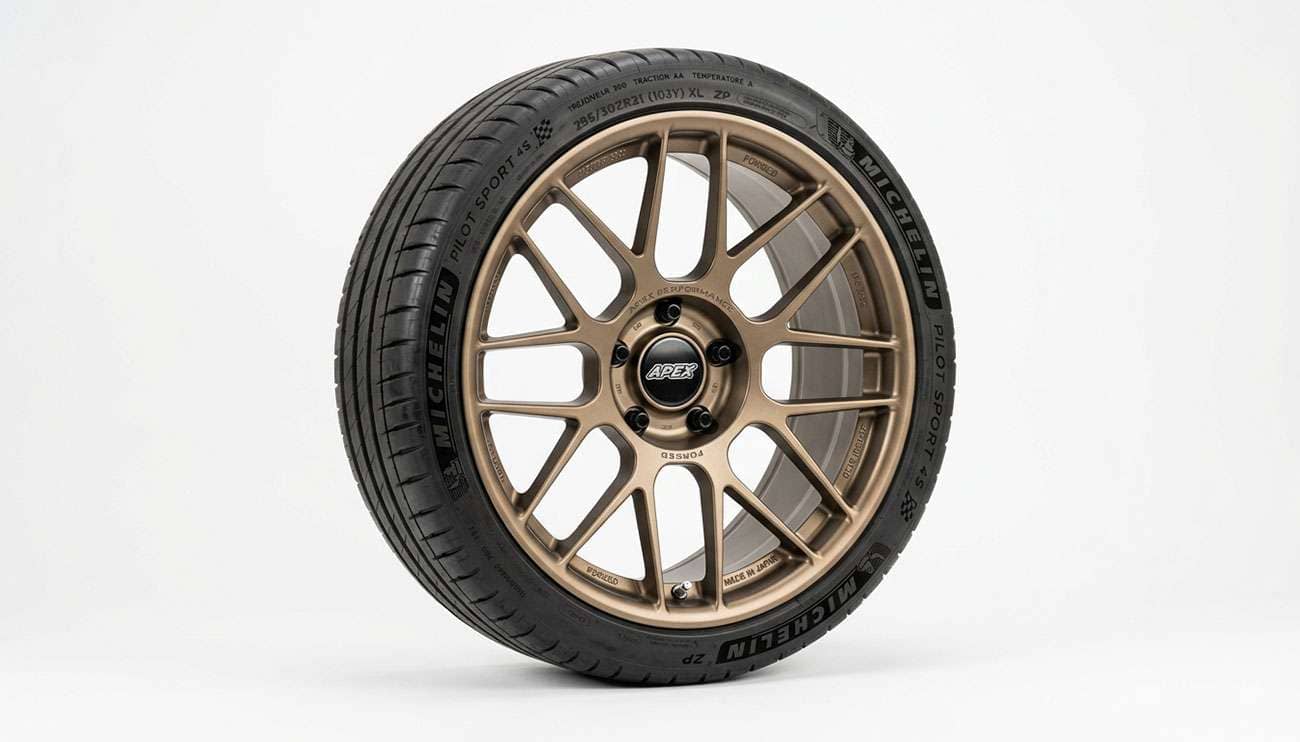
Spend any time around performance cars and you'll hear it stated as gospel: shave a pound of unsprung weight and it's worth ten, or twenty, or even thirty pounds anywhere else on the car. It's one of those numbers that gets repeated so often nobody stops to ask where it came from. As someone who matches wheels to vehicles by the numbers all day, I want to give you the honest version: what unsprung weight really is, the physics of why it matters, and exactly where the folklore stops holding up. The short answer is yes, it matters, but probably not the way you've been told.
Picture your car split into two halves at the suspension springs. Everything the springs hold up is sprung weight: the chassis, body, engine, transmission, fuel, seats, and you. Everything below the springs, the mass that hangs off the suspension and follows the road directly, is unsprung weight. That's your wheels, tires, brake rotors and calipers, wheel hubs and bearings, and roughly half of the suspension arms and axle components, the portion that moves with the wheel rather than the body.
The concept isn't new. The term unsprung mass traces back to a mathematician named Albert Healey at the Dunlop tire company, who laid it out in a 1924 lecture titled "The Tyre as a Part of the Suspension System." A century later, engineers are still chasing the same goal he identified: control the mass that follows the road, and you control how the car rides and grips. Here's how the major components sort out.
Component |
Category |
Notes |
|---|---|---|
Wheels and tires |
Unsprung |
The biggest lever a normal owner can actually change |
Brake rotors and calipers |
Unsprung |
Reduced with lightweight or carbon-ceramic setups |
Hubs, bearings, knuckles |
Unsprung |
Move directly with the wheel |
Control arms, axle, springs |
Partially sprung |
Roughly half counts as unsprung; the rest as sprung |
Chassis, body, engine |
Sprung |
Held up by the springs; cushioned from road impacts |
Passengers and cargo |
Sprung |
Adds mass but is isolated from road shock |
Here's the part the rule-of-thumb numbers skip, and it's the part that actually matters. Sprung weight is cushioned. When the body of the car hits a bump, the springs and shocks absorb the impact before it reaches you, which is the whole point of a suspension. Unsprung weight gets no such protection. It's connected straight to the road and has to track every dip, ridge, and pothole in real time.
Now bring in inertia. A heavier object resists changes in motion more strongly. When a heavy wheel hits a bump, its own mass makes it want to keep going up, and then keep going down, overshooting the road surface. The suspension has to fight that inertia to keep the tire pressed against the pavement. If the wheel is too heavy and the bump comes too fast, the suspension can't react quickly enough and the tire momentarily loses full contact with the road. Less contact means less grip, and grip is everything: braking, cornering, traction, and stability all depend on the tire staying planted.
Lighten the unsprung mass and the opposite happens. The wheel has less inertia to overcome, so the suspension can keep it glued to the road through bumps and corners. The payoff is better grip, a more controlled ride, sharper response, and a tire that does its job more consistently. This is why reducing unsprung weight punches above its weight class compared to removing the same mass from the body, and why it shows up in our guide on how tires affect car handling and the deeper look at why lightweight wheels matter.
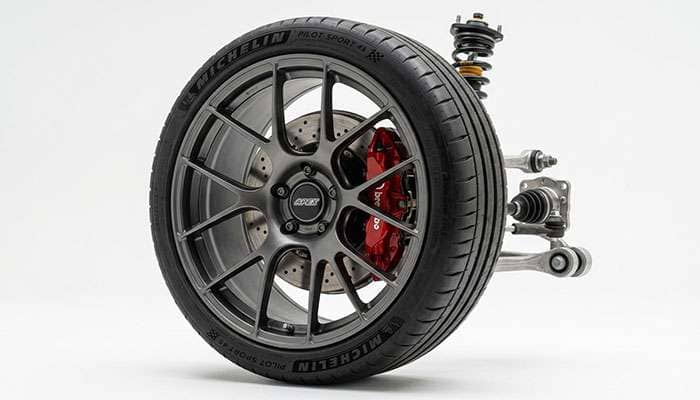
Wheels and tires carry a second penalty that the rest of the unsprung components don't: they spin. Mass that rotates has to be accelerated twice, once linearly as the whole car speeds up, and once rotationally as the wheel spins faster. That rotational inertia is concentrated at the outer edge of the assembly, the rim and the tire, where it has the most leverage.
The practical upshot is that weight removed from the rim and tire helps acceleration and braking a little more than the same weight removed from a non-rotating part. It's a real effect, though a modest one, and it's part of why a lighter wheel feels more eager off the line and pulls down more quickly under braking. It's also why dropping to a smaller-diameter wheel with a taller tire sidewall sometimes nets a handling and ride benefit even when total weight barely changes, because the heavy material moves inward. Our piece on how much wheel weight affects performance puts real test numbers to this.
Now to the claim that started this article. You'll see it everywhere: one pound of unsprung weight equals ten, or fifteen, or even thirty pounds of sprung weight. Let me be precise, because this is where the internet does you a disservice. Those specific multipliers are not backed by any consistent engineering measurement. They're folklore that hardened into "fact" through repetition.
What is true, and what the inflated numbers are clumsily pointing at, is the direction: a pound removed from unsprung mass produces a more noticeable improvement in ride and handling than a pound removed from sprung mass. That's real and well established. But there is no clean, universal conversion factor, because the actual benefit depends on the car's suspension design, spring and damper rates, the speed you're driving, and the roughness of the road. A figure like three to four times the felt effect gets cited more responsibly than thirty, but even that is a rough characterization, not a law. The honest takeaway: treat the concept as real and the exact multiplier as marketing. Reduce unsprung weight because the mechanism is sound, not because a spec sheet promised you a 30-to-1 trade.
So does it actually matter for you? That depends entirely on the car and how you drive it. On a track car or a serious performance build, unsprung weight reduction is absolutely worth chasing, because at the limit, every bit of improved tire contact translates to measurable lap time and braking distance. This is exactly why manufacturers offer expensive carbon-fiber wheels on cars like the Corvette Z06, where an optional carbon wheel set can cut around 40 pounds of unsprung mass, a genuinely significant reduction.
For a daily driver, the gains are real but smaller, and you need to keep them in proportion. An engineer will tell you the goal isn't to obsess over a couple of pounds per corner; it's to keep the ratio of unsprung to sprung mass sensible. In the real world, tire choice and tire stiffness often have a more noticeable effect on ride and handling than shaving a pound or two off each rim. Going from a heavy steel wheel to a quality lightweight alloy will be felt. Agonizing over half a pound between two similar alloys generally won't. And there's a flip side worth knowing: in some off-road and rock-crawling situations, a bit more unsprung mass can actually steady the ride at low speed, so lighter isn't universally better. Context decides.
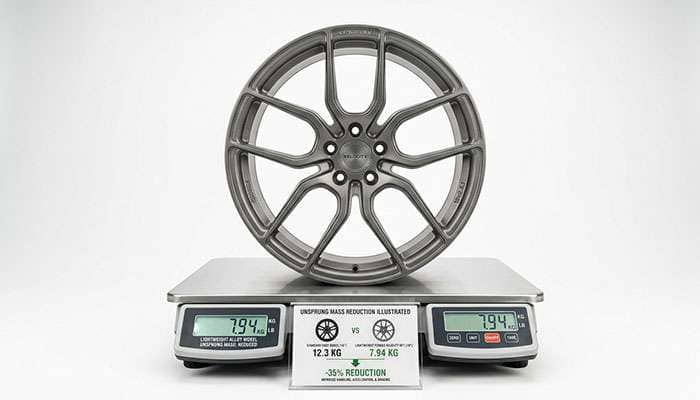
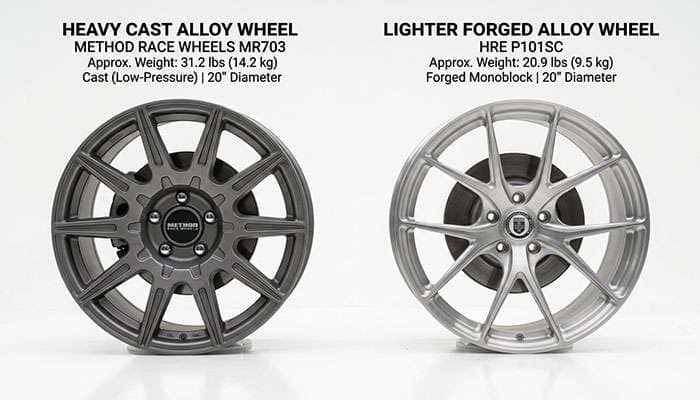
If you've decided it's worth pursuing, the order of operations matters because some changes give far more return than others. Wheels are the biggest lever the average owner controls. Many factory cast wheels are surprisingly heavy, and moving to a quality forged or flow-formed wheel can drop meaningful weight at each corner while adding strength. The difference between manufacturing methods is exactly why our guide on cast versus forged versus flow-formed wheels is worth reading before you buy, along with the rundown of the most popular forged wheel brands and the explainer on the different types of forged wheels. You can browse the lightweight options directly in our forged wheels selection.
Tires are the next lever, and an underrated one. Tire weight varies a lot between models and constructions, and a lighter tire reduces both unsprung and rotational mass at the same time. Beyond that, lightweight or carbon-ceramic brake components shed unsprung weight too, though at a steep price that only makes sense on serious builds. One caution from the fitment side: don't reduce unsprung weight by sacrificing strength. A wheel that's too light for your vehicle's load or your driving is a safety problem, not an upgrade. Match the wheel to the car. Our honest take on whether forged wheels are any good covers that balance, and torsional rigidity in wheel design explains why strength and weight have to be considered together.
Here's my straight answer as someone who sells wheels but would rather you buy the right ones. If you have a performance car, drive it hard, or care about how it responds on a back road or a track, reducing unsprung weight through quality lightweight wheels is one of the better-value handling upgrades you can make, and you'll feel it. If you drive a comfortable daily commuter on smooth roads and never push it, the handling gain from a couple of pounds per corner will be subtle, and you'd be buying the wheels mostly for looks, durability, and the modest acceleration and braking benefit, which is a perfectly fine reason on its own.
What you should not do is overpay chasing an exotic weight savings the inflated multipliers promised, or let a salesman talk you into the lightest possible wheel regardless of strength. The smart move is a quality forged or flow-formed wheel correctly sized for your vehicle, which gets you most of the available benefit without the diminishing returns. Our honest guide on whether performance wheels are worth it and the overview of what performance wheels are will help you decide, and if mileage is a concern, whether rims affect gas mileage addresses that too.
Does unsprung weight actually matter? Yes, the physics is sound: lighter mass below the springs lets your suspension keep the tires planted, which improves grip, ride, braking, and response. But the famous one-to-ten or one-to-thirty conversions are folklore, not measurement. Treat unsprung weight reduction as a real and worthwhile goal pursued with realistic expectations: meaningful on a performance car, subtle on a smooth-riding daily, and always best achieved with a quality lightweight wheel that's correctly matched to your vehicle. Understand the mechanism, ignore the magic numbers, and you'll spend your money where it does the most good.
Sprung weight is everything supported by the suspension springs, such as the chassis, body, engine, and passengers, all of which are cushioned from road impacts. Unsprung weight is the mass below the springs that follows the road directly, including the wheels, tires, brakes, hubs, and roughly half of the suspension arms and axle components.
No, not as a precise figure. The specific multipliers you'll see, whether 10, 15, or 30 to 1, are not backed by consistent engineering measurement and are essentially folklore. What is true is the direction: removing a pound of unsprung weight improves ride and handling more noticeably than removing a pound of sprung weight. The exact benefit depends on the suspension, speed, and road, so there's no universal conversion.
Lighter unsprung components have less inertia, so they react faster to bumps and dips. That lets the suspension keep the tire pressed against the road instead of letting a heavy wheel bounce and lose contact. More consistent tire contact means more grip for braking, cornering, and traction, plus a more controlled ride and sharper response.
Wheels are the biggest lever for most owners, since many factory cast wheels are heavy and switching to a quality forged or flow-formed wheel sheds meaningful weight while keeping strength. Lighter tires help too, reducing both unsprung and rotational mass. Lightweight brake components are an option on serious builds. Just never sacrifice the strength your vehicle needs for the sake of lightness.
It matters, but the effect is subtler than on a performance car. On a smooth-riding daily driver you'll notice the difference moving from heavy steel wheels to quality lightweight alloys, but fussing over half a pound between similar alloys generally isn't worth it. Tire choice and tire stiffness often have a bigger real-world impact on ride and handling than a small change in wheel weight.