
Heavy wheels slowed test vehicles by 0.31 seconds on average laps and added nearly half a second to 0-60 times in controlled testing. This striking performance difference shows exactly why lightweight wheels deliver more impact than most drivers expect.
The physics behind wheel weight creates measurable advantages. Unsprung weight from wheels requires roughly three times the power to accelerate compared to stationary weight. When you drop 15 pounds per wheel, you effectively remove around 180 pounds of unsprung weight from your vehicle. Carbon fiber options push this further, reducing wheel weight by up to 40% compared to die-cast aluminum alternatives.
Performance gains extend well beyond acceleration numbers. Lightweight alloy wheels typically weigh 40-50% less than steel counterparts, creating dramatic improvements in handling response and braking distance. They also provide better heat dissipation, which enhances braking performance and reduces brake failure risk. Whether you're hitting the track or driving daily, lightweight wheels represent one of the most effective upgrades you can make.
We'll break down the science behind wheel weight, share real-world testing data, explore different manufacturing methods, and help you select the right lightweight wheels for your specific vehicle and driving needs.
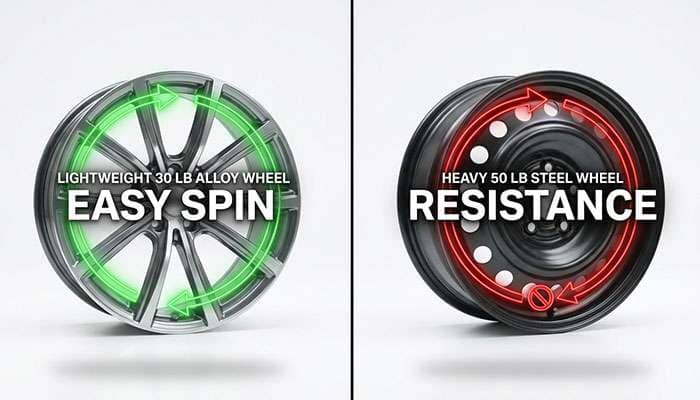
Understanding the physics behind lightweight wheels is crucial for making informed decisions about performance upgrades. The effectiveness of lightweight wheels comes from two fundamental engineering concepts that directly impact how your vehicle performs.
Your vehicle's weight breaks down into two categories that affect performance very differently. Sprung weight includes everything your suspension supports—the engine, body, interior, and passengers. Unsprung weight covers components that aren't cushioned by suspension—wheels, tires, brakes, and parts of your suspension assembly.
This distinction creates significant performance differences. Each pound of unsprung weight impacts acceleration and handling far more than sprung weight. At the drag strip, adding just one pound of unsprung weight affects times like adding two or more pounds of sprung weight. Your suspension must work much harder to control heavier unsprung components when hitting bumps or navigating corners.
Wheels present a double challenge because they're both unsprung and rotating components. Rotational inertia determines how much energy your engine needs to start and stop wheel rotation. This resistance to changes in rotational velocity becomes critical during acceleration and braking.
Weight distribution within the wheel matters enormously. Two wheels weighing exactly the same can deliver completely different performance depending on where that weight sits. A wheel with weight concentrated near the hub creates much less rotational inertia than one with weight at the outer rim.
The physics principle is straightforward: rotational inertia increases with the square of the radius from the rotation axis. Weight at the wheel's outer edge hurts performance disproportionately more than weight near the center.
Real-world testing proves these physics principles work. BMW testing with lightweight 17-pound wheels showed faster lap times and noticeably sharper steering response compared to heavier alternatives. The performance difference goes beyond just numbers.
Test drivers described the heavy-wheeled car as feeling "heavy and lethargic," with reduced feedback that made it harder to control at the limit. At racing speeds of 150 mph, wheels spin approximately 33 times per second, amplifying every ounce of excess weight.
Consider hitting a bump with 30-pound wheels versus 50-pound wheels. The lighter setup creates 60 pounds of force for your suspension to manage, while the heavier wheels generate 100 pounds of punishing impact—dramatically affecting ride comfort and component longevity.
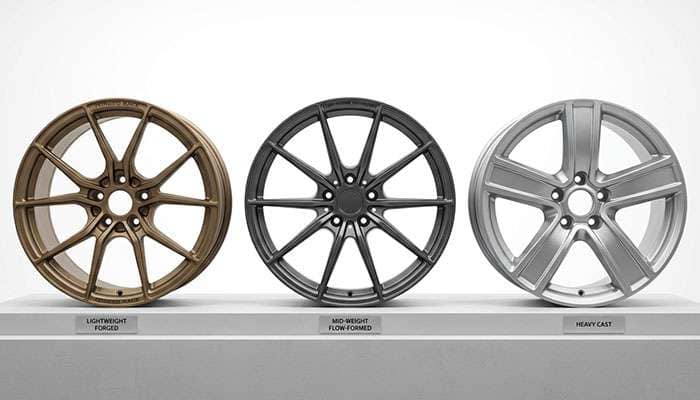
Testing confirms what physics predicts: lightweight wheels deliver measurable performance benefits across multiple metrics. Real track data shows exactly what happens when you swap heavy wheels for lightweight alternatives.
Jonathan Benson's BMW M3 tests revealed dramatic differences between wheel weights. Using identical tires across three setups, the results were clear: 20-pound wheels delivered a 99.13-second lap time, 38-pound wheels clocked 99.92 seconds, and 52-pound wheels required 100.74 seconds. This 1.61-second gap between lightest and heaviest wheels represents a massive advantage in racing.
The same BMW testing showed consistent patterns in acceleration. The 20-pound wheels accelerated from 31-87 mph in 5.76 seconds, while 38-pound wheels required 5.93 seconds, and 52-pound wheels needed 6.07 seconds. While 0.31 seconds might seem small during daily driving, performance enthusiasts understand this difference matters.
Benson's most revealing experiment replaced wheel weight with static ballast. When he installed 20-pound wheels but added 130 pounds of interior ballast (matching the heavier wheels' total weight), acceleration time was 5.88 seconds. This result falls between the lightest and heaviest wheel times, proving that rotating mass hurts performance more than equivalent static weight.
Beyond the numbers, subjective experience varied dramatically. Expert drivers reported the car with lightweight wheels "wants to dance with you," providing clearer steering feedback and better front-axle communication. Heavy wheels made the same car feel "heavy and lethargic" with noticeably reduced feedback. Even amateur drivers describe lightweight wheels as making their car feel "more nimble and responsive" before they see any timing data.
Manufacturing methods determine how much weight you can save and what you'll pay for performance gains. Understanding wheel construction helps you choose the right option for your vehicle and budget.
Cast wheels use molten aluminum poured into molds - the most common and affordable manufacturing method. Forged wheels start differently. Solid aluminum billets get compressed under massive pressure (up to 13,000 tons), aligning the metal's grain structure for exceptional strength while using less material.
The forging process creates wheels that are typically 25-40% lighter than cast alternatives. More importantly, this weight reduction comes with dramatically increased strength - forged wheels can handle impacts and stresses that would crack cast wheels.
Flow forming offers a hybrid approach between casting and forging. The process starts with a cast wheel center, then spins the wheel while pressure rollers stretch and compress the barrel section. This creates a stronger molecular structure in the barrel area.
Flow formed wheels deliver 15-25% weight reduction over traditional cast wheels at a more accessible price point. For most drivers seeking performance improvements without premium pricing, flow formed wheels provide excellent value.
Magnesium wheels push weight savings further - approximately 33% lighter than aluminum equivalents. However, they cost significantly more and require special care to prevent corrosion.
Carbon fiber wheels represent the ultimate in weight reduction. They can reduce wheel weight by 40-50% compared to aluminum while offering exceptional stiffness. Ford's GT500 carbon wheels, for example, shed 60 pounds of unsprung weight versus aluminum alternatives.
Forged wheels consistently deliver the best strength-to-weight ratio. The compression process creates a denser, more uniform grain structure that resists bending, cracking, and deformation. This superior strength allows manufacturers to remove material without compromising structural integrity.
The result? Forged wheels typically achieve 25-40% weight reduction while offering up to 300% greater strength than cast wheels. For performance driving or track use, this combination of light weight and high strength makes forged wheels the top choice.
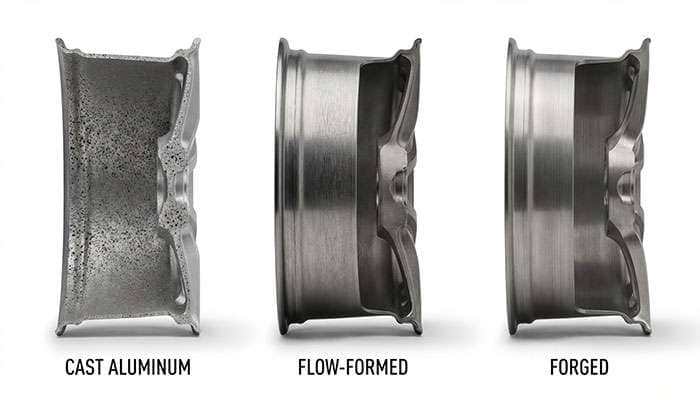
Selecting wheels that balance weight, strength, and cost comes down to understanding your specific driving needs and vehicle requirements.
Flow-formed wheels offer the best blend of weight reduction and durability for street use. Options like APEX Flow Formed Classic Line provide significant weight savings (typically 15-20% lighter than stock) while maintaining strength for daily abuse. Konig and Enkei flow-formed options weigh approximately 19-20 pounds in 18×9.5 sizing.
For competitive driving, forged wheels deliver maximum weight reduction. APEX Forged Sprint Line wheels weigh just 18 pounds yet maintain a 1600-pound load rating. For ultimate performance, Litespeed Racing's magnesium monoblock wheels start at 15 pounds for 19-inch applications.
These common bolt patterns often cause compatibility questions. Although close (only 2mm difference), directly mounting 5×114.3 wheels on 5×112 hubs (or vice versa) isn't recommended for safety reasons. Solutions include proper re-drilling or specialized "wobble nuts" for temporary fitment.
Quality lightweight wheels often exceed load ratings of heavier options. APEX's forged wheels achieve 1600-pound ratings while their flow-formed wheels manage 1550 pounds. Method's 305 NV cast aluminum wheels maintain 2500-pound ratings.
Electric vehicles benefit tremendously from lightweight wheels. Tesla-specific options like Unplugged Performance UP-04 wheels save crucial unsprung mass - 19" applications start at 19 pounds. For trucks, manufacturers like Method offer specialized lightweight designs with reinforced inner lips and higher load capacities.
Consider overall performance gains versus cost. Forged wheels typically cost 30-50% more than cast alternatives but deliver 25-40% weight reduction. The performance advantages—faster acceleration, improved handling, and enhanced driver feedback—often justify the investment for enthusiasts.
Lightweight wheels represent one of the most effective performance upgrades you can make to any vehicle. The physics principles we've covered explain exactly why these wheels create such noticeable improvements - unsprung weight affects your vehicle's performance far more than regular weight.
The testing data confirms what theory predicts: lighter wheels deliver measurable lap time improvements and faster acceleration. More importantly, drivers consistently report sharper steering response, better feedback, and a more connected driving experience. These benefits extend to everyday driving, where lighter wheels enhance ride quality by reducing the forces your suspension must handle over rough surfaces.
Your manufacturing choice determines the balance between weight savings, strength, and cost. Flow-formed wheels offer excellent value for daily drivers, while forged options deliver maximum performance for track use. Premium lightweight wheels require a larger initial investment, but the performance gains make them worthwhile for enthusiasts who value driving dynamics.
We carry lightweight wheel options for sports cars, electric vehicles, and pickup trucks. Whether you're looking for track performance or daily driving improvements, the right lightweight wheels can transform how your vehicle drives, handles, and responds to your inputs.
Ready to upgrade your vehicle's performance? Contact our expert team to find the perfect lightweight wheels for your specific needs and driving style. We'll help you select wheels that deliver the performance gains you're looking for at a price that fits your budget.
Understanding the science behind lightweight wheels reveals why they're among the most impactful performance upgrades you can make for any vehicle.
• Unsprung weight matters 3x more: Each pound of wheel weight affects performance like 2-3 pounds of regular vehicle weight due to physics principles.
• Real testing shows measurable gains: Lightweight wheels improved lap times by 1.61 seconds and reduced 0-60 times by 0.31 seconds in controlled BMW testing.
• Forged wheels deliver maximum benefits: Manufacturing method matters - forged wheels are 25-40% lighter and 300% stronger than cast alternatives.
• Choose based on your driving needs: Flow-formed wheels offer the best value for daily driving, while forged options maximize track performance.
• Investment pays off in driving experience: Beyond raw numbers, drivers consistently report sharper steering response and better vehicle feedback with lightweight wheels.
The performance difference isn't just theoretical - it's measurable and noticeable. Whether you're chasing lap times or simply want a more responsive daily driver, lightweight wheels fundamentally transform how your vehicle accelerates, handles, and communicates with you through the steering wheel.
Lightweight wheels can provide noticeable performance gains. In controlled testing, vehicles with lighter wheels were 0.31 seconds faster on average laps and accelerated nearly half a second quicker from 0-60 mph. However, the overall impact depends on factors like riding style and terrain.
Yes, forged wheels are generally superior to cast wheels. They are typically 25-40% lighter while offering up to 300% greater strength. The forging process creates a denser, more uniform grain structure that better resists bending and cracking under stress.
For everyday use, flow-formed wheels offer a good balance of weight reduction and durability. Options like APEX Flow Formed Classic Line wheels can be 15-20% lighter than stock wheels while maintaining strength for daily driving conditions.
Lightweight wheels can benefit both racing and everyday driving, but the effects are more pronounced in competitive settings. In racing, even small weight reductions can improve acceleration, handling, and lap times. For daily driving, the benefits are subtler but can include improved fuel efficiency and ride comfort.
Carbon fiber wheels can offer significant weight savings, reducing wheel weight by up to 40-50% compared to aluminum alternatives. However, they are typically much more expensive. Whether they're worth the investment depends on your performance goals, budget, and intended use. For serious racers or performance enthusiasts, the benefits may justify the cost.