It depends on two numbers, and every article that told you "it varies" was refusing to name either one. The first is the leak rate. Losing 1 PSI a month is not a leak at all, it is physics. Losing 1 to 2 PSI a week is a small leak you have a week to deal with. Losing 3 PSI a day means local driving only. Losing 10 PSI an hour is not a slow leak. The second number is 25 percent below your placard pressure, and below that the rate stops mattering.
The reason the answer has to be given as two numbers rather than one is that a slow leak is not a single condition. It is a symptom with at least eight possible causes, and those causes range from a two dollar valve stem to a cracked wheel. Half of them are repairable and half of them are not. So this guide does two things: it tells you how far you can drive based on how fast you are losing air, and it tells you how to find out what is actually leaking, because that determines whether you are buying a patch or a wheel.
Measure it properly before you read this table. Check the tire cold, meaning the car has been parked at least three hours, with a real gauge rather than the one bolted to a gas station air hose. Write the number and the time down. Check it again 24 hours later, cold, without adding air. The difference between those two numbers is your leak rate, and it is the only thing that turns this question into an answerable one.
Loss Rate |
What It Actually Is |
Drive It? |
Check Pressure |
Action |
|---|---|---|---|---|
1 to 2 PSI per month |
Normal permeation. Not a leak |
Yes, normally |
Monthly |
Nothing. Top it up and carry on |
3 to 4 PSI after a cold snap |
Temperature, not a leak |
Yes, normally |
Reinflate to placard |
Nothing. It came back with the weather |
1 to 2 PSI per week |
A real but small leak |
Yes, short term |
Weekly |
Find the source within a week |
1 to 3 PSI per day |
Confirmed leak |
Local only, no highway |
Every morning, cold |
Shop this week. Do not road trip it |
5 to 10 PSI per day |
Active leak, getting worse |
Short hop only |
Before every single drive |
Shop today |
10 PSI per hour or faster |
This is not a slow leak |
No |
Not applicable |
Spare or tow. It will be flat before you arrive |
Any rate, tire more than 25 percent under placard |
Structural danger zone |
No, not at any speed |
Inflate to placard before moving |
If it will not hold pressure, spare or tow |
Any rate, sidewall damage visible |
Not a leak problem anymore |
No |
Not applicable |
Spare or tow. The tire is finished |
That last row is short because it is not really a slow leak question. If air is escaping through a sidewall, the cords are compromised and pressure is the least of your concerns. Our guide to tire sidewall damage and whether it is safe to drive covers why that tire comes off the car regardless of how slowly it is losing air.
Start here, because a meaningful share of the people searching this question do not have a leak at all. They have a tire behaving exactly as designed and a misunderstanding about what normal looks like.
Rubber is not airtight. It is air-resistant, which is a different specification. Air molecules migrate through the rubber compound and the inner liner continuously, driven by the pressure differential between the 35 PSI inside and the 14.7 PSI outside. A passenger tire in good condition loses roughly 1 PSI per month this way, and some lose closer to 2. Nothing is wrong with it. There is no hole. It is the tire doing what every tire has always done, and it is why the recommendation has always been to check your pressures monthly.
If you top a tire up once a month and it holds for a month, you do not have a leak. You have a tire. If you are topping it up every few days, you have a leak. That distinction is the first thing to establish, because it is the difference between doing nothing and going to a shop.
This is the other false alarm, and it produces a wave of them every autumn. Pressure in a sealed volume tracks temperature. The working figure is roughly 1 PSI for every 10 degrees Fahrenheit. So a tire set to 35 PSI on a 75 degree afternoon reads about 31 PSI on a 35 degree morning, and it has not lost a molecule of air. The first genuinely cold morning of the season lights up TPMS warnings across entire cities, and the overwhelming majority of those cars are fine.
This is also why "cold pressure" means what it means. Cold does not mean cold outside. It means the tire has not been driven, because driving heats the air inside and raises the reading. Check a tire after a highway run and you may see 4 to 6 PSI more than its true cold pressure, which is how people convince themselves a leaking tire is holding fine. Check it cold or the number is fiction.
Permeation and temperature affect all four tires roughly equally. A leak affects one. If one tire is consistently 5 PSI below the other three, that is not weather and it is not permeation. That is a leak, and the rest of this guide is for you.
There is a threshold that makes the leak rate irrelevant, and almost nobody writing about slow leaks mentions it.
Federal Motor Vehicle Safety Standard 138 requires that the tire pressure monitoring system on every passenger vehicle sold in the United States illuminate a warning when any tire drops 25 percent or more below the vehicle manufacturer's recommended cold inflation pressure. For a car with a 35 PSI placard, that trigger point is about 26 PSI. For a 44 PSI truck placard, it is 33 PSI.
Understand what that means, because the implication is not intuitive. The regulators did not pick 25 percent as an early warning. They picked it as the point at which a tire is meaningfully underinflated in a way that affects safety. The light is not telling you that a problem is developing. It is telling you that you are already at the threshold that federal safety engineers drew a line at.
Drivers treat the TPMS light as the moment the problem starts. It is closer to the moment the problem gets serious. A tire can be 20 percent underinflated, which is a real and consequential amount, and show you no light at all. By the time the dashboard speaks up, you have gone past the point where the tire is doing its job properly.
So the rule that overrides the rate table: if a tire is more than 25 percent below its placard pressure, it does not matter whether it took a month or an hour to get there. Do not drive it. Inflate it to the placard number first. If it will not hold long enough to reach a shop, put the spare on. Our guide to whether you can still drive with the TPMS light on goes deeper on what the system is and is not telling you.
And find the placard, do not guess. It is on the driver's door jamb, and the number on it is the vehicle manufacturer's specification for your car at its load rating. The number molded into the tire sidewall is the tire's maximum, which is a completely different figure and is not what you inflate to.
You cannot decide what to do until you know what is leaking. This takes ten minutes in a driveway and costs nothing, and it is the single most useful thing in this article.
Mix dish soap and water in a spray bottle. Heavy on the soap, roughly a 1 to 4 ratio, because you want it to foam rather than run off. Inflate the tire to its placard pressure first, or a few PSI above. Pressure is what pushes the air out through the leak, and a soft tire will hide a leak that a properly inflated one shows immediately.
Then spray, methodically, and watch for bubbles that grow. Not the foam you just sprayed on, which will look like bubbles everywhere for a few seconds. You are looking for a spot that keeps producing new bubbles after the foam settles, or a bubble that inflates into a dome. Work through these zones in order, and do not stop when you find one, because tires can have more than one leak:
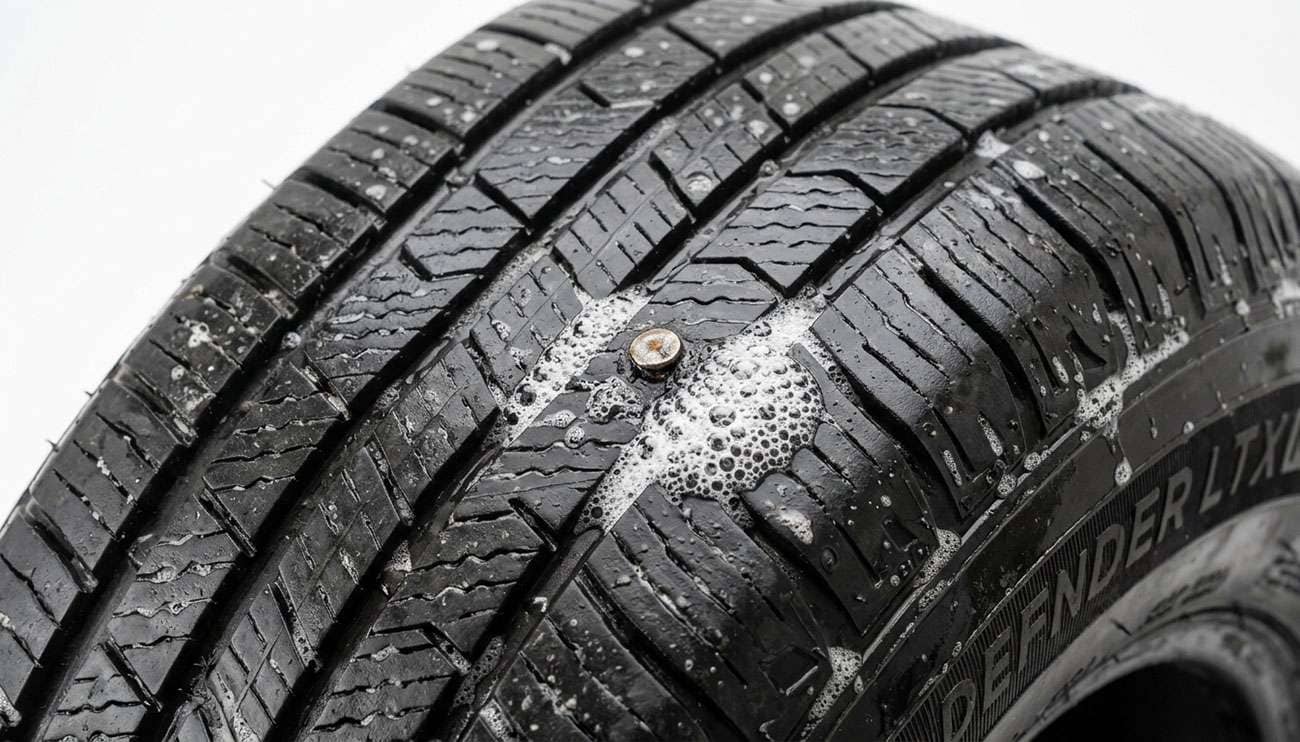
The tread face, looking especially for a nail or screw head you may not have noticed. The shoulder, where the tread curves into the sidewall. The entire sidewall, inside face as well as outside, which means turning the wheel to full lock. The valve stem, both at the tip with the cap off and at the base where it passes through the wheel. The bead, which is the seam where the tire meets the rim, all the way around on both the outside and the inside of the wheel. The wheel itself, across the spokes and around the barrel.
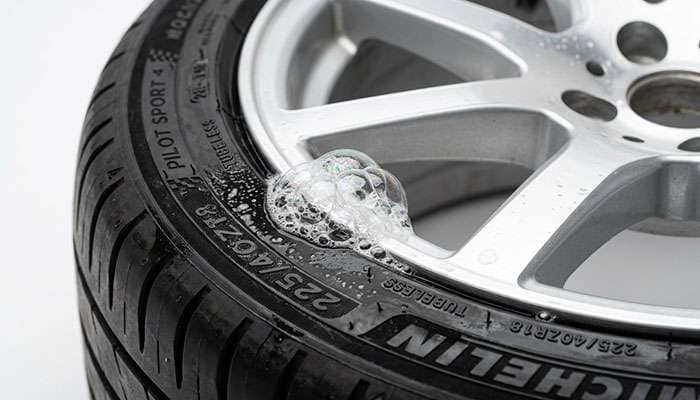
A leak you cannot find with soapy water is usually one of three things. It is at the bead on the inner face of the wheel, which is genuinely hard to see with the wheel on the car. It is the TPMS sensor seal, which sits inside the wheel at the valve hole. Or it is porosity in an aging tire, where air seeps through the carcass everywhere at once rather than escaping from a single point, which produces no bubbles anywhere and no fix.
All three of those need the wheel off the car and, in the first two cases, the tire dismounted. A shop will drop the whole wheel in a water tank, which finds anything the spray bottle missed in about fifteen seconds. If the driveway test comes up empty and the tire is definitively losing air, that tank is your next step.
Now that you know where the bubbles are, here is what it means. This is the table that decides whether this is a twenty dollar afternoon or a new wheel.
Where the Bubbles Are |
What It Is |
Repairable? |
What You End Up Buying |
|---|---|---|---|
Middle of the tread |
Puncture in the repairable crown area |
Yes, if under 1/4 inch |
A patch-plug repair |
Tread shoulder, near the edge |
Puncture outside the repairable zone |
No |
A tire |
Anywhere on the sidewall |
Sidewall puncture or cut |
Never |
A tire |
Tip of the valve stem |
Failed valve core |
Yes, easiest fix there is |
A valve core. Pennies |
Base of the valve stem |
Cracked or dry-rotted stem |
Yes, replace it |
A valve stem, tire dismounted |
Around the TPMS sensor |
Failed sensor grommet or seal |
Yes |
A TPMS service kit |
Along the rim edge, all the way around |
Bead seat corrosion |
Sometimes. Depends on pitting depth |
A cleanup and reseal, or a wheel |
From a spoke or the wheel barrel |
Cracked wheel, usually pothole impact |
Rarely, and not in a load path |
A wheel |
No bubbles anywhere, tire is old |
Carcass porosity from age |
No |
A tire |
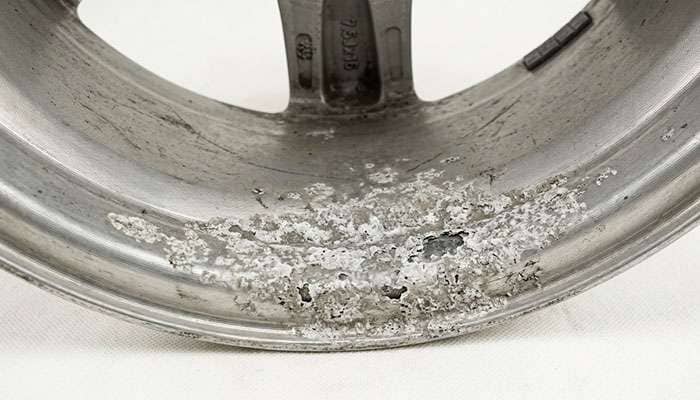
If your bubbles form a line along the rim edge, you have found the most common slow leak on any aluminum wheel more than a few years old, and it has nothing to do with your tire. Aluminum oxidizes. On the bead seat, the flat machined ledge where the tire's bead presses against the wheel to form the air seal, that oxidation grows as a white chalky crust that lifts the bead off the sealing surface just enough to let air past. Road salt accelerates it dramatically, which is why this is close to a seasonal certainty in the rust belt and comparatively rare in the southwest.
The fix is to dismount the tire, media blast or wire wheel the bead seat back to clean bare aluminum, and remount with sealer. That works, and it lasts, provided the corrosion has not pitted the seat. If it has, there is no flat surface left for the bead to seal against and no amount of sealer changes that. The wheel is done. The reason this catches people out is that the tire is perfectly fine, has plenty of tread, and is not the problem at all. You can see it alongside the other ways wheels fail in our rundown of the most common wheel damage issues.
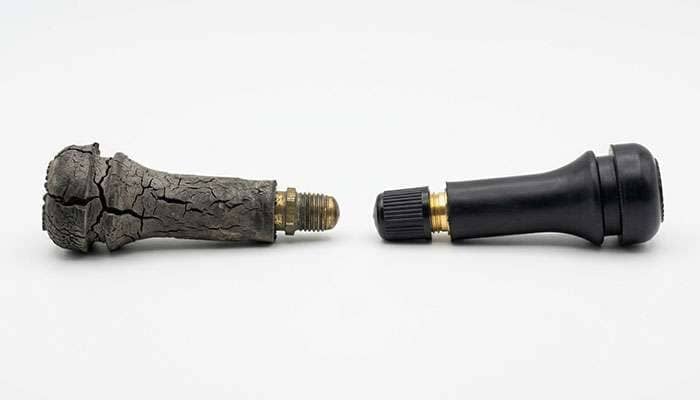
Rubber snap-in valve stems age. They dry out, they crack at the base where they flex against the wheel, and they start seeping. They are the cheapest possible answer to this question and they are routinely overlooked because people assume a leak means a puncture. Take the cap off and put soapy water on the tip first. A leaking valve core is a thirty second repair with a tool that costs about five dollars. It is worth ruling out before anything else, and our note on checking your valve stems explains why they should be replaced with every new tire rather than reused.
The reason a slow leak is not just an inconvenience is that driving a tire underinflated damages it permanently, and the damage does not reverse when you put the air back.
A tire carries the vehicle on its air, not its rubber. Underinflate it and the sidewall deflects further with every rotation because there is less air column supporting the load. That extra deflection is mechanical work, and mechanical work in rubber becomes heat. The tire runs hotter, and it runs hotter continuously, at roughly 800 rotations per mile.
Heat is what separates the tread from the belts. The adhesion between the rubber and the steel belt package degrades with sustained elevated temperature, and once that bond starts to fail the tread can separate from the carcass at speed. This is why underinflation is one of the leading contributors to tire failure that NHTSA identifies, and why the agency pushed for TPMS to be mandatory in the first place. The failure does not happen in the driveway. It happens on a hot highway at 70 mph, which is the exact condition that generates the most heat.
Here is what makes this worse than it sounds. The heat damage accumulates. Every mile driven at 25 percent under adds to it, and it never gets undone by reinflating. A tire that spent three weeks getting topped up every couple of days and driven low in between has taken damage you cannot see from the outside. The tread looks fine. The sidewall looks fine. The internal bond has been cooked.
That is the honest reason the answer to "can I just keep adding air" is no. You are not maintaining the tire. You are running down a clock on it, and the clock is invisible.
Chronic underinflation wears the two shoulders of the tread faster than the center, because the underinflated tire's contact patch loads the edges and lifts the middle. If you look at a tire that has been running low for months you will see the outer and inner ribs worn noticeably more than the middle ribs. That pattern is your evidence that the tire has been low far longer than you thought, which is worth knowing before you spend money repairing it. Measure the tread depth at the shoulders and at the center and compare. If the shoulders are meaningfully lower, this leak is not new, and the repair decision becomes a replacement decision.
If the source is a tread puncture, usually yes, but the rules are narrower than most drivers realize and narrower than some shops will admit.
The industry standard, from the Tire Industry Association and the tire manufacturers, limits repairs to the crown area, which is the central portion of the tread. Punctures in the shoulder or the sidewall are not repairable, full stop, because those areas flex too much for any repair to survive. The puncture also has to be no larger than 1/4 inch in diameter. Beyond that the structural damage to the belts is too great.
There is a further rule people rarely hear: repairs cannot overlap. If the tire already has a repair and the new puncture is close to it, or if it has too many repairs already, the tire is done regardless of where the new hole is.
The correct repair is a combination patch-plug, installed from inside the tire with the tire dismounted from the wheel. The plug fills the injury channel so moisture cannot reach the steel belts and rust them, and the patch seals the inner liner. Both halves matter. A string plug jammed in from the outside without dismounting the tire does not seal the liner and does not stop water getting to the belts, which is why it is a roadside measure rather than a repair. It is also why a shop that will not do it your way is often the shop that is right. Our guides on choosing between a tire plug and a patch and why a shop will not patch your tire lay out exactly where those lines are drawn.
Leave it in until you get to the shop. The nail is currently doing a partial job of sealing the hole it made, and pulling it out in the driveway converts a slow leak into a fast one. Note where it is, note whether it is in the crown or the shoulder, and drive per the rate table. Our piece on whether you can still drive with a nail in your tire covers that specific case in detail.
Cold pressure now, with a real gauge. Compare it to the placard on the door jamb, not to the sidewall maximum and not to what you remember. Calculate the percentage below placard. If it is more than 25 percent under, you are not driving it until it is inflated, and if it will not hold, you are on the spare.
Inflate to placard. Note the time. Check again 24 hours later, cold, without adding air. That single number puts you in a row of the table at the top of this page and turns a vague worry into a decision. Do not skip this because it feels slow. It is the difference between knowing and guessing.
If all four are down by a similar amount, you probably do not have a leak at all. You have permeation, a cold snap, or a car that has not seen an air hose in six months. One tire low and three fine is a leak.
Ten minutes, properly inflated, all six zones. Find out whether you are looking at a valve core or a cracked wheel, because those are the same symptom with a hundredfold difference in cost.
Aerosol tire sealant is an emergency product for getting off a shoulder, not a repair. It coats the inside of the tire, it fouls the TPMS sensor, and many shops will charge you extra to clean it out or simply decline the repair. If you have any option other than sealant, take it. If your plan is to seal it and forget it, understand you have likely converted a repairable puncture into a tire you are replacing plus a sensor you are replacing.
Adding air twice a week is not maintenance. It is a subscription to a problem that is quietly cooking your tire every mile in between top-ups. If the diagnosis is a wheel rather than a tire, deal with the wheel. If the tire has been running low for weeks or the shoulders are worn from it, replace it and shop tires at Performance Plus Tire by size and load rating rather than repairing something that has already taken heat damage you cannot see.
The reason nobody gives you a number is that there are two numbers, and both are easy to measure and neither takes any expertise. Rate first: 1 PSI a month is a tire, 1 PSI a week is a small leak, 3 PSI a day is local driving only, 10 PSI an hour is a tow. Then the override: more than 25 percent below the door jamb placard and none of the rest applies, because that is the threshold federal safety engineers picked for a reason.
Then find out what is leaking, because a slow leak is a symptom, not a diagnosis. A spray bottle of soapy water and ten minutes tells you whether you are buying a five dollar valve core, a patch-plug, a bead reseal, or a wheel. Those are wildly different outcomes and the only thing standing between you and knowing which one you have is a driveway test that costs nothing.
The thing worth taking away is the part that does not show. Every mile driven meaningfully underinflated puts heat into the tire and degrades the bond between the tread and the belts, and reinflating does not undo it. Topping it up and carrying on feels like managing the problem. It is not. It is running a clock you cannot see.
It depends on the rate. Losing 1 to 2 PSI per week means you can drive normally short term but should find the source within a week. Losing 1 to 3 PSI per day means local driving only, checking pressure cold every morning, and no highway. Losing 5 to 10 PSI per day means short hops only with a pressure check before every drive, and a shop today. Losing 10 PSI per hour is not a slow leak and needs a spare or a tow. Overriding all of that: if the tire is more than 25 percent below the placard pressure on the door jamb, do not drive it at any rate.
Yes. Rubber is air-resistant rather than airtight, and air migrates through the tire's compound and inner liner continuously because of the pressure difference between the inside and outside. A healthy passenger tire loses roughly 1 to 2 PSI per month to this permeation, which is why monthly pressure checks are the standard recommendation. Temperature adds to the confusion, moving pressure about 1 PSI for every 10 degrees Fahrenheit. Both effects hit all four tires roughly equally. If one tire is consistently several PSI below the other three, that is a leak rather than normal behavior.
The three usual causes are a valve stem issue, bead seat corrosion, and age porosity. A valve core or a cracked, dry-rotted rubber stem leaks at the tip or the base and is cheap to fix. Bead corrosion is white chalky aluminum oxidation on the machined ledge where the tire seals to the wheel, which lifts the bead just enough to pass air, and it is very common on older aluminum wheels in salt states. Porosity in an aging tire lets air seep through the carcass everywhere at once rather than from one point, so it produces no bubbles and has no repair. A TPMS sensor seal can also leak from inside the wheel.
It depends entirely on the source. A puncture in the crown, meaning the central tread area, that is no larger than 1/4 inch can be repaired with a combination patch-plug installed from inside the dismounted tire. Punctures in the tread shoulder or anywhere on the sidewall are not repairable because those areas flex too much for a repair to survive. Valve stems, valve cores, and TPMS seals are all straightforward replacements. Bead corrosion can sometimes be fixed by dismounting the tire and cleaning the bead seat back to bare aluminum, but if the seat is pitted the wheel needs replacing. A cracked wheel is generally a replacement.
Mix dish soap and water heavily, roughly one part soap to four parts water, in a spray bottle. Inflate the tire to its placard pressure first, because pressure is what pushes air through the leak and a soft tire hides leaks a properly inflated one reveals. Spray the tread face, the shoulder, both sidewalls including the inner one, the valve stem at both the tip and the base, the bead seam all the way around on both sides of the wheel, and the wheel spokes and barrel. Look for bubbles that keep growing after the initial foam settles. If you find nothing and the tire is definitely losing air, a shop can submerge the whole wheel in a water tank.
No, and the reason is that the damage happens between the top-ups rather than at the moment the tire is lowest. An underinflated tire flexes more in the sidewall on every rotation, that flexing generates heat, and sustained heat degrades the bond holding the tread to the steel belts. That degradation is cumulative and reinflating does not reverse it. A tire that has spent weeks being topped up every few days and driven low in between has taken internal damage you cannot see from the outside, while the tread and sidewall still look perfectly normal. Adding air manages the symptom while the tire itself is being consumed.