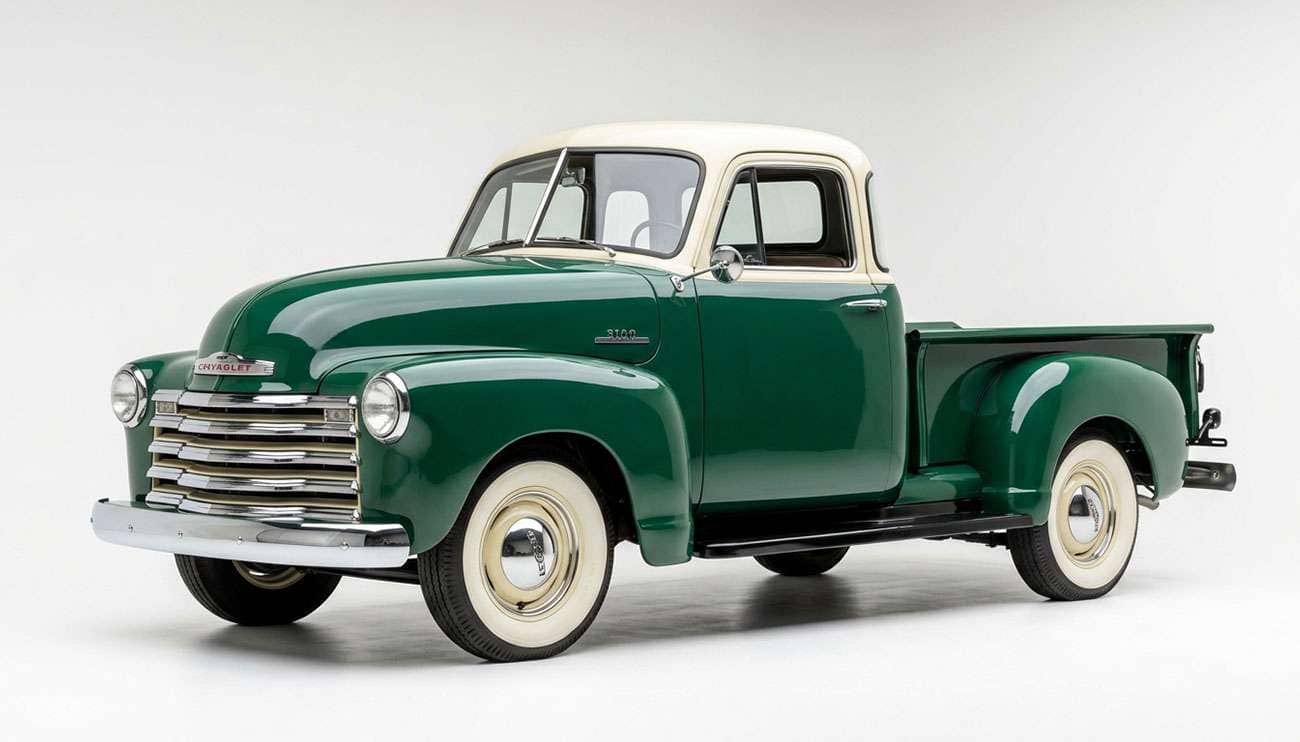
Every 1947-55 first-series Chevy 3100 left the factory on six-lug, 6x5.5 wheels, 16 inches in diameter and 4 to 4-1/2 inches wide, wearing 6.00-16 six-ply tires. You can keep that six-lug pattern or convert to the 5x4.75 Chevy car pattern, but you can't convert just one end: the front needs a disc brake kit or new hubs, and the rear needs a different axle. And on a stock front axle, the pattern isn't what decides whether a wheel fits. Backspacing is, because the long factory tie rod sits about 3/4 inch inside the original wheel.
I've been putting these trucks back on the road from our shop in Long Beach since 1971, and almost every Advance Design wheel question comes down to one of three paths. Pick yours first, and the rest of this guide falls into place.
Your Path |
Bolt Pattern |
What Has to Change |
Best For |
|---|---|---|---|
Keep it stock |
6x5.5 |
Nothing; wheels need about 4 inches of backspacing or less to clear the tie rod |
Original or period look, 16-inch wheels |
Six-lug disc brakes |
6x5.5 |
Front disc kit on the stock spindles; rear axle can stay |
Better brakes without changing wheels or the rear end |
Five-lug conversion |
5x4.75 |
Five-lug front disc kit plus a five-lug rear axle |
Rally, Torq Thrust, and most 15-, 17-, and 18-inch hot rod wheels |
IFS swap |
Usually 5x4.75 |
Front crossmember and suspension, plus a matching rear axle |
Lowered builds and bigger wheels |
A 3100 came on 16-inch, six-lug stamped steel wheels with six hubcap clips riveted to the face. Early trucks used a 16x4 wheel. Chevrolet widened it to 16x4-1/2 around mid-1951, and the wider wheel became the replacement part for earlier years too. Standard tires were 6.00-16 six-ply, with 6.50-16 six-ply as an option, and some service manuals list the 6.00 up front with 6.50s in the rear.
Item |
Factory Spec |
|---|---|
Bolt pattern |
6 on 5.5 in (6x139.7 mm) |
Lug thread |
7/16-20, right-hand on both sides |
Standard wheel |
16x4 early, 16x4-1/2 from about mid-1951 |
Standard tire |
6.00-16, 6-ply |
Optional tire |
6.50-16, 6-ply |
Optional 15-inch setup |
6.70-15 on a 15-inch wheel (regular production option) |
Hubcap mounting |
Six clips riveted to the wheel face |
Front suspension and brakes |
Straight axle, leaf springs, drum brakes |
Chevrolet also listed an optional 15-inch wheel with 6.70-15 tires. Exactly which years and which version of that wheel is still argued on the old truck forums, so if a 3100 shows up on 15s, don't assume they're wrong for the truck, and don't assume they're original either.
One more note on the "1955" in the name. Only the 1955 First Series is an Advance Design truck. The 1955 Second Series is the Task Force body, a different truck, and it isn't covered here.
A 1947-55 Chevy 3100 uses a 6 on 5.5-inch bolt pattern, also written 6x139.7 mm. That's the same circle Chevy and GMC half-ton trucks have used for decades, and our 6x5.5 bolt pattern guide lists the vehicles that share it. Matching numbers just mean the holes line up. They don't mean the wheel fits.
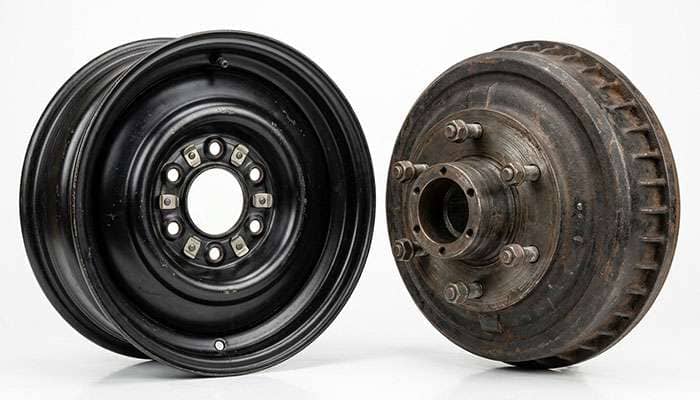
Original 3100 studs are 7/16-20, and they're right-hand thread on both sides of the truck. You'll hear that old trucks used left-hand nuts on the driver's side. Some did: period Chryslers, several Fords, and some GM cars ran them. On Chevy half-tons, owners report right-hand studs all the way around. If you find an "L" stamped on a stud, somebody swapped parts in from another vehicle.
Modern six-lug wheels are built for bigger studs, usually 14 mm or 1/2-inch. Your 7/16 studs will pass through the holes, but the nut has to match both the thread and the wheel's seat, or the wheel isn't really clamped. Our breakdown of lug nut seat types covers how to match them. Aluminum wheels also have thicker mounting pads than the stock steel ones, so check that you've still got full thread engagement.
Aftermarket truck wheels are almost all lug-centric on a 3100, so a center bore bigger than your hub is fine. A bore that's smaller than the raised center of your drum or axle flange is not. Test-fit one wheel flat against the drum before you mount tires.
Some will, and the deciding number is backspacing. The factory tie rod on these straight axles runs nearly the full width of the axle, and with stock wheels its end sits only about 3/4 inch from the inside of the wheel. A wider wheel with deeper backspacing moves its inner lip inboard, right into that tie rod. That's why mid-'60s and later four-wheel-drive Chevy truck wheels, same bolt pattern and all, hit the tie rod on an Advance Design truck.
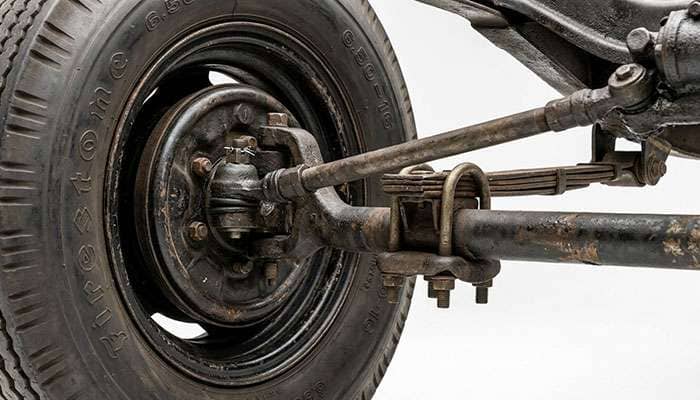
Owners running stock axles and hubs report that 15x7 and 15x8 wheels with about 4 inches of backspacing clear the tie rod, typically with 215/70R15s up front and 235/70R15s in back. Classic-style 15-inch six-lug wheels mostly sit right around that 4-inch mark, which is why they're the easy fit. Most 16x8 six-lug wheels sold today carry closer to 4.5 inches of backspacing, because they're designed for modern trucks, and that extra half inch is exactly where the tie rod lives.
If you're not sure how to read the number on a wheel you already own, our guide to measuring backspacing on classic rims walks you through it with a straightedge and a tape.
Don't take anybody's number on faith, mine included. With your current wheel on the truck and the front end straight, measure the gap between the tie rod end and the inside face of the wheel. Then measure the backspacing of that wheel. Any new wheel can add roughly that gap to the current backspacing before it touches, minus a little for suspension travel and wear. Do both sides; old axles and tie rods aren't always symmetrical.
Vintage truck suppliers sell later knuckle-style tie rod ends that sit about 3/8 inch shorter at the outer end than the original multi-piece ends. That's enough for a slightly wider wheel, not a modern 4x4 wheel. What not to do: stack flat washers between the wheel and the drum to space it out. That's a known way to break studs.
The tie rod isn't the only thing in the way. On these straight-axle trucks, fat car-style radials can rub the drag link and pitman arm joint at full left lock. Turn the wheel lock to lock with the truck on the ground before you call any setup finished.
Convert if you want 15-, 17-, or 18-inch hot rod wheels and you're already planning brakes and a rear axle. Stay six-lug if you want 16s, a period look, or a truck that keeps its original running gear. Either way, the decision is really a brake and axle decision, because a 3100 can't run five lugs on one end and six on the other without carrying two spares.
Bolt-on front disc kits for 1947-54 half-ton trucks mount to the stock drum-brake spindles and come in both patterns. The five-lug kits convert the front to the common GM 5 on 4-3/4 pattern, typically with 11-inch rotors. The six-lug kits keep 6x5.5, and at least one maker of a 12-inch six-lug kit notes that wheels of 15 inches or larger may be needed to clear the brake parts. Some kits also change the spindle and push the wheels out a little, so check track width and fender clearance with your actual wheels.
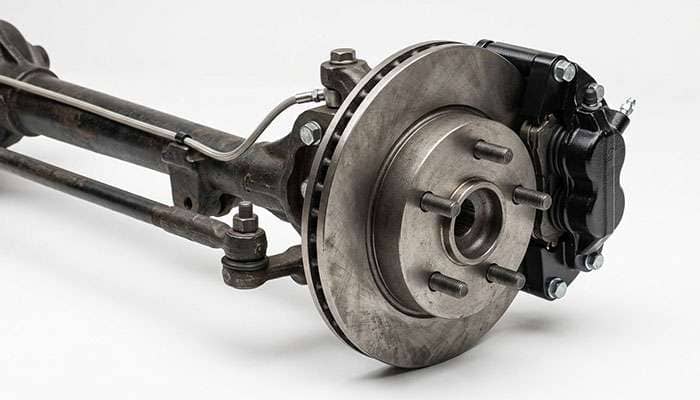
The factory rear is six-lug, and five-lug car axle shafts don't swap into it. So a five-lug conversion means a five-lug rear. The stock 1947-55 half-ton rear measures roughly 60 to 62 inches wide, and owners point to 1980s Camaro 10-bolt rears as close in width, cheap, and easy to find. Expect to deal with spring perches and, on torque-tube trucks, the driveline change. If you're new to the five-lug pattern, our 5x4.75 bolt pattern guide covers what shares it.
Independent front suspension kits built for these trucks replace the axle, the leaf springs, and the steering, and most builders order them with five-lug hubs to match a five-lug rear. An IFS front also gets rid of the long tie rod problem, but it changes the front track width and the wheel's relationship to the fenders. Pick backspacing for the kit you're installing, using the kit maker's wheel spec, not the numbers that worked on the old straight axle.
Six-to-five wheel adapters bolt on in an afternoon, and that's the appeal. But an adapter adds thickness, pushing the wheel outboard, which changes how the load sits on old wheel bearings and puts two sets of studs and nuts in series. On a 70-year-old straight axle, I'd rather see the brakes and axle done properly. Our look at wheel spacers and adapters covers where they make sense and where they don't.
Here's the part most swap advice skips. The five-lug conversion is sold as the way to get more wheel choices, and at 15, 17, and 18 inches, that's true. At 16 inches, it's backwards. Sixteen-inch wheels are a truck size, and the truck market builds them in 6x5.5. Across the wheels we track, 16-inch six-lug wheels outnumber 16-inch 5x4.75 wheels several times over. Flip to 15 inches and 5x4.75 has the deeper bench.
There's a reason the 16s look right, too. The Advance Design truck was drawn around a tall, narrow tire, and its round wheel openings frame a lot of sidewall. A 16-inch wheel with a 28- to 30-inch tire fills that opening the way the designers meant it to. Drop to a 15 and you need a taller sidewall to keep the same height; go to 17s or 18s and you're building a different look, which is fine, but it's a choice.
So if you love the proportions of a 3100 on 16s, the factory pattern is the easier road. You'll find 16-inch six-lug smoothies, eight-spokes, Daytonas, and soft-8s in 7- and 8-inch widths. Look for the versions with about 4 inches of backspacing, not 4.5. For the classic steel look, our guide to smoothie wheels and baby moons walks through cap styles that suit these trucks.
If you're going five-lug anyway, plan on 15s, 17s, or 18s. And if you're staying six-lug but don't need 16s, our own Hot Rod Hanks line builds its six-lug truck wheels, from the Artillery to the Soft 8, mostly in 15-inch sizes.
On a stock-height 3100, plan on a tire around 28 to 30 inches tall and keep the width modest. The fenders have room. The limits are the tie rod and drag link up front, and the stock rim width. Here's how the common choices line up.
Tire Size |
Wheel |
Approx. Height |
Notes |
|---|---|---|---|
6.00-16 bias ply |
Stock 16x4-1/2 |
About 28 in |
Factory standard; most correct look |
6.50-16 bias ply |
Stock 16x4-1/2 |
About 29 in |
Factory option; a little more presence |
600R16 / 650R16 bias-look radial |
Stock 16-inch |
Close to the bias sizes |
Period look, radial ride; whitewall versions available |
LT215/85R16 |
16-inch |
30.4 in |
Tall and narrow; owners run it on stock rims |
225/75R16 |
16x6 to 16x7 |
29.3 in |
Popular stock-height look; needs a wider wheel |
235/85R16 |
16x6.5 to 16x7 |
31.7 in |
Big for a stock truck; check steering clearance |
215/70R15 front, 235/70R15 rear |
15x7 front, 15x8 rear |
26.9 in / 28.0 in |
Owner-reported fit on stock axles, about 4 in backspacing |
235/75R15 |
15x6 to 15x7 |
28.9 in |
Common 15-inch replacement for the original height |
You don't have to give up the factory size to get a good tire. 6.00-16 and 6.50-16 are still built in bias ply, and both come as bias-look radials that keep the tall, narrow profile with a radial's ride and wear. Our Kontio WhitePaw Vintage, for instance, comes in a 600R16 whitewall. If you're weighing the two constructions, our guide to bias-look radial tires lays out the trade-offs.
A stock 16x4-1/2 rim is narrow by modern standards, and most modern radials list a minimum approved rim width wider than that. Tall, narrow LT sizes like 215/85R16 are the ones owners run successfully on stock rims. A 225/75R16 belongs on a 6- to 7-inch wheel. Check the tire maker's approved rim width for the exact tire before you mount it.
On a 3100, a wheel that's almost right doesn't fail quietly. It costs you in steps.
Each step ends with the same purchase: the right wheels, plus whatever steering parts the wrong ones took with them.
Here's the order I'd work in, start to finish.
A 1947-55 Chevy 3100 came on 6x5.5 sixteen-inch wheels and 6.00-16 tires, and that setup is still easy to live with. Converting to 5x4.75 opens up the hot rod wheel catalog at 15, 17, and 18 inches, but it's a brakes-and-axle job at both ends, not a wheel swap. Whichever way you go, the stock axle cares more about backspacing than bolt pattern, so keep it near 4 inches, and if 16-inch wheels are what you want, the factory six-lug pattern has more of them.
The 1947-55 first-series Chevy 3100 uses a 6 on 5.5-inch bolt pattern, also written 6x139.7 mm, with 7/16-20 right-hand studs. The pattern matches later Chevy half-ton trucks, but backspacing and lug nut seats still decide whether a modern wheel fits.
Standard tires were 6.00-16 six-ply on 16x4-1/2 six-lug steel wheels, with 6.50-16 six-ply as an option. Chevrolet also listed an optional 15-inch wheel with 6.70-15 tires.
The bolt pattern matches, but many won't clear the stock tie rod. The tie rod end sits about 3/4 inch inside the original wheel, and later four-wheel-drive wheels with deeper backspacing hit it. Owners report about 4 inches of backspacing as the safe number on a stock axle.
Yes, with a 5x4.75 front disc brake kit that mounts to the stock spindles and a five-lug rear axle, since five-lug car shafts don't swap into the factory rear. Many owners use a 1980s Camaro 10-bolt. Wheel adapters work but push the wheels outboard.
Plan on about 28 to 30 inches tall and modest width. On stock 16-inch rims, 6.00-16, 6.50-16, or LT215/85R16 work. On 15-inch wheels with about 4 inches of backspacing, owners run 215/70R15 front and 235/70R15 rear, or 235/75R15.
No. Owners report right-hand 7/16-20 studs on both sides of 1947-55 Chevy half-tons. Left-hand driver-side lugs were used on period Chryslers and some Fords and GM cars, so an "L" stamped stud on a 3100 usually means parts were swapped in.