
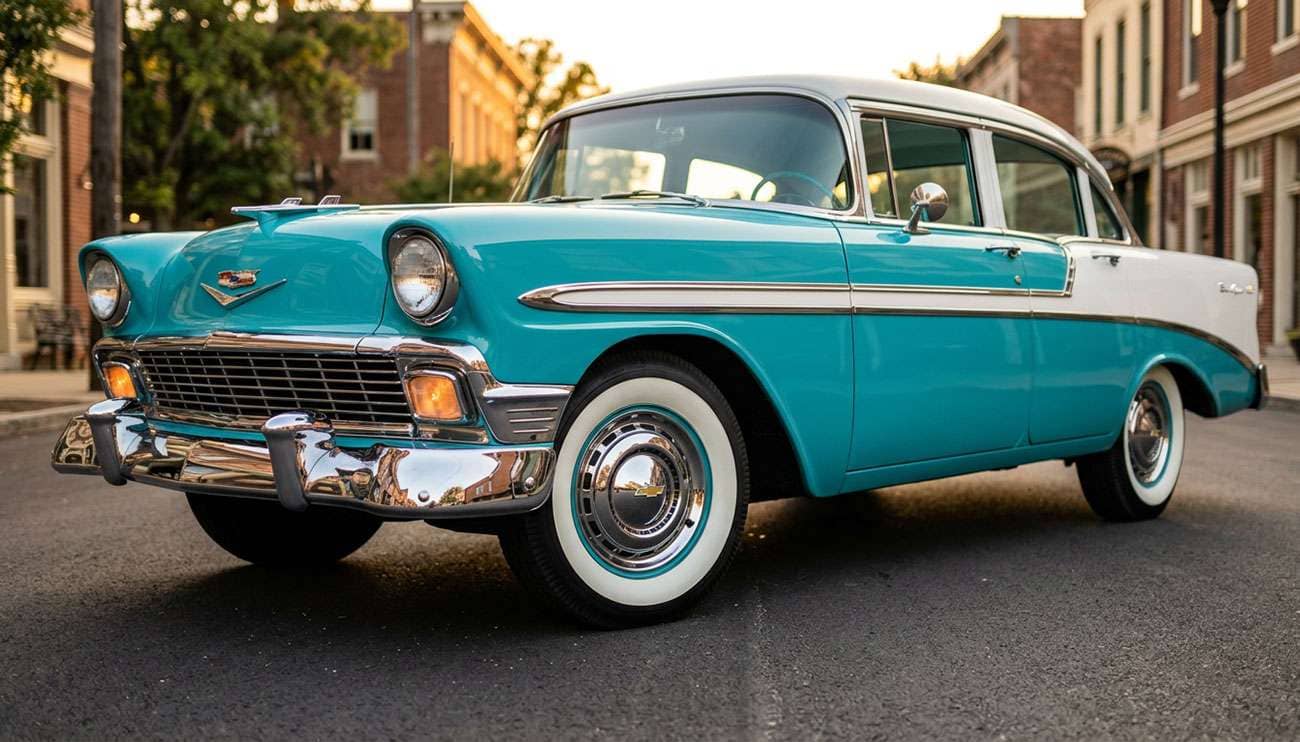
If you own a classic car, you've faced the same frustrating choice every enthusiast faces when it's time for new tires: do you go with authentic bias ply tires that look right but ride terribly, or do you put modern radials on it that drive great but look completely wrong?
For decades, that was the only option. You picked appearance or performance. Never both. Then bias look radials showed up and changed the game entirely. If you haven't heard of them yet — or if you've seen the term and weren't sure what it meant — you're about to discover the single best upgrade you can make to any antique or classic vehicle you actually drive.
Here's the reality. Original bias ply tires were the only option from the early 1900s through the mid-1970s. Every car that rolled off the line — from Model A Fords to first-generation Camaros — came on bias ply rubber. Those tires have a distinctive look: tall, narrow profiles, squared-off shoulders (sometimes called "pie-crust" shoulders), specific tread patterns, and in many cases, wide whitewalls that defined an entire era of automotive style.
The problem is that bias ply tires drive like it's 1955. The crisscross internal ply construction makes them wander on the highway, follow ruts in the pavement, heat up faster, wear out quicker, and provide significantly less grip than modern radials — especially in wet conditions. The ride feels vague and disconnected. Braking distances are longer. If you've ever driven a classic car on original-style bias ply tires in traffic, you know exactly what I'm describing. It's an experience, but not always a safe one.
Standard radial tires solve every one of those performance problems. But they look wrong. A modern P-metric radial has a different profile — wider, with rounded shoulders and a shorter sidewall. Put a set of 225/75R15 radials on a 1957 Chevy Bel Air and the car drives beautifully, but it looks like it's wearing running shoes with a tuxedo. The proportions are off. The sidewall shape is wrong. The tread pattern screams "modern." For a car show, a concours judging, or simply your own satisfaction, it's a compromise that's hard to live with.
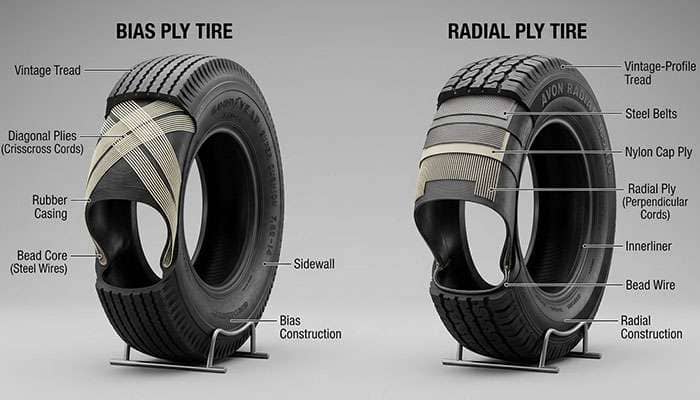
A bias look radial is exactly what the name suggests — a tire that looks like a bias ply on the outside but is built like a radial on the inside. The exterior profile, shoulder shape, tread pattern, sidewall markings, and overall proportions match a vintage bias ply tire. But underneath that period-correct skin, the internal construction uses modern radial technology: steel belts, perpendicular ply cords, and contemporary rubber compounds.
The term "bias look radial" isn't an official industry classification. It was coined by Coker Tire Company when they debuted the American Classic bias look radial at the 2013 SEMA Show. The concept was simple but revolutionary — build brand-new molds that replicate the exact dimensions, tread designs, and sidewall styling of classic bias ply tires, then engineer the internal structure as a full radial. The result won multiple industry awards and opened up an entirely new product category.
Since then, several manufacturers have developed their own bias look radial lines. At Performance Plus Tire, we carry three distinct brands — each with its own strengths depending on your vehicle, your era, and your priorities.
The difference is immediate. If you've been driving on bias ply tires and swap to bias look radials, the first thing you'll notice is that the car tracks straight. No more fighting the steering wheel on grooved pavement. No more wandering at highway speed. The ride gets quieter, the handling gets more precise, and you'll stop shorter in both dry and wet conditions. Your tread will last significantly longer — we're talking 2-3 times the mileage in many cases. And nobody looking at the car will know you made the switch, because the tire looks identical to the original.
Here's how the three construction types compare on the specs that actually matter when you're choosing tires for a classic vehicle:
Feature |
Bias Ply |
Standard Radial |
Bias Look Radial |
|---|---|---|---|
Internal Construction |
Diagonal crisscross plies (30-45°) |
Perpendicular plies with steel belts |
Perpendicular plies with steel belts |
External Appearance |
Period correct |
Modern — rounded shoulders, wider profile |
Period correct — matches bias ply profile |
Ride Quality |
Harsh, follows road imperfections |
Smooth, compliant |
Smooth, compliant |
Highway Tracking |
Wanders, follows ruts |
Tracks straight |
Tracks straight |
Tread Life |
15,000–25,000 miles |
40,000–60,000 miles |
35,000–50,000 miles |
Wet Traction |
Poor |
Excellent |
Good to excellent |
Concours / Show Judging |
Passes — fully authentic |
Fails — wrong profile and markings |
Passes most — nearly identical look |
Best For |
Trailer queens, concours restorations |
Daily-driven classics, pro-touring builds |
Weekend cruisers, show-and-drive cars |
Price Per Tire |
$100–$350 |
$80–$250 |
$120–$400 |
The takeaway is clear. If your classic car leaves the garage, bias look radials give you everything a modern radial offers — ride, grip, tread life — without sacrificing the look that makes your car special.
Bias look radials now cover a surprisingly wide range of eras and applications. Here's how the sizing breaks down by vehicle era:
If you're running a Ford Model A, a 1930s hot rod, or any pre-war automobile, you'll find bias look radials in 16-inch through 21-inch fitments. The Autobahn Bias Look Radial covers 15-16 inch sizes with Continental-style tread patterns that are factory-correct for European pre-war cars like the VW Beetle and Porsche 356. For American pre-war cars, the American Classic Model A Plus Radial fits 19- and 21-inch wheels. Use our Antique Tire Size Conversion tool if you're not sure what modern size replaces your original fitment.
This is where the selection really opens up. Most 1950s and early 1960s cars ran 13-, 14-, and 15-inch wheels with sizes like 670-15, 710-15, 750-14, and 800-14. Bias look radials are available in all of these sizes — you'll see them listed with the same numeric sizing plus an "R" (for example, 670R15 instead of 670-15). Whitewall options range from narrow 1-inch stripes to wide 3¼-inch whitewalls, plus blackwall for those who prefer that look.
For muscle cars, the Firestone Wide Oval Radial is available as a bias look option in F70-14, G70-14, and other popular 70-series sizes. You can also find BFGoodrich Silvertown radials with redline or goldline sidewalls for that authentic late-1960s appearance. These tires match the wider, shorter-sidewall proportions of the muscle car era while delivering modern cornering grip.
Bias look radials come in every sidewall treatment you'd expect: wide whitewall, narrow whitewall, blackwall, redline, goldline, and raised white letter. The key advantage over painted or ground whitewalls is that the better manufacturers build the whitewall directly into the tire during production — it's part of the rubber, not applied after the fact. This means the white stays white and doesn't peel or yellow. Check our Whitewall Tires Guide for a deeper dive on sidewall options.
Not every classic car owner needs bias look radials. Here's how to decide:
You drive your classic regularly — weekend cruises, car shows you drive to (not trailer), road trips, or occasional daily use. You want the car to look period-correct but handle safely in modern traffic. You're tired of bias ply tires wandering on the highway. You want tread that lasts more than one season of driving.
Your car is a concours-level restoration that gets trailered to shows and judged on factory correctness down to the last detail. Some judging organizations will deduct points for radial construction regardless of appearance. If the car barely moves under its own power, the performance advantages of radials don't matter.
You're building a pro-touring car where modern performance is the priority and period-correct appearance isn't a concern. A restomod with disc brakes, coilovers, and a crate engine deserves modern P-metric radials that maximize the upgraded suspension's capability.
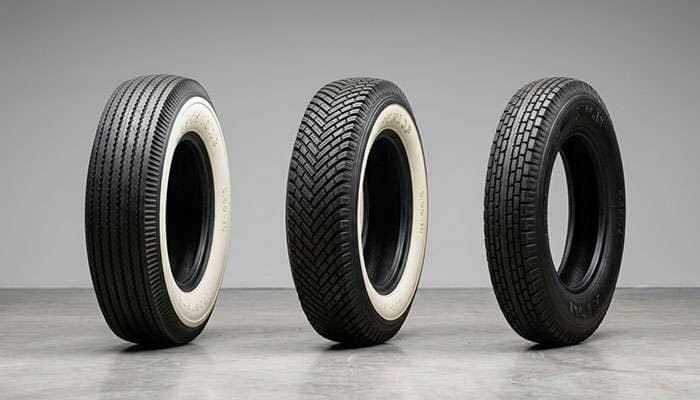
At Performance Plus Tire, we've curated the strongest selection of bias look radials in the market. Here are the three lines we recommend most — starting with two brands you can only find through select specialty dealers.
The Kontio Tyre WhitePaw line is a standout in the classic tire world. Made in Finland, these tires combine a genuine whitewall construction — built into the tire from day one, not painted or ground — with modern radial internals that deliver a 400 treadwear rating and an A traction grade. That's serious performance for a vintage-style tire.
The WhitePaw Vintage Bias Look Radial gives you the narrow profile and squared shoulders of a classic bias ply with all the ride quality and longevity of a modern radial. Available in wide and narrow whitewall configurations across 13-, 14-, and 15-inch sizes, Kontio covers everything from early 1950s sedans through mid-1960s Cadillacs and Lincolns. If you want the best combination of authentic appearance, build quality, and value, the Kontio WhitePaw is where I point most customers first.
If you own a European classic — a VW Beetle, Karmann Ghia, Porsche 356, or any pre-war European vehicle — the Autobahn Bias Look Radial was made specifically for you. These tires are manufactured by Garage Vintage and feature tread patterns that replicate the original Continental tires that came factory-installed on these vehicles.
Available in 15- and 16-inch sizes with blackwall, narrow whitewall, and wide whitewall options, Autobahn tires nail the period-correct look that European classic owners demand. The diagonal tread pattern is an exact match for the era, and the radial construction transforms how these lighter European cars handle on modern roads. For VW and Porsche enthusiasts, there's nothing else on the market that gets this specific.
The American Classic line — manufactured by Coker Tire in the USA — is the original bias look radial and still one of the most popular. Available in eleven sizes across 13-, 14-, and 15-inch wheels (plus 19- and 21-inch Model A fitments), American Classic covers the broadest range of American vehicles from 1928 through the mid-1960s.
The pie-crust shoulder detail and vintage tread patterns are faithful reproductions of original bias ply designs. Steel-belted radial construction provides a dramatically improved ride over the bias ply tires they replace. Wide whitewall, narrow whitewall, and blackwall options are available. If your project is a classic American car from the 1940s, 1950s, or early 1960s and you want a USA-made tire, American Classic is the proven choice.
Not sure which line fits your vehicle? Browse our full classic tire selection or call us at 888-926-2689 — we match tires to classic cars every day. If you're also shopping for classic wheels, check out our Classic Wheels Guide for pairing recommendations.
Both use the same internal radial construction — steel belts and perpendicular ply cords. The difference is in the mold. A bias look radial is manufactured in a mold that replicates the external dimensions, shoulder shape, tread pattern, and sidewall profile of a classic bias ply tire. A standard radial uses a modern mold with wider, rounder proportions. Internally, they perform similarly. Externally, the bias look radial matches the appearance of a vintage tire while the standard radial does not.
No. Never mix bias ply and radial tires on the same vehicle. The two construction types respond differently to steering inputs, cornering loads, and braking forces. Mixing them creates unpredictable handling — the front and rear of the car will behave differently, which can lead to loss of control. If you're switching to bias look radials, replace all four tires at once.
Most bias look radials are tubeless tires and do not require inner tubes when mounted on airtight wheels. However, if your classic car has wire wheels, spoke wheels, or other wheel types that are not airtight, you will need to run inner tubes. Check your wheel type before ordering. When in doubt, it's always safe to run a tube inside a tubeless tire — but you cannot run a tubeless tire without a tube on a non-sealed wheel.
It depends on the organization and the level of judging. Many bias look radials are visually indistinguishable from original bias ply tires at a casual inspection — the sizing, sidewall markings, tread pattern, and shoulder shape all match. However, the "R" in the size designation (for example, 670R15 instead of 670-15) identifies it as a radial. Strict concours judging at the highest levels may deduct points for non-original construction. For most local and regional shows, bias look radials pass without issue.
Bias look radials use the same sizing convention as the original bias ply tires with an "R" added. If your car originally came with 670-15 tires, you need a 670R15 bias look radial. If you're not sure what your car's original tire size was, check your owner's manual, the data plate on the vehicle, or use Performance Plus Tire's Antique Tire Size Conversion tool to cross-reference original and modern sizes. You can also call us at 888-926-2689 and we'll look it up for you.
All three are excellent tires built for slightly different applications. Kontio Tyre WhitePaw offers a 400 treadwear rating and A traction grade, which is among the highest in the vintage tire category — making it an outstanding value for cars that see regular driving. Autobahn specializes in European classic fitments with Continental-replica tread patterns that no other manufacturer offers. American Classic covers the broadest range of American vehicle fitments and is manufactured in the USA. The right choice depends on your vehicle's origin and your specific size requirements.



