
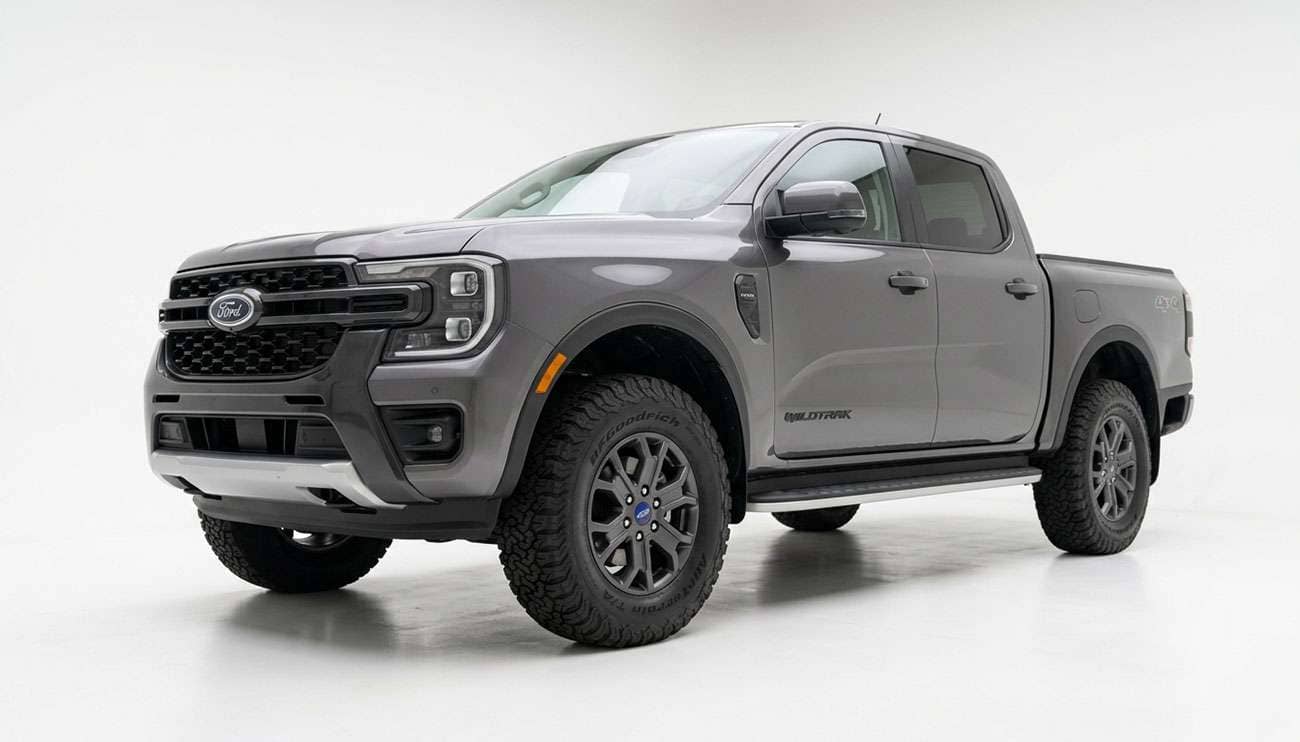
On a truly stock Ford Ranger, factory wheels, no leveling kit, no spacers, front crash bars untouched, the biggest tire that clears cleanly is 265/70R17, about 31.6 inches tall. On 18-inch factory wheels the match is 265/65R18. That holds for the 2019-2023 truck and the redesigned 2024-and-newer truck. Sizes around 32 inches (255/75R17, 255/70R18) live on the edge, and 33s (285/70R17) rub on anything but a Raptor. Most answers stop at "it depends on your setup." Here is what it depends on: which generation you own, the wheel offset you run, and whether the size you want only exists in LT construction.
I'm Dennis Feldman, and I handle fitment questions at Performance Plus Tire every day. Ranger owners ask this one more than almost anything else, because the Ranger is a midsize truck that looks like it should swallow a 33 and doesn't. The table below is the answer for your specific truck. The sections after it explain why.
Feature |
Factory Size |
Biggest Clean Fit |
Edge Size (may rub) |
What Touches First |
|---|---|---|---|---|
2019-2023 XL / XLT / Lariat, 17-inch wheel |
255/65R17 or 265/65R17 (about 30.5 in) |
265/70R17 (31.6 in) |
255/75R17 (32.1 in) |
Front crash bar and liner at full lock |
2019-2023 on 18-inch wheel |
265/60R18 (30.5 in) |
265/65R18 (31.6 in) |
255/70R18 (32.1 in) |
Front crash bar and liner at full lock |
2021-2023 Ranger Tremor |
265/70R17 (31.6 in) |
Already at it |
255/75R17 (32.1 in) |
Front crash bar at full lock |
2024+ XL / XLT, 17-inch wheel |
255/70R17 (31.1 in) |
265/70R17 (31.6 in) |
255/75R17 (32.1 in) |
Front liner and bumper corner at lock |
2024+ XLT / Lariat, 18-inch wheel |
255/65R18 (31.1 in) |
265/65R18 (31.6 in) |
255/70R18 (32.1 in) |
Front liner and bumper corner at lock |
2024+ Ranger Raptor |
285/70R17 (32.7 in) |
Already at 33 |
Wider 33s on stock wheels |
Inner sidewall to suspension |
Diameters are calculated, not marketing numbers. A "32-inch" tire on a sidewall is a rounded label; the math on 265/70R17 lands at 31.6 inches, and a 285/70R17 lands at 32.7. When you are working inside a quarter inch of clearance, the rounded number is the one that gets people in trouble.
The second axis that matters is not the truck. It is the wheel and the tire construction you pair with it. This table is where most people end up deciding what to buy:
Feature |
What It Changes |
Effect on the Biggest Tire |
|---|---|---|
Factory wheel, +55 mm offset |
Tire sits tucked toward the suspension |
Width limit is inboard; 265 wide is comfortable |
Aftermarket wheel, 0 mm offset |
Tire moves about 2.2 in outboard |
Clears the inside, but hits the crash bar and liner sooner at lock |
Aftermarket wheel, negative offset |
Tire pokes past the fender |
Needs trimming or a level to run anything over 31.6 in |
P-metric construction |
Lighter, softer, rated at lower pressure |
Available up to 265/70R17; rare above it |
LT construction |
Heavier, stiffer, needs more air pressure |
Dominates 275/70R17 and 285/70R17 |
You cannot measure an upgrade until you know your starting point, and the Ranger has two very different starting points. The truck returned to the US market for 2019 after a long absence, and Ford replaced it with an all-new generation for 2024. Same name, same 6x139.7 bolt pattern, different chassis.
The fifth-generation US Ranger shipped on three wheel diameters. XL trucks could leave the factory on 255/70R16 (30.1 inches) or 17-inch tires. XLT and Lariat trucks ran 255/65R17 or 265/65R17 (30.1 and 30.6 inches), with 265/60R18 (30.5 inches) on the 18-inch wheel. Factory wheels were 16x7, 17x8, and 18x8, all at a +55 mm offset, on a 93.1 mm hub bore with M12x1.5 lug nuts.
Notice what those numbers say. Every factory size on this truck lands between 30.1 and 30.6 inches. That is a short tire for a midsize pickup, and it is why owners feel like there is room to grow. There is, but less than the wheel well suggests.
The redesigned Ranger grew. Ford stretched the wheelbase by 50 mm and widened the track by 50 mm, roughly two inches each. Factory tires grew with it: the XL and base XLT run 255/70R17 (31.1 inches), and the XLT and Lariat on 18-inch wheels run 255/65R18 (also 31.1 inches). Non-Raptor wheels stay at the familiar +55 mm offset on a 93.1 mm hub.
That half-inch jump in factory diameter is the detail most people miss. A 2024 Ranger owner moving to 265/70R17 gains only about half an inch. A 2019 owner moving to the same size gains a full inch. Same tire, very different upgrade.
Yes. On both generations, 265/70R17 is the size owners consistently report running on factory wheels and factory suspension without rubbing. The Ford Ranger Tremor package from 2021-2023 shipped from the factory on 265/70R17, which tells you Ford's own engineers were comfortable with that diameter in that wheel well, even if the Tremor gave itself a little extra ride height to do it.
The size works because it adds height without adding much width. A 265 section width is the same width many 2019-2023 trucks already ran in 265/65R17. You are only adding sidewall. The tire grows about half an inch in radius, and that half inch mostly goes up into the open space of the wheel well rather than forward into the crash bar.
On 18-inch wheels, the equivalent size is 265/65R18, which calculates to 31.6 inches, a near match. If your truck came on 18s, you do not need to change wheels to get the same result.
If you have been eyeing that size on another midsize truck, the logic is the same one we walked through in will 33s fit a stock Tacoma: the first upsize is almost always a sidewall upsize, not a width upsize.
Your speedometer reads low. Going from a 2019-2023 truck's 265/65R17 to 265/70R17 makes the tire about 3.4 percent taller, so at an indicated 60 mph you are actually doing about 62. From a 2024 truck's 255/70R17 the change is about 1.8 percent, or roughly 61 mph at an indicated 60. Ford's speedometer and odometer calibration can be updated with a programmer or at a dealer. We cover the math in detail in how bigger tires affect your speedometer.
Not on a stock non-Raptor Ranger without contact. A 285/70R17, the common "33," calculates to 32.7 inches tall and 11.2 inches wide. That is about 1.1 inches taller and nearly an inch wider than 265/70R17. On a stock XL, XLT, or Lariat, that combination puts rubber against the front crash bar and liner when you turn to full lock, and against the liner when the suspension compresses over a dip while turning.
The middle ground, about 32 inches, is where owners split. A 255/75R17 or a 255/70R18 calculates to 32.1 inches. Some trucks run them with nothing more than an occasional brush at full lock in a parking lot. Others rub hard enough to want the crash bar trimmed or relocated. The difference usually comes down to wheel offset and how aggressive the tread shoulder is, which we will get to below.
Why does a Ranger stop short of 33 when a full-size truck does not? It is not the fender opening. It is the front crash bars, sometimes called intrusion beams, that sit behind the front bumper corners. They are a structural part of how the truck manages a frontal impact, and they sit right where a taller, wider tire swings at full lock. That is why the real-world limit is lower than the open space you see when you look into the wheel well with the wheels pointed straight.
The same pattern shows up across midsize trucks, which is why our will 33s fit a stock Colorado breakdown lands in a similar place. For a general look at how far any stock truck can go before it needs suspension help, see the biggest tire you can run without a lift.
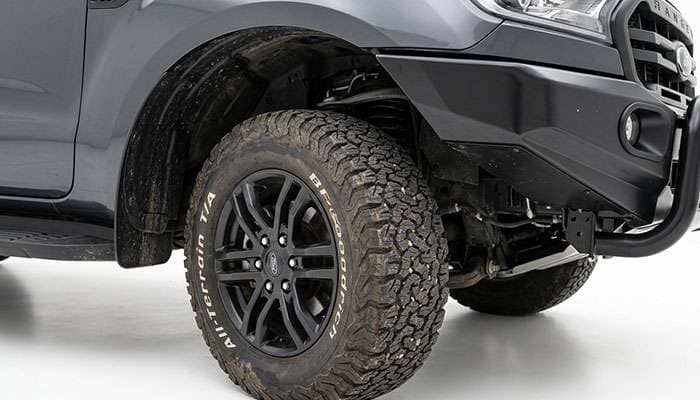
Owners commonly report that a 2- to 2.5-inch leveling kit gets a non-Raptor Ranger to about 275/70R17 (32.2 inches) cleanly. True 285/70R17s usually take that level plus crash bar work, a modest lift, or both. At that point you are no longer asking what fits a stock Ranger. You are planning a build, and gearing becomes part of the conversation. A heavier, taller tire on the 2.3L EcoBoost changes how the truck accelerates and tows, and whether a regear makes sense is a question worth answering before you buy the tires, not after.
Slightly bigger as delivered, but not dramatically bigger as a ceiling. This is the generation question almost nobody puts in front of you, and it changes how you should read every forum post you find.
The 2024 truck's extra 50 mm of track width moves each wheel about an inch farther outboard than on the 2019-2023 truck, and the body grew around it. Ford used that room to put a taller tire on the truck from the factory: 31.1 inches instead of about 30.5. What the new generation did not do is open up a full inch of extra clearance at the front corners for owners to use. The practical stock ceiling is still about 31.6 inches, with 32 inches on the edge.
So the honest answer by generation looks like this:
Here is the catch when you research online: a large share of the fitment photos and posts out there come from 2019-2023 trucks, because they have been on the road longer. A size that "fit with no issues" on one generation does not automatically transfer to the other, because the factory tire, the track width, and the front-end packaging are all different. Before you trust a post, confirm the model year.
These two are the exceptions that make the rule confusing, because they ship on tires a regular Ranger cannot match without work.
The Tremor was an off-road package for the 2021-2023 SuperCrew 4x4 in XLT and Lariat trim. It came on 17-inch wheels with 265/70R17 all-terrain tires, FOX 2.0 monotube shocks with rear piggyback reservoirs, retuned springs, and 9.7 inches of ground clearance, 0.8 inches more than a standard SuperCrew 4x4. Increased suspension travel came with it: 6.5 inches front, 8.1 inches rear.
For a Tremor owner, the factory tire already is the stock-truck maximum. Moving to 32 inches gets you into the same edge territory as any other Ranger of that generation, and the slightly higher stance helps at the rear more than at the front crash bar.
The Raptor is a different truck under the skin. It ships on 285/70R17 BFGoodrich KO3 all-terrains, a 33-inch tire, on 17x8.5 wheels with beadlock-capable wheels available. It uses FOX 2.5-inch Live Valve internal bypass shocks, aluminum upper and lower control arms, and a Watts-link rear suspension. All of that was engineered around a 33.
That is why the question "biggest tire on a stock Ranger" has two answers depending on whether the truck says Raptor. If you own a Raptor, you are already running the size other Ranger owners are asking about. Raptor owners who want a wider 33 on stock wheels report the limit is the inner sidewall to suspension clearance, not the crash bar.
More than any other single variable after the generation. And it is the one that trips people up most when they buy wheels and tires together.
The Ranger's factory wheels sit at a high positive offset, +55 mm. Offset is the distance from the wheel's centerline to its mounting face. A high positive offset pulls the wheel and tire inward, tucked toward the suspension and frame. On a 17x8 wheel, +55 mm works out to roughly 6.7 inches of backspacing.
Now look at what is on the aftermarket shelf. In the 17-inch 6x139.7 aftermarket wheel market, the middle of the range sits right at zero offset, and fewer than one wheel in 400 comes anywhere close to the Ranger's +55. Most of those wheels were designed for wider trucks with more track to fill. Bolt one on a Ranger and the tire moves about 2.2 inches outboard.
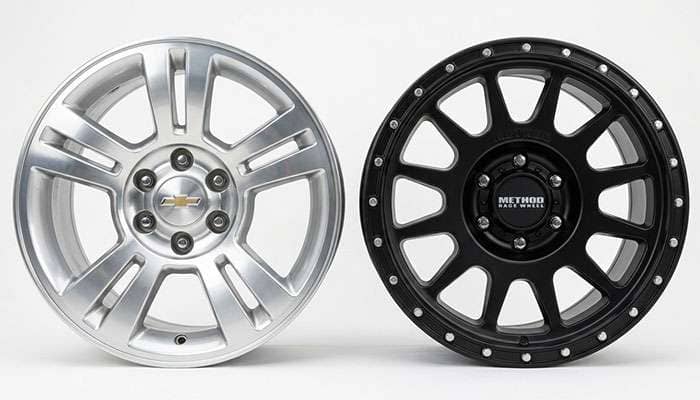
Moving the tire outboard trades one problem for another. On the factory wheel, the inside edge of a wide tire is what gets close to the upper control arm and spindle. On a zero-offset wheel, the inside is wide open, but now the outer shoulder of the tire swings farther forward when you turn. That puts it into the crash bar, the bumper corner, and the front of the liner sooner.
That is why a 255/75R17 can fit one Ranger and rub on the next. On factory wheels, the narrow 255 width stays tucked and the extra height mostly goes up. On a zero-offset wheel, the same tire reaches the front corner earlier in the steering arc. If your goal is the biggest tire on an otherwise stock truck, the factory offset is your friend. If your goal is the aggressive look, plan for 31.6 inches as your limit or plan for trimming. We explain the general mechanism in why your tires are rubbing.
The Ranger's hub bore is 93.1 mm. Most aftermarket 6x139.7 wheels are bored at 106 mm or larger to fit Tacoma, Silverado, and other trucks. That wheel will still bolt on, but it is no longer centered by the hub. It is centered by the lug nuts alone. Use hub-centric rings sized 93.1 mm on the inside to the wheel's bore on the outside. Skip them and you can chase a vibration at highway speed that no amount of balancing fixes.
Often you do not get a choice. This is the capacity question almost every Ranger fitment guide leaves out, and it affects your ride, your weight, and your air pressure.
Most factory Ranger tires are P-metric or Euro-metric passenger construction. As you climb in size, the market shifts under you. At 255/70R17 and 255/65R18, the factory-sized tires, nearly everything available is passenger construction. At 265/70R17, about half the options on the market are LT. At 275/70R17, almost every option is LT. At 285/70R17, more than four in five are LT.
So the choice to go bigger often doubles as the choice to go from passenger to light-truck construction. That is not bad, but it is different. Here is the mechanism.
A load index is a number on the sidewall that maps to a maximum weight per tire. A load index of 113 means 2,535 pounds. A load index of 121, common on a Load Range E LT tire in 265/70R17, means 3,195 pounds. On paper, the LT tire carries far more.
Two details change the picture. First, under Tire and Rim Association practice, a P-metric tire used on a light truck has its rated load divided by 1.10. That 113-rated P-metric tire is really good for about 2,305 pounds on your Ranger. Second, an LT tire only reaches its rated load at its maximum rated pressure, which for Load Range E is 80 psi. Run it at the door-placard pressure meant for the factory passenger tire and it carries less than its sidewall suggests.
The takeaway for a Ranger owner: if you go LT, set pressure from the tire manufacturer's load and inflation table for your actual axle weight, not from the placard. If you mostly drive empty on pavement, a Load Range C or a passenger-construction 265/70R17 will ride closer to stock. If you tow or haul near the truck's limits, LT construction gives you the margin. For the full construction comparison, see P-metric vs. LT tires.
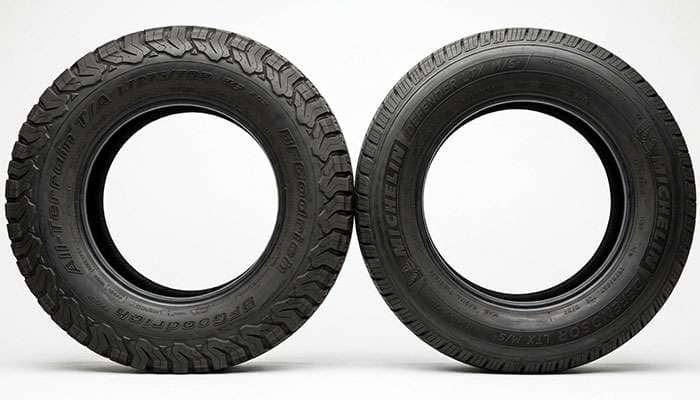
An LT all-terrain in 265/70R17 typically weighs noticeably more than the factory passenger tire. That is unsprung, rotating weight. You feel it as slightly slower acceleration, slightly longer stopping distances, and a few tenths of a mile per gallon. On a 2.3L Ranger, a one-step upsize with an LT tire is very livable. Stack 33-inch LT tires on top of that, and the effect becomes something you notice every day.
Owners who push to the edge size often say a little rub at full lock is no big deal. Sometimes that is true. Often it is the start of a damage ladder, and each rung costs more than the last.
The cost of picking 265/70R17 over a size that rubs is zero. The cost of picking the size that rubs is a tire, maybe a set, plus the liner and the trim. That math is why we steer stock-truck owners to the clean fit first.
Here is the sequence I use when a Ranger owner calls in. It takes five minutes and saves a set of tires.
The biggest tire on a stock Ford Ranger is 265/70R17 on 17-inch wheels or 265/65R18 on 18s. That is about 31.6 inches, and it clears on both the 2019-2023 and the 2024-and-newer truck. Push to 32 inches and you are trading clearance for the chance of rubbing at full lock. Push to 33 and you are planning a level, crash bar work, or a lift, unless your truck is a Raptor, which shipped on 33s from the factory.
What decides the edge cases is not a single number. It is the generation, the offset of the wheel the tire is mounted on, and the construction of the tire you buy. Get those three right and the Ranger will look better, ride on more capable tread, and never leave a mark on the liner.
Not without rubbing on a non-Raptor Ranger. A 285/70R17 is about 32.7 inches tall and contacts the front crash bar and liner at full lock. It usually takes a leveling kit plus crash bar work or a lift. The Ranger Raptor is the exception; it ships on 285/70R17 tires from the factory.
Yes. 265/70R17 fits both the 2019-2023 and 2024+ Ranger on factory wheels with no lift or level. Ford shipped the 2021-2023 Ranger Tremor on this size. On 18-inch wheels, 265/65R18 is the equivalent.
Owners commonly report a 2- to 2.5-inch leveling kit lets a non-Raptor Ranger run about 275/70R17, roughly 32.2 inches, without rubbing. True 33-inch 285/70R17 tires usually need crash bar modification or more lift on top of the level.
Yes. Moving from 265/65R17 to 265/70R17 on a 2019-2023 Ranger makes the speedometer read about 3.4 percent low, so 60 indicated is about 62 actual. On a 2024+ Ranger moving from 255/70R17, the error is about 1.8 percent. A programmer or dealer can recalibrate it.
The 2019 and newer Ford Ranger uses a 6x139.7 (6x5.5) bolt pattern with a 93.1 mm hub bore and M12x1.5 lug nuts. Factory wheels on non-Raptor trucks use a +55 mm offset.
The 2024+ Ford Ranger Raptor comes on 285/70R17 BFGoodrich KO3 all-terrain tires, a 33-inch size, mounted on 17-inch wheels, with beadlock-capable wheels available.



