
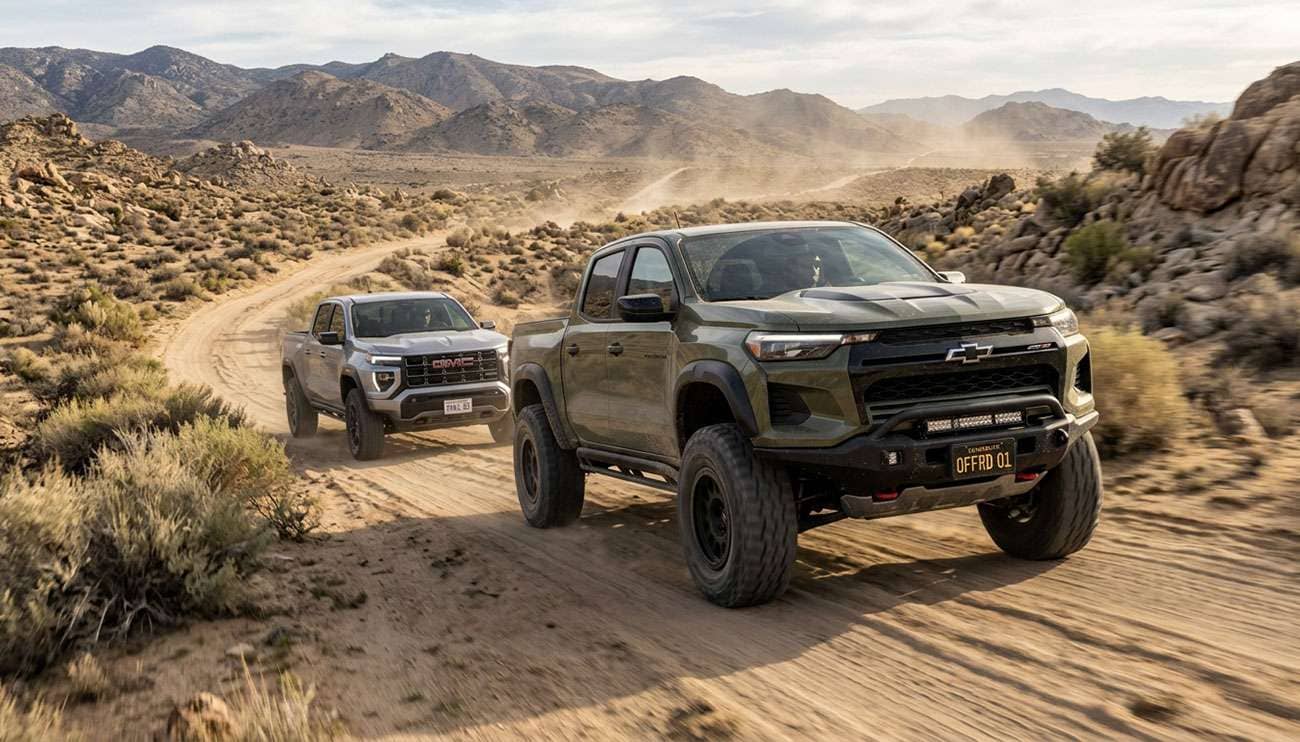
Most answers to this question treat the Colorado as one truck and stop at it depends. It depends on two things: the generation and the trim. On a 2023-and-newer Trail Boss, yes. It rides 2 inches higher on a wider track, and Chevrolet's own 20-inch option ships a 33-inch 275/60R20. The ZR2 already wears 33s from the factory. On a 2023+ WT, LT, or Z71, and on a 2015-2022 Colorado outside the ZR2, a 33 does not fit at stock height; the practical ceiling is about 32 inches. The 2023 redesign also changed the bolt pattern, and the 33 you choose sets your load range.
Below is the breakdown by generation and trim, the three tire sizes people mean when they say 33, and what each one asks of your truck.
Start with your model year and trim. The factory tire height tells you how far you are from a 33, and the factory lift and track width tell you how much room Chevrolet already built in.
Colorado Trim |
Years |
Factory Tire |
Factory Height |
Factory Lift and Track |
Do 33s Fit Stock? |
|---|---|---|---|---|---|
WT, LT |
2023+ |
255/65R17 or 265/60R18 |
30.1-30.5 in |
Base height and track |
No; about 32 in is the ceiling |
Z71 |
2023+ |
265/65R18 |
31.6 in |
No Trail Boss lift or wide track |
Not without a level |
Trail Boss |
2023+ |
LT275/65R18 on 18s; 275/60R20 on optional 20s |
32.1 in; 33.0 in on 20s |
2 in lift, wider track |
Yes; the factory sells one |
ZR2 |
2023+ |
LT285/70R17 116/113Q |
32.7 in |
3 in lift, about 3 in wider track |
Already on 33s |
ZR2 Bison |
2024+ |
LT315/70R17 |
34.4 in (sold as a 35) |
ZR2 plus Bison hardware |
Already past 33s |
WT, LT, Z71 |
2015-2022 |
265/70R16, 255/65R17, 265/65R17, or 265/60R18 |
30.1-30.6 in |
Base height and track |
No; a 265/70R17 is already tight |
ZR2 |
2017-2022 |
LT265/65R17 (sold as a 31) |
30.6 in |
2 in lift, 3.5 in wider track |
Borderline; usually with trimming |
Heights are calculated from each size and rounded to a tenth of an inch. The optional 22-inch Trail Boss package runs a 275/50R22, which calculates to 32.8 inches.
The 2023 Trail Boss is the key row. It is the only non-ZR2 Colorado built with a factory lift and a wider stance, and Chevrolet sold it with a 33 already mounted when you ordered the 20-inch wheels. If your Trail Boss is on the standard 18s, a 33 is a size step the truck was designed to accept.
The ZR2 rows show how far the platform moved. The 2017-2022 ZR2 was a 2-inch-lifted truck on what Chevrolet called 31-inch tires. The 2023 ZR2 went to a 3-inch lift and a 33 from the factory, and the Bison edition added for 2024 steps up again. Same badge, different truck.
The Z71 and Trail Boss show why track width matters as much as lift. Both ride on 18-inch wheels, but the Z71's tires tuck inside the fenders while the Trail Boss's sit out toward the fender edge. The wider track moves the whole tire outboard, away from the control arms and body mount on the inside of the wheel opening. That is room a leveling kit cannot add to a Z71, because a level raises the front of the truck without moving the tire outward.
The WT, LT, and Z71 rows are where most of the questions come from. Those trucks sit at base height on the base track, with a factory tire about 30 to 31.6 inches tall. Getting to 33 adds 1.4 to 2.9 inches of diameter, and the bigger tire reaches farther forward and back inside the wheel opening at full steering lock. That is where it rubs, and a lift does not fix it on its own.
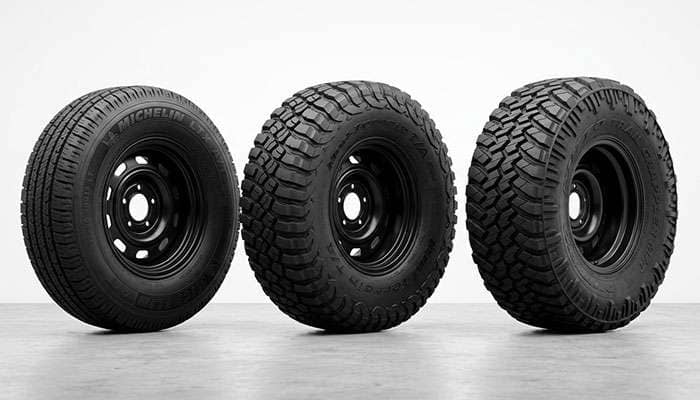
A 33 is a height. It is not a width, and width is what decides whether a tire clears on a midsize truck. Three common sizes all land at about 33 inches, and they ask very different things of your fender, your wheel, and your suspension.
Size |
Height |
Width |
What the Market Offers |
Typical Load Index |
Rated Load per Tire |
|---|---|---|---|---|---|
255/80R17 |
33.1 in |
10.0 in |
LT only, narrow |
121-123 |
3,197-3,415 lb |
275/60R20 |
33.0 in |
10.8 in |
Mostly passenger, some LT Load Range E |
115-123 |
2,679-3,415 lb |
285/70R17 |
32.7 in |
11.2 in |
Mostly LT Load Range E; C and D exist |
116-126 |
2,756-3,748 lb |
33x12.50R17 |
33.0 in |
12.5 in |
LT flotation |
114-124 |
2,601-3,527 lb |
Rated load is the Tire and Rim Association figure for each load index at the tire's maximum rated inflation.
The spread is 2.5 inches of width, from 10.0 to 12.5, with nearly identical height. On a Colorado, that difference decides the outcome at full lock. When you turn the wheel, the front tire swings forward and backward inside the wheel opening. A wider tire reaches the bumper cover, fender liner, and body mount sooner, and a lift does not move those parts out of the way. The lift buys room above the tire. The rubbing on a midsize truck usually happens in front of it and behind it.
That is why the narrow 255/80R17 is the easiest 33 to fit. It is the same width as the factory 255/65R17 on a WT or LT and only taller. The 285/70R17 is the ZR2's factory size, 1.2 inches wider, and it expects the ZR2's lift and track. The 33x12.50R17 is 2.5 inches wider than the narrow 33 and belongs on a lifted truck with wheels built to push it outboard.
Tread pattern adds width the size does not show. A mud-terrain 285/70R17 like the ZR2's factory tire carries big shoulder lugs that wrap onto the sidewall, and those lugs are what touch the liner first at full lock. An all-terrain in the same size with a squarer shoulder often clears where the mud-terrain does not. When a fitment report says a size fits, check what tread it was.
Wheel offset moves the tire more than the tire size does. A lower or negative offset pushes the tire outward, which helps clear the upper control arm on the inside and hurts at the fender on the outside. Offset guides written for 33s on 2023+ trucks point to wheels around 0 mm offset, like a 17x8.5 or 20x9, paired with a level or lift. The same tire on a factory wheel sits farther inboard. If you are weighing 33s against 31s or 35s in general, our comparison of 31s vs. 33s vs. 35s covers the weight, gearing, and fuel trade-offs across all three.
Yes, and it matters for anyone shopping wheels for 33s. The 2015-2022 Colorado uses a 6x120 bolt pattern with a 66.9 mm center bore. The redesigned 2023-and-newer Colorado uses 6x139.7 (6x5.5 inches) with a 78.1 mm center bore and M14x1.5 lug nuts, the same pattern as GM's full-size trucks.
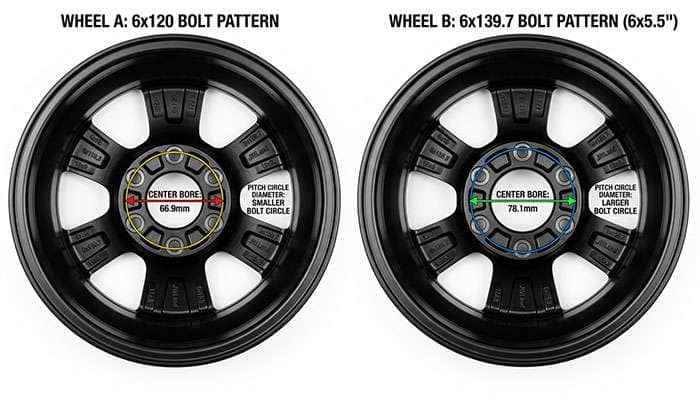
Wheels do not carry over between generations. A set of 17s from a 2020 Colorado will not bolt onto a 2024, and a wheel listed for a 2024 will not bolt onto a 2020. Both patterns have six lugs, so they look close in a photo. They are not close on the hub.
The change works in your favor on a newer truck. The 6x139.7 pattern is one of the most common truck patterns on the market, so a 2023+ Colorado owner has far more wheel choices in the offsets a 33 needs. The 2015-2022 truck's 6x120 pattern has a narrower selection. Our guides to the 6x120 bolt pattern and the 6x139.7 bolt pattern list what else shares each one. Check the center bore too. The 2023+ Colorado's is 78.1 mm, and 6x139.7 wheels built for other makes can have a larger bore that needs a hub-centric ring.
Here is the variable nobody names when they talk about 33s on a midsize truck. The ZR2's factory 33 is a Load Range C tire. Most 285/70R17s you can buy are Load Range E.
The factory LT285/70R17 116/113Q carries 2,756 pounds per tire at its 50 psi maximum. A Load Range E 285/70R17 at a 121 index carries 3,197 pounds at 80 psi. That extra capacity comes from a heavier casing with more plies, which means more weight at each corner and a stiffer sidewall at the pressures a Colorado actually runs. The Trail Boss follows the same pattern: its factory LT275/65R18 is also Load Range C, at a 113 index.
A Load Range E tire is not wrong on a Colorado. It meets and exceeds the factory rating, and it makes sense if you tow near the truck's limit or run a loaded camper shell. But it is not an upgrade by default. On a 2023+ Colorado's 2.7-liter turbo four, a heavier tire costs you acceleration, braking distance, and fuel economy, and the stiffer casing rides harder unloaded. If the ZR2's factory ride is what you want, look for a C or D.
Pressure is where Load Range E buyers get confused. At the same pressure, a Load Range C and a Load Range E tire of the same size carry about the same load; the load and inflation tables for light truck tires track each other up to 50 psi. The E's extra capacity only appears above 50 psi, where the C stops. So an E tire aired to the ZR2's placard pressure carries about what the factory C did, with a heavier casing doing the work. Raise the pressure only when the load calls for it, following the tire maker's table.
The passenger 275/60R20 is the opposite case. Most versions carry a 115 index, 2,679 pounds, which is above the Trail Boss's factory LT275/65R18 at 113. It is lighter and quieter than an LT tire of the same height, which is why a passenger-construction 20-inch 33 works as a factory option. Our breakdown of load range vs. load index explains how the letter and the number relate.
Whatever you choose, match or beat the load index on your door placard and inflate to the placard pressure, adjusted for the load range as the tire maker's load and inflation table directs. An LT tire reaches its rated load only at its maximum pressure. At lower pressure it carries less.
It depends on the truck you start with, and the answer is smaller than most people expect for the narrow sizes.
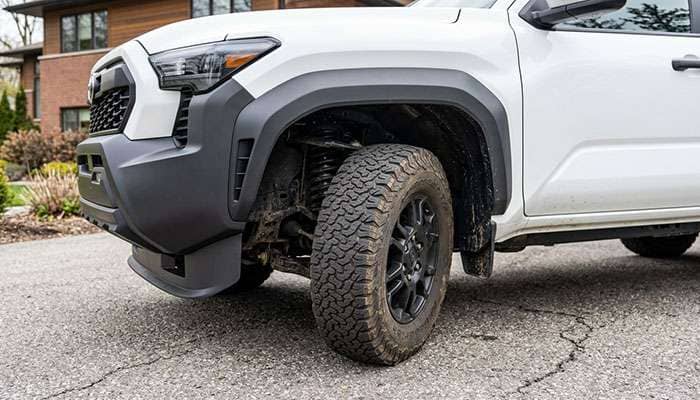
2023+ WT, LT, and Z71: At stock height, a tire around 32 inches, such as a 255/75R17, is the practical ceiling. Fitment write-ups for these trucks report a 275/60R20 working after a leveling kit of about an inch. A 285/70R17 wants more than that, plus a wheel that places it correctly.
2023+ Trail Boss: No lift required for a 33. The factory 2-inch lift and wider track already make the room, and the factory 20-inch 33 proves it.
2023+ ZR2: Already on 33s. The question on a ZR2 is 34s and 35s, and the Bison is Chevrolet's answer for 35s.
2015-2022 non-ZR2: A 265/70R17, about 31.6 inches, is already a tight fit at stock height, and some owners report mild rubbing with it. A 2 to 3-inch lift is the usual route to a 285/70R17 on factory wheels. For a 33 wider than about 10 inches, plan on 3 inches or more of lift and wheels in the 0 to -12 mm offset range.
2017-2022 ZR2: The 2-inch lift and 3.5-inch wider track give it more room than the standard trucks. Lift maker fitment guides put a 265/70R17 at the stock limit, a narrow 255/80R17 clearing with a leveling kit of about 1.25 inches, and a 285/70R17 needing trimming at that height. Some owners run 285/70R17s with no lift at all, but that is the edge of what fits.
The pattern is consistent. Lift helps, but width and offset decide it. A narrow 33 on a leveled truck often fits where a wide 33 on a lifted truck still rubs. If you are working out the tallest tire for your truck as it sits, our guide to the 33s on a stock Tacoma walks through the same width and offset logic on Colorado's closest competitor.
Yes, by an amount that depends on where you started. Going from a 30.1-inch 255/65R17 on a WT or LT to a 33.0-inch tire makes the tire 9.6 percent taller. At an indicated 65 mph you are doing about 71. The odometer undercounts by the same 9.6 percent, and the transmission, traction control, and stability systems all read a wheel speed that no longer matches the truck.
On a Trail Boss, the jump from a 32.1-inch factory tire to 33.0 inches is 2.8 percent, about 67 mph at an indicated 65. That is within what most owners live with, and the factory 20-inch 33 was calibrated from the plant. On a 2023+ ZR2, a factory 33 is already accounted for.
The bigger jumps change more than the speedometer. A taller tire acts like a numerically lower final drive, so the truck accelerates more slowly and the transmission may hunt between gears on grades. Our guide to bigger tires and your speedometer covers recalibration and how far off you can drive before it matters.
A 33 that almost fits costs you in steps. Each one costs more than the one before it.
Work through this before you buy anything.
A 33 fits a stock 2023-and-newer Colorado Trail Boss, and the ZR2 already runs one. On a 2023+ WT, LT, or Z71, and on a 2015-2022 truck outside the ZR2, 33s need a level or lift, and the width of the 33 matters more than the height. The 2023 redesign changed the bolt pattern from 6x120 to 6x139.7, so wheels do not carry over between generations. And the 33 you pick sets the load range: the ZR2's factory tire is a Load Range C, while most replacement 285/70R17s are Load Range E. Pick the generation, then the width, then the load range, and the right 33 is usually obvious.
On a 2023 or newer Trail Boss, yes, and the ZR2 already runs 33s from the factory. On a 2023+ WT, LT, or Z71, and on 2015-2022 trucks outside the ZR2, 33s need a leveling kit or lift.
The 2023 and newer Trail Boss runs an LT275/65R18, about 32.1 inches tall, on 18-inch wheels. The optional 20-inch package uses a 275/60R20, about 33 inches tall.
The 2023 and newer ZR2 runs LT285/70R17 116/113Q Load Range C tires, about 32.7 inches tall. The 2017-2022 ZR2 ran LT265/65R17 tires, about 30.6 inches tall.
On a 2023+ WT, LT, or Z71, about 32 inches, such as a 255/75R17. On 2015-2022 non-ZR2 trucks, a 265/70R17 at about 31.6 inches is already a tight fit.
No. The 2015-2022 Colorado uses a 6x120 bolt pattern, and the 2023 and newer Colorado uses 6x139.7. The wheels do not interchange in either direction.
On a 2023+ WT, LT, or Z71, yes, usually about an inch for a narrow 33 like a 275/60R20. A Trail Boss or ZR2 does not need one. Wider 33s need more lift and a lower wheel offset.



