
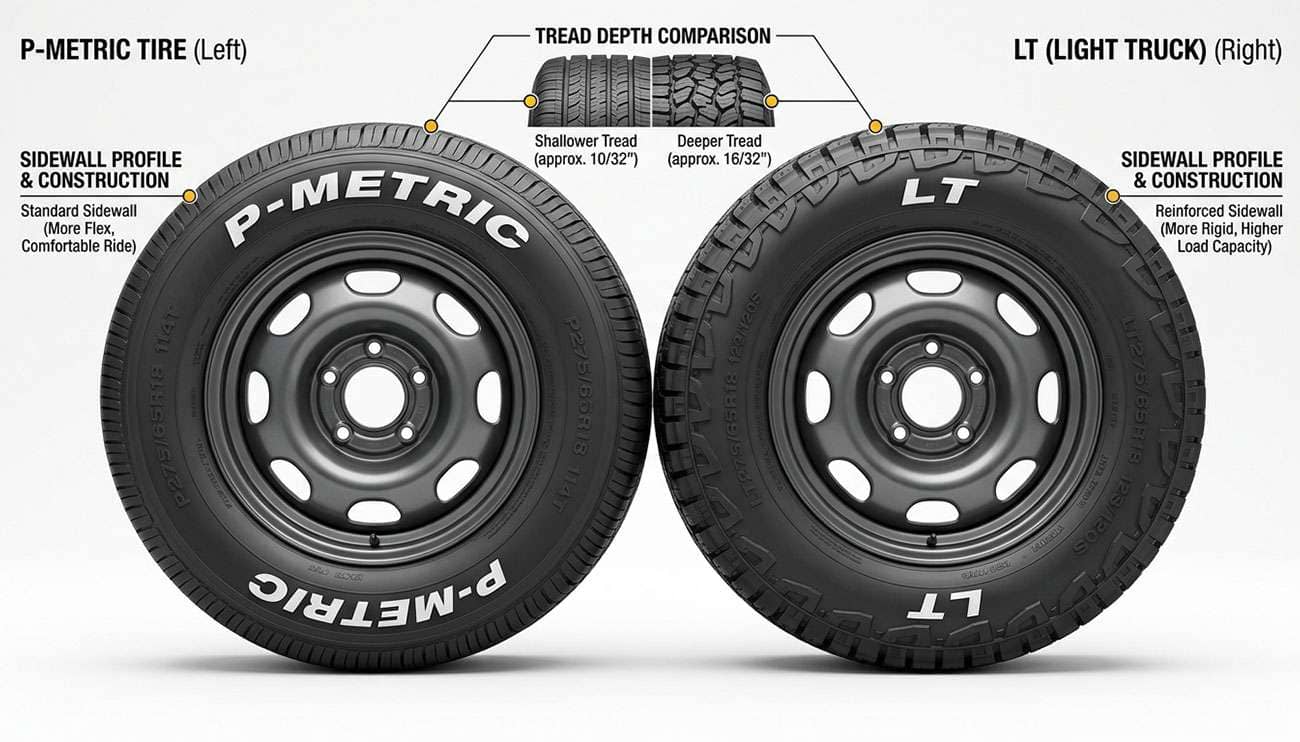
The call comes in about twice a week. F-150 owner is replacing his factory tires, walked into a tire shop, and the salesperson is pushing him toward LT-metric. His truck came with P-metric from the factory and they've worked fine for 45,000 miles. Does he really need to switch?
The answer depends entirely on what he's doing with the truck. The factory equipment was engineered around a specific use case — daily driving, modest payload, occasional light towing. If that's still what the truck does, P-metric is the right call and the salesman is selling him more tire than he needs. If anything has changed — bigger trailer, regular hauling, off-road work, lift kit and bigger tires — the math shifts toward LT.
This article walks you through the construction differences that actually matter, the load-capacity formula that decides whether your current tires can handle your towing, and the use-case framework I'd apply if you handed me your VIN and your trailer weight. By the end you'll know what your truck actually needs, not what the tire shop's commission structure tells you to buy. If you've already gone bigger on tires, the lift kit tire size chart covers the diameter side of this decision.
The first letter (or absence of one) at the start of a tire size tells you which engineering standard the tire was built to. This is more than a label — it determines internal construction, allowable pressure, and how load capacity is calculated.
P-metric tires start with a "P" and follow the United States passenger car standard. P275/65R18 is a P-metric tire. They're engineered for passenger vehicles — cars, SUVs, and light-duty pickups that aren't expected to carry heavy loads or tow large trailers. The construction prioritizes ride comfort, fuel economy, and quiet highway performance.
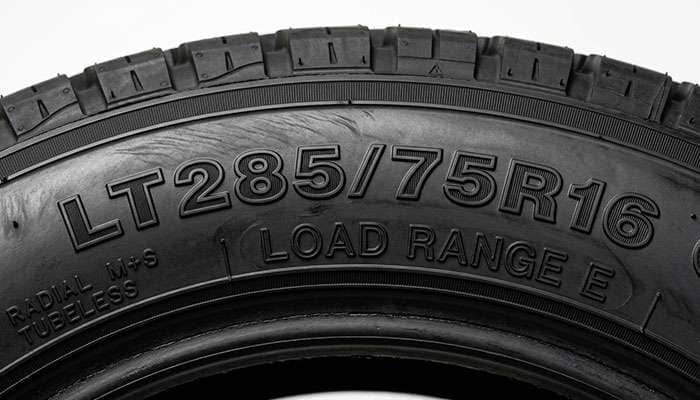
LT-metric tires start with "LT" and follow the United States light truck standard. LT275/65R18 is an LT-metric tire. They're engineered for trucks and SUVs that work for a living — towing, hauling, off-road duty, and any application where load capacity, sidewall durability, and heat resistance matter more than ride comfort. For more on what each part of a tire size code means, the basics matter when you're comparing across the two standards.
Euro-metric tires have no letter prefix. 275/65R18 with no letter is a Euro-metric, often called metric passenger. They're built to European Tyre and Rim Technical Organisation specs and are very similar to P-metric in practice. The main practical difference is that Euro-metric tires don't get the load derating that P-metric tires require when fitted to a light truck (more on that below).
You'll also see "ST" on trailer tires (Special Trailer) and "T" on temporary spares. Neither applies to the main P vs LT decision but worth recognizing on a sidewall.
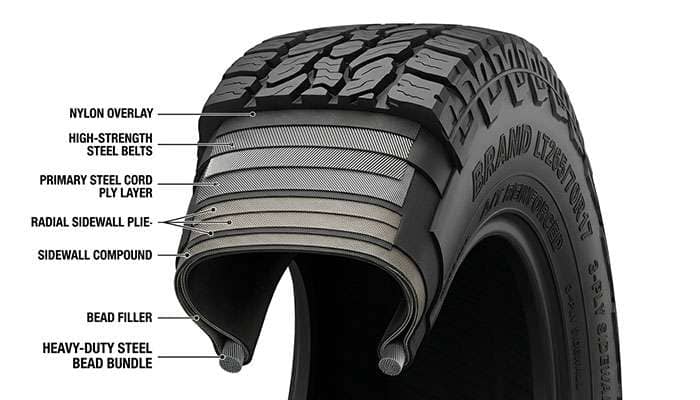
The P vs LT distinction isn't cosmetic — the tires are built differently from the bead up. Five physical differences explain everything about why one is right and the other is wrong for a given application.
1. Sidewall plies. P-metric tires typically have two body plies in the sidewall. LT tires have two to four, depending on load range. More plies means a stiffer sidewall, better impact resistance, and higher load capacity at the cost of ride compliance.
2. Bead bundle. The bead is the steel wire bundle inside the inner edge of the tire that seats against the wheel. LT tires use heavier bead bundles to handle the higher inflation pressures and the loads they're rated for. It's a small detail that matters when you're at the upper end of what the tire can carry.
3. Maximum inflation pressure. A standard P-metric tire typically tops out at 35–44 psi. An LT tire can run anywhere from 50 psi (Load Range C) up to 80 psi (Load Range E) at maximum load. Higher pressure capacity means higher load capacity, and it's why LT tires need a higher-pressure inflation setup at the shop.
4. Load range designation. P-metric tires use Standard Load (SL) or Extra Load (XL) designations. LT tires use Load Range letters — C, D, E, and F — which correspond to ply ratings. The SL versus XL choice on a P-metric tire is a milder version of the same decision, but the gap between any P-metric and an LT Load Range E is significant.
5. Tread compound and depth. LT tires usually run deeper tread and a stiffer compound to resist heat buildup under load. P-metric compounds are tuned for low rolling resistance and quiet operation. The compound difference is part of why LT tires cost you MPG and ride softness.
Here's the part nobody at the tire shop will explain unless you ask, and it's the one that decides safe towing.
Every tire has a load index — a two- or three-digit number after the size that maps to a maximum load capacity at maximum pressure. A 116 load index = 2,756 pounds per tire. A 121 load index = 3,197 pounds. The relationship between load range and load index is critical here — load range tells you ply construction, load index tells you actual load capacity.
Here's the catch with P-metric tires on a light truck. The Tire and Rim Association requires you to derate the load capacity by approximately 10% (a factor of 1.10) when a P-metric tire is fitted to a light truck or SUV. A P-metric tire with a load index of 116 (2,756 lb capacity) is treated as having 2,505 lb capacity on a truck. That's the math your factory used to engineer in the safety margin.
LT tires don't get derated because they were built for trucks to begin with. An LT tire with a load index of 121E carries its full rated capacity on the truck.
Worked example. A 2022 F-150 with a 7,200 lb GVWR has front axle weight around 3,400 lb and rear around 3,800 lb under load. Each tire needs to carry about 1,800 lb up front and 1,900 lb in the back. A factory P275/65R18 with a 116 load index → derated to 2,505 lb per tire → handles it easily under daily driving. But add a 6,500 lb trailer with 650 lb of tongue weight on the rear axle, and the rear axle load jumps to about 4,450 lb (2,225 per tire). Now you're inside 90% of the derated capacity. Add a hot day, a long grade, and underinflation, and you're in trouble.
Same truck on LT275/65R18 with a 121E load index → 3,197 lb per tire, no derating → enormous margin even under full towing load. That's the difference.
The cleanest way to make the P-versus-LT decision is by trailer weight. Below a certain threshold, P-metric handles the load with margin. Above it, you need the LT.
Trailer Weight |
Tire Recommendation |
Load Range |
Notes |
|---|---|---|---|
Under 3,000 lb |
P-metric is fine |
SL or XL |
Small utility trailer, jet ski, light boat |
3,000–5,000 lb |
P-metric XL or LT |
XL or Load Range C |
Borderline; LT recommended for regular use |
5,000–7,500 lb |
LT required |
Load Range D |
Large boat, mid-size travel trailer, dual ATV |
7,500–10,000 lb |
LT required |
Load Range E |
5th wheel, large travel trailer, equipment trailer |
10,000+ lb |
LT or HD truck tire |
Load Range E or F |
Heavy-duty truck application; consider 3/4-ton or larger |
One caveat. This chart assumes the truck itself is rated to tow the weight you're pulling. A half-ton truck with a 10,000 lb tow rating handles 9,000 lb safely on LT Load Range E tires. The same trailer behind an underrated truck is a safety problem regardless of what tires you mount.
Switching from P-metric to LT isn't free. The construction that makes LT tires tough also makes them heavier, stiffer, and less efficient. Three real costs to factor.
MPG drops 1 to 2.5 miles per gallon. The additional rubber and steel in the sidewall, plus the heavier tread compound, increases rolling resistance and unsprung weight. A truck that gets 21 MPG on P-metrics typically gets 19–20 MPG on LTs of the same size. Over 20,000 miles a year at $3.50/gallon, that's roughly $300–$700 in additional fuel cost.
Ride quality gets stiffer. The reinforced sidewalls don't compress as much over bumps. You'll feel road imperfections more, especially with the LT inflated to its high recommended pressure. The fix many owners use is running lower-than-max pressure when not towing — back off to around 45–50 psi on a Load Range E that maxes at 80 psi. That recovers some compliance without compromising safety, as long as you re-air before any heavy load.
Road noise increases. The deeper, stiffer tread compound generates more highway noise. Some all-terrain LTs are remarkably quiet; aggressive mud-terrain LTs are loud enough to dominate the cabin at 70 mph.
The trade-off math: if your truck never tows or hauls heavy, the LT cost in MPG and ride quality will always exceed the benefit. If you tow regularly, the safety margin and sidewall durability justify the trade easily.
Here's the framework I'd apply to any customer who asks. Find the row that matches what you actually do with the truck.
Daily commuter, no towing. P-metric SL or XL. The factory tire is fine. Don't let anyone upsell you to LT — you're paying MPG and ride comfort for capacity you won't use.
Daily driver with occasional light towing (under 3,000 lb). P-metric XL. The Extra Load designation gets you about 5–10% more capacity than Standard Load without the LT cost penalty.
Regular towing 3,000–5,000 lb. LT Load Range C. You're now firmly in light truck territory. C-rated LTs aren't dramatically heavier than P-metrics, ride reasonably, and give you the safety margin and sidewall durability you'll appreciate at the trailer hitch.
Heavy towing 5,000+ lb or regular hauling. LT Load Range D or E. Don't compromise here. The 10-ply vs 12-ply decision falls inside the Load Range E to F bracket and affects how much margin you carry.
Off-road or work truck. LT Load Range E minimum. Sidewall puncture resistance is the key feature, not load capacity. Off-road work eats sidewalls that aren't built for it.
Lifted truck with 35"+ tires. LT-only. Most aftermarket off-road tires in 35" and up only come in LT construction anyway, so the decision is made for you. The construction matches the use case.
Concrete examples from current PPT inventory at the most common factory truck size — 275/65R18 — across the use-case spectrum.
For the daily-driver F-150 / Silverado / Ram / Tundra that rarely tows: The factory-style P275/65R18 in an all-season highway tire. Most OE replacements at this size are P-metric SL or XL. Tires like the Bridgestone Dueler H/L Alenza Plus, Michelin Defender LTX M/S (P-metric versions), or Goodyear Wrangler Fortitude HT keep ride quality and MPG close to stock and handle daily duty cleanly.
For the half-ton with occasional 4,000 lb towing: An LT275/65R18 Load Range C or D all-terrain. The Falken Wildpeak A/T4W in this size strikes a strong balance — reasonable highway noise, three-peak severe snow rating, and the LT construction that gives you margin under load. The BFGoodrich All-Terrain T/A KO3 in LT275/65R18 is the safest pick for the broadest mix of conditions.
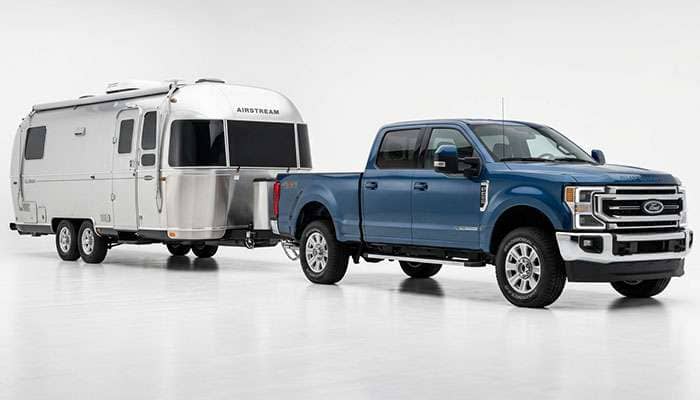
For the regular tow rig pulling 7,000 lb fifth-wheel or travel trailer: LT275/65R18 or LT275/70R18 in Load Range E. The BFGoodrich KO3 and Falken Wildpeak A/T4W are both available in Load Range E. The Toyo Open Country A/T III in LT load ratings is another popular choice — slightly quieter on highway, slightly less aggressive off-road. For heavier mud-terrain duty under load, the BFGoodrich Mud-Terrain T/A KM3 in LT goes deeper but at the cost of MPG and noise.
For the lifted truck on 35s towing or working hard: LT35x12.50R17 or LT285/70R17 in Load Range E. The KM3, the KO3, the Wildpeak A/T4W, the Cooper Discoverer STT Pro, and the Mickey Thompson Baja MTZ all have offerings at this size and load range.
Three errors I see in the shop more than any others.
Downgrading from LT to P-metric to save money or improve ride. If your truck came from the factory with LT tires, the engineering team built around that capacity. Replacing them with P-metrics drops your effective tow rating, payload, and sidewall durability — usually without the owner knowing it. The truck still drives normally until you load it heavy and discover the limit. This is the single most dangerous mistake on the list. Never go from LT to P on a truck that needs LT.
Mixing P-metric and LT on the same truck. Different sidewall stiffness, different load capacity, different inflation pressures. You'll get uneven wear, unpredictable handling under braking, and an effective load capacity limited to whichever tire is weaker. Always replace all four tires at once when changing from one designation to the other.
Running LT tires at P-metric pressures. An LT Load Range E tire inflated to 35 psi (P-metric pressure) flexes excessively under load, builds heat, and can blow out. The factory door-jamb placard pressure assumes P-metric construction. If you've switched to LT, look at the LT tire's own load/pressure table on the manufacturer's website to find the right pressure for your axle weight. As a rule of thumb, LT Load Range E unloaded sits around 50–55 psi, climbing to 65–80 psi when towing or hauling heavy.
The P-versus-LT question isn't about prestige or capability — it's about matching the tire to the load. P-metric is the right answer for the majority of half-ton truck owners who use their trucks like cars. LT is the right answer for anyone who actually works the truck. The trap is that both groups get pitched the wrong tire by salespeople who don't know which one you are.
If you commute and run errands, stay with P-metric and don't apologize for it. If you tow 5,000 lb or more on any regular basis, run LT and don't apologize for that either. If you're in the middle — occasional towing, mixed use — the XL load range on a P-metric or the Load Range C on an LT both work, and the right answer depends on which compromise you prefer.
The math is what decides. Your trailer weight, your load index, and the derating rule. Once you've run those numbers, you'll know which row of the chart applies. Then it's just shopping.
Check the sidewall of one of your current tires. If the size starts with a P (like P275/65R18), it's P-metric. If it starts with LT (like LT275/65R18), it's LT. If there's no letter at all (just 275/65R18), it's Euro-metric, which behaves similarly to P-metric. You can also check the door jamb placard, which lists the original tire size and the recommended inflation pressure.
Yes, as long as you maintain the same overall diameter and use a load index equal to or higher than the original. The LT tire will give you more load capacity, better sidewall durability, and improved towing performance at the cost of about 1 to 2.5 MPG and a stiffer ride. Adjust inflation pressure based on the LT tire's load/pressure table rather than the P-metric door jamb spec — running an LT at P-metric pressure causes excessive sidewall flex and heat buildup.
Strongly not recommended. If your truck came with LT from the factory, the engineering team designed around that capacity. P-metric replacements will drop your effective tow rating, payload capacity, and sidewall durability — possibly without you realizing it until the truck is loaded heavy. The factory wouldn't have specified LT if the truck didn't need it.
Load Range letters correspond to ply ratings and max inflation pressure. Load Range C is 6-ply equivalent, typically maxing at 50 psi, suited for light truck duty under 5,000 lb of towing. Load Range D is 8-ply equivalent, maxing at 65 psi, suited for towing in the 5,000 to 7,500 lb range. Load Range E is 10-ply equivalent, maxing at 80 psi, required for heavy towing above 7,500 lb. Load Range F is 12-ply for the heaviest applications.
Yes. The door jamb placard assumes P-metric construction. An LT tire run at P-metric pressures (typically 35–40 psi) will flex too much, build excessive heat, and wear unevenly. Look up the LT tire manufacturer's load/pressure table for your specific tire and axle load. As a rule of thumb, Load Range E LTs unloaded sit around 50–55 psi, climbing to 65–80 psi when towing heavy.
LT tires typically cost 15 to 30 percent more than their P-metric equivalents in the same size and tread design. The premium pays for the additional construction — more sidewall plies, heavier bead bundles, stiffer compound. Over the life of the tire, the MPG difference adds another $300 to $700 per year depending on miles driven and fuel cost. Factor both into your total cost of ownership before switching.



