
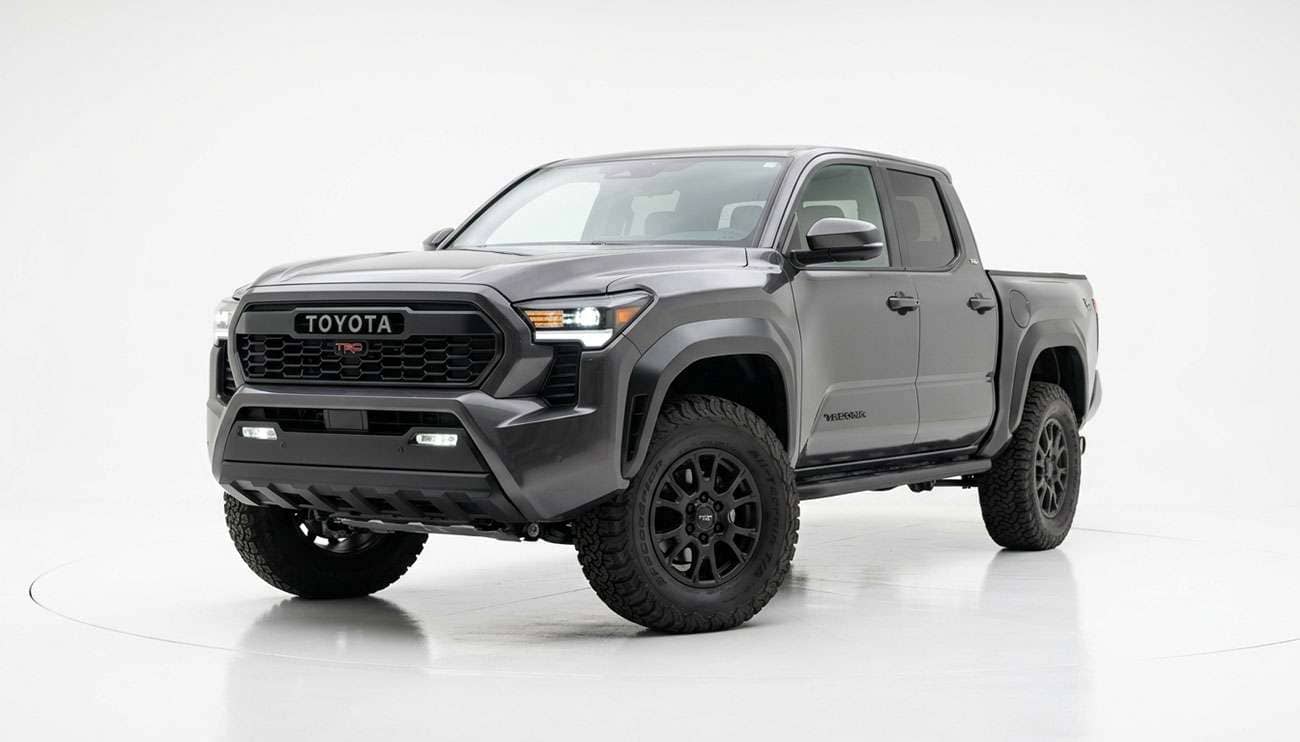
On a stock Tacoma, whether a 33 fits comes down to two numbers that rarely appear on a fitment chart: your wheel's offset and the tire's load index. A 285/70R17 mounted on the factory wheel sits roughly two and a quarter inches further inboard than the same tire on a 17x9 aftermarket wheel. And an LT tire running at the door placard pressure squats wider and shorter than the size chart says it should. Diameter is the smallest variable in the equation.
Most guides answer this question by asking which generation you drive. Generation does matter, and we will get to it. But two owners with the same year truck and the same 285/70R17 routinely report opposite results, and generation cannot explain that. What explains it is that one of them bought wheels and the other did not, and one of them is running 35 psi in a Load Range E tire while the other is running 50.
Here is where a 285-width 33 actually sits, keyed to the wheel it is bolted to rather than the year on the title.
Front wheel |
Tire position vs. factory |
What to expect on stock suspension |
|---|---|---|
Factory 17x7.5, +25 to +30mm (2nd and 3rd gen) |
Baseline, tucked in |
Mud flap removal plus fender liner trim; cab mount contact at full lock is common |
Factory 18x8, +55 to +60mm (4th gen base trims) |
About 1 in. further inboard |
Minor liner or bumper tab work; the cab mount stays out of the way |
Aftermarket 17x8.5, 0mm offset |
About 1.6 in. further outboard |
Liner trim plus pinch weld work; cab mount contact likely on 2nd and 3rd gen |
Aftermarket 17x9, -12mm offset |
About 2.3 in. further outboard |
Trimming plus cab mount work on 2nd and 3rd gen; noticeable on 4th gen too |
Factory wheel with a 1.25 in. spacer |
Exactly 1.25 in. further outboard |
Clears the upper control arm, moves the contact to the fender instead |
That table spans about three and a half inches of lateral tire position. No 33-inch tire on the market varies by more than half an inch in diameter. The wheel is doing seven times as much work as the tire.
A 33 is a marketing round-off, not a measurement. Tire manufacturers will call anything between roughly 32.6 and 33.1 inches of overall diameter a 33, which means the sizes Tacoma owners discuss under that one label are not the same tire in any meaningful sense.
The sizes people mean are 285/70R17 at about 32.7 inches, 285/75R16 at about 32.8 inches, 265/70R18 at about 32.6 inches, the narrow 255/85R16 and 255/80R17 at about 33.1 inches, and the flotation sizes 33x10.50R17 and 33x12.50R17 at a flat 33.00 inches by definition. Across that whole family, diameter varies by under half an inch. Section width varies by two and a half inches, from just over ten inches on the 255s to a full 12.5 on the wide flotation size.
Width is the dimension that determines whether you cut plastic. Height is the dimension everyone talks about. That mismatch is most of the confusion in this topic, and it shows up again when you look at what each size can actually carry.
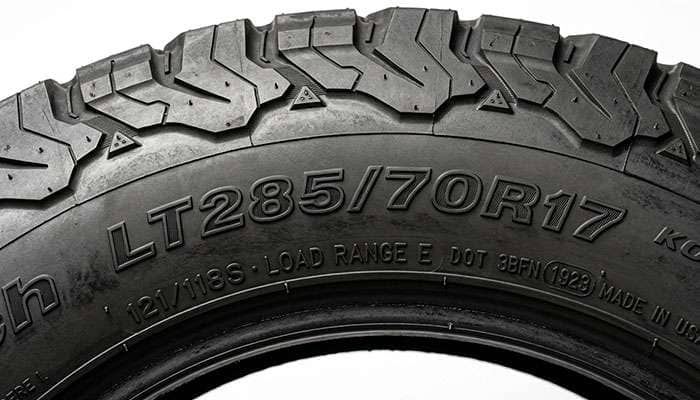
Here is the capacity picture across the 33 family, which is where the buying decision actually lives.
Size |
Typical construction |
Load index range |
Rated capacity per tire |
|---|---|---|---|
265/70R17 (common factory size) |
P-metric and LT both sold |
113 to 123 |
2,535 to 3,417 lb |
285/70R17 |
Mostly LT |
116 to 126 |
2,756 to 3,748 lb |
285/75R16 |
LT only |
116 to 126 |
2,756 to 3,748 lb |
265/70R18 |
P-metric and LT both sold |
113 to 124 |
2,535 to 3,527 lb |
255/80R17 |
LT only |
121 to 123 |
3,197 to 3,417 lb |
255/85R16 |
LT only |
112 to 129 |
2,469 to 4,079 lb |
33x12.50R17 |
LT flotation only |
114 to 124 |
2,601 to 3,527 lb |
Read the right-hand column again. Inside the single size 285/70R17, the spread between the lightest-rated tire and the heaviest is nearly a thousand pounds per corner. Two owners can both say they are running a 285/70R17 and be describing tires that differ by four thousand pounds of capacity across the truck. That is not a rounding difference. That is the difference between a tire that meets your truck's axle rating with margin and one that does not.
Offset is the distance from the wheel's mounting face to its centerline. Positive offset pulls the wheel inboard toward the suspension. Negative offset pushes it outboard toward the fender. That much is standard. What is missing from most fitment discussions is the arithmetic that turns offset into clearance.
The outboard edge of a wheel sits at half its width, minus its offset, measured from the hub face. Run that on a factory 17x7.5 with +27mm of offset and the outer flange sits about 2.7 inches out from the hub. Run it on a 17x9 with -12mm and it sits about 5.0 inches out. The difference is 2.3 inches, and every bit of it goes straight toward the fender liner.
Rim width does a second thing on top of that. A tire's stated section width is measured on one specific rim, and the tire spreads as the rim gets wider. The working figure across the industry is about 0.2 inches of section width for every half inch of rim width. Move a 285/70R17 from a 7.5-inch factory wheel to a 9-inch aftermarket wheel and the tire itself grows roughly 0.6 inches wider, half of which pushes further outboard again. The same tire, the same size code, three quarters of an inch wider in reality.
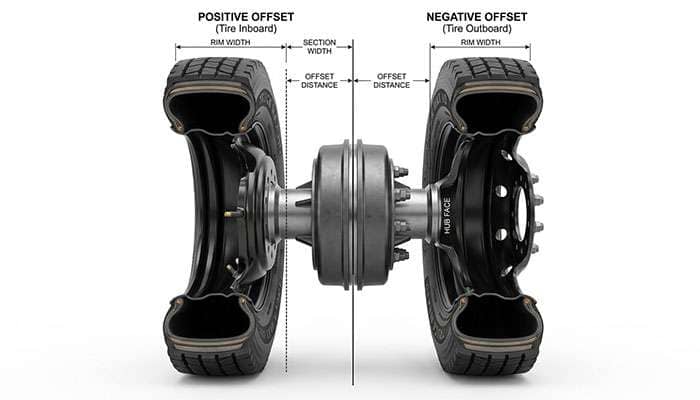
This is why aggressive wheels and big tires are a package deal in the worst sense. Owners buy the 17x9 with negative offset because it looks right, and then discover the tire that would have cleared on the factory wheel now needs a cab mount chop. The wheel caused the problem, and the tire gets blamed. If your goal is the largest tire with the least cutting, the factory offset is the most valuable thing you own. Our guide to the 17x9 negative offset setup walks through what that stance actually costs in clearance, and the Toyota Tacoma aftermarket wheels fitment guide covers the offset ranges worth shopping.
Spacers behave the same way with one wrinkle. A 1.25-inch spacer moves the tire exactly 1.25 inches outboard and gains you nothing inboard, because the wheel's own geometry has not changed. Spacers solve upper control arm contact. They make fender contact worse. If your rub is at the liner, a spacer is the wrong tool.
Here is the part of this decision that gets skipped almost universally, and it has consequences well past whether you hear a scuff at full lock.
Under FMVSS 110, the federal standard governing tire selection, the combined load rating of the tires on each axle has to meet or exceed that axle's gross axle weight rating. Your door placard lists the original tire size and the cold inflation pressure that produces the required capacity. Both halves of that statement matter. The pressure on the placard is correct for the tire on the placard. Change the tire and the pressure is no longer a given.
Two things happen when a Tacoma owner moves to a 33.
First, most 33-class sizes are sold in LT construction rather than P-metric. An LT tire reaches its rated capacity only at its rated inflation pressure. A Load Range E carries its full number at 80 psi. A Load Range C carries its full number at 50 psi. At the Tacoma's placard pressure, typically in the low-to-mid thirties, an LT tire is carrying a fraction of what its load index advertises. The load index on the sidewall is a ceiling, not a promise.
Second, the Tire and Rim Association applies a derate when a P-metric passenger tire is fitted to a light truck, pickup, or multipurpose vehicle. The tire's load rating is divided by 1.10, a reduction of about nine percent. A P-metric tire with a load index of 113 is rated for 2,535 pounds on a car and roughly 2,300 pounds on your Tacoma. If you are cross-shopping a P-metric 33 against an LT 33 on load index alone, you are comparing numbers that are not measured the same way.
The practical outcome is uncomfortable but simple. It is entirely possible to buy the most popular 33 on the market, bolt it on, set it to the door placard pressure, and end up with less usable load capacity at each corner than the factory tire you removed. The tire is bigger, more expensive, and rated higher on paper, and it is carrying less.
The fix costs nothing. Pull the load and inflation table for the exact tire you are buying, find the pressure that delivers at least the capacity your placard requires, and set your cold pressures there. On an LT tire on a Tacoma that is frequently in the mid-forties rather than the low thirties. The Tire Industry Association has pushed this point for years in its technician training, and it is the single most valuable thing in this article.
Now the two halves connect, and you get the mechanism behind every contradictory owner report you have read.
A tire is a pressure vessel. Its shape under load is set by inflation pressure, not by the numbers stamped on it. Drop the pressure and the sidewall deflects more. The tire squats, which reduces its loaded diameter below its free-standing diameter, and it bulges, which increases its loaded section width above its free-standing width. The tire gets shorter and fatter as pressure comes down.
That is why a 32.7-inch tire never measures 32.7 inches on the truck. Loaded diameter on a light truck tire typically runs about three quarters of an inch under the free-standing figure, and further under it as pressure drops. Clearance math done on the catalog diameter is measuring a tire that is not touching the ground.
Put the pieces together. An owner running an LT285/70R17 Load Range E at the placard's 32 psi has a tire that is sitting noticeably wider at the shoulder and squatting lower in the wheel well than the same tire at 45 psi. Under compression, at full steering lock, that extra width is exactly where the fender liner and the cab mount live. The owner at 45 psi reports it clears. The owner at 32 psi reports it rubs. Same truck, same tire, same wheel. Different pressure.
Independent front suspension compounds it. On the Tacoma, the tire and the fender move together as the suspension cycles in a straight line, so the tightest clearance is never the parked measurement. It shows up when you combine steering angle with compression: turning into a steep driveway, articulating over a rock, or taking a dip with weight in the bed. Anything you measure in a level garage is the most optimistic reading you will ever get.
If you are already hearing contact, our walkthrough of why your tires are rubbing helps you place the noise before you start cutting anything.
A 33 does not contact everywhere at once. It works through the wheel well in a predictable order, and knowing the order tells you how much work your specific truck needs rather than how much work the internet says a Tacoma needs.
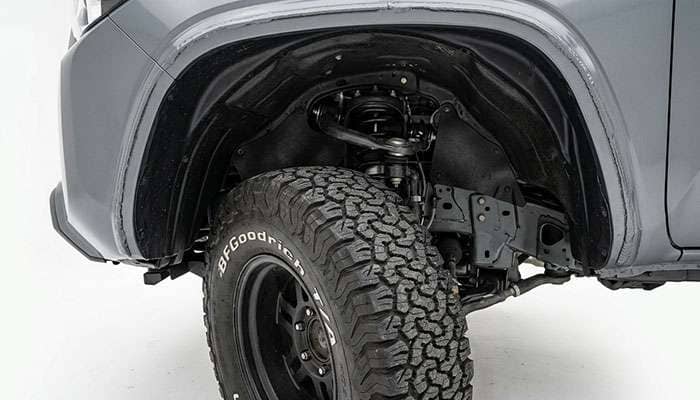
The mud flap goes first. It is plastic, it hangs into the path, and removing it is free and reversible. On a mild 33 upsize with factory wheels, that is occasionally the whole job.
The fender liner is next. The inner plastic liner catches the wider tire at steering lock, and trimming or heat-forming it is an afternoon with hand tools. Behind it is the pinch weld, the folded seam along the bottom lip of the fender, which gets rolled rather than cut.
The cab mount is the real fork in the road on 2nd and 3rd generation trucks. It is the body bracket just behind the front tire, it is steel, and it is what a 285-width tire strikes when you turn hard. Cutting or relocating it is permanent metalwork, not trim work, and it is the line between an upsize and a project. On 4th generation trucks the wheel opening geometry moved and the cab mount is largely out of the picture for a 33.
The upper control arm is last and it is mostly a lift and long-travel concern rather than a stock suspension one. If you are catching the control arm on a stock truck, look at your wheel offset before you look at anything else.
Generation sets which of these rungs you start on. A 4th generation truck on base off-road trims runs high factory offset and a forgiving opening, which puts most owners at mud flaps and minor liner work. A 3rd generation truck on factory wheels sits a rung or two higher. The same 3rd generation truck on 17x9 wheels with negative offset jumps to the top of the ladder, which is the outcome most owners did not plan for when they bought the wheels.
Contact is not cosmetic and it does not stay where it started. The progression is consistent enough to name.
It opens with liner scuffing, which is noise and a wear mark. Left alone, the liner tears at its fasteners and begins flapping at highway speed, at which point it starts catching the tire on every compression rather than only at lock.
Then the contact moves to the pinch weld, and this is where it stops being a plastic problem. The pinch weld is a folded steel seam with an edge on it. Repeated sidewall contact against that edge abrades the sidewall rubber, and sidewall rubber is the thinnest structural area on the tire. Once abrasion reaches the casing cords there is no repair, because a sidewall cannot be patched or plugged. If you are seeing scuffing on a sidewall, our guide to tire sidewall damage and whether it is safe to drive is worth reading before your next trip.
Running the tire underinflated to soften the contact makes all of it worse. An underinflated LT tire builds heat in the shoulder, wears the outer ribs faster than the center, and at sustained highway speed heat is what drives belt and tread separation. NHTSA has documented underinflation as a leading contributor to tire failure for years, and an oversized LT tire at passenger-car pressures is underinflated by any measure that matters.
Where the cab mount is involved, contact breaches the paint on a structural body bracket. That is a rust site in a load-bearing area, and it is behind the fender where nobody looks at it until the repair is structural.
Finally there is the drivetrain arithmetic, which is mild at 33s but real. A 285/70R17 is about three and a half percent taller than a stock 265/70R17, so your speedometer reads roughly that much low and your effective gearing goes slightly taller. Most owners live with it. Our articles on how bigger tires affect your speedometer and whether to regear after bigger tires cover where that stops being tolerable, which is usually a 35-inch conversation rather than a 33-inch one.
Every item on that ladder is avoidable by buying the size your wheel offset supports, at a load index that meets your axle rating, and inflating it to the pressure its own load table specifies. None of that costs extra. It just has to be decided before the order goes in rather than after.
Work through this in order. It takes about twenty minutes and it replaces every contradictory forum thread on the subject.
Read your door placard. Write down the original tire size, the cold inflation pressures, and the front and rear gross axle weight ratings. Those numbers are your target, not a suggestion.
Find your wheel's real specs. Diameter, width, and offset are usually cast or stamped on the inner barrel or the back of the spokes. If you bought the wheels, check the invoice. Do not assume factory offset unless the wheels are factory.
Do the outboard math. Half your rim width minus your offset, converted to the same units, gives you the outer edge position from the hub face. Compare that against the factory figure. Anything more than about an inch and a half outboard of stock puts you on the trimming ladder regardless of which 33 you choose.
Pick the width before the height. Every 33 is within half an inch of every other 33 on diameter. They are not within two and a half inches of each other on width. On 2nd and 3rd generation trucks, the narrow 255-width 33 clears with dramatically less cutting than a 285, and it is actually the taller tire.
Check the load index against your placard. Confirm the tire's rated capacity meets the per-tire requirement implied by your axle rating, and remember the 1.10 derate if you are looking at a P-metric option.
Pull the load and inflation table. Find the cold pressure that delivers your required capacity on that specific tire, and set your pressures there rather than at the placard number. Reset your TPMS thresholds to match.
Test it turned and loaded. Before you commit to trimming, cycle the steering to full lock both directions with weight in the bed and roll over a driveway lip. A tire that clears parked and straight tells you almost nothing.
If you would rather see the general ceiling before you get into specifics, our article on the biggest tire you can run without a lift covers the same reasoning across other platforms.
Will 33s fit a stock Tacoma without a lift? On a 4th generation truck with factory wheels, usually, with mud flap removal and minor liner work. On a 2nd or 3rd generation truck with factory wheels, a narrow 255-width 33 gets close to bolt-on and a 285-width 33 means trimming and often cab mount work. On any generation with 17x9 negative-offset wheels, you are trimming, because the wheel moved the tire two and a quarter inches toward the fender before the tire had any say in it.
And whichever one you land on, the load index and the inflation pressure that supports it are the difference between a 33 that carries your truck properly and one that squats into the liner and wears its shoulders off. That is not a fitment detail. It is the tire doing its actual job.
When you are ready to shop the size your setup supports, our all-terrain tire selection lets you compare load index and load range side by side before you buy.
Yes on a 4th generation truck with factory wheels, typically with mud flap removal and minor fender liner work. On 2nd and 3rd generation trucks a narrow 255-width 33 comes close to bolt-on, while a 285-width 33 generally needs liner trimming and often cab mount work. Aftermarket wheels with low or negative offset move every one of those answers up a rung.
The common metric equivalents are 285/70R17 at about 32.7 inches, 285/75R16 at about 32.8 inches, 265/70R18 at about 32.6 inches, and the narrow 255/85R16 and 255/80R17 at about 33.1 inches. The flotation sizes 33x10.50R17 and 33x12.50R17 are a flat 33.00 inches because a flotation code states the height directly rather than computing it.
Frequently on 2nd and 3rd generation trucks running a 285-width 33, especially at full steering lock with weight in the bed. Rarely on a 4th generation truck, where the wheel opening geometry keeps the cab mount out of the tire's path at 33-inch sizes. Keeping factory offset and choosing a narrower 33 is the most reliable way to avoid the cut entirely.
Not the door placard number. The placard pressure is calibrated to the original tire. For an LT replacement, pull the manufacturer's load and inflation table, find the cold pressure that delivers at least the capacity your gross axle weight rating requires, and set your pressures there. On a Tacoma running LT 33s that is often in the mid-forties rather than the low thirties.
Only for inboard contact. A spacer moves the tire outboard by its exact thickness, which clears the upper control arm but pushes the tire harder into the fender liner and pinch weld. If your contact is at the liner or the cab mount, a spacer makes the problem worse rather than better.
A 285/70R17 is about three and a half percent taller than a stock 265/70R17, so an indicated 70 mph is closer to 72.5 mph actual. Most owners correct it with a programmer and leave the gearing alone. Regearing generally enters the conversation at 35 inches, though a loaded truck that tows regularly on 33s can justify a mild ratio change.



