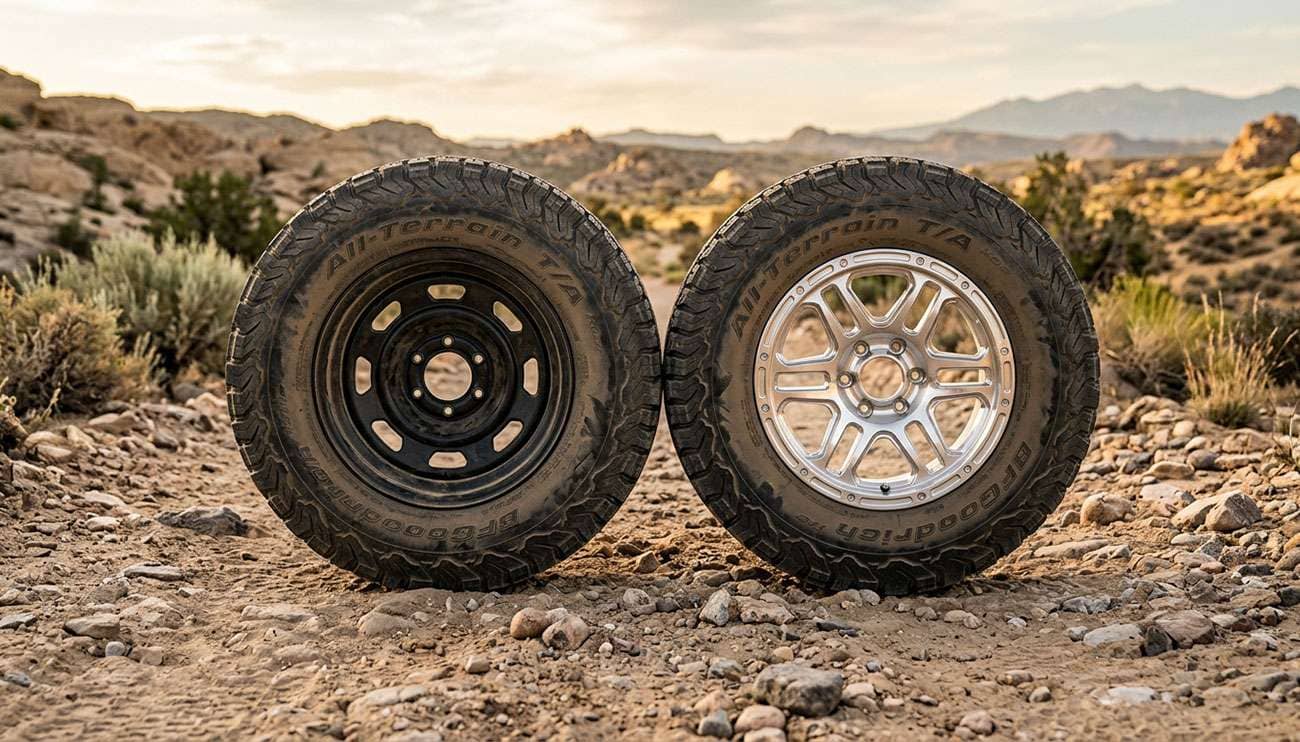
Steel rims are better off-road at one thing: how they fail. A steel wheel bends where a cast aluminum wheel can crack, and you can often hammer it back on the trail. But steel is not the stronger wheel on paper. The median 17-inch steel off-road wheel is rated at 2,100 pounds, against 2,500 for aluminum. Once your truck needs more than that, the load rating decides it before the material does.
Most answers to this question stop at "steel bends, aluminum cracks," then move on to weight and rust. All of that is true. The part nobody puts in front of you is capacity. I spend most of my week on fitment questions, and the first number I ask for is the one on your door sticker. Run that number against the wheels on the market and steel looks very different. Here is how it stacks up by construction, by axle weight, and by what actually fits your truck.
Find the wheel you are considering and read across. Load ratings are market medians for 17-inch off-road wheels.
Wheel |
When It Hits a Rock |
Trail Fix |
Median Load Rating |
Best Fit |
|---|---|---|---|---|
Steel |
Bends. Can still crack at welds or lug holes |
Hammer the flange, reseat the bead |
2,100 lb |
Remote trips and lighter 15- to 17-inch rigs |
Cast aluminum |
Takes small hits, then can crack or chip |
Rarely |
2,500 lb |
Most trucks and SUVs on moderate trails |
Flow-formed aluminum |
Barrel may bend, cast face can crack |
Limited |
2,500 lb |
Weight-conscious builds |
Forged aluminum |
Bends instead of breaking apart |
Limited, but a shop can often straighten it |
2,650 lb |
Hard use where budget allows |
Take the higher front or rear GAWR from your door sticker and divide by two. That is the floor. Our wheel load rating guide adds about 20 percent for towing and off-road use, so I do the same here. Then look at how much of the market clears that number.
Highest GAWR |
Typical Rig |
Minimum Per Wheel |
With 20 Percent Margin |
Steel That Clears It |
Aluminum That Clears It |
|---|---|---|---|---|---|
3,500 lb |
Jeep, mid-size pickup or SUV |
1,750 lb |
2,100 lb |
About 4 in 10 |
More than 9 in 10 |
4,000 lb |
Half-ton |
2,000 lb |
2,400 lb |
About 1 in 9 |
Nearly 9 in 10 |
4,800 lb |
Heavy half-ton |
2,400 lb |
2,880 lb |
About 1 in 20 |
About 1 in 8 |
6,000 lb |
Three-quarter ton, 8-lug |
3,000 lb |
3,600 lb |
About 1 in 14 |
About 2 in 3 |
The first three rows cover 16- and 17-inch five- and six-lug wheels. The last row covers 8-lug wheels. Look at the half-ton row. On a 4,000-pound axle, about 1 in 9 steel wheels clears the margin, and nearly 9 in 10 aluminum wheels do.
Not by the number you buy on. A load rating is what the maker says the wheel will carry per corner, and SAE J2530 is the common aftermarket test standard, with cornering fatigue, radial fatigue, and impact tests. On that scale, the steel off-road market sits well below aluminum at every common diameter.
Off-Road Wheels |
Steel Median |
Aluminum Median |
Steel at 2,500 lb or More |
Aluminum at 2,500 lb or More |
|---|---|---|---|---|
15-inch |
1,600 lb |
2,200 lb |
2 percent |
27 percent |
16-inch |
2,000 lb |
2,500 lb |
12 percent |
75 percent |
17-inch |
2,100 lb |
2,500 lb |
16 percent |
85 percent |
8-lug, all sizes |
2,200 lb |
3,640 lb |
27 percent at 3,000 lb |
95 percent at 3,000 lb |
This is a design choice, not a limit of the metal. Steel can carry enormous loads, and big-rig steel wheels prove it. Most steel off-road wheels are rolled and stamped for lighter duty, and many share roots with classic truck and Jeep designs. Stronger ones exist. A few crawler-style steel wheels reach 3,000 pounds in 17-inch 6-lug. You just have to look for them, because the heavier ratings are the exception.
Check that the rating is published at all. About 1 in 7 steel off-road wheels does not list one, against about 1 in 30 aluminum wheels. If you cannot find the number, you cannot run the math above.
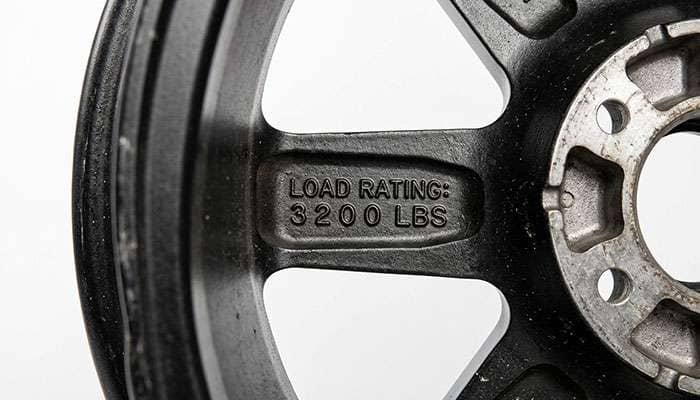
A lower rating does not make a wheel fragile. A 2,100-pound steel wheel can survive a hit that cracks a 2,500-pound cast wheel. Those are two separate questions: how much it carries all day, and what it does on the worst day. You need both answered, and on most trucks the first question comes first, because you live with it every mile.
It comes down to ductility, which is how far a metal stretches before it fractures. Wheel steel yields and moves when you overload it. Cast A356 aluminum has silicon in it for pouring, and that makes the finished wheel more brittle. It can also carry porosity from cooling in the mold. So a cast wheel takes a hit, flexes a little, and then cracks when you pass its limit.
That is why "aluminum" is too broad a word here. Forged 6061 aluminum is more ductile than cast, and it bends instead of breaking apart. A flow-formed wheel falls in between, with a stronger barrel on a cast face. Our breakdown of cast vs. forged vs. flow-formed wheels covers why. So the honest comparison is steel against cast. Steel against forged is a much closer fight, and forged usually wins on load and weight while losing on price.
Steel fails differently, but it does fail. It is only as strong as the welds that join the center to the barrel, and cheap wheels can show up out of true before you ever mount them. Repeated overload or loose lug nuts can start fatigue cracks around the lug holes. A steel wheel gives you more warning. It does not give you immunity.
Yes, if the damage is to the bead flange. That is the outer lip, and it is the most common off-road wheel damage, especially at low pressure over rocks. One owner hit a boulder at 55 mph, exposed the bead on a steel rim, and pounded it back with a sledge. Steel takes that. Cast aluminum usually does not, because hammering can start cracks you cannot see. Our guide to whether a bent rim is safe to drive draws those lines in more detail.
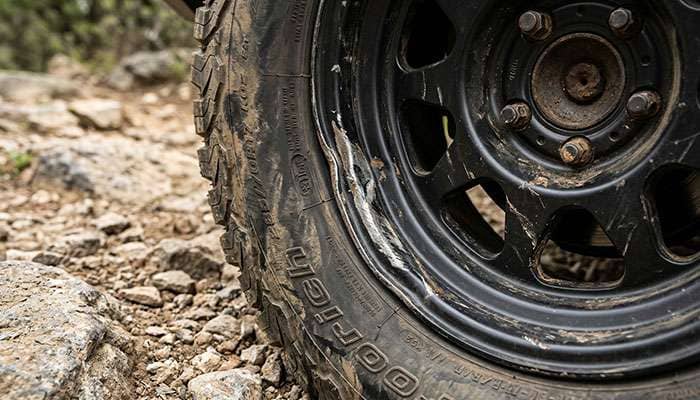
If you have a good spare, use it and leave the bent wheel alone. This is for when you do not. Here is what a field repair actually takes:
Know where the fix stops. A bent flange is fixable. A cracked weld, a bent center, or a damaged lug seat is not, and the wheel should come off the truck. Those are load paths, and no hammer restores them. A full-size spare on a second wheel beats the best trail repair you will ever make.
Less than you may have heard, and the gap depends on size. These are median listed weights for off-road wheels, rounded to the pound.
Size |
Steel |
Aluminum |
Difference |
|---|---|---|---|
15x8 |
28 lb |
27 lb |
1 lb |
16x8 |
36 lb |
28 lb |
8 lb |
17x8 |
38 lb |
33 lb |
5 lb |
17x9 |
40 lb |
36 lb |
4 lb |
Call it 4 to 8 pounds per corner at 16 and 17 inches, or about 16 to 32 pounds across the truck. Some heavy-duty aluminum wheels weigh as much as steel, so check the actual listing. Is that weight worth worrying about? Unsprung weight has no fixed conversion factor, as we explain in does unsprung weight matter. It hurts ride and fuel use a little on the highway, and at crawl speed it can even steady the truck. Tire choice usually moves the scale more than wheel material does.
This is where many modern trucks run out of options, before weight ever comes up.
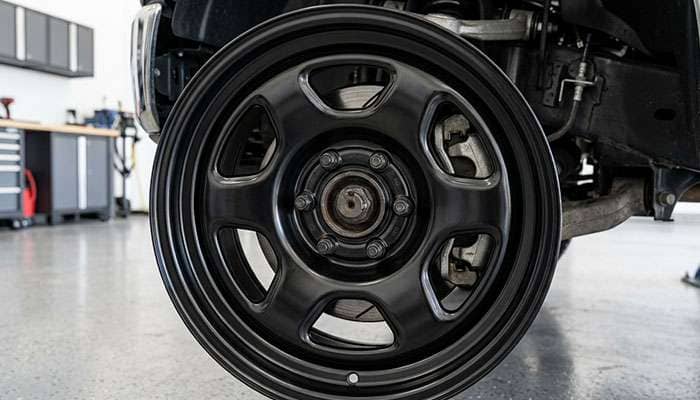
Yes, once the coating chips, and rocks will chip it. Surface rust is cosmetic at first. The place to watch is the bead seat, where corrosion can cause slow leaks. Sand it and repaint it when you see it. Aluminum is not immune either. Road salt can eat at the bead area, and aluminum can corrode where it sits against steel at the hub. If you run salted roads all winter, plan on maintaining either wheel.
Yes. Aluminum conducts heat roughly three times better than steel, so it pulls brake heat away faster, and open spoke designs move more air across the rotor. You will not notice that on a slow trail. You may notice it on a long, loaded descent or while towing through the mountains. If that describes your driving, it is one more point for aluminum.
Often, yes, and this gets lost in the steel-vs-alloy argument. Many of those comparisons put a small steel wheel against a much larger alloy. Sidewall is what protects the rim. On a 33-inch tire, a 15-inch wheel leaves you 9 inches of sidewall, a 17 leaves 8, and a 20 leaves 6.5. That is 2.5 inches more cushion before a rock reaches the rim, and it comes from the diameter, not the metal. If you can run the smaller wheel, it may do more for you than switching materials.
At low speed on a light rig, they can be. Rocks hit the lip from the side, steel takes that without cracking, and the extra weight matters less at crawl speed. The tradeoff is that steel dents more easily. Owners have bent steel wheels on fairly mild trails that a thick aluminum lip would have shrugged off. Low pressure is a separate problem. Bead retention comes from the bead seat and any bead-grip features, not the material, and steel beadlocks do exist. Our comparison of beadlock vs. bead grip wheels covers when each one earns its place.
This is the case steel's reputation was built on, and load is what complicates it. Far from help, a wheel you can fix has real value. But an overland build is also the heaviest thing you will put on a wheel, with a rack, water, and gear sitting on the rear axle. Weigh the truck loaded, run the axle math, and see what clears. If a steel wheel clears it, you have a strong case. If it does not, a properly rated aluminum wheel and a matching spare will get you farther than a repairable wheel running over its rating.
Usually not. Desert running means speed and heat, which both favor aluminum. Owner reports cut both ways on failures. Some have run alloys hard at speed for years without a crack, and at least one broke a wheel at the bead seat after a high-speed run off the road. At those speeds I would rather have a forged wheel with real load capacity, which also bends when it fails, than a heavier steel wheel with less capacity.
Less than you might think. Steel earned its price reputation on basic stamped wheels, and those still exist. But across off-road wheel listings, the median 15-inch steel and aluminum wheels cost about the same. At 16 inches the median aluminum wheel is about 15 percent cheaper than steel, and at 17 inches it runs about 20 percent more. Owners on overland forums have noticed the same thing, that the old gap has mostly closed. So do not choose steel on price alone. Price the wheel that clears your axle math, because a cheap wheel that cannot carry the truck is not a bargain.
It is a smart setup if you do it right. Four aluminum wheels on the road and a steel spare gives you a fixable wheel at the back of the truck for less money. Match the tire so the overall diameter stays the same, and make sure the spare clears your brakes and suspension at its offset. Then check the lug nuts. Steel and aluminum wheels often use different seats, so the nuts on your truck may not be right for the spare. Carry the correct set in the door pocket, and test-fit the spare at home before you need it on the trail.
Steel makes sense when these are true:
Go with aluminum when these are true:
An underrated wheel rarely fails on the first trip. It costs you in steps.
Steel earns its reputation on the trail, and it deserves it. It bends, it takes a hammer, and it gets you home. But it usually carries less, fits fewer modern trucks, and offers almost nothing past 17 inches. So start with your axle weight, then pick the failure you can live with. When you are ready, browse our off-road wheels and check the load rating on the one you like.
They are better for remote trail repair, because steel bends and can often be hammered back. They are usually not better on load rating, fit, or weight. For a half-ton or heavier truck, a properly rated aluminum wheel is usually the better choice.
Not on load rating. In the off-road market, the median 17-inch steel wheel is rated at 2,100 pounds and the median aluminum wheel at 2,500. Steel is more forgiving in a hard impact, which is a different kind of strength.
Yes, though less often than cast aluminum. Steel wheels can crack at the welds or around the lug holes, usually after overload, loose lug nuts, or repeated hits. Any cracked wheel should come off the vehicle.
Usually, by about 4 to 8 pounds per corner at 16 and 17 inches. At 15 inches the gap is close to nothing, and some heavy-duty aluminum wheels weigh as much as steel.
Often, if only the bead flange is bent. Deflate the tire, work the flange back with a heavy hammer and block, and reseat the bead. Treat it as a get-home repair. A cracked weld or bent center cannot be fixed that way.
Take the higher GAWR from your door sticker and divide by two, then add about 20 percent for towing or off-road use. A 4,000-pound axle needs 2,000 pounds per wheel at minimum and about 2,400 with margin.