
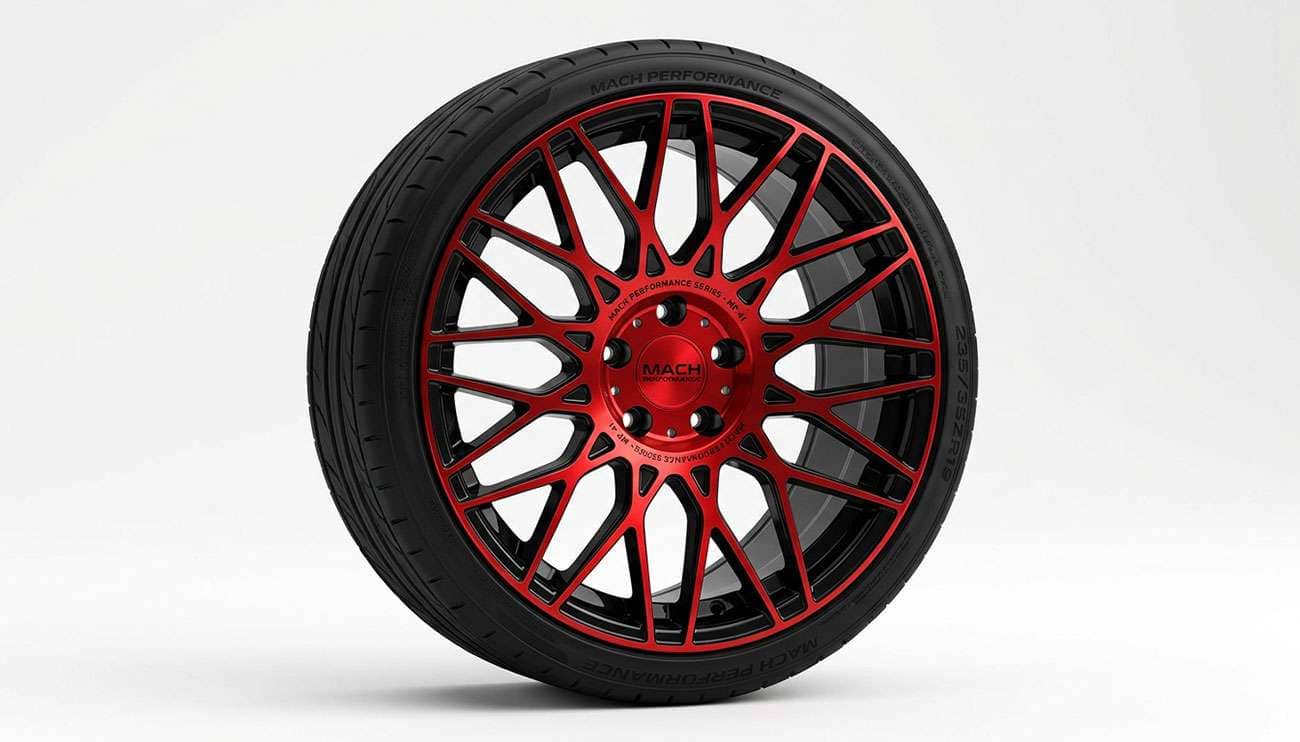
Yes, with a qualifier that almost nobody states. Mach Performance wheels, the MP series, are one-piece cast alloy wheels priced from roughly $198 to $310. Judged as cast wheels in that bracket they are a strong buy: clean designs, broad fitment coverage, OEM TPMS compatibility, and a structural warranty. Judged against forged wheels costing three times as much, they are not forged and have never claimed to be. The real question is not whether they are good. It is what you are asking them to do.
That distinction matters because most reviews of budget-to-mid-tier wheels either oversell them as giant-killers or dismiss them for not being something they were never built to be. Neither helps you decide. What follows is the specification picture, where the MP series genuinely performs, and the two or three situations where I would point you at something else.
The variable is construction method versus intended use, and it settles the question faster than any subjective impression of how a wheel looks.
A one-piece cast alloy wheel is produced by pouring molten aluminum into a mold. It is the most common manufacturing method in the aftermarket and the reason a wheel can cost two hundred dollars instead of nine hundred. The grain structure that results is less dense than forged aluminum, which means that for equivalent strength a cast wheel carries slightly more material and slightly more weight. That is the entire trade, and it is a real one.
What it is not is a safety problem. Cast wheels from a legitimate manufacturer are engineered and load-rated for street use, and the overwhelming majority of wheels on the road are cast. The performance difference shows up in unsprung mass and in how the wheel behaves at the extreme edge of abuse, not in whether it will hold up on your commute. We covered the full manufacturing comparison in cast vs. forged vs. flow-formed wheels if you want the metallurgy.
So the honest framing is this: if you are building a street car, a daily-driven sport sedan, or a clean show-oriented setup, the MP series does what you need at a price that leaves budget for tires. If you are tracking the car hard, running serious power, or chasing every pound of rotating mass, you want forged, and Mach's own Hybrid Forged family or another forged line is where that conversation goes.
Mach is a brand of 2 Crave, a Southern California designer and distributor of custom light-alloy wheels. 2 Crave runs several lines aimed at different corners of the market, including Xtreme, Black Diamond, Heavy Hitters, and Fiero, with Mach positioned as the Euro-inspired, performance-oriented line for sedans and sport coupes.
That parentage is worth knowing for two practical reasons. The first is availability of support: a wheel from a company with an established multi-brand catalog and domestic distribution is a wheel you can get warranty service and replacement singles on, which is not always true of import-direct brands that appear and vanish. The second is design intent. 2 Crave built Mach specifically to deliver European styling cues without European pricing, which explains both what the wheels look like and where the cost savings come from.
That places Mach in the value-to-mid tier of the market rather than against the premium forged names, which is exactly where it is priced to compete.
Mach splits into three families, and picking the wrong one is the most common mistake I see. Find your row before you shop finishes.
Family |
Series Code |
Construction |
Built For |
|---|---|---|---|
Performance |
MP |
One-piece cast alloy |
Lightweight, handling-minded designs across a wide range of vehicles. The volume seller and the subject of this review. |
Euro Concave |
ME |
One-piece cast alloy |
Deep concave profiles for import-inspired stance builds where face depth is the point. |
Hybrid Forged |
MF |
Forged |
Premium, status-forward builds wanting forged strength and reduced weight at the top of the Mach range. |
The question in the title asks specifically about the Performance series, and that is the right question to ask, because MP is where the value argument actually lives. The ME series costs more for the concave face, and if you want a deep dish check caliper and suspension clearance before ordering, since aggressive concavity introduces problems that a flatter face does not.
Here is the part most brand reviews skip, and it is the part that should decide your purchase.
Weight. A cast wheel is typically heavier than a forged wheel of the same size and design by a meaningful margin. That weight is unsprung and rotating, which is the worst place to carry it. It affects acceleration, braking, and how quickly the suspension can respond over broken pavement. On a street car the difference is detectable if you know what you are feeling for and largely irrelevant if you do not. On a track car it shows up in lap times. Our breakdown of how much wheel weight actually affects performance has the test data.
Impact behavior. This is the practical one for anyone driving on real roads. Cast aluminum is comparatively brittle. Hit a serious pothole hard enough and a cast wheel is more likely to crack, where a forged wheel is more likely to bend. A bent wheel can sometimes be straightened. A cracked one is scrap. If your commute involves genuinely bad pavement, factor that in, and consider running a slightly taller sidewall to give the rim some protection.
Alloy and finish durability. The aluminum alloy used and the quality of the finish matter as much as the casting for how the wheel looks in year three. Our guide to wheel aluminum alloys explains what the different series actually do,, and keeping the finish right comes down to cleaning it correctly for its type. Machined faces in particular need attention, because a machined surface under clearcoat will corrode from the edges if the clearcoat gets chipped and stays wet.
What cast construction does not cost you: load capacity, safety, or legitimacy. A properly engineered cast wheel carries a load rating appropriate to its intended application, and matching that rating to your vehicle is a real step rather than a formality. Our wheel load rating guide covers how to check it, and it matters more than most buyers realize on heavier sedans and crossovers.
Mach covers diameters from roughly 16 to 22 inches in widths between about 7 and 10.5 inches, with offsets commonly running from +15mm to +50mm. That is a broad enough spread to serve everything from a modest OEM-plus upgrade to an aggressively flush stance, and it is one of the genuine strengths of the line.
Breadth is also where people get into trouble. An offset range that wide means the catalog contains wheels that will absolutely not work on your car, and the wheel does not know that. Three numbers decide whether a set fits: bolt pattern, center bore, and offset. Get any one wrong and the wheel either will not mount or will sit wrong enough to rub.
Offset is the one that causes the most grief because its effects are counterintuitive. Our explainer on wheel offset and how to get the fit right is the piece to read before you order. In short, a lower offset number pushes the wheel outward toward the fender and a higher one pulls it inward toward the suspension, and both directions have a failure mode.
Center bore is the quieter problem. Aftermarket wheels are usually machined with a bore larger than any single vehicle's hub so one wheel can fit many cars, which means the wheel needs hub-centric rings to center properly on your hub. Skip them and the wheel centers on the lug seats instead, which frequently produces a vibration people misdiagnose as a balance problem. We covered why in hub-centric vs. lug-centric wheels.
Mach wheels are designed to accept OEM TPMS sensors, which removes one of the more annoying surprises in an aftermarket wheel purchase. If your existing sensors are in good condition they can typically be transferred during mounting. If they are near the end of their battery life, replacing them while the tire is already off the wheel saves you paying for the same labor twice. Our guide to TPMS sensors on aftermarket wheels covers what transfers, what does not, and what needs a relearn procedure.
The wheels carry a manufacturer's limited warranty covering the wheel structure. As with essentially every wheel warranty in the industry, that covers manufacturing defects rather than road hazard, curb damage, or finish damage caused by harsh cleaners. Read the terms with that expectation and it will not disappoint you.
On hardware: confirm your lug seat type. Wheels are machined for conical, ball, or flat seats, and your factory lug nuts may not match the aftermarket wheel. Using the wrong seat type is genuinely dangerous, because the clamping force never develops correctly no matter how tight the nut feels. This is a five-dollar problem that becomes a serious one if ignored.
Any brand review that cannot name the cases where the product is wrong is not a review. Three situations where I would steer you elsewhere.
Dedicated track use. If the car sees real track days with heat cycles, hard braking, and curb strikes, the weight penalty and the impact behavior of cast construction both work against you. Step up to the Hybrid Forged family or to a dedicated forged line.
Heavy vehicles at aggressive sizes. A large SUV or a heavy crossover on a 22-inch wheel is asking a lot of any cast wheel. Verify the load rating against your vehicle's gross axle weight rating rather than assuming the size implies the capacity. If the numbers are close, buy up.
Severe pothole territory. If you live somewhere with genuinely destroyed winter roads and you run a low-profile setup, you will crack wheels eventually. That is true of any cast wheel, not a Mach-specific criticism, but it is worth saying plainly rather than letting you find out.
Outside those three cases, the MP series is a well-judged product for what it costs.
Pulled from current stock. Prices are starting points and vary by size and finish, so confirm your fitment before ordering.
Best value in the line. The Mach MP.41 in Gloss Black with Red Machined Face starts at $198, the lowest entry point in the Mach range, and the red machined accent gives it more visual interest than most wheels at that price. The same design in Satin Black at $227 is the understated version, and Satin Gray at $248 splits the difference.
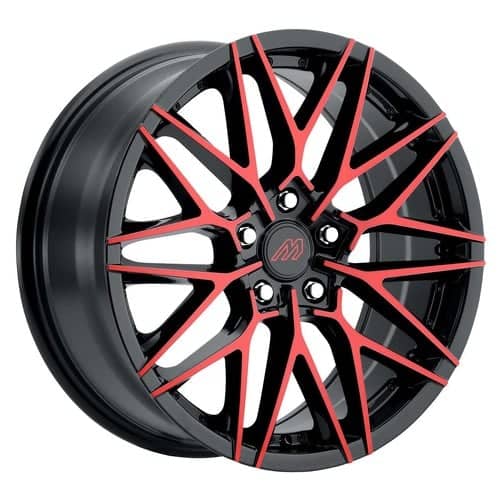
Best for a clean OEM-plus look. The Mach MP.42 in Arctic Silver with Machined Face and Chrome Rivets at $227 in 17x7.5 with a +40mm offset is close to a factory-style fitment on a lot of sedans, and the rivet detail reads more expensive than it is. The Gloss Black with Machined Lip version at $227 is the darker take.
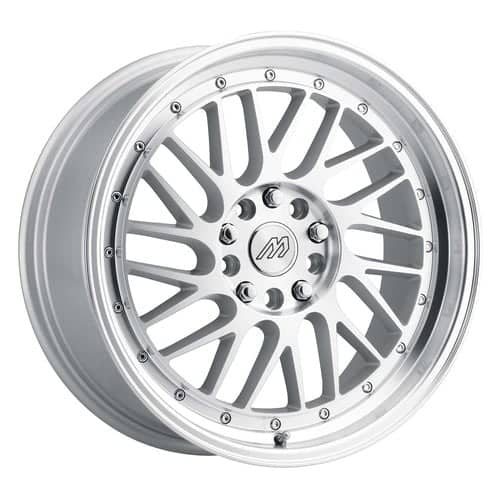
Best simple multi-spoke. The Mach MP.43 in Arctic Silver at $227 and the Metallic Black at $227 are the least fussy designs in the range, which makes them the safest choice if the car is doing the talking and the wheel just needs to not argue with it.
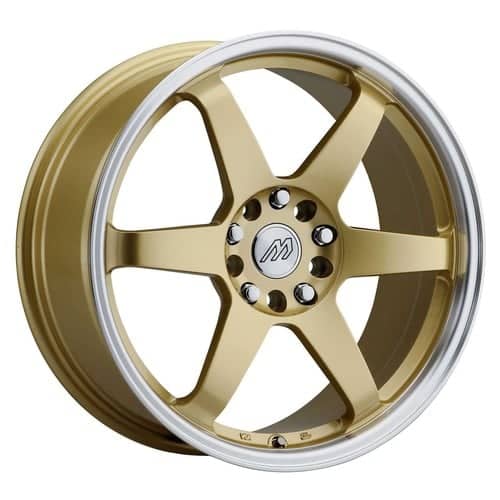
Best for something with color. The Mach MP.60 in Gloss Gold with Machined Lip at $248 is the standout if you want gold without going to a boutique brand, and the MP.60 in Gloss Black with Red Face at $248 carries the same idea in a more aggressive direction.
If you want the concave face instead. The Euro Concave series steps up in price: the Mach ME.6 in Gloss Black with Machined Face at $269 in 18x8 with a +35mm offset, and the Mach ME.1 in Satin Black at $299 in 18x9.5 with a +40mm offset for a wider, more planted setup.
The full range runs to 82 wheels across all three families. Browse the complete Mach wheel lineup to filter by your size and finish.
1. Get your bolt pattern. Count the lugs and measure the circle. If you are unsure, our fitment team can pull it from your year, make, and model.
2. Get your center bore. Measure the hub, not the wheel. Assume you will need hub-centric rings and be pleased if you do not.
3. Decide your offset target before you browse. Work out whether you want the wheel flush, tucked, or factory-neutral, and convert that into an offset range. Shopping by looks first and offset second is how people end up with rub.
4. Check the load rating against your vehicle. Especially on anything heavy or anything going to 20 inches and above.
5. Confirm lug seat type. Conical, ball, or flat. Order the correct lug hardware at the same time as the wheels.
6. Plan the TPMS. Decide whether you are transferring existing sensors or replacing them while the tires are off.
Are Mach Performance wheels good? For a street-driven sedan, sport coupe, or crossover where you want European styling cues and a clean stance without spending forged money, yes, and the MP series is the specific family to look at. Starting prices from $198 with broad size and offset coverage, OEM TPMS compatibility, and a structural warranty behind a company with an established multi-brand catalog make it a sensible purchase rather than a gamble.
What you are giving up is the weight advantage and impact resilience of forged construction, which matters if you track the car, run a heavy vehicle at an aggressive size, or drive on genuinely destroyed pavement. In those cases step up to the Hybrid Forged family or a dedicated forged line, and you will be happier for it.
Get the three fitment numbers right and this is a well-judged wheel for the money. Call our Fitment Team with your year, make, and model and we will confirm bolt pattern, center bore, offset, and load rating before anything ships.
Yes, for street-driven applications. The Mach Performance (MP) series consists of one-piece cast alloy wheels starting around $198, offering clean Euro-inspired designs, broad size and offset coverage, OEM TPMS compatibility, and a manufacturer's structural warranty. As cast wheels they carry slightly more unsprung weight than forged alternatives and are more prone to cracking than bending under hard impacts. For daily drivers, sport sedans, and show-oriented builds they represent strong value. For dedicated track use or heavy vehicles at large diameters, forged construction is the better choice.
Mach is a brand of 2 Crave, a Southern California designer and distributor of custom light-alloy wheels. 2 Crave also produces the Xtreme, Black Diamond, Heavy Hitters, and Fiero lines. Mach is positioned as the Euro-inspired, performance-oriented brand in that group, aimed at sedans and sport coupes that want European styling cues without European pricing.
Most Mach wheels are one-piece cast alloy, including both the Performance (MP) and Euro Concave (ME) families. The Hybrid Forged (MF) family uses forged construction for greater strength and reduced weight at the top of the range. Construction varies by specific model, so confirm the individual wheel if the distinction matters to your build.
Mach wheels are generally offered in diameters from about 16 to 22 inches, in widths between roughly 7 and 10.5 inches, with offsets commonly ranging from +15mm to +50mm. That covers everything from a mild OEM-plus upgrade to an aggressive flush stance. Exact availability varies by model and finish, so confirm the specific combination for your vehicle before ordering.
Yes. Mach wheels are designed to accept OEM TPMS sensors. Existing sensors in good condition can usually be transferred during mounting. If your sensors are near the end of their battery life, replacing them while the tires are already off saves paying for the same labor twice. Some vehicles require a relearn procedure after the swap.
Usually yes. Aftermarket wheels are typically machined with a center bore larger than any single vehicle's hub so one wheel can serve many applications, which means rings are needed to center the wheel properly on the hub. Without them the wheel centers on the lug seats instead, which commonly produces a vibration that gets misdiagnosed as a balance problem. Confirm your hub diameter and order the correct rings with the wheels.
Reviewed by Dennis Feldman, Vice President, Performance Plus Tire



