
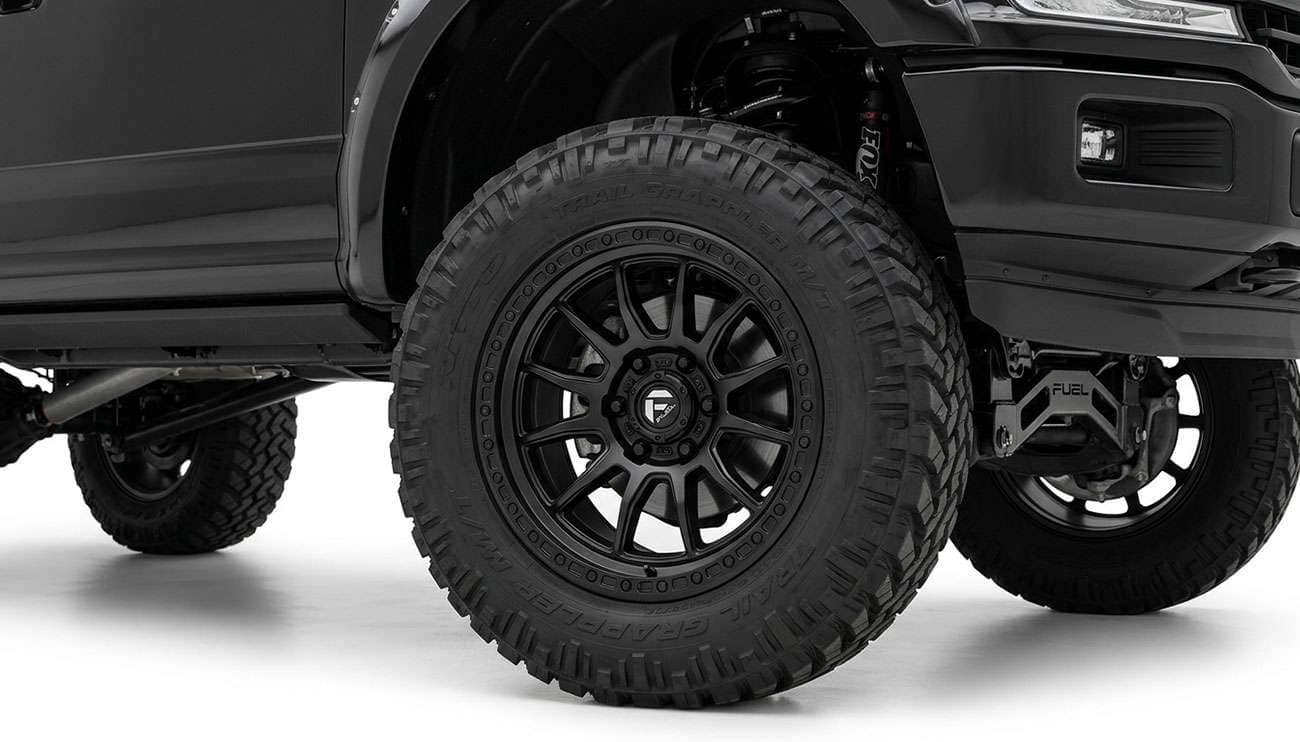
Short answer: yes, with a caveat nobody puts in writing. The Fuel Rebel 6 is one-piece cast aluminum rated at 2,300 to 2,500 pounds per wheel, carries a limited lifetime structural warranty, and runs 259 to 524 dollars per wheel. That part is genuinely good. What decides whether it is good for you is which fitment you order. The offset range swings 64mm across the line, the beadlock ring is decorative, and your factory lug nuts almost certainly will not fit.
Every other page you will find on this wheel repeats the same manufacturer paragraph about split spokes and faux rivets. None of them tell you that the 6x139.7 pattern ships in two different hub bores, or that owners on the F-150 and Gladiator forums have been snapping studs because their lug nuts bottom out before they clamp anything. Those are the details that decide whether you are happy in six months. Start here:
Your Situation |
Verdict |
What to Order |
|---|---|---|
Stock truck, appearance upgrade only |
Strong yes |
18x9 or 20x9 at +1 or +20 offset |
2-inch level, 33 to 34-inch tires |
Best case for this wheel |
17x9 or 18x9 at -12 offset |
4-inch lift, 35s, want the tire outboard |
Yes |
20x10 at -18 or 22x12 at -44 |
Trail rig airing down below 15 psi |
No |
You need a true beadlock, not a simulated ring |
Loaded past 2,300 lb per corner |
No |
Step up to a higher-rated 8-lug wheel |
Coastal or road-salt daily driver |
Conditional |
D679 matte black, and budget for finish care |
The Rebel is a Fuel Off-Road design produced by MHT Luxury Alloys, the parent company that has been building aftermarket wheels since long before the Fuel badge appeared in 2009. The Rebel 6 is the six-lug member of the family. There is a matching Rebel 5 and an eight-lug version, all sharing the same split-spoke face and outer ring detail.
Construction is one-piece cast aluminum. Not flow-formed, not forged, not two-piece. Fuel is straightforward about this, and the spec sheet backs it up. Here is what our catalog data shows across the six-lug line:
That 34-pound figure for a 17x9 deserves attention. A cast off-road wheel in that size commonly lands between 35 and 40 pounds. The Rebel 6 is at the light end of its class, which matters more than most buyers realize once you hang a 60-pound all-terrain on it.
Three finishes are in production, and they are genuinely different products in terms of how they age:
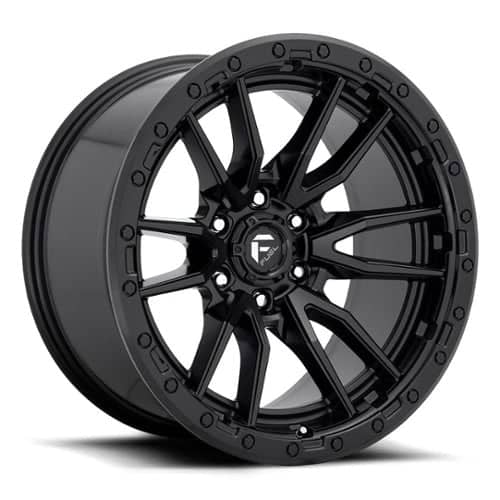
D679 Matte Black. The volume seller. Single-color coating with no two-tone transition line, which is the most durable configuration in the family for reasons covered further down.
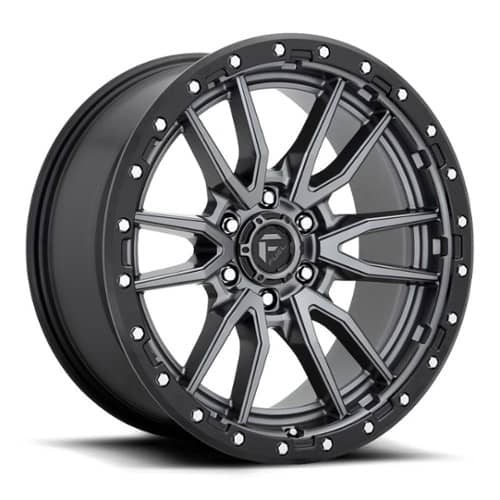
D680 Matte Gunmetal with Black Bead Ring. The only Rebel 6 available in a 16x8, which makes it the pick if you are running a smaller diameter for sidewall or brake clearance reasons.
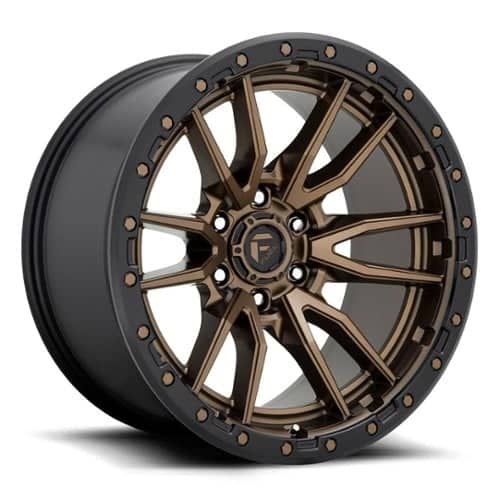
D681 Matte Bronze with Black Bead Ring. The current style leader. Bronze reads well against white, gray, and dark blue paint, and it hides trail dust better than black does.
If you want the broader picture on how Fuel builds across its whole catalog rather than this one model, we covered the brand in depth in Are Fuel Wheels Good? The Truth About Durability and Performance.
No. The ring and the rivet detail on the outer lip of the Rebel 6 are cast into the wheel as styling. They do not touch the tire bead, they do not clamp anything, and they cannot be removed or torqued.
This is worth understanding properly rather than treating it as a gotcha. A real beadlock wheel uses a separate steel or aluminum ring bolted to the outer flange with 24 to 32 fasteners, and that ring physically pinches the outer tire bead against the wheel. It is a mechanical clamp. It also requires a torque schedule, tends to seep at the ring gasket, and is not DOT approved in most configurations.
What holds a tire bead on a standard wheel is friction between the bead and the flange, generated by air pressure pushing the bead outward. Drop the pressure and that friction falls off. Somewhere below roughly 15 psi on a truck tire, a hard lateral load in a rut or off a rock ledge can overcome it and roll the bead off the seat. A simulated ring contributes exactly nothing to preventing that.
The practical takeaway: treat the Rebel 6 as a standard wheel and keep trail pressures at 18 psi or above unless you have a very good reason and a plan for reseating a bead in the field. If your use case genuinely requires single-digit pressures, buy a real beadlock. We laid out the difference between clamping ring designs and the newer bead-retention profiles in Beadlock vs Bead Grip.
For the overwhelming majority of buyers, the simulated ring is the right call. You get the look without a re-torque schedule, without ring gasket leaks, and without the legal gray area, at roughly a third of the price of a functional beadlock.
Cast and forged wheels fail differently, and knowing which failure mode you are buying into is more useful than arguing about which is better.
In casting, molten aluminum fills a mold and cools. The grain structure that results is essentially random, and there will be some porosity. In forging, a solid billet is pressed under enormous force, and the grain flows to follow the shape of the part. That directional grain is why a forged wheel is roughly 20 to 25 percent stronger for the same weight.
The consequence at the trailhead: a forged wheel hit hard enough will usually deform and bend. A cast wheel hit that hard is more likely to crack. A bent wheel often holds air long enough to get you home. A cracked wheel does not. That is the real argument for forged, and it is a legitimate one.
Now the counterweight. A forged 17x9 in this style typically weighs 28 to 30 pounds and costs 700 to 1,000 dollars or more per wheel. The Rebel 6 in that size weighs 34 pounds and costs 299 dollars. You are paying roughly a quarter of the price for four to six extra pounds and a different failure mode. For a truck that sees fire roads, gravel, sand, and the occasional moderate trail, that is a sound trade. For a dedicated rock rig taking repeated hard impacts on sharp granite, it is not.
Worth doing the unsprung weight math while you are here. A 34-pound 17x9 with a 33-inch all-terrain at roughly 60 pounds gives you about 94 pounds per corner. Move to a 22x12 at 56 pounds with a 35-inch tire and you are near 140 pounds per corner, and you will feel it in ride quality, braking distance, and steering effort. The full breakdown of how construction method drives these numbers is in Cast vs Forged vs Flow Formed Wheels.
Four six-lug patterns, five diameters, and widths from 8 to 12 inches. Here is the complete fitment matrix from our current stock:
Size |
Offset |
Backspacing |
Bolt Patterns |
Weight |
|---|---|---|---|---|
16x8 |
+1 |
4.54 in |
6x139.7 |
35 lb |
17x9 |
+1, -12 |
5.04 / 4.53 in |
6x114.3, 6x120, 6x135, 6x139.7 |
34 to 40 lb |
18x9 |
+20, +1, -12 |
5.79 / 5.04 / 4.53 in |
6x114.3, 6x120, 6x135, 6x139.7 |
35 to 36 lb |
20x9 |
+20, +1 |
5.79 / 5.04 in |
6x135, 6x139.7 |
40 lb |
20x10 |
-18 |
4.79 in |
6x135, 6x139.7 |
43 lb |
22x9 |
+20 |
5.79 in |
6x135, 6x139.7 |
46 lb |
22x10 |
-13 |
4.99 in |
6x135, 6x139.7 |
49 lb |
22x12 |
-44 |
4.77 in |
6x135, 6x139.7 |
56 lb |
Matching pattern to platform:
That last pair is the trap. 6x139.7 is one bolt pattern serving two completely different hub diameters. Toyota and Nissan hubs measure 106.1mm. GM half-ton hubs measure 78.1mm. Order a 106.1 bore wheel for a Silverado and the lug pattern will line up perfectly, the wheel will bolt on, and you will have a 28mm gap between the hub and the wheel bore. The wheel is then centered by the studs alone rather than by the hub, which is where the steering-wheel shimmy at 45 mph comes from. The fix is a set of 106.1-to-78.1 hub-centric rings, but the better move is ordering the correct bore in the first place.
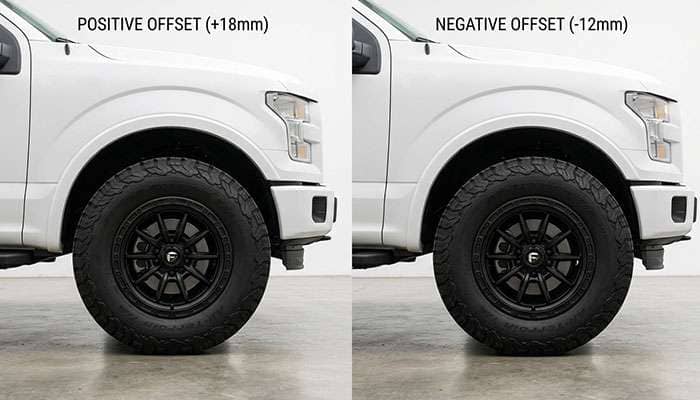
Offset is the distance from the wheel's mounting face to its centerline. Positive offset tucks the wheel inward toward the suspension. Negative offset pushes it outward past the fender. If you want the full mechanical explanation, start with Wheel Offset Explained: How to Get the Perfect Fit Every Time.
The Rebel 6 spans +20 to -44. That is a 64mm swing, or roughly 2.5 inches of lateral tire position between the two extremes on the same truck. It is entirely possible to buy the wrong Rebel 6 for your build and conclude the wheel is bad when the wheel was never the problem.
Suspension State |
Target Offset |
Resulting Stance |
What to Watch |
|---|---|---|---|
Fully stock, OE tire size |
+20 |
Flush to slightly tucked |
Nothing. Closest to factory geometry |
Stock, one size up on tires |
+1 |
Flush with the fender |
Inner liner contact at full lock |
2-inch level, 33 to 34-inch tires |
-12 |
About half an inch of poke |
Upper control arm clearance |
3 to 4-inch lift, 33 to 35-inch tires |
-18 on a 10-inch width |
Roughly 1.5 inches of poke |
Mud flaps, fender liner trimming |
6-inch lift, 35s or larger, wide body |
-44 on a 12-inch width |
Well outside the fender line |
Fender flare coverage and local law |
There is a mechanical cost to running the aggressive end of that range, and it is not just cosmetic. Pushing the wheel outboard increases scrub radius, which means the tire's contact patch now sits further from the steering axis. Every bump input and braking force acts on a longer lever arm back through the steering linkage, the wheel bearings, and the ball joints. Going from +20 to -44 roughly triples the moment arm on those components compared to factory. Bearings that would have gone 150,000 miles start showing play at 60,000.
Tire rubbing is the other consequence, and it is more predictable than most people expect. On a stock-height half-ton, a 20x10 at -18 with a 33-inch tire will typically contact the fender liner at full steering lock and the upper control arm on compression. Neither is dangerous immediately, but both grind through liner material and eventually into wiring. We walked through the diagnostic sequence for that in Why Are My Tires Rubbing?
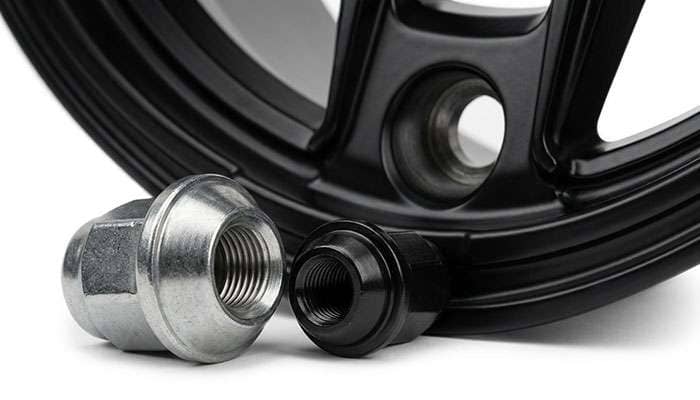
Yes, and this is the single most under-documented thing about owning this wheel. Your factory lug nuts will not work, the wheel does not ship with replacements, and getting this wrong has cost owners wheel studs.
The Rebel 6 uses recessed lug pockets sized for a small-diameter conical seat nut. Factory bulge acorn nuts on a modern F-150, Tacoma, or Titan measure roughly 26mm across the flange. The Rebel's pockets are cut for something closer to 23mm. That three millimeters is the whole problem.
There are two failure modes, and only one of them is obvious.
Mode one: the nut is too wide to enter the pocket. It sits proud of the wheel face, visibly wrong, and you go buy the right nuts. Annoying, but self-correcting.
Mode two: the nut enters the pocket but bottoms on the stud before its taper ever contacts the wheel seat. This is the dangerous one. You put a torque wrench on it, it clicks at 130 ft-lb, and every visual and tactile signal says the job is done. What that wrench actually measured was thread friction between the nut and the stud. The clamp load holding your wheel to the hub is close to zero.
Here is why that matters mechanically. A wheel is not held on by the studs resisting shear. It is held on by friction between the wheel's mounting face and the hub face, and that friction is generated entirely by clamp load, which is generated entirely by correctly seated lug nuts under tension. Six properly torqued nuts on a half-ton generate tens of thousands of pounds of clamping force across that joint. With no clamp load, the wheel walks against the hub with every acceleration and braking cycle. The stud holes elongate. The studs take cyclic bending they were never designed for, and they fail by fatigue, usually one at a time, usually starting on the drive axle.
The symptoms, in the order owners report them on the truck forums: lug nuts that are loose again 50 miles after installation, a rhythmic click at low speed, a wheel that has visible movement when you grab it at 12 and 6 o'clock, and then a snapped stud. If you are already down a stud, read Missing Lug Nut: How Long Can You Drive? before you drive it anywhere.
What to buy instead:
Verify engagement before you trust anything. Thread one nut onto a bare stud with the wheel off and count the turns to bottom, then thread it with the wheel on and confirm the taper contacts the seat well before that point. Torque in a star pattern to your vehicle's spec, then re-torque at 50 to 100 miles. Our full procedure is in How to Torque Lug Nuts Perfectly: A Mechanic's Step-by-Step Guide, and we keep hardware specs organized on our lug nut reference page.
Fuel backs the Rebel 6 structure for the life of the original owner and the finish for twelve months. That gap tells you where the engineering confidence sits, and it is honest of them to publish it that way rather than bury it.
In practice, the finish holds up well if you understand what you bought. All three Rebel 6 variants are matte. Matte coatings have no gloss layer, which means there is nothing to polish and nothing to correct. A scratch stays a scratch. On the plus side, matte black in particular hides brake dust better than any polished or machined face ever will, and touch-up on a uniform matte black is trivially easy.
The two-tone variants deserve one specific caution. On the D680 and D681, the black bead ring accent is a separate coating application from the main face color. Wherever two coatings meet, you have an edge, and edges are where moisture gets under a finish and starts lifting it. If you park within a few miles of salt water, or you drive through winter road salt, the transition line on the two-tone finishes is the spot to inspect at every tire rotation. The single-color D679 does not have this vulnerability at all.
Care is simple and non-negotiable in one respect: never put an acid-based wheel cleaner on these. The strong acid cleaners sold for brake dust removal will etch a matte coating permanently and there is no recovery. Use a pH-neutral wheel cleaner, a soft brush, and rinse thoroughly. If you run them through winter salt, a quick rinse of the barrel and the back of the spokes once a week is worth more than anything you can buy in a bottle.
Identical face design, identical construction, identical finish options, identical pricing. The only difference is lug count, and that is dictated by your vehicle, not your preference. You cannot choose between them.
The Rebel 5 covers 5x114.3, 5x127, 5x139.7, and 5x150, which puts it on the Jeep Wrangler JK and JL, the Gladiator, the Tundra from 2007 forward, and older Ram and Chevy half-tons. The Rebel 6 covers the four six-lug patterns listed above.
Two places people get tripped up. Toyota Tundra owners need to know their generation: through 2006 it is 6x139.7 and takes the Rebel 6, from 2007 forward it is 5x150 and takes the Rebel 5. Ram 1500 owners sometimes shop the Rebel 6 by mistake, but every Ram 1500 is a five-lug truck and takes the Rebel 5. Confirm your pattern and hub bore before ordering rather than assuming.
Both are stocked, and the finishes match if you are outfitting two trucks in a fleet or a matching pair. Browse the full line on our Fuel Rebel wheels page, or filter by pattern on our 6-lug wheels page.
The wheel price is the number everyone shops. It is roughly 60 to 75 percent of what you will actually spend. Here is the realistic line-item picture for a set of four:
Line Item |
Typical Cost |
Notes |
|---|---|---|
Four Rebel 6 wheels |
1,036 to 2,096 dollars |
259 per wheel at 16 inches up to 524 at 22x12 |
Conical lug nut set with locks |
40 to 90 dollars |
Not optional. Factory nuts will not fit |
Thin-wall socket |
10 to 25 dollars |
Needed for roadside work later |
TPMS sensors |
200 to 320 dollars |
Skip if transferring your existing set |
Mount, balance, road force |
100 to 200 dollars |
Road force balancing is worth it at 20 inches and up |
Hub-centric rings |
20 to 40 dollars |
Only if your bore does not match the hub |
Realistic total |
1,400 to 2,700 dollars |
Before tires, if you are also sizing up |
One item that is not on that list: center caps. Fuel includes them with every Rebel 6. Several competing brands sell caps separately at 20 to 30 dollars each, so that is 80 to 120 dollars you are not spending. Small thing, but it is a real difference in the total.
Four situations where a different wheel serves you better, stated plainly:
You air down below 15 psi regularly. The simulated ring is styling. If you are running low pressure on technical terrain often enough that debeading is a live concern, buy a functional beadlock and accept the maintenance that comes with it.
You take repeated hard impacts on sharp rock. Cast aluminum cracks where forged bends. If your use case involves regularly loading a wheel hard enough to damage it, the higher entry price of a forged wheel buys you a failure mode that gets you home.
Your loaded corner weight exceeds the rating. Most Rebel 6 fitments are rated at 2,300 lb per wheel, with the 16x8 and 22x9 at 2,500 lb. Six-lug trucks are half-tons and midsize pickups, so this rating covers normal use with headroom. If you have a heavily built rig with a bumper, winch, drawer system, and rooftop tent, weigh each corner rather than estimating.
You want a bright or polished look. The Rebel 6 comes in matte only. No chrome, no polished lip, no machined face. If your build calls for shine, this is the wrong model within an otherwise deep catalog.
Are Fuel Rebel 6 wheels good? For the buyer they are designed for, yes, and the value is better than the price suggests. Thirty-four pounds in a 17x9, a 2,300 lb rating, an included center cap, a limited lifetime structural warranty, and 299 dollars is a defensible package. The design has been in production long enough to prove itself, and it fits nearly every six-lug half-ton and midsize pickup on the road.
The reason people end up unhappy with this wheel is almost never the wheel. It is a 106.1 bore on a 78.1 hub. It is a -44 offset on a stock-height truck. It is a factory lug nut bottoming on a stud while the torque wrench says everything is fine. Get the fitment right and buy the correct hardware, and the Rebel 6 will outlast the truck you put it on.
Ready to spec a set? Check current sizes and finishes on our Fuel Rebel wheels collection, and call us with your year, make, model, and suspension setup before you order. Getting the offset right the first time is free. Getting it wrong costs you a restock fee and a month.
Yes. At 34 to 43 pounds in the 17 to 20-inch sizes, the Rebel 6 is competitive with factory alloy weight, so ride quality and fuel economy stay close to stock. Choose a positive offset of +1 or +20 for daily use, since the aggressive negative offsets increase scrub radius and accelerate wheel bearing and ball joint wear over high mileage.
No. Center caps are included, but lug nuts are not, and your factory nuts will not fit the recessed lug pockets. You need small-diameter 60-degree conical seat nuts in the correct thread pitch for your vehicle, plus a thin-wall socket. Budget 40 to 90 dollars for a quality set with locks.
Most Rebel 6 fitments are rated at 2,300 pounds per wheel. The 16x8 and the 22x9 are rated at 2,500 pounds. That is sufficient for six-lug half-ton and midsize pickups in normal use, including moderate towing, but heavily built overland rigs should verify actual corner weights on a scale.
Only to standard limits. The bead ring on the Rebel 6 is cast-in styling and does not clamp the tire bead. Below roughly 15 psi, bead retention depends entirely on friction against the wheel flange, and a hard lateral load can unseat it. Stay at 18 psi or above unless you switch to a functional beadlock wheel.
Yes, a center cap is included with every Rebel 6 wheel. That is worth noting because several competing brands sell caps separately at 20 to 30 dollars each, which adds 80 to 120 dollars to a set of four.
Finish only. The D679 is matte black, the D680 is matte gunmetal with a black bead ring, and the D681 is matte bronze with a black bead ring. Construction, weight, and load ratings are identical. The D680 is the only variant offered in a 16x8, and the single-color D679 has no two-tone coating edge, which makes it the most durable choice in salt or coastal conditions.



