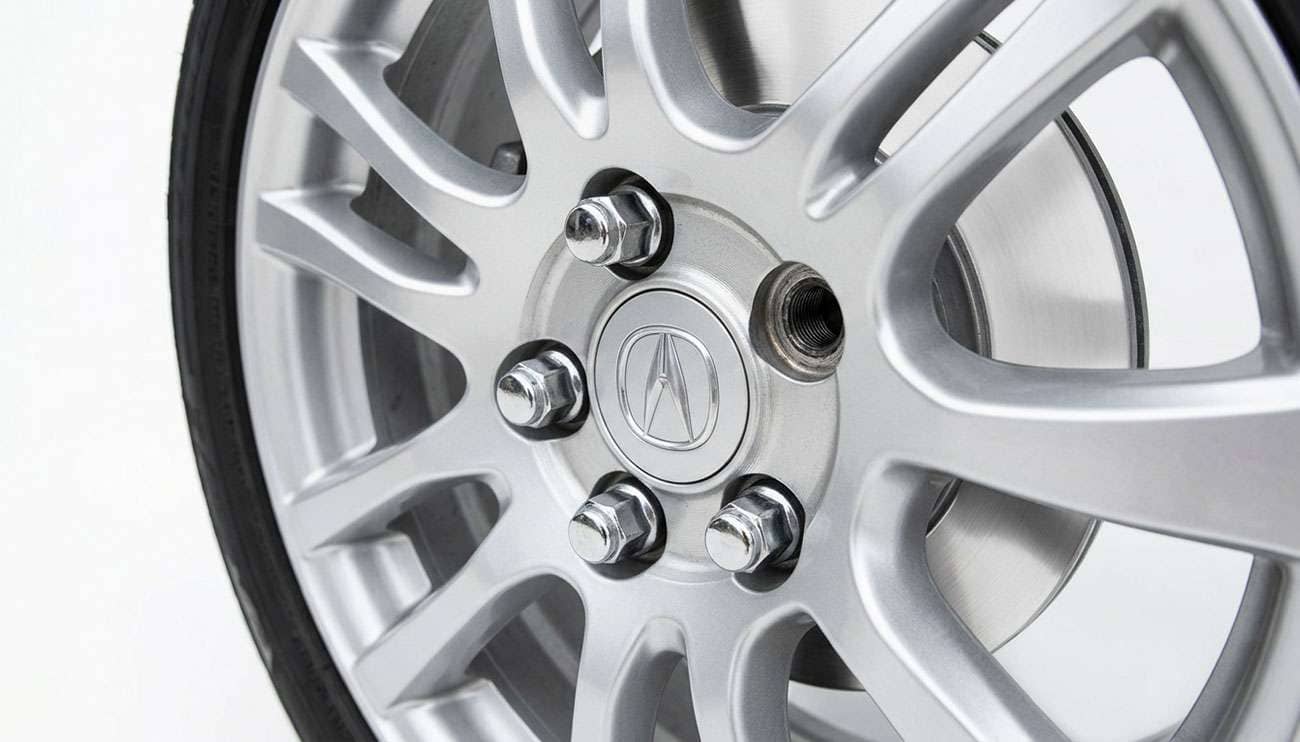
Short version, and it is the thing nobody on the internet will tell you: it depends on how many lug nuts your wheel has. On a 5-lug car, one missing nut buys you a short, slow trip to a shop. Under 20 miles, under 45 mph, and that is the whole allowance. On a 4-lug, you are already in trouble. Two missing on any wheel and you do not drive at all. And "it held up fine" is not the same thing as "it was safe."
I have been around wheels a long time, and I want to be honest with you about why every article you just read hedged. They hedged because the honest answer has an "it depends" in it, and most people writing about this do not want to do the work of explaining what it depends on. So they say "get it looked at soon" and call it a day. That is not useful when you are standing in a parking lot at 7 in the morning looking at a wheel with a hole where a nut ought to be. Let us do this properly.
Find your setup and read across. Count the lug holes on the wheel, not the nuts that are still there. Everything below assumes you have re-torqued the remaining nuts before you move the car, which is not optional, and which I explain further down.
Wheel Setup |
Clamp Load Lost |
Drive It? |
Max Speed |
Max Distance |
What To Do |
|---|---|---|---|---|---|
4-lug, 1 missing |
25 percent |
Barely. Emergency only |
25 mph |
Under 5 miles |
Tow it if you have any other option |
5-lug, 1 missing |
20 percent |
Short hop only |
45 mph |
Under 20 miles |
Re-torque the other 4, drive straight to a shop |
6-lug, 1 missing |
17 percent |
Short hop only |
45 mph |
Under 25 miles |
Re-torque the other 5, drive straight to a shop |
8-lug, 1 missing, unloaded |
12.5 percent |
Short hop only |
45 mph |
Under 25 miles |
Empty the bed, drop the trailer, then go |
8-lug, 1 missing, loaded or towing |
12.5 percent |
No |
0 |
0 |
Unload first or get it towed |
Any wheel, 2 missing |
25 to 50 percent |
No |
0 |
0 |
Tow it. This is not a judgment call |
Two missing next to each other |
Worse than the number suggests |
No |
0 |
0 |
Tow it. The wheel is already cocked on the hub |
Broken stud, not just a lost nut |
Same, plus a damaged hub |
No |
0 |
0 |
Tow it. The stud has to be pressed out and replaced |
Lug bolt wheel, no studs, 1 missing |
20 to 25 percent |
No |
0 |
0 |
Tow it. Nothing is locating the wheel on the hub |
That last row catches people out, so let me explain it before we go on. Most American cars use studs, which are threaded posts sticking out of the hub. You hang the wheel on the studs and thread nuts onto them. A lot of German cars use lug bolts instead, which pass through the wheel and thread into the hub. There are no studs to hang the wheel on. That means the bolts do two jobs at once: they clamp the wheel and they hold it in position. Lose one and you have lost a fifth of both jobs at the same time. If you are driving a BMW, a Mercedes, a VW, or an Audi and you are down a bolt, the math is not the same as it is on a Chevy. Call a truck. Our guide to what lug bolts are used for walks through the difference in more detail.
Here is where almost everybody gets it wrong, including some people who ought to know better. They look at a 5-lug wheel with one nut gone and think: four out of five, that is 80 percent, that is plenty of margin. If that were how it worked, this would be a much shorter article.
The nuts do not hold your wheel on. Friction does. When you torque a lug nut down, you stretch the stud slightly, like a very stiff spring, and that stretch pulls the wheel hard against the flat face of the hub. That pressure is called clamp load, and it is the clamp load that makes the wheel and the hub behave like one solid piece of metal. The wheel is held on by being squeezed against the hub so hard it cannot move. The studs are just what does the squeezing.
Understand that and the rest follows. The question is not "are there enough nuts to physically stop the wheel from falling off." The question is "is there enough clamp load to keep the wheel from ever moving against the hub, even a thousandth of an inch, ever." Because the moment it can move, you are on the clock.
Take a 5-lug wheel and pull one nut. You did not just lose 20 percent of the clamp evenly all the way around. You opened a 144 degree gap in the clamping pattern with nothing holding that arc down. The wheel is now clamped hard on one side and free on the other. Every time that unclamped arc rolls around to the bottom and takes the car's weight, it tries to lift off the hub face. Then it comes back down. Then it does it again, roughly 800 times a mile.
That is the part the "80 percent is fine" crowd misses. It is not a static load problem. It is a fatigue problem, and fatigue does not care that you had enough clamp on average.
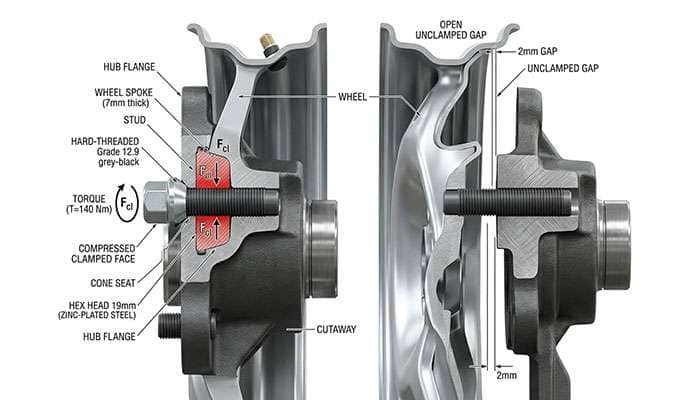
The chain reaction goes like this, and I have watched it play out more times than I would like:
The wheel starts moving microscopically against the hub. That movement scrubs the two surfaces together, which polishes and wears the seating faces, which means the studs lose a little of their stretch. Less stretch means less clamp. Less clamp means more movement. More movement means the nuts start backing off on their own, because a nut that is not under full tension will walk. Now you have one missing nut and two loose ones. The remaining studs are taking bending loads they were never designed for, because a stud is built to be pulled straight, not flexed sideways a thousand times a mile. Then a stud snaps. Then the one next to it snaps, because it just inherited the load. Then the wheel leaves the car.
Every step of that makes the next step come faster. That is why "I drove on it for two weeks and it was fine" is not evidence that it was fine. It is evidence that you were somewhere on a curve that gets steeper the longer you stay on it. The Tire Industry Association's standard practice of re-checking wheel torque 50 to 100 miles after any wheel service exists precisely because this joint loses clamp on its own even when nothing is missing. Take a fastener out of it and you have removed the margin that standard was built to protect.
This is the most-asked version of the question, so it gets its own answer: yes, briefly, slowly, once, to get somewhere it can be fixed. Not as a way of life.
You will find people on forums who will tell you they ran four nuts on a five-lug wheel for years and nothing happened. I believe them. That does not make it good advice, and here is the honest reason why. A 5-lug wheel with four properly torqued nuts has enough clamp load to hold under normal, gentle, unloaded driving on smooth pavement. What it does not have is margin. Margin is what covers the pothole you did not see, the panic stop, the day you put four people and their luggage in the car, the curb you clipped. Those are the moments the joint gets tested, and those are exactly the moments you no longer have anything in reserve.
So the rule I give people is: four out of five gets you to a shop. Twenty miles, forty-five miles an hour, no highway, no hard braking, no hard cornering, and re-torque the four you have got before you turn the key. Anything past that and you are gambling with a part that fails without warning, and the failure mode is your wheel departing the vehicle at speed. A wheel and tire together run 40 to 60 pounds. At 60 mph that is not a car problem, it is a physics problem for whoever is behind you.
Front, and it is not close.
Your front wheels do more jobs than your rears. They steer, which means they take side loads every time you turn. They do most of your braking, because weight transfers forward when you slow down, so the front brakes do roughly 70 percent of the work. If the car is front-wheel drive, they also put the power down. Every one of those jobs is a load that tries to twist the wheel against the hub, and twisting the wheel against the hub is exactly what a missing nut lets it start doing.
There is a second reason the front is worse, and it is about consequences rather than loads. If a rear wheel gets loose you feel a wobble and the car gets vague. If a front wheel gets loose, you lose steering on that corner. A wheel that departs the front of the car takes the car's ability to point itself with it. Same failure, very different outcome.
Rear is not fine, it is just less urgent. The same fatigue chain is running, the same studs are working sideways, and the same wheel is going to come off eventually. The difference is you have got somewhat more time and somewhat better odds when it goes. If you are towing or loaded, throw that out. A loaded rear axle can carry more weight per wheel than the front does on the same truck, and now you are asking fewer studs to hold more.
If you have noticed any shimmy or wobble along with the missing nut, do not drive it at all, front or rear. Vibration means the wheel is already moving on the hub, which means you are past the early stage of the chain and into the part where it accelerates. Our breakdown of steering wheel vibration and whether it is your tires or your wheels covers how to tell the difference between a balance problem and a mounting problem, and a mounting problem with a nut missing is the bad one.
These get talked about as the same problem. They are not, and the difference decides whether you drive or call a truck.
Look into the empty hole in the wheel. If you can see a threaded post sticking up, you lost a nut. The stud is fine, it just does not have anything on it. If the hole is empty, or there is a snapped-off stub of metal in there with rough torn threads, the stud broke. Sometimes the stud snaps and the nut is still on the broken piece, which is why people find a lug nut rattling around inside their hubcap and think they got lucky. They did not.
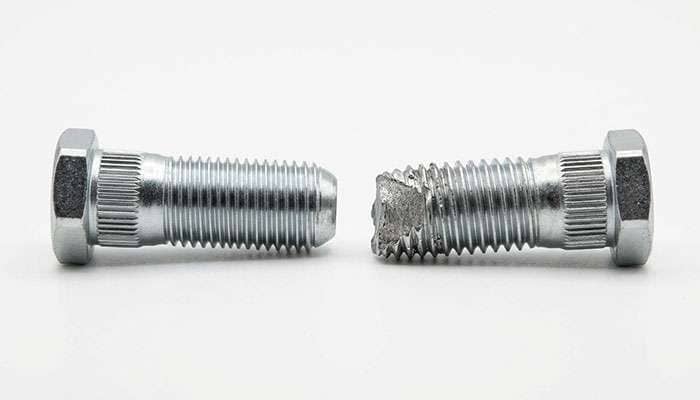
A missing nut is a two dollar part and five minutes. A broken stud is a different animal. First, studs do not usually break out of nowhere. Something caused it: it was over-torqued at some point and stretched past its yield, or it was under-torqued and fatigued, or it has been carrying a bending load because a nut next to it went missing weeks ago. So a broken stud is usually a symptom that the whole hub needs looking at, not a one-off.
Second, replacing it is real work. The stud gets pressed out and a new one pressed in, and on a lot of front hubs and most late-model cars that means pulling the brake rotor and sometimes the hub assembly itself. It is not a roadside fix. Third, if one stud has failed from fatigue, the ones beside it have been living the same life under the same loads for the same number of miles. Any shop worth its salt is going to recommend replacing the whole set on that corner, and they are right to.
Bottom line: nut missing, stud intact, you have got a short slow trip. Stud broken, you do not drive it. Call for a tow.
There is no federal law that names lug nuts and gives you a number. What there is, in essentially every state, is an unsafe vehicle or defective equipment statute that gives an officer the discretion to cite you for operating a vehicle in an unsafe mechanical condition. A wheel missing a fastener lands squarely inside that language. Whether you get cited depends entirely on whether anyone notices, which is a bad thing to build a plan around.
Commercial vehicles are a different story and there is nothing vague about it. Under the federal out-of-service criteria that apply to commercial trucks, loose, missing, or broken wheel fasteners are an out-of-service condition. That means the truck does not move from the inspection site until it is fixed, not "gets a ticket and drives on." If you run a work truck, a dually, a hotshot rig, or anything with a DOT number, a missing lug nut is not a maintenance item you get to schedule. It parks you.
The other legal angle nobody thinks about until it is too late is the civil one. If your wheel comes off and hits somebody, the question in the aftermath will be whether you knew. If you noticed a missing lug nut and kept driving, you knew. That changes the conversation from accident to negligence, and it changes it for your insurance company too.
Set the safety argument aside for a minute, because some people are going to drive on it regardless and I would rather they understood the bill they are running up. The chain reaction I described does not just end in a wheel coming off. It eats parts on the way there, and it eats them in a very predictable order.
The remaining studs are getting flexed sideways every rotation. Steel does not mind being pulled. It minds being bent back and forth. Every mile is taking fatigue life out of studs that were fine when you started. By the time you fix the missing nut, the ones that stayed behind may already be compromised, and there is no way to look at a stud and see fatigue. It looks perfect right up until it does not.
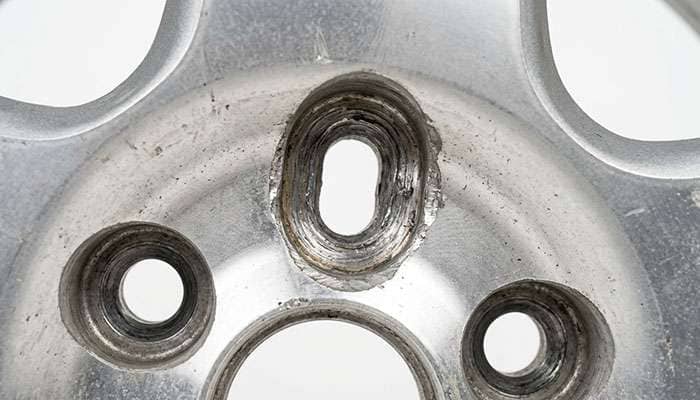
This is the expensive one, and it is the one people never see coming. Once the wheel can move against the hub, the lug holes in the wheel start taking a beating. A lug hole is machined to a specific shape, a taper, a ball, or a flat with a washer, depending on your lug nut seat type, and the nut has to match that shape perfectly to seat right. When the wheel shifts, the nut seat wears out of round. The hole goes egg-shaped. On an aluminum wheel this happens faster than most people would believe, because aluminum is soft and the stud is hardened steel and only one of them is going to win.
Once a lug hole is elongated, that wheel is finished. You cannot machine it back. A nut will not seat squarely in an out-of-round hole no matter how well you torque it, which means it will not hold clamp load, which means it will loosen, which means you have built the same problem into a brand new set of nuts. You started with a missing two dollar part and you have arrived at buying a wheel. This is one of the most common ways a perfectly good wheel gets scrapped, and it shows up in our rundown of common truck rim problems more than anything else on the list.
A wheel that is not clamped flat is not running true, and a wheel that is not running true is feeding a side load into the wheel bearing that the bearing was not designed for. Bearings are not cheap and they are not quick. If it goes far enough that the studs damage the hub flange itself, you are into hub assembly money, which on a modern car with an integrated bearing and ABS sensor is a genuinely unpleasant number.
So the ladder is: two dollar nut, thirty dollar stud, a few hundred for a wheel, a few hundred more for a bearing or hub. Every rung you climb is because you did not stop at the one below it. If you have already climbed far enough that the wheel is scrap, you can shop wheels at Performance Plus Tire by vehicle and bolt pattern to get the right one, and while you are in there get the right seat type nuts to go with it. Buying the wheel and the fasteners together is how you make sure they actually match, which is more than a lot of people can say about the setup they are running now.
Nuts do not evaporate. If you lost one, something caused it, and if you fix the nut without fixing the cause you will be back here in a month.
This is the number one cause and it happened at a shop, not in your driveway. A tech runs an impact gun on the nuts because it is fast, and an impact gun has no idea how tight it is going. Over-torque stretches the stud past its elastic range so it never comes back, and a stud that has yielded cannot hold clamp load no matter how right the number looks on a torque wrench afterward. Under-torque leaves the joint loose from minute one. Either way the nut works its way off over the following weeks. If you lost a nut a few hundred miles after a tire rotation or a brake job, you now know why. Doing it correctly is what our guides on how to tighten lug nuts properly and how to torque lug nuts perfectly are for, and the star pattern in those guides is not a suggestion.
Any time a wheel comes off and goes back on, the joint settles in the first few dozen miles as the mating surfaces bed together. That settling costs you clamp load. The fix is to re-check torque after 50 to 100 miles, which is the industry standard practice and which almost no retail shop tells the customer to do. If your wheel came off recently and a nut went missing shortly after, that is the mechanism.
Big one on aftermarket wheels. Conical nuts in a ball seat wheel, or ball seat nuts in a conical wheel, will thread on and feel tight and be completely wrong. The nut is contacting on a line instead of across a surface, so it cannot generate real clamp load, and it will back off. If you put wheels on and started losing nuts, check the seat type before you blame anything else.
Worth saying out loud: a single missing nut on one wheel, particularly if it is a nice wheel, is sometimes the first step of a theft that got interrupted. If your nuts are locking nuts and one is gone, or if you find one nut missing on each of several wheels, that is not a torque problem. Our guide to wheel locks and theft prevention covers what to do about it.
Rust, road salt, and old cross-threaded damage all stop a nut from pulling down square. A nut that cannot seat cannot hold. If a nut spins on easy and then suddenly gets tight way before it should, stop, because you are probably cross-threading it and you are about to turn a nut problem into a stud problem.
You are standing at the car. Here is the order.
Count the total lug holes in the wheel, not the nuts remaining. Then look into the empty one. Threaded post visible means you lost a nut. Snapped stub or nothing there means the stud broke, and that is a tow, full stop. Go find your row in the table at the top of this page.
Do this before anything else. If a shop did your wheels wrong, they did all four wrong. Grab each nut on every wheel and try to turn it by hand. Anything that moves by hand is loose, and a loose nut is the same problem as a missing one, just earlier. People find the missing nut, fix that corner, and drive off on three other wheels that are backing off as we speak.
Before you drive anywhere, torque the remaining nuts to spec in a star pattern with an actual torque wrench. Not a breaker bar, not the lug wrench from the trunk, not by feel. Most passenger cars want 80 to 100 lb-ft and most trucks want considerably more, and the real number is in your owner's manual. This step matters more than usual right now, because the nuts you have left are the only thing between you and the chain reaction. Getting them right is what buys you the miles in that table.
If you are tempted to run to the parts store, understand that a lug nut has to match three things: thread pitch, seat type, and length. A nut with the right threads and the wrong seat will thread on, feel tight, and fail. This is the single most common mistake people make trying to fix this themselves in a parking lot, and it puts you right back where you started with a nut that will not hold.
Nearest shop, surface streets, no highway, speed and distance per the table. No hard braking, no hard cornering, nothing in the trunk you can leave behind. If the wheel makes any noise, if you feel any shimmy, or if the steering goes vague, pull over and call for a tow. Those are not warnings that something might happen later. Those are the sound of it happening now.
Ask for the studs on that corner to be inspected, and ask why the nut went missing. If the shop just spins a new nut on and hands you the keys without answering that, you have not fixed anything, you have reset the clock. And if that wheel has been running loose for a while, have them look at the lug holes before you accept it back.
How long can you drive with a missing lug nut? On a 5-lug, about twenty miles at forty-five miles an hour, to a shop, once, with the other four torqued right. On a 4-lug, five miles and only because you have no choice. On a 6 or 8-lug, a little more rope, unless you are loaded, in which case none. Two missing, a broken stud, or a lug bolt car, you do not drive at all.
The reason everybody hedges on this question is that the wheel usually does not fall off today. It falls off three weeks from now, on the highway, after you forgot about it. That gap between the cause and the consequence is what makes people comfortable, and it is exactly what makes this dangerous. A lug nut is the cheapest part on your car and it is holding on the only four pieces of your vehicle that touch the ground.
Fix the nut, find out why it left, and check the other three wheels while you are at it. If the wheel is already chewed up, replace it with the right one and put the right fasteners on it, and then re-torque it at a hundred miles like the shop should have told you to in the first place.
It depends on how many lug nuts the wheel uses. On a 5-lug wheel, one missing nut allows a short trip to a shop: under 20 miles and under 45 mph, with the remaining four torqued to spec first. On a 4-lug wheel you have lost 25 percent of the clamp load and should limit it to under 5 miles at 25 mph, or tow it. On 6-lug and 8-lug wheels you have slightly more margin, but not if you are loaded or towing. Two missing nuts, a broken stud, or a lug bolt wheel means you do not drive at all.
Briefly and slowly, to get somewhere it can be repaired. Four properly torqued nuts on a 5-lug wheel have enough clamp load for gentle driving on smooth pavement, but no margin left for a pothole, a panic stop, or a loaded car. Keep it under 20 miles and under 45 mph, stay off the highway, and re-torque the four remaining nuts in a star pattern before you move. Running four out of five as a permanent arrangement puts continuous bending fatigue into the remaining studs, and studs give no warning before they snap.
No. A broken stud is a different and more serious problem than a missing nut, and it needs a tow rather than a careful drive. Studs rarely break without a cause, so a broken one usually means the hub was over-torqued, under-torqued, or has been carrying a bending load from an adjacent fastener that went missing earlier. That means the neighboring studs have lived the same life and may be fatigued too. The stud must be pressed out and replaced, which often requires removing the brake rotor or hub assembly, so it is not a roadside repair.
The front is worse. Front wheels steer, handle roughly 70 percent of braking force because weight transfers forward under deceleration, and put the power down on front-wheel-drive cars. Each of those loads tries to twist the wheel against the hub, which is exactly the movement a missing nut permits. The consequences differ too: a loose rear wheel produces a wobble, while a loose front wheel costs you steering on that corner. A rear wheel is not a free pass, though, and if you are towing or loaded the rear can carry more weight per wheel than the front.
There is no federal law naming a specific number of lug nuts for passenger cars, but essentially every state has an unsafe vehicle or defective equipment statute broad enough to cover a wheel missing a fastener, and an officer can cite you under it. Commercial vehicles are explicit: loose, missing, or broken wheel fasteners are an out-of-service condition under federal criteria, meaning the truck does not move until it is repaired. There is also civil exposure. If you knew about the missing nut and kept driving, and the wheel comes off and causes harm, that shifts the question from accident toward negligence.
Yes, and if you feel vibration along with a missing lug nut you should stop driving rather than continue to a shop. Vibration means the wheel is no longer clamped flat against the hub and has begun moving against it, which is the middle of the failure chain rather than the beginning. At that point the seating surfaces are wearing, the remaining nuts are losing tension, and the studs are taking bending loads. A wheel that shimmies with a fastener missing is not warning you about something that could happen later. It is telling you the process is already running.