
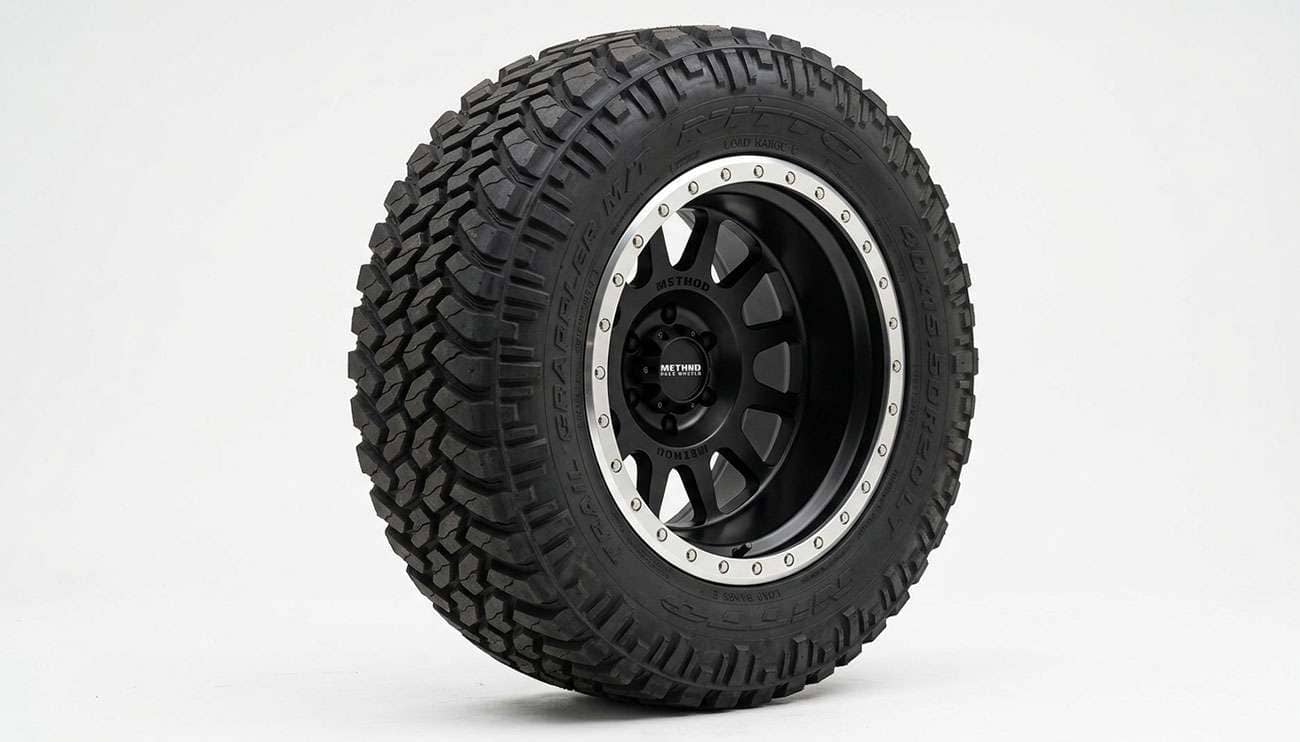
Here is the fact that decides this, and almost no guide prints it. A 20x12 at the market-standard negative 44 offset has 4.77 inches of backspacing. A 20x10 at its standard negative 18 offset has 4.79 inches. Those are functionally identical. Your inboard clearance does not change at all when you step up to a 20x12. Every bit of the extra two inches goes outboard, toward your fender.
That single fact reframes the whole question. 20x12 is not a suspension clearance problem, it is a fender problem plus a wheel bearing problem. If you have flares, trimmed fenders or a lift, it is a good wheel. If you are running stock sheet metal on a daily driver, it is the wrong purchase and no amount of style will fix that.
Measurement |
20x10 at -18 |
20x12 at -44 |
What Changes |
|---|---|---|---|
Backspacing |
4.79 inch |
4.77 inch |
Nothing. Inboard clearance is unchanged |
Overall wheel width |
11.0 inch |
13.0 inch |
2 inches, all of it outboard |
Front spacing to fender |
6.21 inch |
8.23 inch |
You need 2 more inches of fender room |
Tire centerline from hub face |
0.71 inch outboard |
1.73 inch outboard |
1 inch more leverage on the bearing |
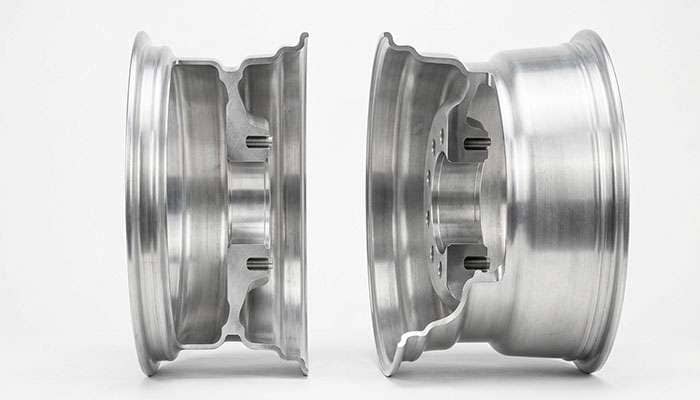
The math is straightforward. Backspacing in inches equals the rim width plus one, divided by two, plus the offset divided by 25.4. On a 12-inch rim that first term is 6.5. Negative 44 divided by 25.4 is negative 1.73. So 6.5 minus 1.73 gives 4.77 inches, and that matches the published spec on essentially every 20x12 built at that offset.
This size is remarkably standardized. Over half of all 20x12 wheels are drilled at exactly negative 44, and around 70 percent sit between negative 51 and negative 44. Ninety-three percent run negative offset of some kind. Compare that to the 20x10, where the median lands at negative 18 and the specs run much wider, as we covered in our breakdown of how big 20x10 wheels actually are. Manufacturers converged on negative 44 for 20x12 because it is what clears a typical lifted truck's suspension while producing the stance buyers are asking for.
Your Situation |
Is 20x12 Good for You? |
What You Need First |
|---|---|---|
Lifted truck with flares or trimmed fenders |
Yes, this is what the size exists for |
Confirm 8.25 inches of fender clearance outboard of the hub face |
Leveled truck, stock fenders |
Marginal, expect rubbing at full lock |
Fender liner trimming and a cab mount chop on many platforms |
Stock height daily driver |
No, a 20x10 at -18 gets you most of the look |
Nothing, choose the narrower wheel instead |
Truck that tows near its rated capacity |
No, the added bearing leverage works against you |
Stay closer to factory offset and verify wheel load rating |
Snow and road salt climate |
Poor, tires throw spray and debris well past the fender |
Mud flaps at minimum, and check local coverage laws |

The Weld Off-Road Granada Six W125 in 6x135 at negative 44 is textbook for this size. 4.77 inches of backspacing, a 2,500 lb load rating, 87.1 mm hub bore, and it starts around $116.26 per wheel. That combination fits an F-150 with a lift and covers the majority of what people mean when they say 20x12.
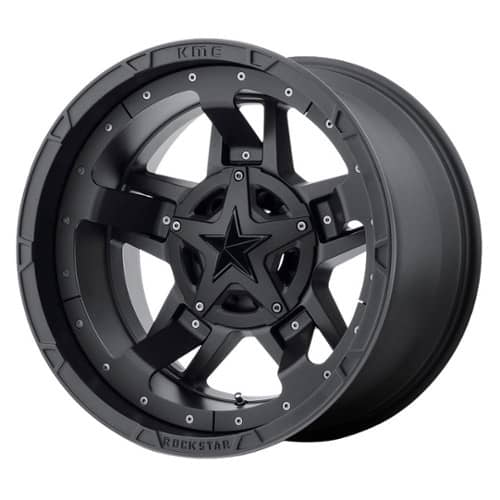
Move to a heavy-duty platform and the XD Series XD827 Rockstar III in 8x180 at negative 44 runs about $131.34 with a 3,640 lb load rating and a 124.2 mm bore. Same width, same offset, same backspacing. The difference is 1,140 lbs of additional capacity per corner, and that is the spec that determines whether the wheel belongs under a three-quarter-ton truck.
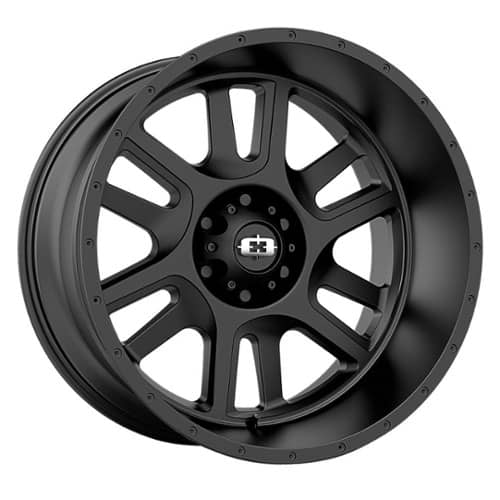
If you want more poke than negative 44 delivers, the Vision 419 Split sits at negative 51 for around $195.52, which drops backspacing to 4.49 inches and pushes the wheel another 0.28 inches outboard. That does not sound like much on paper. On a fender that is already tight, a quarter inch is the difference between clean and rubbing.
The load rating range in this size runs from about 566 lbs on the light end to 3,800 lbs on the heavy end. That is nearly seven to one. A 20x12 built for a sports car application will bolt to a truck hub if the pattern matches and will be structurally wrong for the job. SAE publishes the fatigue test standards these ratings come from, and the Tire Industry Association trains technicians to treat the gross axle weight rating divided by two as an absolute floor.
A 12-inch rim wants a genuinely wide tire. Here is what actually mounts, with the honest note on which ones sit inside their published rim width range.
Tire Size |
Overall Diameter |
Published Rim Range |
Where a 12 Inch Rim Sits |
|---|---|---|---|
33x12.50R20 |
33.0 inch |
8.5 to 11 inch |
1 inch above maximum |
35x12.50R20 |
35.0 inch |
8.5 to 11 inch |
1 inch above maximum |
37x12.50R20 |
37.0 inch |
8.5 to 11 inch |
1 inch above maximum |
33x13.50R20 |
33.0 inch |
9.5 to 12 inch |
At maximum, inside spec |
35x13.50R20 |
35.0 inch |
9.5 to 12 inch |
At maximum, inside spec |
37x13.50R20 |
37.0 inch |
9.5 to 12 inch |
At maximum, inside spec |
38x13.50R20 |
38.0 inch |
9.5 to 12 inch |
At maximum, inside spec |
325/60R20 |
35.4 inch |
10 to 11.5 inch |
Half inch above maximum |
This is the part most 20x12 coverage skips. The 35x12.50R20 is by a wide margin the most commonly mounted tire on this wheel, and every manufacturer publishes its approved rim width range as 8.5 to 11 inches. A 12-inch rim is one full inch past the top of that range. It gets done constantly and it usually works, but you should know you are outside the spec sheet before you order, not after.
If you want the tire that actually matches the wheel, it is a 13.50-wide flotation size. A 35x13.50R20 or 37x13.50R20 lists a range topping out right at 12 inches, which puts your 20x12 exactly at the wide end of approved rather than past it. The 13.50 sizes cost more and the model selection is thinner, but the fitment is correct. For a full breakdown of the most popular option, our piece on what tire size 35x12.50R20 actually measures covers the specifics.
Strip away the diameter and the rule is the same on a 17x12, an 18x12, a 20x12 or a 22x12. Rim width should land at roughly 80 to 90 percent of the tire's section width once you convert that section width to inches.
Run it for 12 inches. Divide 12 by 0.90 and you get 13.3 inches. Divide by 0.80 and you get 15 inches. So the design target for a 12-inch rim is a tire measuring somewhere between 13.3 and 15 inches wide. In flotation terms that is a 13.50 through a 15.50. In metric that is roughly 340 mm to 380 mm.
The practical approved range stretches about an inch below that ideal, which is how a 12.50 tire ends up on a 12-inch rim in the real world. It works because the bead can still seat properly and the sidewall angle stays within tolerance. What it costs you:
None of that is a reason to avoid a 12-inch rim. It is a reason to pick the tire deliberately instead of defaulting to whatever the last guy ran.
No, and not by a small margin.
A 275/60R20 has a section width of 275 mm, which is 10.83 inches. Applied to the 80 to 90 percent rule, the design target rim for that tire is between 8.7 and 9.7 inches, and manufacturers typically publish an approved range of about 7.5 to 9.5 inches. A 12-inch rim sits roughly 2.5 inches past the top of that range.
What happens mechanically if you force it: the beads get pulled apart far beyond where the carcass was designed to sit. The sidewalls go from curved to nearly vertical, the tread crowns concave instead of flat, and the contact patch collapses toward the shoulders. You lose braking distance, you lose wet grip, and you put the bead under permanent tension that a hard pothole hit can break loose.
There is also the appearance problem. A 275 is 10.83 inches wide on a wheel that is 13 inches wide overall. The rim lip would stick out past the tire on both sides. It does not look aggressive, it looks like a mistake, and it is the first thing that meets a curb.
If you have your heart set on a 275/60R20, the wheel you want is a 20x9 or a 20x8.5. Our size breakdown of 275/60R20 in inches covers where that tire belongs.
The width is identical, the offsets are nearly identical, and the backspacing is exactly identical. Both sizes cluster at negative 44, and since backspacing is calculated from rim width and offset only, a 20x12 at negative 44 and a 22x12 at negative 44 both give you 4.77 inches. Diameter does not enter that equation.
So the differences come down to three things.
Factor |
20x12 |
22x12 |
Why It Matters |
|---|---|---|---|
Sidewall on a 35 inch tire |
7.5 inch |
6.5 inch |
A full inch more cushion against potholes |
Backspacing at -44 |
4.77 inch |
4.77 inch |
Identical, fitment work is the same either way |
Tire selection |
Deep, especially in 12.50 and 13.50 |
Thinner, particularly in 13.50 sizes |
You can actually pick a tread pattern on 20s |
Tire cost |
Lower |
Meaningfully higher per tire |
Multiplied by four, and again at replacement |
Unsprung weight |
Lower |
Higher barrel and heavier assembly |
Affects braking, acceleration and suspension work |
If the truck sees dirt roads, gravel, job sites or anything that is not smooth pavement, the 20x12 is the better engineering choice by a clear margin. That extra inch of sidewall is real protection. If the truck is a pavement build and you want the biggest possible face on the wheel, the 22x12 delivers that. Our breakdown of what 22x12 means goes deeper on that side.
The rim diameter itself does nothing to your transmission. What affects it is the overall tire diameter, and people conflate the two because bigger rims usually arrive attached to bigger tires.
Your transmission does not know what size wheel is bolted on. It knows how much torque it takes to turn the driveshaft, and tire diameter is a lever arm in that equation. Go from a 32-inch factory tire to a 35-inch tire and you have increased that lever arm by 9.4 percent. A truck with 3.73 gears now behaves like it has roughly 3.41 gears. Nothing broke, but every gear got taller.
What you actually feel from that:
The fix, if you are going up two sizes or more, is regearing the differentials to restore the original effective ratio. Going from 32 to 35 inches on 3.73 gears, moving to 4.10 puts you back roughly where you started. We covered the full picture in our article on whether big rims damage transmissions.
The practical note for 20x12 buyers: this size is almost always paired with a 35 or 37-inch tire, so the transmission conversation is not optional. It comes with the purchase whether you plan for it or not.
Moving the tire centerline outboard is not free, and the costs accumulate in a predictable order.
First, the wheel bearing carries more moment. At negative 18 on a 20x10, the tire centerline sits 0.71 inches outboard of the hub face. At negative 44 on a 20x12, it sits 1.73 inches out. You have roughly doubled the lever arm through which every bump, every corner and every braking event acts on the bearing.
Then scrub radius changes. The steering axis was designed to intersect the ground near the center of the contact patch. Push the contact patch outboard and you increase scrub radius, which is why heavily offset trucks tug at the wheel over uneven pavement and pull under hard braking if the surfaces differ side to side.
Then the ball joints and tie rod ends feel it. The same leverage that loads the bearing loads everything else in the steering knuckle assembly. These parts do not fail immediately. They wear at an accelerated rate, and the failure shows up as play in the steering long before anything breaks.
Then the tires wear unevenly. Increased scrub radius means the tire is being dragged slightly sideways through every steering input. On a 13.50-wide tire that is a lot of rubber being scrubbed. Feathered edges on the outer tread blocks are the signature.
Then you replace parts early. A wheel bearing that would have gone 120,000 miles goes 60,000. Ball joints follow. None of it is catastrophic, and all of it is billable. Our rundown of the problems that come from incorrect wheel offset walks through the full failure sequence.
To be clear, this is not an argument against 20x12. It is an argument for knowing what you bought. A lifted truck that gets driven reasonably and inspected on schedule handles this fine for years. A truck that tows heavy on aggressive offset is spending its bearing life faster than the owner expects. The tradeoffs here are the same ones that apply across the category, which we laid out in our piece on the drawbacks of deep dish wheels.
Six steps, in order. Steps one and two are the ones that disqualify most people, so do them first.
Step 1: Measure your outboard fender clearance. Park straight, measure from the hub mounting face to the inside of the fender lip at its tightest point. A 20x12 at negative 44 needs 8.23 inches plus tire bulge. If you do not have it, you need flares, trimming, or a narrower wheel.
Step 2: Check clearance at full lock, loaded. Static measurement is not enough. Turn the wheel to the stop with weight in the truck and look at the cab mount, the fender liner and the inner fender seam. This is where 20x12 rubs on most half-tons.
Step 3: Read your gross axle weight rating and divide by two. That is your minimum wheel load rating. Load ratings in this size range from under 600 lbs to 3,800 lbs, so the spread is wide enough to get this wrong.
Step 4: Pick the tire before you pick the finish. A 13.50-wide flotation size sits inside the approved rim range for a 12-inch wheel. A 12.50 sits an inch past it. Decide which tradeoff you want and price both, because 13.50s cost more.
Step 5: Plan for the gearing. If you are moving up two tire sizes or more, budget for a regear or accept the driveability and heat penalty. Do not find out about this after the wheels are mounted.
Step 6: Verify hub bore and lug seat type. Hub bores in this size run from around 67 mm to 125 mm. Anything larger than your hub needs centering rings. Aftermarket wheels frequently want a different lug seat than factory, and the wrong seat will not clamp correctly no matter the torque.
If you want to see what is available and filter by bolt pattern and offset, our 20x12 wheel selection is the place to start.
Are 20x12 wheels good? For a lifted truck with the fender room to carry them, yes, and they are the most standardized aggressive size on the market. Over half of them are built at exactly negative 44 offset because that number solved the problem the segment was trying to solve.
What makes this decision easier than most people expect is that the inboard side does not change. A 20x12 at negative 44 has essentially the same backspacing as the 20x10 at negative 18 you might already be running. Your suspension clearance stays where it is. All two inches of added width go outboard, so the question becomes entirely about fender room and about how much extra leverage you want on your wheel bearings.
Measure the fender gap. Check the load rating against half your gross axle weight rating. Pick the tire from the approved range rather than from what looks right. Do those three things and 20x12 is a good wheel. Skip them and it is an expensive lesson in fender trimming.
They are good for a lifted truck with fender flares or trimmed fenders, and poor for a stock-height daily driver. The deciding measurement is outboard fender clearance. A 20x12 at the standard negative 44 offset has the same backspacing as a 20x10 at negative 18, so your inboard suspension clearance does not change at all. All two inches of extra width push outboard toward the fender.
Common fitments are 33x12.50R20, 35x12.50R20, 37x12.50R20 and the 13.50-wide equivalents in 33, 35, 37 and 38 inch diameters, plus 325/60R20 in metric. The 12.50 sizes publish an approved rim range of 8.5 to 11 inches, which puts a 12-inch rim one inch above maximum. The 13.50 sizes top out at 12 inches, so they sit at the wide end of approved rather than past it.
No. A 275/60R20 has a section width of 10.83 inches and an approved rim width range of roughly 7.5 to 9.5 inches. A 12-inch rim sits about 2.5 inches past the maximum. The sidewalls would be pulled nearly vertical, the tread would crown, the contact patch would collapse, and the rim lip would sit proud of the tire on both sides. That tire belongs on a 20x9 or 20x8.5.
The design target is a tire measuring 13.3 to 15 inches in section width, since rim width should be roughly 80 to 90 percent of section width. In flotation terms that is a 13.50 through a 15.50. The practical approved range extends about an inch narrower, which is how 12.50-wide tires end up on 12-inch rims. Going narrower stands the sidewall up, increases measured section width and makes airing down riskier.
Backspacing is identical at the same offset, since the calculation uses rim width and offset only. Both sizes cluster at negative 44 and both give 4.77 inches. The real differences are sidewall height, where a 35-inch tire leaves 7.5 inches on a 20 versus 6.5 on a 22, plus deeper tire selection and lower tire cost on the 20, and higher unsprung weight on the 22.
Rim diameter alone does nothing. Overall tire diameter is what changes the effective gear ratio. Moving from a 32-inch to a 35-inch tire increases the lever arm by 9.4 percent, which makes 3.73 gears behave like 3.41. The results are later torque converter lockup, more converter slip and heat, shifted shift points, and a speedometer reading about 9.4 percent low. Regearing restores the original ratio.
On most stock and leveled trucks, yes. A 20x12 at negative 44 places the outer wheel edge 8.23 inches from the hub mounting face, roughly two inches further out than a 20x10 at negative 18. Combined with a 12.50 or 13.50-wide tire, that typically pushes the tire past the fender lip. Flares also matter legally, since many jurisdictions require the fender to cover the tread width.



