
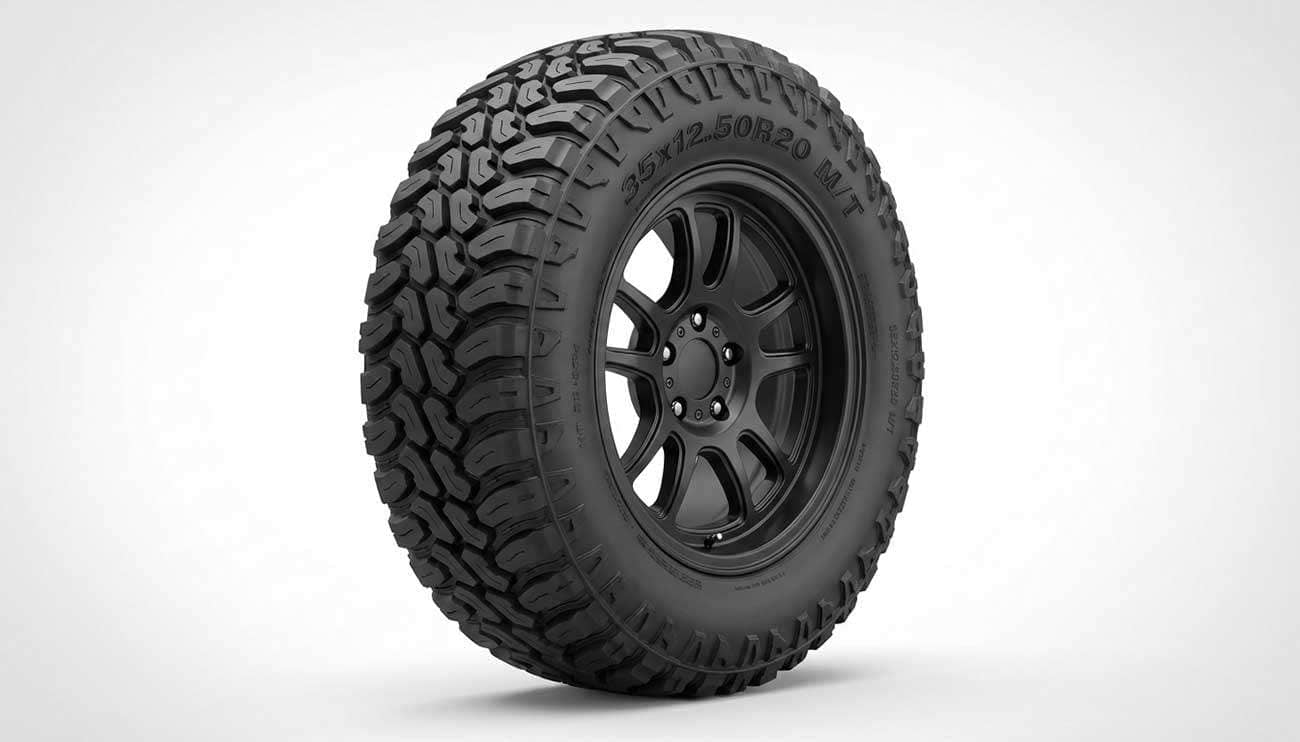
The 35X12.50r20 tire size measures exactly 35.02 inches in diameter and 12.52 inches in width. Understanding what tire size is 35X12.50r20 means knowing these precise measurements and how they impact your vehicle's capabilities.
This popular off-road tire size brings significant differences compared to standard metric equivalents. With a circumference of 110.03 inches (2794.76 mm) and sidewall height of 7.51 inches (190.8 mm), these tires complete 575.84 revolutions per mile—4.5% fewer rotations than comparable smaller sizes.
We'll break down the complete 35X12.50r20 size conversion, explore its metric equivalents, and explain how these measurements affect your vehicle's performance, speedometer accuracy, and off-road capabilities. Whether you're planning an upgrade or need exact specifications for fitment, these details matter for making the right choice.
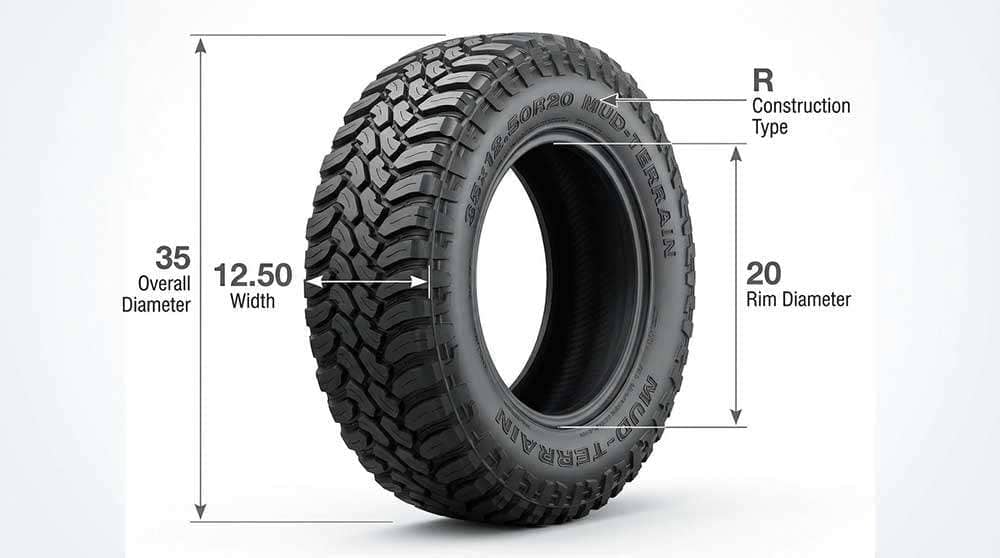
Every number and letter in the 35x12.50r20 tire code tells you something essential about the tire's dimensions and construction. The alphanumeric sequence on your tire's sidewall contains critical details that determine proper fit, performance characteristics, and vehicle compatibility.
That first number represents the tire's overall diameter when properly inflated but not carrying load. This means 35 inches from one side of the tire to the other, measured straight through the center. This dimension matters because it determines your wheel well clearance requirements and directly affects your vehicle's ground clearance.
Here's something important to know: the actual measured diameter can vary slightly from what's printed on the sidewall. The tire only reaches its full 35-inch diameter when mounted on a rim and properly inflated. An unmounted tire might measure around 33 or 34 inches, which can create confusion when you're checking available space for upgrades.
The second number shows section width—the tire's measurement from sidewall to sidewall when you're looking at it head-on. For a 35x12.50r20 tire, that's 12.5 inches or approximately 318 millimeters.
This flotation-style measurement differs from metric tire sizing. While metric sizes show tread width first, this measurement includes the total width with both sidewalls. Understanding this distinction helps when you're checking rim compatibility and wheel well clearance. Section width also determines the tire's contact patch with the ground, which affects both traction and handling performance.
The "R" identifies your tire's internal construction as radial. This single letter significantly impacts the tire's performance characteristics. Radial construction means the internal cords (plies) run perpendicular to the direction of travel.
Radial construction became the industry standard for good reasons. You get better road grip, lower rolling resistance for improved fuel economy, enhanced ride comfort, and superior durability compared to older construction methods. If you see a "B" instead of "R," that indicates bias-ply construction, while "D" means diagonal bias construction.
The final number specifies the wheel diameter in inches. This 20-inch measurement refers to the diameter of the wheel rim that this tire fits. This dimension is absolutely critical for proper fitment—mounting a tire on the wrong rim size creates dangerous situations.
The rim diameter must match the tire specification exactly. Unlike other tire dimensions where you might have some flexibility, never deviate from this number when selecting replacement tires. This measurement represents the distance between the two bead seat areas where your tire forms its tight seal with the wheel.
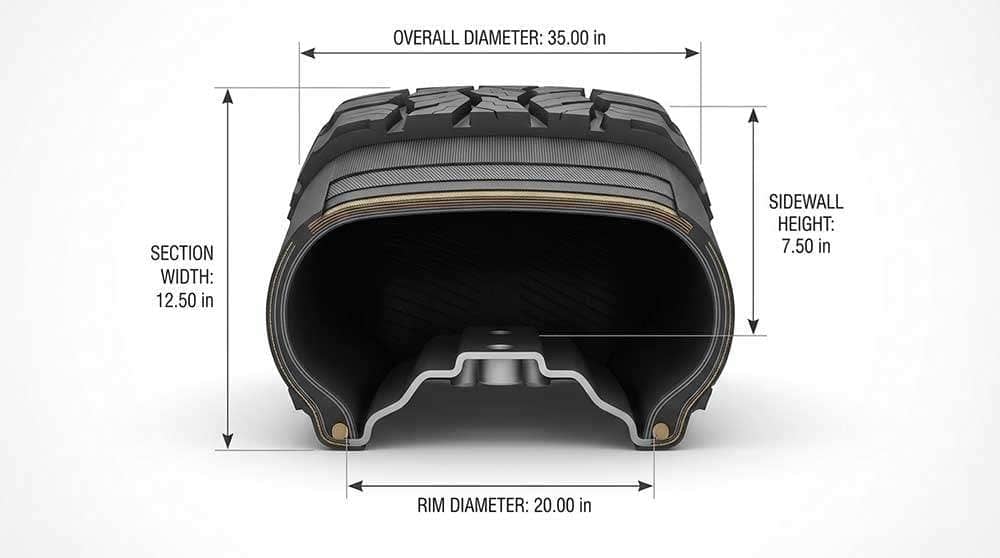
Precise measurements reveal that 35x12.50r20 tires often vary from their nominal size designation. Manufacturing tolerances and design differences between brands create these variances, making exact specifications crucial for proper fitment and performance planning.
Most 35x12.50r20 tires measure 35.02 inches (889.6 mm) when properly mounted and inflated. However, actual measurements vary between manufacturers. The Nitto Ridge Grappler in this size measures 34.76 inches, while the BFGoodrich All-Terrain T/A KO2 comes in at 34.5 inches.
Despite the "35" designation, real-world measurements typically fall between 34.5 and 35.02 inches in diameter. This variation matters when calculating clearance requirements for your vehicle, especially if you're working with tight tolerances in wheel wells or suspension components.
Standard 35x12.50r20 tires measure 12.52 inches (318 mm) in section width. This measurement represents the tire's width from sidewall to sidewall when mounted on an appropriate rim, and it must be compatible with your vehicle's wheel wells and suspension components.
The substantial width creates a larger contact patch with the ground, enhancing traction for off-road applications. The BFGoodrich All-Terrain T/A KO2 maintains the expected 12.5-inch width, while the Nitto Ridge Grappler matches the 12.52-inch specification exactly.
Sidewall height measures 7.51 inches (190.8 mm) from rim to tread surface for typical 35x12.50r20 tires. This dimension significantly influences ride quality, with taller sidewalls providing better cushioning over rough terrain.
The substantial sidewall height offers excellent flexibility for air-down situations during off-road driving. This measurement also helps determine the aspect ratio, which affects handling characteristics and load-carrying capacity.
Circumference measures approximately 110.03 inches (2794.76 mm), directly affecting speedometer accuracy and gear ratio calculations.
Revolutions per mile (RPM) typically register between 575 and 602, depending on the manufacturer:
Standard 35x12.50r20: 575.84 revolutions per mile
Nitto Ridge Grappler: 598 revolutions per mile
BFGoodrich All-Terrain T/A KO2: 602 revolutions per mile
Toyo Open Country M/T: 592 revolutions per mile
The revolution count runs 4.5% lower than comparable smaller tires, causing your speedometer to read approximately 4.5% slower than your actual speed without recalibration.
Additional specifications include weight variations from 66.8 lbs for the BFGoodrich KO2 to 73.5 lbs for the Nitto Ridge Grappler, plus load capacity ranging from 3195 to 3640 lbs per tire.
Performance Plus Tire offers a wide selection of quality 35x12.50r20 tires with detailed specification sheets for those seeking verified measurements.
These precise measurements ensure proper fitment and performance, particularly for upgrades from stock tire sizes or custom off-road builds with specific clearance requirements.
Converting 35x12.50r20 tires into metric measurements helps when comparing options across international brands. Many manufacturers list sizes in both formats, and understanding the exact conversions reveals which options work best for your vehicle.
The 325/60r20 stands as the closest metric equivalent to a 35x12.50r20 tire. When you compare the dimensions side-by-side, the similarities are remarkable:
Diameter: 325/60r20 measures 35.35 inches (898 mm) versus 35.02 inches (889.6 mm) for 35x12.50r20 – just 0.33 inches or 0.9% difference
Width: 325/60r20 is 12.8 inches (325 mm) while 35x12.50r20 is 12.52 inches (318 mm) – only 0.28 inches variance
Sidewall Height: 7.68 inches (195 mm) for the 325/60r20 compared to 7.51 inches (190.8 mm) – merely 0.17 inches difference
Circumference: 111.07 inches versus 110.03 inches – a 1.04-inch variation
Revolutions per mile: 570.46 for 325/60r20 and 575.84 for 35x12.50r20 – a 0.9% difference
These negligible variations mean most vehicles equipped for one size can accommodate the other without modifications.
Close, but 315/60r20 tires aren't identical to 35x12.50r20. The key differences include:
Diameter: 315/60r20 measures 34.88 inches (886 mm), making it 0.14 inches (3.6 mm) smaller – a 0.4% difference
Width: 12.4 inches (315 mm) for the 315/60r20 versus 12.52 inches (318 mm) – only 0.12 inches (3 mm) narrower
Sidewall Height: 7.44 inches (189 mm) compared to 7.51 inches (190.8 mm) – a minimal 0.07 inch (1.8 mm) difference
These small variations mean you could switch from 315/60r20 to 35x12.50r20 with virtually no impact on speedometer accuracy or performance.
No, 285/60r20 tires differ substantially from 35x12.50r20:
Diameter: 285/60r20 measures 33.46 inches (850 mm), making it 1.56 inches (39.6 mm) smaller – a significant 4.7% difference
Width: 11.22 inches (285 mm) versus 12.52 inches (318 mm) – 1.3 inches (33 mm) narrower
Revolutions per mile: 602.67 for 285/60r20 compared to 575.84 for 35x12.50r20 – resulting in a 4.5% speedometer discrepancy
These differences will affect vehicle performance and may require suspension modifications.
Beyond the options we've covered, other metric equivalents include:
295/65r20: Another close match at approximately 35.1 inches in diameter
285/70r20: Slightly taller at 35.7 inches in diameter
325/60r20: The closest overall match
The 35x12.50r20 correlates closely with these metric designations depending on specific brand and model variations.
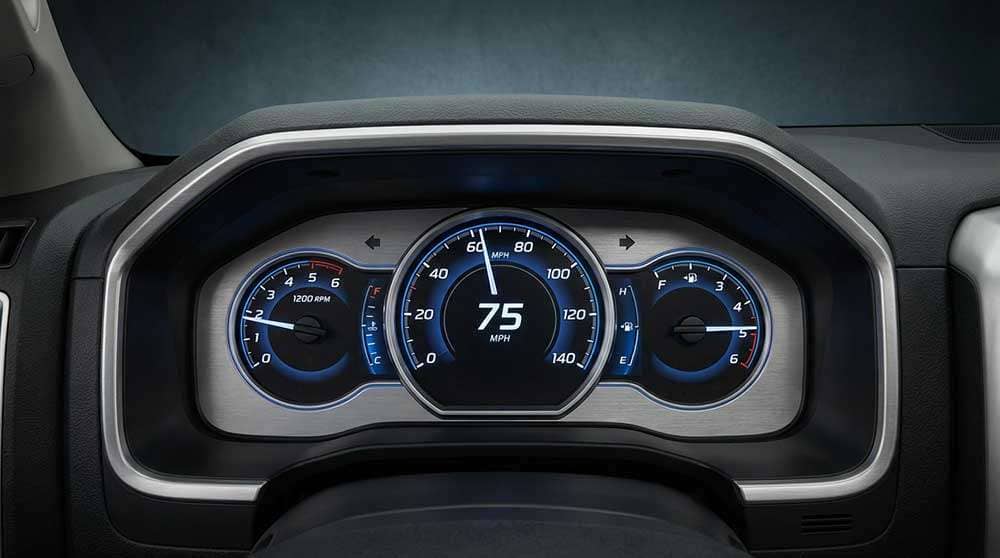
Installing 35x12.50r20 tires creates substantial changes in your vehicle's performance characteristics. These modifications go beyond appearance and ground clearance, directly impacting critical driving parameters that demand careful consideration.
Your speedometer reads slower than your actual speed when running 35x12.50r20 tires. The variance is consistent across all speeds:
Speedometer Reading |
Actual Speed |
|---|---|
50 mph |
52.4 mph |
60 mph |
62.8 mph |
65 mph |
68.1 mph |
70 mph |
73.3 mph |
Your vehicle's computer bases speed calculations on factory tire revolutions per mile. Larger tires cover more ground per rotation, creating this discrepancy. Without speedometer recalibration, you risk unintentional speeding violations.
Engine RPM at highway speeds varies dramatically with your differential gear ratio. At 65 mph using 35x12.50r20 tires:
Lower gear ratios from 2.35 to 3.55:
2.35 ratio: 1465 RPM
2.73 ratio: 1702 RPM
3.07 ratio: 1914 RPM
3.55 ratio: 2214 RPM
Higher gear ratios from 3.73 to 5.38:
3.73 ratio: 2326 RPM
4.11 ratio: 2563 RPM
4.88 ratio: 3043 RPM
5.38 ratio: 3355 RPM
These numbers help determine if regearing becomes necessary after your tire upgrade. Most experts recommend differential regearing to restore factory-like performance and reduce drivetrain stress.
Expect a fuel economy drop of 1-3 MPG when switching to 35x12.50r20 tires. The reduction comes from increased rolling resistance, additional weight, and higher aerodynamic drag.
Performance impacts include:
Slower acceleration from altered gear ratios
Additional stress on transmission components
Vehicle owners consistently report that regearing their differentials helps offset these effects. One owner documented achieving 17-18 MPG with factory 265/70/R17 tires, then seeing fuel economy drop to 15.4 MPG after upgrading to larger tires comparable to 35x12.50r20.
Computer re-tuning can further minimize these impacts, providing smoother shift patterns and better throttle response.
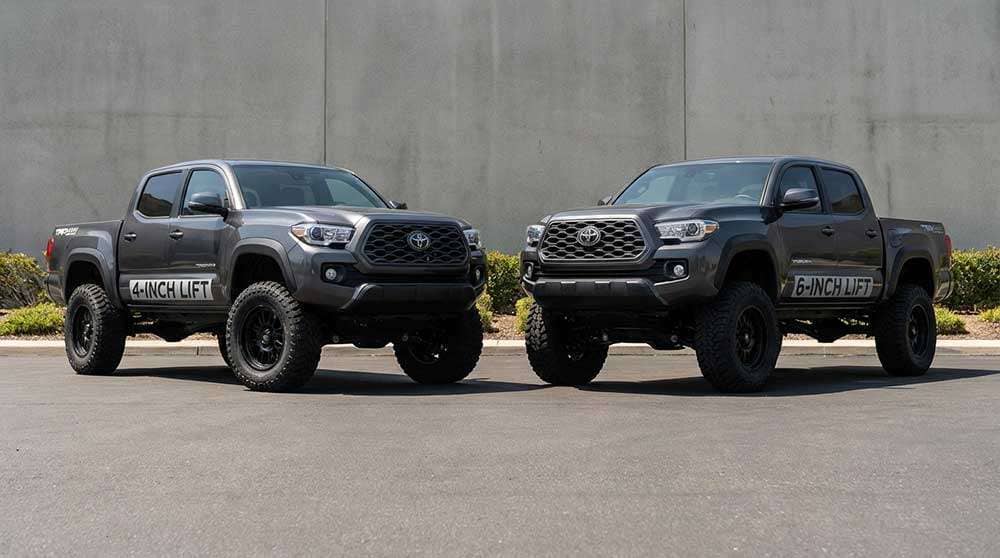
Proper fitment for 35x12.50r20 tires requires careful attention to both vehicle modifications and wheel specifications. These practical considerations determine whether you can successfully run this popular tire size on your vehicle.
Yes, 35x12.50r20 tires fit on 20-inch rims when you have adequate wheel width. These tires work best on wheels between 8.5-11 inches wide. However, many tire shops won't mount 12.5-inch wide tires on standard 8-inch factory wheels, even though some drivers successfully use this combination. We recommend wheels with 9-inch width or greater for optimal performance. If you're stuck with narrower wheels, consider 11.5-inch wide tires instead.
Lift requirements depend on your specific vehicle model. Most vehicles need a 4-6 inch lift to properly accommodate 35x12.50r20 tires. Silverado owners typically choose a 4-inch lift, though some models work with just a 2.5-inch leveling kit plus minor modifications. Jeep Wrangler owners generally require a 4-inch suspension lift plus a 1-inch body lift for proper clearance and suspension travel.
The 35x12.50r20 size has become the go-to choice for modern builds because it strikes the perfect balance. These tires work excellently with common 4-6" lifts or leveled trucks on 20x9 to 20x12 wheels, adding substantial sidewall and width without jumping to the extreme height of 37s. They also clear easily on popular platforms including Silverado/Sierra 1500, F-150, Ram 1500/2500, Bronco, Gladiator, and Tundra with proper offset and minor trimming.
The choice depends on your vehicle and intended use. 33-inch tires require minimal modifications and maintain factory ride quality, making installation much simpler. 35-inch tires demand more substantial modifications including lift kits, realignment, and often new brake or gear systems. The larger 35-inch tires provide better obstacle clearance but add weight and rolling resistance. For serious off-road enthusiasts seeking maximum ground clearance, 35s offer advantages worth the investment. For all-around performance with fewer modifications, 33s might be preferable, though Performance Plus Tire offers quality options in both sizes.
The 35x12.50r20 tire size delivers exactly what serious off-road enthusiasts need: proven performance with manageable modifications. These tires measure 35.02 inches in diameter and 12.52 inches in width, creating the ideal balance between capability and practicality for most truck and SUV builds.
Your vehicle will see real changes when you make the switch. The 325/60r20 offers the closest metric alternative with nearly identical dimensions, while other sizes like 285/60r20 create significant differences that affect both fitment and performance. Most drivers notice the 4.7% speedometer variance and 1-3 MPG fuel economy change, but these trade-offs deliver superior ground clearance and off-road capability.
The 4-6 inch lift requirement fits perfectly with popular truck modifications, making 35x12.50r20 the go-to choice for modern builds. Whether you're building a weekend trail rig or an everyday driver with serious off-road capability, these tires provide the performance you want without the extreme modifications required for larger sizes.
When choosing between 33-inch and 35-inch options, consider your priorities. The 35s demand more investment in suspension and possibly drivetrain modifications, but they reward you with significantly better obstacle clearance and commanding presence both on and off the trail.
At Performance Plus Tire, we understand the importance of getting your tire selection right the first time. Our extensive selection of 35x12.50r20 tires from trusted brands ensures you'll find the perfect match for your vehicle and driving style, backed by our fitment expertise to make your upgrade smooth and successful.
Understanding the 35x12.50r20 tire size helps you make informed decisions about vehicle modifications, performance impacts, and proper fitment requirements.
• Exact measurements matter: 35x12.50r20 tires actually measure 35.02" diameter and 12.52" width, with 575.84 revolutions per mile affecting speedometer accuracy by 4.7%.
• Metric equivalent is 325/60r20: This closest match differs by only 0.33" in diameter and 0.28" in width, making them virtually interchangeable for most applications.
• Expect performance trade-offs: Installing these tires reduces fuel economy by 1-3 MPG and requires speedometer recalibration to avoid unintentional speeding.
• Plan for 4-6 inch lift requirement: Most vehicles need substantial suspension modifications for proper clearance, though some models work with 2.5" leveling kits.
• Choose based on your priorities: 35s offer superior ground clearance over 33s but demand more modifications, making them ideal for serious off-roaders willing to invest in upgrades.
The popularity of 35x12.50r20 tires stems from their optimal balance between enhanced capability and reasonable modification requirements, making them the go-to choice for modern lifted truck builds.
The closest metric equivalent to a 35x12.50R20 tire is 325/60R20. This size is nearly identical, with only minor differences in dimensions. The 325/60R20 measures 35.35 inches in diameter and 12.8 inches in width, compared to 35.02 inches and 12.52 inches for the 35x12.50R20.
While close, 35-inch tires (35x12.50R20) are not exactly the same as 315/60R20 tires. The 35-inch tires are slightly larger, with a diameter of 35.02 inches compared to 34.88 inches for the 315/60R20. The width difference is minimal, with 35-inch tires being 12.52 inches wide versus 12.4 inches for the 315 size.
Most vehicles require a 4-6 inch lift to properly accommodate 35-inch tires. However, the exact lift requirement can vary depending on the specific vehicle model. Some trucks may only need a 2.5-inch leveling kit with minor modifications, while others might require additional body lifts for proper clearance and suspension travel.
Installing 35-inch tires can impact vehicle performance in several ways. They typically reduce fuel economy by 1-3 MPG due to increased rolling resistance and weight. Speedometer readings will be about 4.7% slower than actual speed, requiring recalibration. Acceleration may decrease, and the engine might work harder at highway speeds, potentially necessitating differential regearing for optimal performance.
35-inch tires, like the 35x12.50R20, are popular for off-road use because they offer an ideal balance between increased ground clearance and reasonable modification requirements. They provide substantial improvement in obstacle clearance compared to stock tires without requiring the extensive modifications needed for larger sizes like 37-inch tires. This size also works well with common lift heights and wheel sizes, making them a versatile choice for many off-road enthusiasts.



