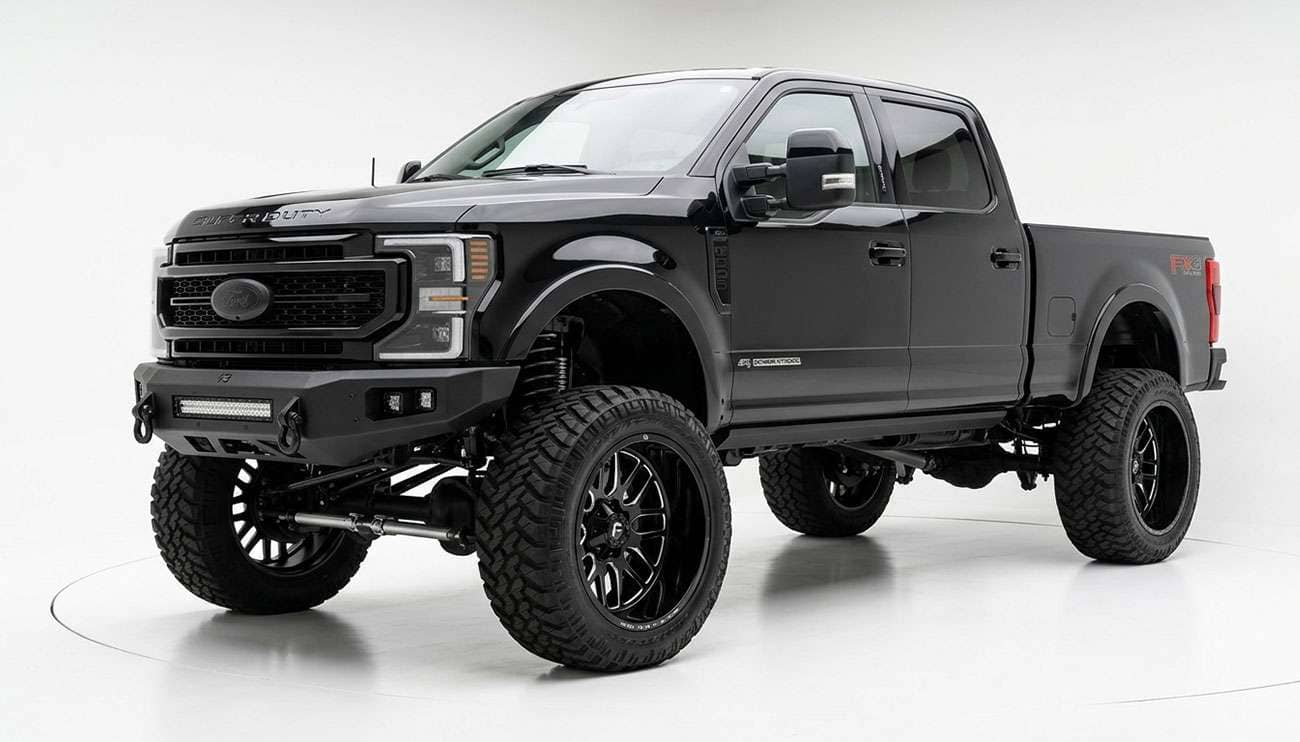
A 22x12 wheel is 22 inches in bead seat diameter and 12 inches in bead seat width. That is the whole of what those two numbers say, and it is not enough to order a wheel. The specification that decides whether a 22x12 clears your suspension, sits under your fender, or eats a set of wheel bearings is offset, and it is not in the name. In this size, offset is negative in nearly every case, and the default is 44 millimeters negative, which works out to 4.77 inches of backspacing.
Most explanations give you diameter and width and stop. Here is the part nobody puts in front of you: two wheels both stamped 22x12 can place their outer edge more than an inch apart and their inner edge more than an inch apart, in opposite directions. Same size. Different wheel. Start with the table, then read the section that matches your question.
22x12 at this offset |
Backspacing |
What it does on the truck |
|---|---|---|
Zero offset |
6.50 in |
Rare in this size. Centered mounting pad, least poke, most inner interference |
-40 mm |
4.93 in |
The mildest common setup. Still well outside the fender on most stock trucks |
-44 mm |
4.77 in |
The default. More than half the wheels built in this size land here |
-51 mm |
4.49 in |
A quarter inch further out than the -44. Usually needs fender work |
-76 mm |
3.51 in |
Deep-dish territory. Show stance, and the hardest on bearings and steering |
Both numbers describe the bead seat, which is the machined shelf inside the rim where the tire's bead locks in. That distinction matters more than people expect.
The 22 is bead seat diameter, measured across the wheel from one bead seat to the other. It is not the outside diameter of the wheel. The rim flange, the lip that stands proud of the bead seat, adds roughly another inch to the physical outer diameter. That is why a 22-inch wheel measures closer to 23 inches across a tape measure and why people occasionally think they have been sold the wrong size.
The 12 is bead seat width, measured from the inside face of one flange to the inside face of the other. Same story. The actual outside-to-outside width of a 22x12 runs about 13 inches, because each flange adds roughly half an inch. That extra inch is not decoration, it is the number you have to use when you calculate backspacing, and it is the single most common arithmetic mistake in wheel fitment.
Dimension |
What 22x12 says |
What the wheel actually measures |
|---|---|---|
Diameter |
22 in at the bead seat |
About 23 in across the flanges |
Width |
12 in at the bead seat |
About 13 in across the flanges |
Offset |
Nothing |
Typically -40 mm to -76 mm in this size |
Bolt pattern |
Nothing |
Five, six, or eight lug in a dozen different circles |
Hub bore |
Nothing |
Commonly 78 mm to 130 mm depending on the platform |
Load rating |
Nothing |
Roughly 2,500 lb to 3,700 lb per wheel |
Read down that right-hand column and the problem becomes obvious. The size designation covers two of six specifications that have to be right. For the full anatomy of a wheel spec, our guide on wheel offset, backspacing, and bolt patterns explained lays out every number in order.
Offset is the distance from the wheel's mounting pad, the flat face that bolts to your hub, to the centerline of the rim. It is measured in millimeters. Positive offset means the mounting pad sits outboard of the centerline, which tucks the wheel in. Negative offset means the mounting pad sits inboard of the centerline, which pushes the whole assembly out.
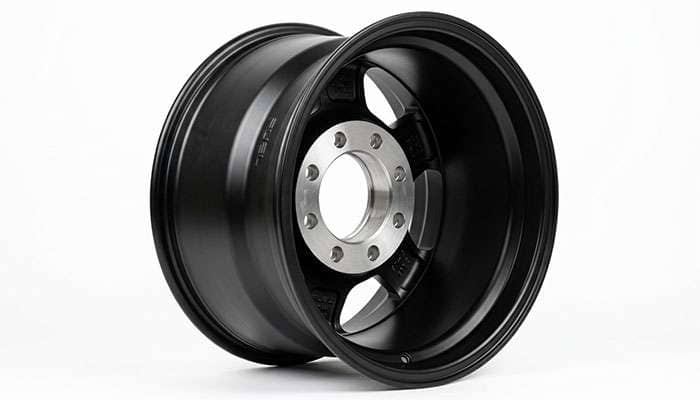
Backspacing is the same idea expressed differently: the distance from the mounting pad to the inboard flange. Offset is a design number and backspacing is a tape measure number, and you can convert between them with one line of arithmetic.
Backspacing in inches = (wheel width + 1) divided by 2, plus offset in millimeters divided by 25.4.
Run a 22x12 at -44 millimeters. Twelve plus one is thirteen, divided by two is 6.5 inches. Negative 44 millimeters is negative 1.73 inches. Add them and you get 4.77 inches of backspacing. That is not a rounded estimate, that is the number printed on the spec sheet of the overwhelming majority of wheels built in this size.
This is the part worth sitting with, because it explains why a 22x12 both fixes clearance problems and creates them.
Take a factory truck wheel, say a 20x9 at plus 44 millimeters. Its outer flange sits 3.27 inches outboard of the mounting pad and its inner flange sits 6.73 inches inboard. Now put on a 22x12 at negative 44. The outer flange moves to 8.23 inches outboard and the inner flange moves to 4.77 inches inboard.
Both edges moved outboard. The outer edge went out by about 5 inches per side. The inner edge also went out, by about 2 inches. That is why the swap buys you a heap of room against upper control arms, sway bar end links, and coilover bodies, and simultaneously puts five inches of tire outside where the factory fender stops.
Track width goes up by roughly 7 inches across the axle, since the centerline of each wheel shifts about 3.5 inches outboard. Every consequence in this article traces back to that one number. Our piece on running a negative offset setup works through the same logic on a smaller wheel where the effects are easier to see.
The more negative number sticks out more. Offset runs on a number line, so lower always means further out, and that holds across the sign change.
Line them up on a 22x12 and the ranking is straightforward. A -76 sticks out more than a -51, which sticks out more than a -44, which sticks out more than a -40, which sticks out more than a zero, which sticks out more than any positive number. Each millimeter of difference is 0.039 inches at the fender.
Comparison |
Difference in millimeters |
Extra poke per side |
|---|---|---|
-40 to -44 |
4 mm |
0.16 in |
-44 to -51 |
7 mm |
0.28 in |
-44 to -76 |
32 mm |
1.26 in |
Factory +44 to -44 |
88 mm |
3.46 in of centerline shift |
One correction worth making, because it trips people up constantly. Offset alone does not tell you how far a wheel sticks out. A 22x12 at -44 and a 22x10 at -44 share an offset, but the wider wheel puts its outer flange a full inch further out, because half the extra width goes outboard of the centerline. Compare offsets only when the widths match. Otherwise compare backspacing, or compare the outer flange position directly. Our breakdown of how much you can change offset covers the safe working range on a given platform.
It is not a tire size at all. It is a wheel size, and this is worth clearing up because a lot of people search it the other way around.
Tire sizes describe the tire: either a metric designation like 305/45R22, where the numbers are section width in millimeters, aspect ratio, and rim diameter, or a flotation designation like 35x12.50R22, where the numbers are overall diameter, section width, and rim diameter, all in inches. Wheel sizes describe the wheel: diameter by width, both in inches, with offset stated separately. A 22x12 tells you about the metal, not the rubber.
Nor is 22x12 standard in the sense of factory equipment. No manufacturer ships a truck on a 12-inch-wide 22 from the assembly line. It is an aftermarket size, built for people who want a wide, aggressive stance, and the bolt patterns confirm it: heavy-duty eight-lug circles, half-ton six-lug circles, and the five-lug patterns that show up on Wrangler and Gladiator platforms.
That aftermarket-only status has practical consequences. There is no factory fender designed around this width, no factory alignment spec that accounts for the track width change, and no owner's manual page that tells you the correct torque sequence for the lug seat style your new wheels use. All of that becomes your responsibility.
In practice, the 22x12 gets paired with four families of tire, and the honest answer comes with a caveat that most sources skip.
Tire size |
Overall diameter |
Section width |
Typical published rim range |
|---|---|---|---|
33x12.50R22 |
33.0 in |
12.5 in |
8.5 to 11 in |
35x12.50R22 |
35.0 in |
12.5 in |
8.5 to 11 in |
37x13.50R22 |
37.0 in |
13.5 in |
8.5 to 11 in |
305/45R22 |
32.8 in |
12.0 in |
9.5 to 11 in |
35x15.50R22 |
35.0 in |
15.5 in |
Wide flotation, built for 12 in and up |
Look at the right-hand column. The four tires that get mounted on 22x12 wheels every single day sit at or above the top of their published rim width ranges. A 12-inch rim is wider than the range most manufacturers publish for a 12.50 or 13.50 flotation tire. Specifications vary by manufacturer and the tire's own spec sheet is the authority, so check the one you are buying.
What actually happens when a tire runs on a rim wider than its published range is worth understanding rather than fearing. The sidewalls pull outward and stand more vertical, which flattens the tread contour and moves load onto the shoulders. The rim flange sits closer to the widest point of the tire, so it takes more of the hit from a pothole or a curb. Steering response sharpens, ride compliance drops, and airing down for trail work carries more bead-unseating risk than it would on a narrower wheel. The relationship between rim width and tire shape is covered in full in our guide on tire size for wheel width.
Published ranges for 12.50-inch flotation tires generally run from 8.5 to 11 inches, with 10 inches serving as the measuring rim the section width is based on. That means a 12.50 tire is designed around a 10-inch wheel and validated across a range that stops an inch short of a 22x12.
The rule of thumb behind those numbers is that rim width wants to land somewhere around 75 to 85 percent of section width. Run that on a 12.5-inch tire and you get 9.4 to 10.6 inches, which is exactly where the measuring rim sits. Run it in reverse from a 12-inch rim and the tire it was shaped around is closer to 14 or 15 inches of section width.
Rim width |
Effect on a 12.50 tire |
Best suited to |
|---|---|---|
8.5 in |
Sidewalls pull inward, tread crowns slightly |
Airing down, rock crawling, bead retention |
10 in |
The shape the tire was designed to take |
Balanced wear, ride, and traction |
11 in |
Sidewalls stand up, tread flattens, response sharpens |
Street-biased builds staying inside the published range |
12 in |
Above the published range for most 12.50 tires |
Stance-focused builds; step up to a wider tire if you can |
If you have already bought 22x12 wheels and want to stay inside the published range, the move is to go wider in the tire rather than narrower in the wheel. A 14.50 or 15.50 flotation tire, or a wide metric size in the 355 to 375 range, is built around a rim in this width class. The trade is that you have just made an already wide setup wider, which sends you back to the fender coverage question.
You buy 22-inch tires, not 22x12 tires. The 12 belongs to the wheel and never appears in a tire size. Search for the tire designation instead: 33x12.50R22, 35x12.50R22, 37x13.50R22, or a metric size ending in R22.
That distinction is not pedantry, it is what keeps people from ordering the wrong thing. When you shop by wheel size you are choosing metal: diameter, width, offset, bolt pattern, hub bore, load rating, and finish. When you shop by tire size you are choosing rubber: diameter, section width, load range, and tread type. The two purchases share only the 22.
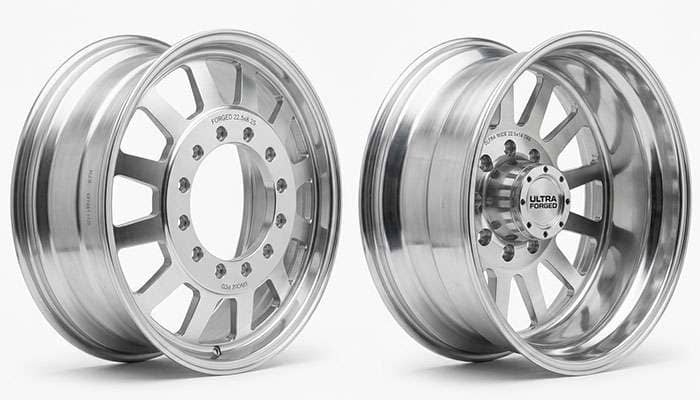
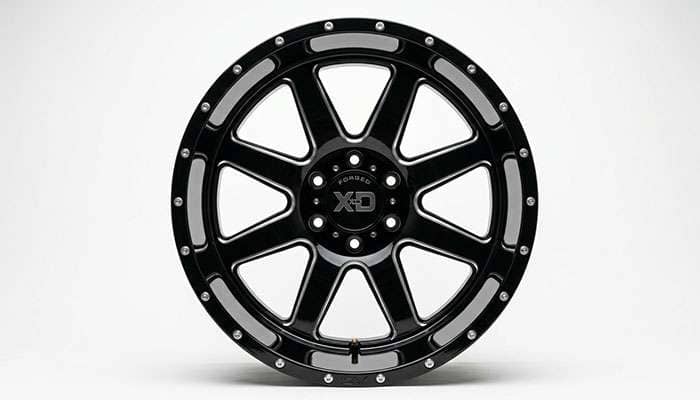
On the wheel side, this size is deep. It comes in one-piece cast construction at the accessible end and forged one-piece, two-piece, and three-piece builds further up, with load ratings from roughly 2,500 to 3,700 pounds per wheel and finishes spanning gloss black milled, chrome, polished, and custom work. Pricing tracks construction more than anything else: cast wheels start in the mid hundreds, forged monoblocks land in the high hundreds, and multi-piece forged builds run into the thousands.
One specification to check before you order anything. Wheel load rating has to meet or exceed your vehicle's gross axle weight rating divided by two. A wheel that looks right and bolts up but is rated for a half-ton is not the wheel for a three-quarter-ton with a gooseneck on the back. You can browse the full range of 22x12 wheels and filter by bolt pattern, offset, and finish.
The bolt pattern lineup in this size tells you exactly who it is built for. Two numbers describe it: the lug count and the diameter of the circle those lugs sit on, in millimeters or inches.
Bolt pattern |
Lug count |
Common platforms |
|---|---|---|
8x165.1 |
Eight |
Heavy-duty GM and older Ram three-quarter and one-ton trucks |
8x170 |
Eight |
Ford Super Duty |
8x180 |
Eight |
Newer heavy-duty GM trucks |
6x135 |
Six |
Ford F-150 and Expedition |
6x139.7 |
Six |
GM half-tons, Toyota trucks, Nissan Titan |
5x127 and 5x139.7 |
Five |
Jeep Wrangler and Gladiator, older Ram half-tons |
Two things the bolt pattern does not cover. Hub bore has to match your hub or be corrected with hub-centric rings, because lug hardware is designed to clamp the wheel against the hub face, not to center it. A wheel centered on its lug hardware will produce a vibration that no amount of balancing will resolve. And lug seat style matters: conical, ball, and flat seats are not interchangeable, and reusing factory lug nuts on aftermarket wheels with a different seat is a genuine safety problem rather than a preference.
Moving each wheel's centerline three and a half inches outboard is not a cosmetic change. It rewrites the geometry the front suspension was designed around, and the effects arrive on a schedule.
Scrub radius goes up immediately. Scrub radius is the distance between where the steering axis meets the ground and the center of the contact patch. Push the wheel outboard and that distance grows. The steering gets heavier at parking speeds, the wheel fights back harder over broken pavement, and braking on a surface that grips unevenly side to side pulls at the steering more than it used to.
Bearing load climbs on the same day. The wheel bearing was engineered around a load applied at a specific distance from its centerline. Move that load outboard by three and a half inches and you have lengthened the lever arm acting on the bearing. Nothing fails immediately. Bearing life shortens, and it shortens quietly.
Tire wear shows up in a few thousand miles. The combination of a wide rim under a narrower tire and altered steering geometry pushes wear to the shoulders, and altered scrub geometry adds a diagonal wear signature that looks like an alignment problem but survives an alignment. Our article on how wheel offset affects tire wear covers the specific patterns.
The legal and practical side. Many states require fenders or mudguards to cover the full tread width of the tire. Five inches of tire outside the factory fender line puts a lot of builds outside that requirement, which is why fender flares are so common on this setup. There is also the plain physics of an uncovered tire throwing water, gravel, and road debris at whatever is behind you.
Unsprung mass. A 22-inch wheel wrapped in a 35-inch flotation tire is a heavy rotating assembly. That costs acceleration, braking distance, and fuel economy, and it puts more work through shocks and bushings on every bump. The full list of failure modes from an offset change is in our piece on problems with incorrect wheel offset.
22x12 means 22 inches of bead seat diameter and 12 inches of bead seat width, which describes the wheel and decides almost nothing about whether it fits. Offset carries that weight, and in this size it is negative in nearly every case, most often 44 millimeters negative for 4.77 inches of backspacing.
Understand what that offset does and the rest of the decisions get easier. Both rim edges move outboard, you gain roughly two inches of suspension clearance inside and give up roughly five inches of fender coverage outside, and track width grows about seven inches across the axle. Every consequence in this article, from steering effort to bearing life to whether your state considers the truck legal, follows from that single number the size designation never mentions.
A 22x12 wheel measures 22 inches across the bead seat diameter and 12 inches across the bead seat width. Because both figures are taken at the bead seat rather than the outer flange, the physical wheel measures roughly 23 by 13 inches. The designation does not include offset, bolt pattern, hub bore, or load rating, all of which have to be correct for the wheel to fit.
No. 22x12 is a wheel size, not a tire size. Tire sizes are written as metric designations like 305/45R22 or flotation designations like 35x12.50R22. 22x12 is also not a factory size on any production truck. It is an aftermarket wheel size built for wide, aggressive stance builds.
The common pairings are 33x12.50R22, 35x12.50R22, 37x13.50R22, and metric sizes such as 305/45R22. All of those sit at or above the top of their published rim width ranges on a 12-inch wheel. Tires designed around a rim this wide are the wider flotation sizes such as 14.50 and 15.50, or wide metric sizes in the 355 to 375 range.
The more negative offset sticks out more. Offset runs on a number line, so a -76 pokes further than a -51, which pokes further than a -44, which pokes further than zero or any positive number. Each millimeter equals 0.039 inches at the fender. Compare offsets only between wheels of the same width, since a wider wheel at the same offset still reaches further out.
Published ranges for 12.50-inch flotation tires generally run 8.5 to 11 inches, with 10 inches as the measuring rim the section width is based on. A 10-inch wheel gives the tire the shape it was designed to take. Ranges vary by manufacturer, so confirm against the spec sheet for the exact tire model you are buying.
There is no such thing as a 22x12 tire. The 12 describes the wheel width and never appears in a tire size. Shop for 22-inch tires using the tire designation instead, such as 33x12.50R22 or 35x12.50R22, and shop for the wheel separately by diameter, width, offset, bolt pattern, and hub bore.