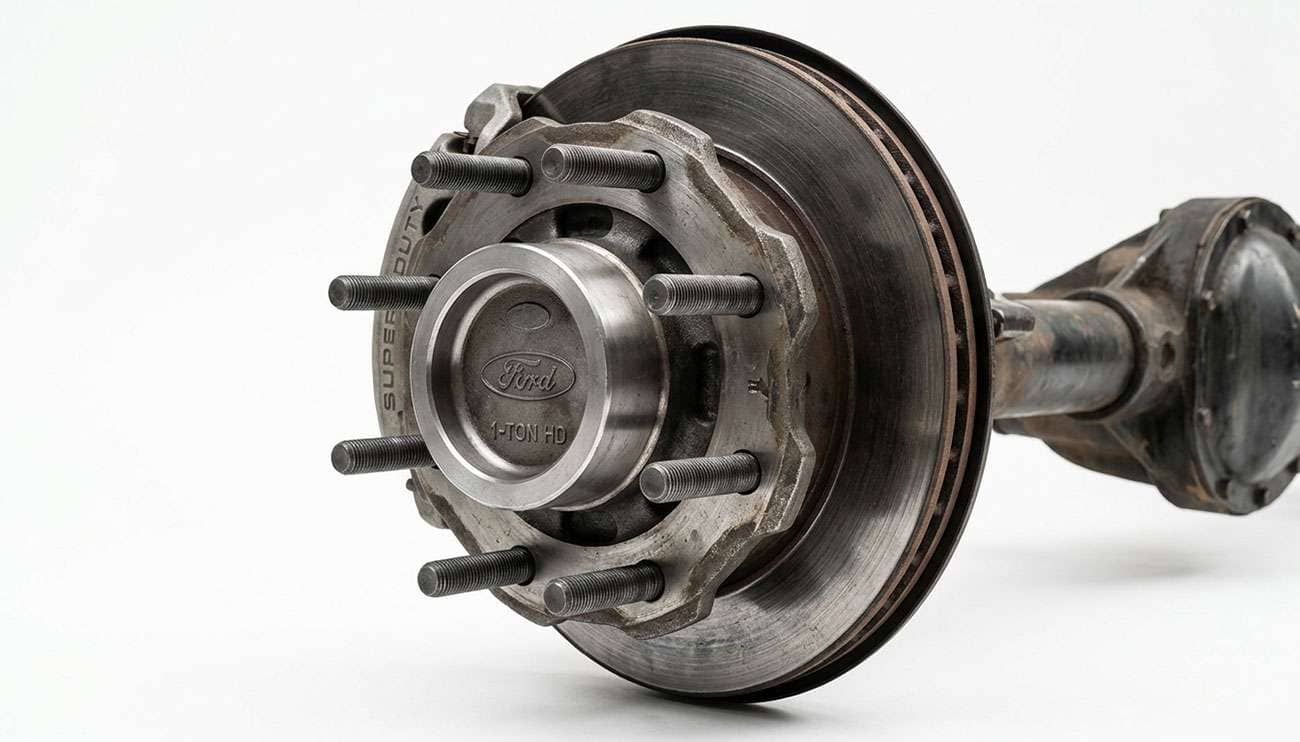
The 8x210 bolt pattern belongs to one truck: the 2011 and newer Chevrolet Silverado 3500HD and GMC Sierra 3500HD, and only in dual rear wheel form. That is the entire list. It is not a family of trucks, it is a single configuration, and the pattern lives inside a narrow box with three walls. Step back before 2011 and the pattern changes. Order the same truck with a single rear wheel and the pattern changes. Move up to a 4500HD and the pattern changes again. Every direction out of that box lands you somewhere else.
I run fitment for this shop, and 8x210 generates a specific category of return: the customer who was right about the make, right about the model, right about the year, and still ordered wheels that will not mount. The badge on the tailgate says 3500HD on both trucks in the parking lot. One of them takes 8x210 and one of them does not.
Here is the box, with all three walls marked. Find your truck before you shop anything else.
Truck Configuration |
Years |
Bolt Pattern |
Hub Bore |
|---|---|---|---|
Silverado / Sierra 3500HD, dual rear wheel |
2011 to present |
8x210 |
154.2 mm |
Silverado / Sierra 3500HD, single rear wheel |
2011 to present |
8x180 |
124 to 125 mm |
Silverado / Sierra 2500HD |
2011 to present |
8x180 |
124 to 125 mm |
Silverado / Sierra 3500 dually |
Through 2010 |
8x165.1 (8x6.5 in) |
Approximately 121 mm |
Silverado 4500HD / 5500HD / 6500HD |
2019 to present |
8x275 |
221 mm |
Four patterns, one nameplate family, and the differences are large enough that nothing crosses over. The jump from 8x180 to 8x210 is 30 mm. The jump from 8x210 to 8x275 is 65 mm. These are not near-misses that someone might force onto a hub. They simply will not go on, which is the good news, because the failure happens in your driveway instead of on the interstate.
This is the wall people hit most often, so it deserves the explanation and not just the fact.
When GM redesigned the heavy duty trucks for 2011, it moved the entire lineup off the old 8x165.1 imperial pattern and onto metric. The 2500HD and the single rear wheel 3500HD both went to 8x180. The dual rear wheel 3500HD went somewhere else entirely, to 8x210.
The reason is load path. A dually carries its rear payload on four tires instead of two, which means the rear hub is wider, the axle flange is larger, and the moment arm from the hub face out to the outer wheel is substantially longer than anything on a single wheel truck. Spreading eight studs across a 210 mm circle instead of a 180 mm circle gives you a wider clamping footprint on a bigger flange, which is what keeps the joint stable when an outer wheel is hanging that far outboard with several thousand pounds on it. Ford made the same engineering call when it split its F-350 dually onto 8x200 back in 2005.
The practical consequence is that "GM HD" is not a wheel spec. If you have a 2018 Silverado 3500HD with a single rear wheel, your pattern is 8x180 and our 8x180 bolt pattern fitment guide is the page you want. If you have a 2018 Silverado 3500HD with duals, your pattern is 8x210 and you are on the right page. Same model year, same badge, same dealership, two different hubs.
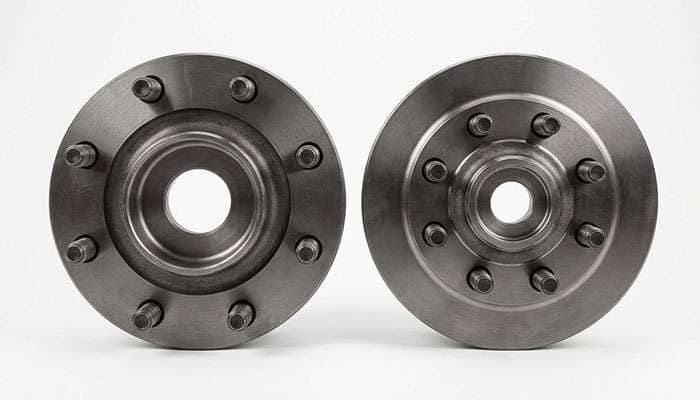
For the wider view of how the dually patterns break down across GM, Ford, and Ram, our piece on dually bolt patterns decoded maps all of them side by side.
An 8x210 bolt pattern measures 8.27 inches. Divide 210 by 25.4 and you get 8.2677, which rounds to 8.27. You will occasionally see it written as 8x8.27, though the metric notation dominates because this pattern was metric from the day it launched.
The inch conversion is worth carrying in your head for one reason: the old GM dually pattern was 8x6.5 inches, which is 165.1 mm. Those two numbers, 6.5 and 8.27, are far enough apart that nobody confuses them once they are in the same units. In millimeters, 165.1 and 210 also look obviously different. The confusion only shows up when a listing mixes systems, quoting one pattern in inches and the other in millimeters in the same table.
Run the division yourself on any listing that gives you an inch figure. For the patterns in this neighborhood: 165.1 mm is 6.5 inches, 180 mm is 7.09 inches, 200 mm is 7.87 inches, 210 mm is 8.27 inches, and 275 mm is 10.83 inches. If a seller quotes an inch dimension that does not divide back to the millimeter number you expect, ask for the metric spec before you send money.
The pattern is only one of four numbers that have to line up. Here is the full spec set for the 8x210 platform.
Specification |
8x210 Value |
Why It Matters |
|---|---|---|
Pitch circle diameter |
210 mm / 8.27 in |
Determines whether the wheel mounts at all |
Stud count |
8 |
Eight studs share the clamp load on a heavy hub |
Thread spec |
M14 x 1.5 |
Governs lug nuts, and rear duals need longer ones |
Center bore |
154.2 mm |
Carries vehicle weight in shear, not the studs |
Common wheel widths |
6.5 to 8.25 in |
Width drives clearance between the rear duals |
Common diameters |
17, 19.5, 20, 22, 24 in |
19.5 is the commercial route, 20 and up is custom |
Lug torque |
About 140 lb-ft |
Verify in the manual; duals get a retorque |
The 154.2 mm center bore is the number that separates this platform from everything else in the eight lug world. For context, the Ford 8x200 dually hub runs about 142.2 mm and the GM 8x180 single wheel hub runs roughly 124 mm. The 8x210 bore is enormous by comparison, and every legitimate 8x210 wheel is machined to it, which is a departure from the passenger car market where open bores and centering rings are the norm. On a truck carrying this much weight, hub-centric is not optional, and reputable manufacturers build it in rather than leaving it to a plastic ring.
Torque matters more here than on almost anything else you will service. GM specifies roughly 140 lb-ft on these trucks, applied in a star sequence with a calibrated wrench, and dual rear wheels need a retorque after a short shakedown drive because the stack of two wheel faces settles. Our walkthrough on how to torque lug nuts perfectly covers the sequence, and on a dually the retorque step is the one that actually keeps wheels attached.
Here is the part that no bolt pattern list will ever tell you, and it is the single most expensive mistake in dually wheel shopping.
A dually set is six wheels, not four, and those six wheels are not the same part. The bolt pattern is identical across all six. The hub bore is identical. The diameter and width are identical. The offset is not, and the spread is not subtle.
Across the 8x210 wheels we carry, front position offsets sit in a high positive band, roughly +94 mm to +142 mm. Rear outer offsets sit in a deep negative band, roughly -140 mm to -246 mm. That is a swing of several hundred millimeters between two wheels that look identical in a product photo and share the same model name.
The reason is geometry. The front wheel needs its mounting pad pushed far outboard so a narrow steer tire sits centered under the fender. The rear inner wheel mounts flat against the hub flange and runs a similar high positive offset. The rear outer wheel then bolts onto the same studs on top of the inner wheel, so its mounting pad has to sit far behind the wheel centerline, which reads as a deep negative offset. Get that number wrong and either the two rear tires rub each other or the outer wheel hangs out past the fender flare.
Manufacturers handle this by splitting the model into separate part numbers. Vision, for example, sells its 181 Hauler Duallie explicitly as Front, Inner, and Rear part numbers within the same design, with the front and inner sharing a positive offset and the rear carrying the negative. Fuel does the same thing on the Blitz D673, listing the front at a positive offset alongside deep negative rear versions under the same model name.
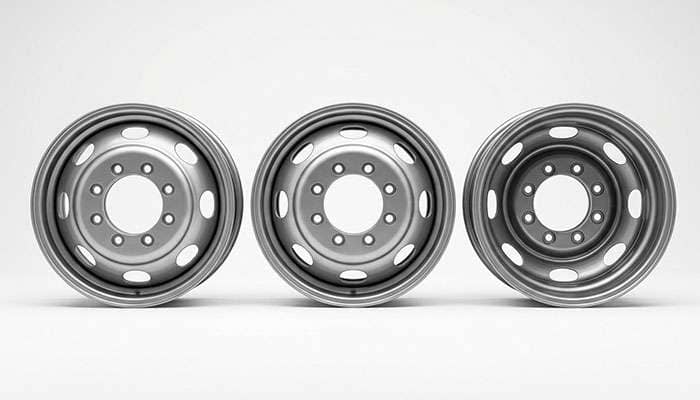
If you are shopping the custom side, the Fuel Blitz D673 in 20x8.25 is a representative example of how the family works: the front sits at a positive offset and the rear versions run deep negative, all on the same 154.3 mm bore.
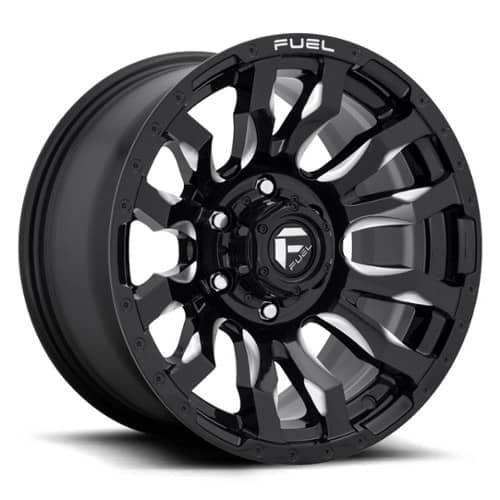
Order six of one part number and four of them are wrong. Order a set from a listing that does not specify position and you are gambling. Any legitimate dually package will name the position on every line item, and if it does not, that is your signal to ask before checkout. Our dually wheels buying guide walks through how a complete six-wheel package should be quoted.
Bolt pattern tells you the wheel mounts. Load rating tells you whether it should be carrying your truck. On a one ton dually those are very different questions, and the arithmetic is not the same front to rear.
Open the driver's door and read the placard. It gives you a gross axle weight rating for the front and a separate one for the rear. The front number is carried by two wheels, so divide it by two. The rear number is carried by four wheels, so divide it by four. Those two results are your minimum per-wheel load ratings, and on a dually the front requirement is usually the higher of the two even though the rear axle carries far more total weight. That surprises people every time.
Per-wheel load ratings across the 8x210 market run from about 2,500 pounds on the light end up to roughly 4,300 pounds at the top. That is a meaningful spread, and it maps almost perfectly onto intended use. The 20, 22, and 24 inch custom wheels cluster in the 2,500 to 3,200 pound range, which is fine for a truck that spends its life empty or pulling a light trailer. The 19.5 inch commercial wheels are where the high ratings live, because those are built for trucks that actually run at gross weight.
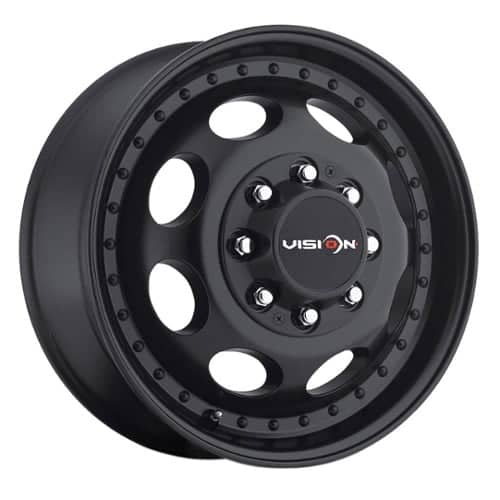
If you tow at or near your rating, the 19.5 inch route is the honest answer. The Vision 181 Hauler Duallie in 19.5x6.75 carries a 4,300 pound per-wheel rating and comes machined to the 154.2 mm bore, and it is offered in the full Front, Inner, and Rear position set so a complete six-wheel order stays straight.
One more thing on the 19.5 inch route: those wheels take 19.5 inch commercial tires in load range G or H, which run much higher inflation pressures than a light truck tire. That is a different tire program with different pressure management, and it is not a swap to make casually if the truck is a daily driver that rarely sees a load.
No. They are 10 mm apart, which sounds close and is not. Ten millimeters on the pitch circle puts every stud 5 mm out of position radially, and eight lug holes on a truck wheel do not have anywhere near that much clearance. The wheel will not go on.
The 8x200 pattern is the Ford and Ram dually spec. Ford moved the F-350 and F-450 dual rear wheel trucks to 8x200 in 2005 and has stayed there. Ram switched the 3500 dually from the old 8x6.5 to 8x200 in 2019. So 8x200 and 8x210 are the two dominant modern dually patterns in North America, they are the two you are most likely to see listed next to each other, and they do not interchange in either direction. Our 8x200 bolt pattern guide covers that side.
The hub bores differ too, which is a useful secondary check. The Ford and Ram 8x200 hub runs about 142.2 mm. The GM 8x210 hub runs 154.2 mm. If you are looking at a used set and the seller is unsure of the pattern, measuring the center hole will separate them fast.
Adapters exist to bridge patterns, and on a passenger car they are a reasonable tool. On a dual rear wheel truck I do not recommend them, and I will say that plainly. An adapter adds a second bolted joint in a load path that is already carrying an outer wheel far outboard of the hub face, and it stacks additional length onto studs that are already reaching through two wheel faces at the rear. If you are working through a spacer or adapter question on a truck, read our piece on the benefits of wheel spacers and adapters first and understand exactly what you are adding to the joint.
Through the 2010 model year, GM dual rear wheel trucks ran 8x165.1, which is 8x6.5 inches. That pattern goes back decades across GM three-quarter and one ton trucks, and it covers the 3500 dually right up to the 2011 redesign.
This is the second wall of the box, and it catches people shopping used wheels. A set of dually wheels off a 2009 Silverado 3500 will not fit a 2012 Silverado 3500HD, even though both are Chevrolet one ton duallys and the trucks look similar from across a lot. The pattern changed, the hub bore changed, and the wheels are not interchangeable.
The 2011 model year is the clean dividing line for GM. If your truck is a 2011 or newer 3500HD dually, you are on 8x210. If it is 2010 or older, you are on 8x165.1. There is no overlap year and no transitional period to worry about.
The third wall is the one almost nobody knows about, because the trucks are less common and the spec sheets are harder to find.
When Chevrolet brought back the medium duty Silverado in 2019 as the 4500HD, 5500HD, and 6500HD, those trucks did not inherit the 3500HD hub. They run an 8x275 bolt pattern on a 221 mm center bore, with a 19.5x6.75 factory wheel. That is a different architecture built for a different weight class, and no 8x210 wheel will mount to it.
It is an easy assumption to make in the other direction too. A 19.5 inch wheel on a 3500HD dually and a 19.5 inch wheel on a 4500HD look like the same product category. They are the same diameter and width. They are not the same bolt pattern, and they are not the same bore. If you are buying used 19.5 inch takeoffs, confirm which truck they came off before anything else.
So the complete boundary set for 8x210 reads: 2011 or newer, 3500HD, dual rear wheel. Any one of those three conditions failing puts you on a different pattern.
Since the bolt pattern itself will not physically mount if it is wrong, the failures on this platform come from the other three variables: offset, bore, and load rating. Those do mount, and then they degrade.
Immediately. Wrong rear outer offset shows up the first time you look at the truck from behind. Either the two rear tires are touching or nearly touching, or the outer wheel is standing proud of the fender. Sidewall contact between rear duals is the fastest tire killer on this platform, and it does its damage on the inner tire where you will not see it from outside the truck.
First few hundred miles. Lug nuts backing off. On a dually rear, the outer wheel clamps through the inner wheel, so you have two mating faces settling instead of one. This is why the retorque exists. If nuts keep loosening after a proper retorque, something in the stack is not seating flat and the answer is not more torque.
First few thousand miles. Uneven tire wear across the rear duals, because two tires that are not carrying equal load will not wear equally. On a dually the inner rear tires are the ones nobody inspects, which is exactly why they are the ones that fail. Pull the truck up and actually look at them, and if you find damage, our guide on tire sidewall damage and whether it is safe to drive covers what disqualifies a tire.
Under load. This is where an under-rated wheel finds its limit. A wheel rated at 2,500 pounds on a truck whose placard math calls for more is not a slow-developing problem, it is a structural one that surfaces the day you actually hitch up to something heavy. The National Highway Traffic Safety Administration tracks wheel separation as a crash cause, and the Tire Industry Association builds its commercial wheel service curriculum around torque, seating, and load rating for exactly this class of vehicle.
A one ton dually at gross weight is a different animal from a half ton pickup. The margins that forgive a sloppy fit on a light truck do not exist here.
Six steps, and the first three take about two minutes.
One. Confirm the truck is a 3500HD with dual rear wheels, model year 2011 or newer. If any of those three is false, you are not on 8x210.
Two. Read the driver's door placard. Note the model year, the front gross axle weight rating, and the rear gross axle weight rating.
Three. Do the load math. Front rating divided by two, rear rating divided by four. The larger of those two results is the per-wheel load rating floor you should not go below.
Four. Decide your diameter honestly based on use. If the truck tows at or near gross regularly, look at 19.5 inch and the load ratings that come with it. If it is mostly a daily driver, 20 or 22 inch will clear your requirement with room.
Five. Order by position, not by quantity. Two fronts, two rear inners, two rear outers. Confirm every line item on the order names its position and its offset before you pay.
Six. Torque to spec in a star sequence with a calibrated wrench, then retorque after fifty to a hundred miles. On a dual rear wheel truck this step is not optional.
The 8x210 bolt pattern answers to exactly one truck: the 2011 and newer Chevrolet Silverado 3500HD and GMC Sierra 3500HD in dual rear wheel form, on a 154.2 mm hub bore with M14 x 1.5 studs. Single rear wheel versions of the same truck are 8x180. Pre-2011 duallys are 8x165.1. The 4500HD and up are 8x275. Once you have confirmed you are inside that box, the real work starts, because a dually set is six wheels in three positions with wildly different offsets, and the per-wheel load rating you need comes off your own door placard rather than off a product page. Get the position and the rating right and the fit is straightforward. When you are ready to shop, our full selection of 8x210 bolt pattern wheels is filtered to the pattern, and we will confirm the front, inner, and outer offsets with you before anything ships.
The 2011 and newer Chevrolet Silverado 3500HD and GMC Sierra 3500HD with dual rear wheels. That is the only application. Single rear wheel versions of the same truck use 8x180, and pre-2011 GM duallys use 8x165.1.
An 8x210 bolt pattern is 8.27 inches. Divide 210 by 25.4 to get 8.2677 inches. It is sometimes written as 8x8.27, though the metric notation is far more common.
No. They differ by 30 mm and the hub bores are different as well, 154.2 mm for 8x210 against roughly 124 mm for 8x180. GM uses 8x180 on the 2500HD and the single rear wheel 3500HD, and 8x210 only on the dual rear wheel 3500HD.
No. The 10 mm difference puts every stud 5 mm out of position, which is far beyond the clearance in the lug holes, so the wheel will not mount. The hub bores differ too, 154.2 mm on GM against about 142.2 mm on the Ford and Ram trucks.
154.2 mm. Legitimate 8x210 wheels are machined to that bore so the hub carries the load in shear rather than the studs. You will see 154.2 and 154.3 used interchangeably on listings, which is a rounding difference rather than two specs.
Six, in three positions. Two front and two rear inner run high positive offsets, and two rear outer run deep negative offsets. They share the bolt pattern and bore but are different part numbers, so order by position rather than ordering six of the same item.
Roughly 140 lb-ft, applied in a star sequence with a calibrated torque wrench. Confirm the figure in your owner's manual, and retorque the rear duals after fifty to a hundred miles because the two stacked wheel faces settle.