
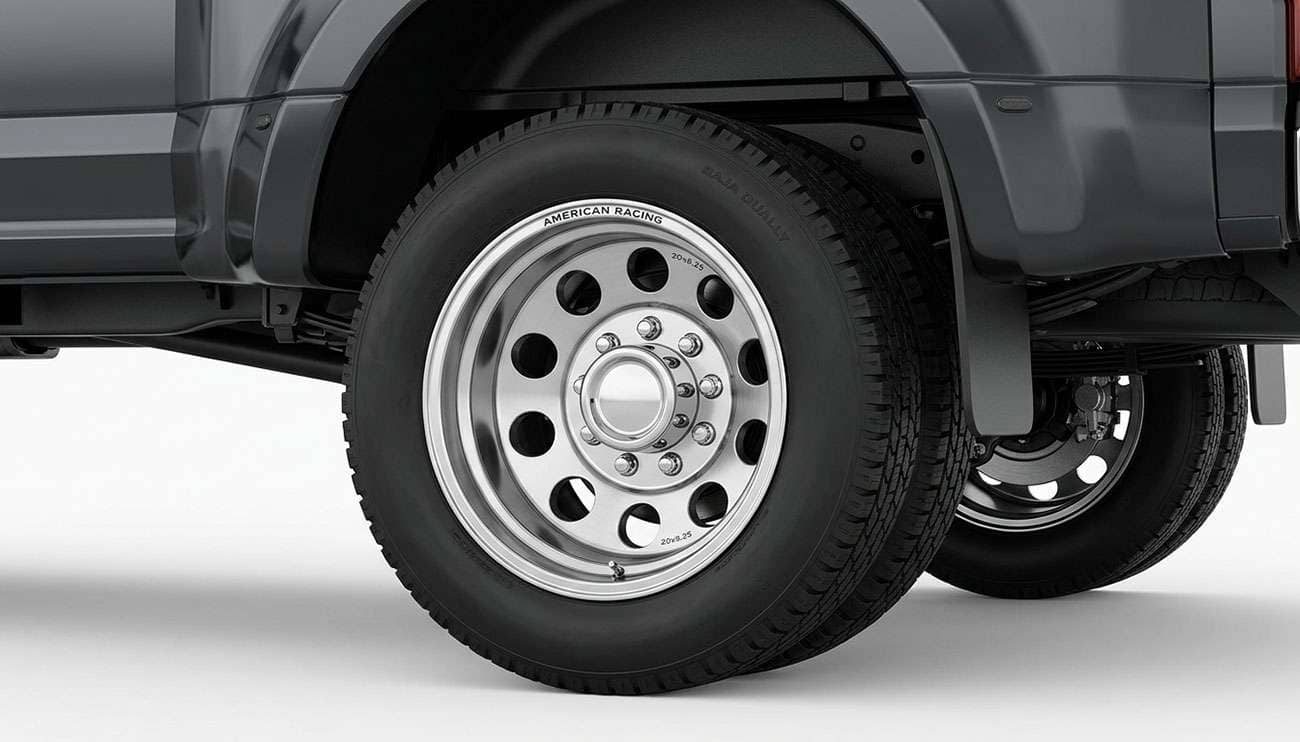
8x200 is the modern dual-rear-wheel pattern from Ford and Ram. It covers the 2005 and newer Ford F-350 Super Duty in dually configuration, the F-450 pickup for a stretch in the early 2010s, and the 2019 and newer Ram 3500 dually. Single-rear-wheel versions of those same trucks do not use it. GM heavy duty duallies do not use it either.
Here is what a vehicle list will not tell you. The bolt circle is only the first of three specs that decide whether a wheel goes on. You also need the right hub bore, which is 142mm on every 8x200 truck, and the right offset for the axle you are working on, because dually front and rear wheels are separate parts with offsets that differ by more than 250mm. Two wheels can both be stamped 8x200 and neither one fit your truck.
The list is short because the pattern is recent and narrowly applied.
Vehicle |
Years |
Configuration |
Hub Bore |
Notes |
|---|---|---|---|---|
Ford F-350 Super Duty |
2005 to present |
Dual rear wheel only |
142mm |
Single rear wheel F-350 is 8x170, not 8x200 |
Ford F-450 Super Duty pickup |
Roughly 2011 to 2016 |
Dual rear wheel pickup |
142mm |
Verify on the truck, this model changed patterns more than once |
Ram 3500 |
2019 to present |
Dual rear wheel only |
142mm |
2018 and earlier Ram 3500 dually is 8x165.1 |
Ram 4000 |
2019 to present |
Dual rear wheel |
142mm |
International and Mexico market heavy duty, not sold in the US |
That is the whole list. If your truck is not on it, you have a different pattern, and the next section explains why that matters more than it sounds like it should.
The F-450 pickup deserves its own warning. Over its life that truck has worn an 8x225 pattern, a 10x225 pattern, and 8x200, depending on the year and whether it was built as a pickup or a chassis cab. It is the one vehicle in this family where the model name genuinely tells you nothing. Measure it.
Most guides answer this question with a vehicle list and stop. The list is useful and it is also the easy half. What decides whether a wheel actually mounts is three numbers, and the bolt circle is only one of them.
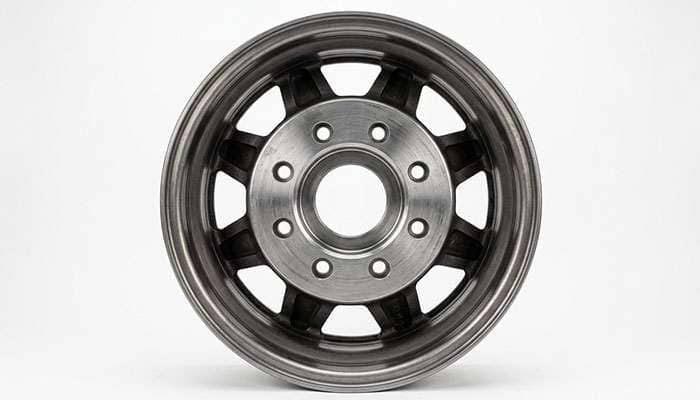
Bolt circle. 8x200 means eight studs arranged on a circle 200mm in diameter, which converts to about 7.87 inches. Because there is an even number of studs you can measure it directly, center of one stud straight across to the center of the stud opposite.
Hub bore. Every 8x200 truck uses a 142mm hub bore. That is a large opening, and it exists because a dually hub is physically bigger than a single-rear-wheel hub. A hub-centric wheel sits on that machined register and the studs carry only clamping load. A wheel with the wrong bore, or one that relies on the lug seats alone to find center, transfers shear load into eight studs that were never meant to locate the wheel. On a truck rated to haul, that is the wrong place to economize.
Offset. This is the one that catches people ordering online. On a dually, the front wheel and the rear wheels are different parts. Across current 8x200 offerings, front-position wheels run positive offsets in the range of roughly +98mm to +156mm, while rear-position wheels run deep negative offsets from about -122mm all the way to -232mm. That is a spread of nearly 400mm inside a single bolt pattern. Ordering four identical 8x200 wheels for a dually gets you parts that will not assemble.
There is a fourth item that is not a number on a spec sheet, and it is why a Ford spacer and a Ram spacer are sold as separate products even though both are 8x200 with a 142mm bore. Hub height, meaning how far the hub and its centering register protrude from the mounting face, differs between the two trucks. Adapter manufacturers publish that distinction plainly and will not cross-list the parts. If you are stacking a spacer or an adapter into the equation, buy the one specified for your truck, not the one specified for your bolt pattern.
The deeper background on why centering matters is in our explainer on wheel center bore, and the practical difference between the two mounting philosophies is covered in hub-centric vs lug-centric wheels.
2005. Before that, from the 1999 launch of the Super Duty through the 2004 model year, the F-350 dually ran 8x170mm with a 125mm hub bore, the same pattern the single-rear-wheel trucks used. For 2005 Ford split the two: the SRW F-250 and F-350 stayed on 8x170, and the dually F-350 moved to 8x200 with the larger 142mm hub.
The reasoning is straightforward. A dually carries more weight on a wider rear track and needs a bigger hub to do it. A larger bolt circle spreads the clamping load further from the hub center, which reduces the bending moment on each stud. Once the hub grew, the pattern had to grow with it.
The practical consequence is that a 2004 F-350 dually and a 2005 F-350 dually do not share wheels. Same truck, same badge, consecutive model years, incompatible. That single change is the origin of most of the confusion in this space. If you are shopping for a 1999 to 2004 truck, our guide to what 8x170 wheels fit is the one you want.
2019, with the launch of the fifth-generation Ram Heavy Duty. Before that the Ram 3500 dually ran 8x165.1mm, the pattern most people still call 8x6.5, going back decades through the Dodge era.
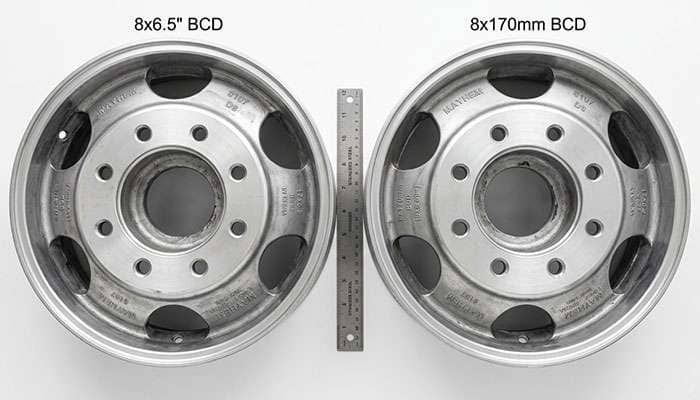
That was a bigger jump than Ford's. Going from 165.1mm to 200mm is nearly 35mm of bolt circle, along with a hub bore change to 142mm. A 2018 Ram 3500 dually and a 2019 Ram 3500 dually share no wheels at all, and because both trucks are still common on the road and both are called Ram 3500, this is the single most common mistaken order we see on this pattern.
The upside is that Ram landed on the same 200mm circle and the same 142mm bore Ford had been using since 2005. For wheel manufacturers that consolidated two separate tooling programs into one, which is why the aftermarket selection in 8x200 has improved sharply since 2019. Just remember the hub height caveat above before you assume a Ford-specific part crosses over.
There are five 8-lug patterns in active use on North American trucks, and the reason people get burned is that the gaps between them are small enough to look like measurement error.
Pattern |
Inch Equivalent |
Hub Bore |
Trucks |
Difference From 8x200 |
|---|---|---|---|---|
8x165.1 |
8x6.5 |
121.3mm Dodge, 125mm GM |
Pre-2019 Ram 2500 and 3500, pre-2011 GM 2500 and 3500 |
34.9mm smaller |
8x170 |
8x6.69 |
125mm |
Ford F-250 and F-350 single rear wheel, 1999 to present |
30mm smaller |
8x180 |
8x7.09 |
124mm |
GM 2500HD and 3500HD single rear wheel, 2011 to present |
20mm smaller |
8x200 |
8x7.87 |
142mm |
Ford F-350 DRW 2005 up, Ram 3500 DRW 2019 up |
Reference |
8x210 |
8x8.27 |
154.2mm |
GM 3500HD dual rear wheel, 2011 to present |
10mm larger |
Look at the last row. 8x210 sits 10mm away from 8x200 on a 200mm circle, a difference of five percent. On the stud that is about 5mm of radial offset, which is enough that a lug nut will start to thread and feel like it is going somewhere. It is not. This is the single most dangerous confusion in 8-lug fitment, and it is made worse by the fact that both trucks are one-ton duallies of the same era wearing similar wheels.
The other thing worth internalizing is that no manufacturer uses the same pattern for its single-rear-wheel and dual-rear-wheel versions of the same truck. Ford splits 8x170 and 8x200. GM splits 8x180 and 8x210. If somebody hands you a set of wheels off a "3500," the first question is always which configuration. For the broader picture across all of them, our dually bolt patterns decoded piece maps the full landscape, and the 8x180 bolt pattern fitment guide covers the GM single-wheel side.
This is the practical trap in 8x200, and it has nothing to do with the bolt circle at all.
A dually carries six wheels. The two fronts are single wheels on a normal hub and need a positive offset that positions the tire under the fender. The four rears mount in pairs, and the inner and outer wheels of each pair are mirrored around the mounting face. To make that geometry work, rear dually wheels carry extreme negative offsets, and the numbers look wrong if you are used to reading offsets on a car.
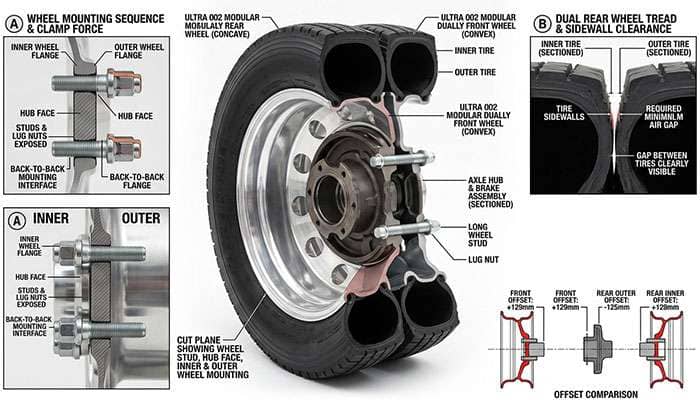
In current 8x200 production, front-position wheels cluster around +98mm to +156mm of offset and rear-position wheels run from roughly -122mm to -232mm. Both are correct. Neither works in the other position. Ordering a set means specifying front wheels and rear wheels separately, and any listing that does not make that distinction is a listing to be careful with.
Sizing follows the same logic. The dominant 8x200 fitments are 20x8.25 and 22x8.25, with 17x6.5 covering factory replacement and 19.5x6.75 serving the commercial and heavy-tow end. The narrow widths on the 17 and 19.5 are not a compromise. A rear dually pair needs the tires to clear each other, and width is what controls that gap. Going wider than the factory spec on a rear pair is how people end up with tires rubbing each other, which they will not notice until the inner sidewalls are chewed up.
If offset numbers this large are new to you, the fundamentals are laid out in wheel offset, backspacing and bolt patterns explained.
They share a bolt circle and they are not the same wheel. Both use 8x165.1mm, which is where the interchange rumor comes from. The hub bores are different: Dodge runs about 121.3mm, GM runs about 125mm, and there are 130.8mm variants in the mix as well depending on year and configuration.
What that means in practice is that a GM 8x6.5 wheel put on a Dodge hub will have a bore larger than the hub register, so the wheel does not center on the hub at all. It centers on the lug seats, if it centers at all, and you are back to eight studs doing a job they were not designed for. The reverse case is worse and simpler: a Dodge wheel with a smaller bore will not slide onto a larger GM hub, so it just does not fit.
The same question applies inside the 8x200 family and the answer is the same shape. Ford and Ram both use 8x200 with a 142mm bore, which gets them much closer than the 8x6.5 crowd ever was. But the hub protrusion differs, so spacers and adapters remain truck-specific. Bolt circle plus bore gets you to "probably." Only checking the actual truck gets you to yes.
A wheel that is genuinely the wrong pattern will not go on, and that is the good outcome. The failures worth understanding are the ones that do go on.
At install. A wheel with the right bolt circle but an oversized bore will bolt up and torque down. Nothing feels wrong in the driveway. What has happened is that the wheel is now located by the tapered lug seats rather than by the hub register, and it is very likely sitting a millimeter or two off center.
First highway drive. That off-center mount shows up as a vibration that changes with speed and does not respond to balancing. People chase it through two or three tire shops before anybody checks the bore.
Over the first few thousand miles. Every rotation cycles a shear load through the studs that the hub register was supposed to carry. The lug seats begin to deform, which lets the wheel move slightly, which lets the lugs back off. This is the mechanism behind the classic complaint of lug nuts that will not stay tight on one particular corner.
Under load. A dually is bought to haul, and the loads that matter arrive when the truck is loaded. NHTSA's Federal Motor Vehicle Safety Standard No. 110 requires the vehicle placard listing the original rim size precisely because the wheel is part of the load-carrying system, and aftermarket wheels are validated to SAE J2530 through cornering fatigue, radial fatigue and impact testing at their rated load. Those tests assume the wheel is mounted the way it was designed to mount. A wheel finding center on its lug seats is outside the condition it was certified under.
At the worst moment. Stud failure on a dually rear is not a slow leak. It is a wheel pair leaving a loaded truck, and it takes the fender and often the brake line with it.
None of this requires anything exotic to go wrong. It is the predictable result of asking eight studs to locate a wheel instead of just clamping it.
The full measuring procedure, including the awkward odd-lug patterns, is in our walkthrough on how to measure lug bolt pattern. When you have your numbers, browse the 8x200 bolt pattern wheels we stock and filter to your axle position before anything else.
8x200 is a narrow, modern pattern: Ford F-350 duallies from 2005 forward, the F-450 pickup for a few years in the early 2010s, and Ram 3500 duallies from 2019 forward. Everything else in the 8-lug world is a different circle, and the closest neighbor is only 10mm away.
But the vehicle list is the easy part. What decides whether the wheel goes on and stays on is the bolt circle, the 142mm hub bore, and an offset that matches the axle you are working on. Get any one of those wrong and the wheel can still bolt up, torque down, and feel fine until it is loaded.
Count your rear wheels, measure across two studs, put a caliper on the hub register. Three minutes, and you will never order the wrong set.
2005. From the 1999 Super Duty launch through 2004, the F-350 dually used 8x170mm with a 125mm hub bore, the same as the single-rear-wheel trucks. For 2005 Ford moved the dually to 8x200mm with a larger 142mm hub while leaving the SRW F-250 and F-350 on 8x170. A 2004 and a 2005 F-350 dually do not share wheels.
The Ford F-350 Super Duty in dual-rear-wheel configuration from 2005 to present, the Ford F-450 Super Duty pickup for roughly 2011 through 2016, the Ram 3500 in dual-rear-wheel configuration from 2019 to present, and the Ram 4000 dually sold in international and Mexico markets from 2019. Single-rear-wheel versions of these trucks use different patterns.
2019, with the fifth-generation Ram Heavy Duty. The 2018 and earlier Ram 3500 dually used 8x165.1mm, commonly called 8x6.5, a pattern that ran back through the Dodge era. The change also brought a new 142mm hub bore. Because both generations are still common and both are badged Ram 3500, this is the most frequent source of wrong wheel orders on this pattern.
Only trucks that are themselves 8x200 with a 142mm hub bore: 2005 and newer Ford F-350 duallies, the F-450 pickup in its 8x200 years, and 2019 and newer Ram 3500 duallies. There is no adapter-free path from another 8-lug pattern to 8x200. Within 8x200, you also have to match the axle position, because front wheels carry positive offsets and rear wheels carry deep negative offsets and the two are not interchangeable.
They share the 8x165.1mm bolt circle but not the hub bore. Dodge runs about 121.3mm and GM runs about 125mm, with 130.8mm variants depending on year and configuration. A GM wheel on a Dodge hub has too large a bore to center on the hub register, so it ends up located by the lug seats. A Dodge wheel on a GM hub often will not physically slide on. Matching bolt circles is not the same as interchangeable wheels.
No. The 10mm difference in bolt circle is enough that the studs will not line up with the lug holes, and the 142mm versus 154.2mm hub bore difference compounds it. The danger is that 10mm on a 200mm circle is small enough that a lug nut can start to thread on a misaligned hole and feel like progress. Do not elongate lug holes or force the fitment. Confirm the pattern with a caliper before mounting anything.



