
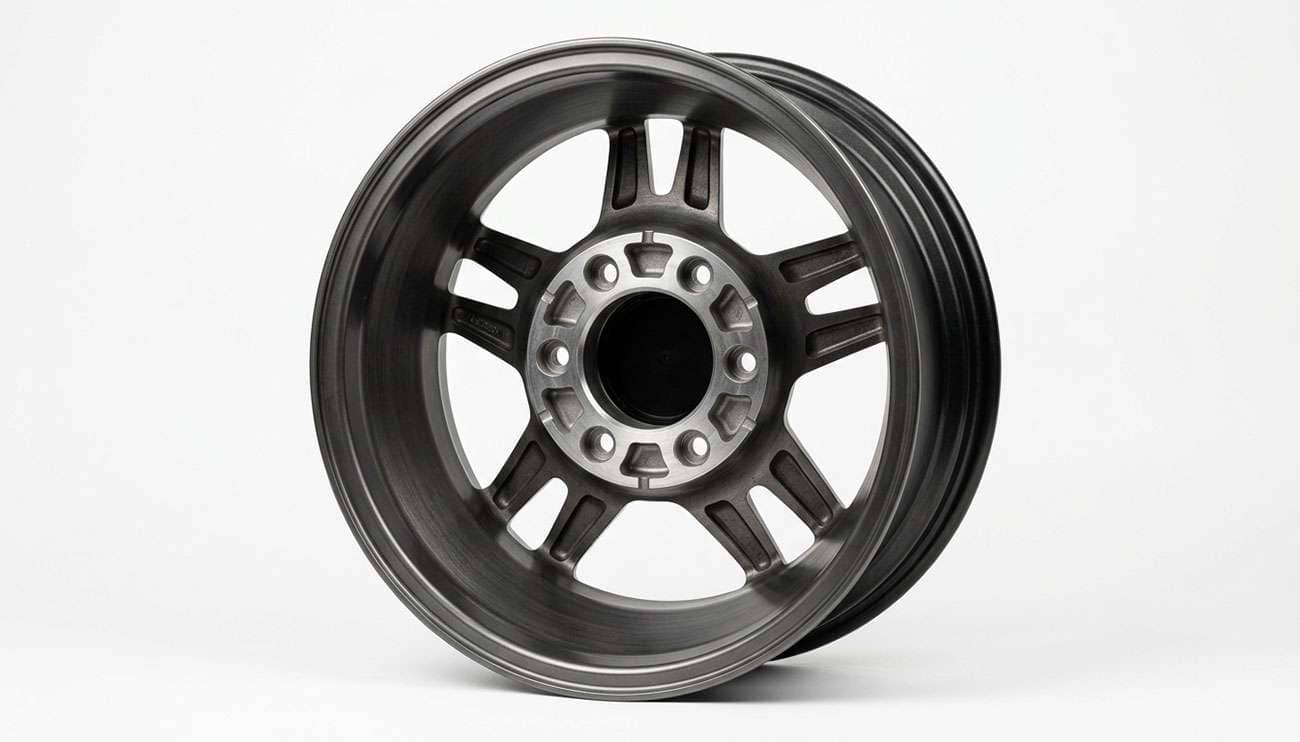
The 6x120 bolt pattern belongs to a specific window of General Motors vehicles: the 2015 to 2022 Chevrolet Colorado and GMC Canyon, the 2018 and newer Traverse, the 2017 and newer Acadia, the 2018 and newer Enclave, the 2019 and newer Blazer, and the Cadillac SRX, XT5, and XT6. Here is what almost no list tells you. Every one of those nameplates also exists in a version that is not 6x120. The badge does not decide the pattern. The model year does.
Most bolt pattern lookups return a make and a model. That format works fine for a manufacturer that picks a pattern and keeps it. It fails badly for General Motors, which has run three different six-lug patterns across overlapping nameplates in the same decade.
The Chevrolet Colorado is the cleanest example of the problem. The first generation, 2004 through 2012, used 6x139.7. The second generation, 2015 through 2022, switched to 6x120. The third generation, 2023 and newer, went back to 6x139.7 to line up with the Silverado. Three generations, two patterns, one badge. A wheel that bolts to a 2018 Colorado will not go on a 2024 Colorado, and the search result that told you "Colorado is 6x139.7" was correct for two thirds of the trucks wearing that name and wrong for yours.
The crossovers did the same thing in the other direction. The Lambda-platform Traverse, Acadia, Enclave, and Saturn Outlook used 6x132. When those vehicles were redesigned onto the newer architecture, they moved to 6x120. So the Traverse is 6x132 through 2017 and 6x120 from 2018, and a set of factory wheels off a 2016 will not bolt to a 2019.
Vehicle |
Years on 6x120 |
What It Used Before or After |
|---|---|---|
Chevrolet Colorado |
2015 to 2022 |
6x139.7 in 2004 to 2012 and again from 2023 |
GMC Canyon |
2015 to 2022 |
6x139.7 in the earlier and later generations |
Chevrolet Traverse |
2018 and newer |
6x132 through 2017 |
GMC Acadia |
2017 and newer |
6x132 through 2016 |
Buick Enclave |
2018 and newer |
6x132 through 2017 |
Chevrolet Blazer |
2019 and newer |
The 1990s Blazer nameplate is unrelated and used different hardware |
Cadillac SRX |
2010 to 2016 |
Superseded by the XT5 |
Cadillac XT5 |
2016 and newer |
Continues the SRX pattern |
Cadillac XT6 |
2019 and newer |
Shares the XT5 hardware |
Saab 9-4X |
2011 to 2012 |
Built on the SRX platform |
Across the whole group the hardware is consistent: a 66.9 millimeter center bore and M14x1.5 lug studs on the 6x120 vehicles. That consistency is genuinely useful, because it means a set of Colorado wheels will physically transfer to a Traverse. Whether it should is a separate question, and that gets covered further down.
Six lug studs arranged evenly around a circle 120 millimeters in diameter.
The first number is the lug count. The second is the bolt circle diameter, sometimes called the pitch circle diameter or PCD, measured through the center of the hub from the center of one stud to the center of the stud directly opposite it.
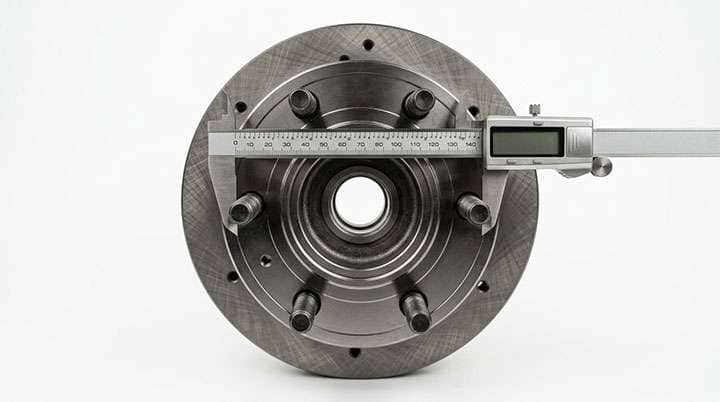
Six-lug patterns are the easiest to measure accurately, and that is worth knowing. With an even number of studs, every stud has one directly across from it, so a single caliper measurement center to center gives you the bolt circle diameter directly. Five-lug patterns have no opposite stud and require either an offset measurement technique or a dedicated gauge, which is where a lot of measurement errors come from.
Put a caliper across two opposite studs on a 6x120 hub and you should read 120 millimeters, or 4.72 inches. Measure to the center of the stud, not the edge, and measure in millimeters if you have the option. Working in inches introduces rounding right where you cannot afford it, for reasons that become clear in the next section. If you want the full procedure, our guide on how to measure lug bolt pattern covers both the even and odd lug counts.
In imperial units, 6x4.72 inches. That is the only equivalent. It is not equivalent to any other bolt pattern, and the near misses are what get people hurt.
This is the part worth slowing down for. Bolt patterns cluster. Manufacturers picked round numbers in both metric and imperial systems, and those numbers landed close together. Here is where 6x120 sits relative to its neighbors.
Pattern |
In Inches |
Difference From 6x120 |
Common On |
|---|---|---|---|
6x114.3 |
6x4.5 |
5.7 mm smaller |
Nissan Frontier and Pathfinder, Honda Ridgeline |
6x120 |
6x4.72 |
Reference |
2015 to 2022 Colorado and Canyon, modern GM crossovers |
6x120.65 |
6x4.75 |
0.65 mm larger |
Older GM light trucks and vans |
6x127 |
6x5.0 |
7 mm larger |
Chevrolet Trailblazer, GMC Envoy |
6x132 |
6x5.2 |
12 mm larger |
Lambda-platform Traverse, Acadia, Enclave, Outlook |
6x135 |
6x5.31 |
15 mm larger |
Ford F-150 and Expedition |
6x139.7 |
6x5.5 |
19.7 mm larger |
Silverado 1500, Tacoma, 4Runner, Titan, 2023+ Colorado |
Look at the third row. The 6x120.65 pattern sits 0.65 millimeters away from 6x120. Split across the radius that is roughly a third of a millimeter of stud position error, which is small enough that the lug nuts will start on the threads and small enough that a wheel can feel like it is going on correctly. It is not small enough to be safe, and the reason why is covered in the damage section below.
The practical rule: 6x120 interchanges with nothing. There is no adapter-free substitution. If a listing says a wheel fits "6x120 / 6x4.75," treat that as a listing error rather than a compatibility claim.
Three Chevrolet nameplates, each with a specific year window.
The Colorado from 2015 through 2022, across every trim including the ZR2. The Traverse from 2018 forward. The Blazer from 2019 forward, meaning the modern crossover, not the body-on-frame truck that carried the name in earlier decades.
If you widen to the rest of General Motors, add the GMC Canyon from 2015 through 2022 and the GMC Acadia from 2017 forward, the Buick Enclave from 2018 forward, and the Cadillac SRX, XT5, and XT6.
What makes this list useful in practice is that it opens up cross-shopping. Because the whole group shares a 66.9 millimeter bore and M14x1.5 studs, a wheel built for a Colorado will physically mount on a Traverse and vice versa. Six-lug GM wheels are a deep aftermarket category, and knowing your pattern lets you shop the whole thing rather than just what a dealer parts counter lists under your specific model. Our guide on choosing 6-lug Chevy wheels walks through selection within that group.
Physical fit is not the same as correct fit, though. A Colorado is a body-on-frame midsize pickup with a payload rating and a tow rating. A Traverse is a unibody crossover. Wheels built for the crossover carry a lower load rating, and a wheel that is under-rated for the vehicle it is on is a wheel that fatigues at the mounting pad. Match the load rating to the truck, not just the studs.
No. They are 0.65 millimeters apart, and they are the five-lug version of exactly the same trap discussed above.
The math is simple. 4.75 inches multiplied by 25.4 gives 120.65 millimeters, not 120. So 5x4.75 is properly written 5x120.65, and the two patterns are distinct even though sources routinely list them as interchangeable.
They also live on very different vehicles. The 5x120 pattern is used by BMW across most of its lineup and by several modern GM cars. The 5x120.65 pattern is the classic General Motors five-lug found on generations of Camaros, Corvettes, and older rear-drive platforms. If you are cross-shopping between a BMW wheel and a classic GM wheel because the numbers look the same, they are not the same, and the difference is not one you can split.
Both of ours are covered in more depth: what car wheels are 5x120 for the metric pattern and the 5x4.75 bolt pattern guide for the imperial one.
No. The F-150 uses 6x135, and 6x5.5 is 6x139.7. The gap is 4.7 millimeters, which is well outside anything that can be forced.
This one confuses people because both are six-lug truck patterns and the numbers sound adjacent. They are not. Ford settled on 6x135 for the F-150 starting with the 2004 model year and has kept it through the current trucks and the Expedition. General Motors, Toyota, and Nissan use 6x139.7 on their half-ton and midsize trucks. The two ecosystems do not overlap.
The only correct path from one to the other is a bolt-on wheel adapter, which is a machined plate that bolts to your 6x135 hub and presents a 6x139.7 face. Adapters are legitimate hardware when they are properly specified and torqued, but they add stack height, push the wheel outboard, and introduce a second clamped joint to maintain. They are a considered decision, not a workaround for buying the wrong wheels.
For the full picture on either pattern, see our 6x135 bolt pattern guide and the 6x5.5 bolt pattern guide.
Bolt pattern is the check everybody runs and the only check most people run. It is also the least likely of the four to leave you stranded, because a mismatched pattern usually announces itself in the driveway. The other three fail quietly.
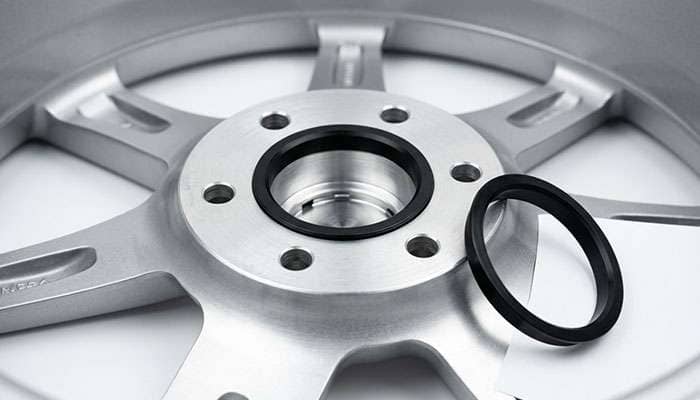
Hub bore. The 6x120 vehicles have a 66.9 millimeter hub. A hub-centric wheel has a bore machined to match, so the vehicle's hub flange carries the weight and the lug nuts only supply clamping force. A large share of aftermarket wheels are produced with an oversized common bore so one casting serves several vehicles, and those ship with hub-centric rings that adapt the bore down. The rings are not optional. Without them the wheel is centered by the lug nut tapers alone, which is a less precise arrangement and a common source of a vibration that no amount of balancing will fix. The distinction between hub-centric and lug-centric wheels is worth understanding before you order.
Load rating. Every wheel carries a stamped maximum load, and it needs to equal or exceed the heaviest axle load your vehicle can put on it. This is where the crossover-versus-pickup issue in this pattern group bites. Same studs, very different requirements.
Offset. Across the 6x120 wheels on the market, offsets run from deep negative to past plus fifty, and the middle of the market sits near plus ten. That spread is intentional, because a Traverse and a lifted Colorado want very different stances, but it means the pattern alone tells you nothing about whether the wheel will clear your brakes on the inboard side or your fender on the outboard side.
Thread pitch. The 6x120 group uses M14x1.5 studs. Lug nuts are not universal, and hardware specification changed across generations on some of these nameplates, so confirm rather than assume when you are reusing nuts from a previous set.
A wheel that is 19.7 millimeters off will not go on. A wheel that is 0.65 millimeters off will, and that is the dangerous case, so it is worth walking through what happens next.
At installation, the nuts feel normal. Six studs each sitting a third of a millimeter off their intended position still thread cleanly, because thread engagement has more tolerance than that. Torque reads correctly on the wrench. Nothing warns you.
In the first hundred miles, the seats are wrong. A lug nut is supposed to make full contact around its entire tapered seat. When the stud is off center within the hole, contact is concentrated on one side of the taper. Clamping force that should be spread evenly around the cone is instead loaded through a fraction of that surface.
Within a few thousand miles, the seats deform. Concentrated contact under repeated load work-hardens and then galls the taper on both the nut and the wheel. The seat spreads slightly. Clamping force drops. You can retorque and it will feel fine, because the wrench measures resistance, not contact area.
The studs start carrying shear. This is the failure that matters. A properly clamped wheel is held by friction between the wheel face and the hub flange, generated by the clamping force of the nuts. Studs are not designed to carry the vehicle's driving and braking loads in shear. Once clamping force degrades, that load transfers to the studs, and studs in shear fatigue and snap rather than stretch and warn.
Then the wheel leaves. Stud failure on a wheel is progressive. One goes, the remaining five carry more, the next goes sooner, and the interval between failures shortens. By the time there is an audible symptom, the sequence is already well underway.
None of that is theoretical. It is the documented reason the Tire Industry Association and every wheel manufacturer treat exact pattern match as non-negotiable rather than a fitment preference.
One. Start with the model year, not the model name. Look at the VIN or the registration and write down the exact year. For every nameplate in this pattern group, the year is what determines the answer.
Two. Measure rather than trust the search result. Pull one wheel, or reach behind if you have clearance, and put a caliper across two opposite studs, center to center. You want 120 millimeters. If you read 120.6 or 121, you are looking at 6x120.65 and you have a different vehicle than you thought.
Three. Measure the hub flange diameter. The machined circular boss the wheel slides over should measure 66.9 millimeters. This number determines whether you need hub-centric rings with your new wheels and what size to order.
Four. Find the load rating requirement. The door jamb placard lists your gross axle weight rating. Divide the higher axle figure by two and that is the minimum per-wheel load rating you need. Compare it to the stamp on the back of any wheel you are considering.
Five. Confirm offset against your current wheels. Find the ET stamp on the back of a spoke or inner barrel of what you are running now. Staying within about ten millimeters of that number keeps your scrub radius and bearing loads close to factory. Larger changes are workable but need clearance verified at full steering lock and full suspension compression.
The 6x120 pattern covers the 2015 to 2022 Colorado and Canyon, the 2018 and newer Traverse and Enclave, the 2017 and newer Acadia, the 2019 and newer Blazer, and the Cadillac SRX, XT5, and XT6. All of them share a 66.9 millimeter bore and M14x1.5 studs, which makes the group easy to cross-shop once you know you are in it.
Getting into it correctly is the part that requires care. Every nameplate on that list has a sibling generation on a different pattern, and 6x120 sits less than a millimeter from 6x120.65, which is close enough to thread and far enough to fail. Confirm the year, put a caliper on the studs, and then shop with confidence.
When you are ready, browse the full 6x120 bolt pattern wheel selection and filter by the offset and load rating your vehicle calls for.
Six lug studs spaced evenly around a bolt circle 120 millimeters in diameter. The first number is the lug count and the second is the pitch circle diameter, measured center to center between two directly opposite studs. Because six-lug patterns have opposite studs, a single caliper measurement across the hub gives you the figure directly.
6x4.72 inches, and nothing else. It does not interchange with 6x120.65 (6x4.75), which is 0.65 millimeters larger, nor with 6x127, 6x132, 6x135, or 6x139.7. Listings that pair 6x120 with 6x4.75 as a single fitment are combining two distinct patterns.
The Colorado from 2015 through 2022 across all trims including the ZR2, the Traverse from 2018 forward, and the Blazer from 2019 forward. Note that the Colorado used 6x139.7 before 2013 and returned to 6x139.7 with the 2023 redesign, so wheels do not carry across Colorado generations.
No. Multiplying 4.75 inches by 25.4 gives 120.65 millimeters, so 5x4.75 is properly 5x120.65 and sits 0.65 millimeters away from 5x120. The patterns also serve different vehicles: 5x120 is common on BMW and some modern GM cars, while 5x120.65 is the traditional General Motors five-lug found on Camaros, Corvettes, and older rear-drive platforms.
No. The F-150 has used 6x135 since the 2004 model year, and 6x5.5 converts to 6x139.7, leaving a 4.7 millimeter gap that cannot be forced. The 6x139.7 pattern belongs to GM, Toyota, and Nissan trucks. Converting between them requires a properly specified bolt-on wheel adapter, which adds stack height and a second clamped joint to maintain.
Physically yes, provided both are in the 6x120 year range, since they share a 66.9 millimeter bore and M14x1.5 studs. Check two things before you do it. Offset differs considerably between truck and crossover applications and affects clearance, and load rating matters in the other direction, since a wheel rated for a unibody crossover may fall short of what a body-on-frame pickup with a payload rating requires.



