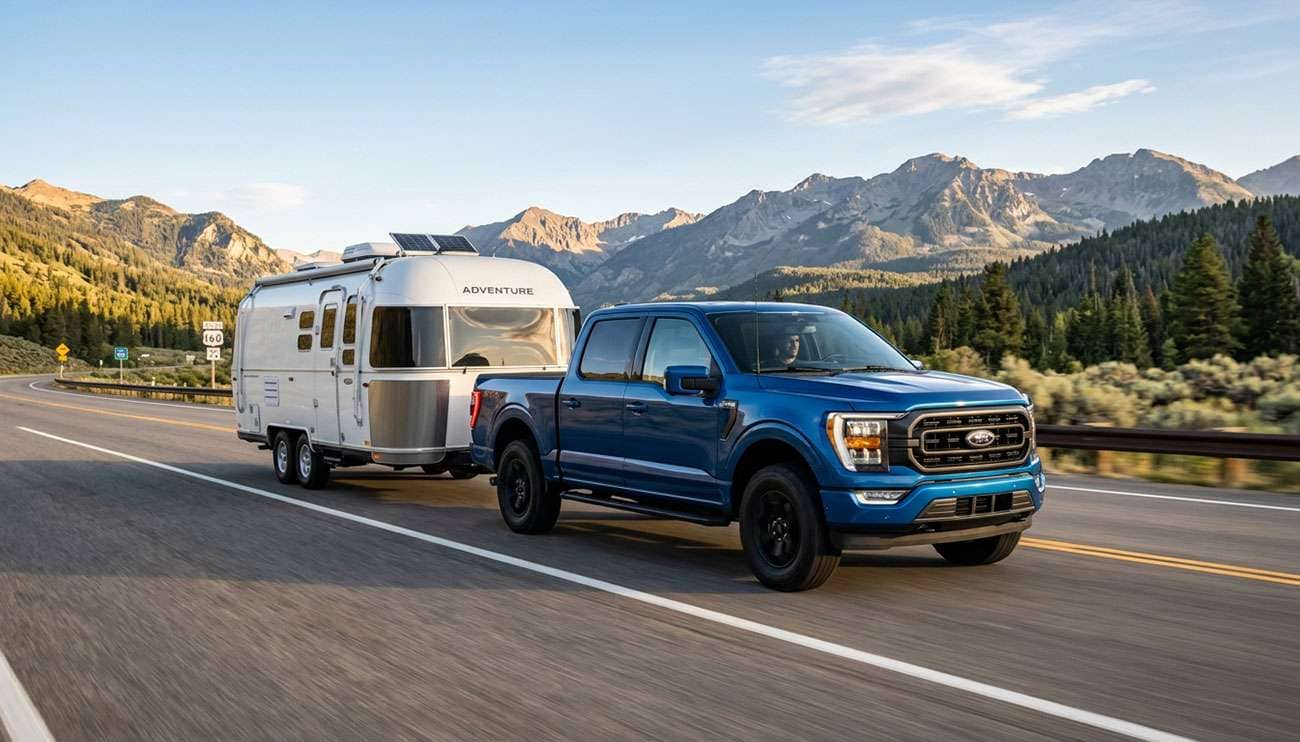
On a half-ton, 18s usually win. On a 3/4-ton or 1-ton, it's close to a draw. The wheel diameter isn't the problem. The tire you can buy for it is. At the same overall height, an 18-inch tire has about an inch more sidewall and more air inside, so it carries more weight: a typical LT275/70R18 Load Range E is rated 225 lb per tire above an LT275/60R20 E that stands the same 33 inches tall. Most answers to this question stop at "it depends on the tire." It depends on the tire's construction, its sidewall height, and which truck class you drive.
We get this question constantly from customers building tow setups, and the pattern across the tire market is consistent. Here's the decision by truck and tire.
18 vs. 20 for Towing: The Answer by Truck and Tire
Your Setup |
Typical 20-Inch Tire |
Better Towing Choice |
Why |
|---|---|---|---|
Half-ton on factory 20s, towing near its rating |
P-metric 275/60R20 or 275/55R20, load index 113 to 116 |
18s with LT Load Range E tires |
The 18 carries 225 to 329 lb more per tire at the same height, with more tire choices |
Half-ton that has to keep its 20s |
P-metric 275/60R20 |
LT275/60R20 Load Range E |
About 980 lb more per tire than the derated P-metric tire |
Half-ton, light occasional trailer |
Factory P-metric |
Either size |
If your measured rear axle load stays well inside the tire's derated rating, diameter doesn't matter |
3/4-ton or 1-ton |
LT275/65R20 Load Range E, load index 126 |
Either size |
The factory 20 carries 3,748 lb, slightly more than the factory 18 |
Any truck on aftermarket wheels |
Varies |
Whichever wheel has the higher load rating |
Diameter doesn't set a wheel's rating; the wheel design does |
The second table puts the capacity gap in numbers. Each row pairs tires of about the same overall height, so the only real difference is how much of that height is wheel and how much is tire.
Same Height, Different Wheel: What LT Load Range E Tires Carry
Overall Height |
18-Inch Tire |
20-Inch Tire |
Sidewall Height |
Capacity Per Tire |
|---|---|---|---|---|
About 32 in. |
LT275/65R18 E, typically 123 (3,415 lb) |
LT275/55R20 E, typically 120 (3,086 lb) |
7.0 in. vs. 6.0 in. |
20 carries 329 lb less |
About 33 in. |
LT275/70R18 E, typically 125 (3,640 lb) |
LT275/60R20 E, typically 123 (3,415 lb) |
7.6 in. vs. 6.5 in. |
20 carries 225 lb less |
33 in. vs. 34 in. |
LT275/70R18 E, typically 125 (3,640 lb) |
LT275/65R20 E, typically 126 (3,748 lb) |
7.6 in. vs. 7.0 in. |
20 carries 108 lb more, because it's a taller tire |
No. A 20-inch wheel with the right tire on it tows as well as an 18. Ford ships its F-250 Super Duty on 20-inch wheels with LT275/65R20 Load Range E tires rated at load index 126, and nobody calls that a weak tow rig. The trouble starts when "20-inch wheels" really means "20-inch passenger tires."
That's what most half-tons wear on their 20-inch trims. Most 20-inch Silverado 1500 trims run P-metric 275/60R20 tires, while the Trail Boss option on 18s gets an LT275/65R18 Load Range C. Ram offers the 1500 Big Horn on either 275/65R18 or 275/55R20 passenger tires, and puts the Rebel on LT275/70R18 Load Range E. The diameter that comes with the light truck tire tells you which one the factory built for work.
A P-metric tire also gives up capacity the moment it goes on a pickup. Under FMVSS 110, when a passenger car tire is installed on a truck, its load rating is divided by 1.10 before the axle total is figured. A typical 275/60R20 P-metric tire at load index 115 is worth 2,679 lb on a car and about 2,435 lb on a truck. The LT275/60R20 Load Range E version of the same size is typically rated 3,415 lb, with no derate. That's roughly 980 lb more per tire without changing the wheel.
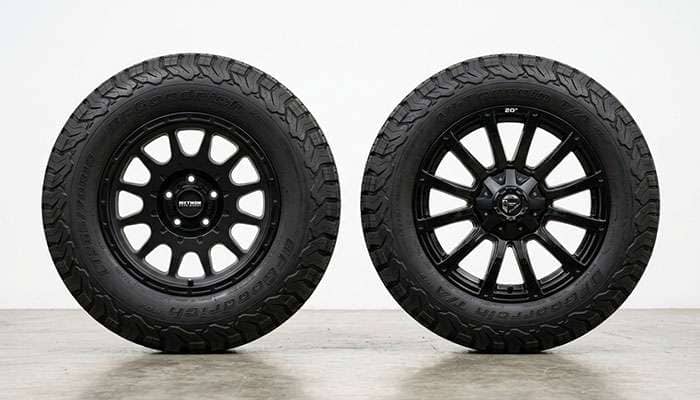
Air carries the load, not rubber. A tire's capacity comes from the volume of air inside it and the pressure that air is held at. The Tire and Rim Association load tables cap a Load Range E tire at 80 psi, so every LT-E tire in a given size works from the same pressure ceiling. The one that holds more air carries more weight.
Hold the overall height constant and move to a bigger wheel, and the extra wheel diameter comes straight out of the sidewall. An LT275/70R18 and an LT275/60R20 both stand about 33 inches tall, but the 18 has a 7.6-inch sidewall and the 20 has a 6.5-inch sidewall. That missing inch of sidewall is missing air, and the load index drops from a typical 125 to a typical 123.
You can see the same physics on a factory door placard. For a 2020 F-250, the listed rear pressures are 75 psi on the LT275/65R18 E (load index 123) and 65 psi on both the LT275/70R18 E (125) and the LT275/65R20 E (126). The tires with more air volume carry the same rear axle at 10 psi less. Less air volume means more pressure to do the same job, and on a 20-inch half-ton size you may run out of pressure before you run out of trailer.
Our guide to P-metric vs. LT tires breaks down the construction side: ply count, bead, and why an LT tire holds its shape under tongue weight.
If you tow near your truck's rating, it's usually the strongest move you can make for under the cost of a hitch upgrade. Three things favor the 18 on a half-ton.
The rule of thumb in our half-ton towing guide still applies: aim to run each rear tire at no more than about 85 percent of its rated capacity at the pressure you're actually using. If the factory 20s already clear that line with room to spare, keep them. If they're close, the 18 buys margin a different brand in the same 20-inch size can't. Our guide to what load range a half-ton needs to tow walks through the rear axle math with tongue weight.
Not for capacity. Heavy-duty trucks ship on LT Load Range E tires at every wheel size, so the passenger tire trap doesn't exist. The F-250 Super Duty lists LT275/65R20 E at load index 126 on its 20-inch trims and LT275/70R18 E at 125 or LT275/65R18 E at 123 on its 18-inch trims. The factory 20 is the taller tire, so it actually carries a little more: 3,748 lb against 3,640 lb.
On an HD truck, the 18 vs. 20 decision comes down to three secondary trade-offs:
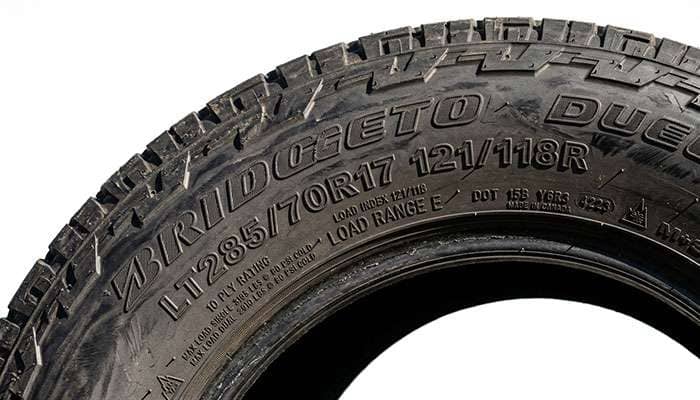
If a heavy fifth wheel or gooseneck has you shopping past Load Range E, check the load index, not just the letter. Our load range vs. load index guide explains how the two relate and why the number is the one that sets capacity.
Not on paper, but they can cut into what your tires can actually carry. Your truck's payload is GVWR minus curb weight, and it's printed on the Tire and Loading Information label on the driver's door opening, the label FMVSS 110 requires. A bigger wheel changes that number only by the extra weight it adds to the truck. Higher trims that ship on 20s also carry more equipment, so the payload on a loaded 20-inch trim is often lower than on a base 18-inch truck for reasons that have nothing to do with the wheel. Read the label on the truck in front of you, not the brochure.
The real payload trap is a replacement tire. The truck's ratings assume the factory tire's load capacity. Swap a 275/65R18 P-metric at load index 116 for a 275/55R20 at 113, and each tire carries about 200 lb less on a truck, even though the payload sticker didn't change. Our guide to whether a lower load index tire is safe covers that mistake in detail.
Tow ratings work the same way. Manufacturers publish them by engine, cab, bed, axle ratio and package under the SAE J2807 test procedure, and wheel diameter usually isn't a column in that chart. What does change is overall tire height. A taller tire acts like a numerically lower axle ratio, which moves the truck's real-world pulling ability down even when the sticker doesn't change.
No, and this surprises a lot of people. Across the aftermarket 6x139.7 wheels on the market, the typical load rating is 2,500 lb per wheel at both 18 and 20 inches, and roughly a fifth to a quarter of those wheels sit below 2,500 lb in either size. Eight-lug HD wheels in 8x170 and 8x180 typically carry 3,640 lb per wheel at both diameters. The wheel's design, construction and bolt pattern set the rating. Its diameter doesn't.
The math for what you need is simple. Take the higher of your two GAWRs from the door label and divide by two. A truck with a 4,400 lb rear GAWR needs at least 2,200 lb per wheel, and closer to 2,600 lb once you add margin for towing. A 2,500 lb wheel covers most half-tons with room to spare, but check it, because the styled wheels at the bottom of the range don't. Our wheel load rating guide shows where to find the number for any wheel.
A little, but construction matters more than diameter. A shorter sidewall flexes less side to side, so a 20-inch tire can feel more planted when tongue weight pushes on the back of the truck. That's the one towing argument for the 20 that holds up.
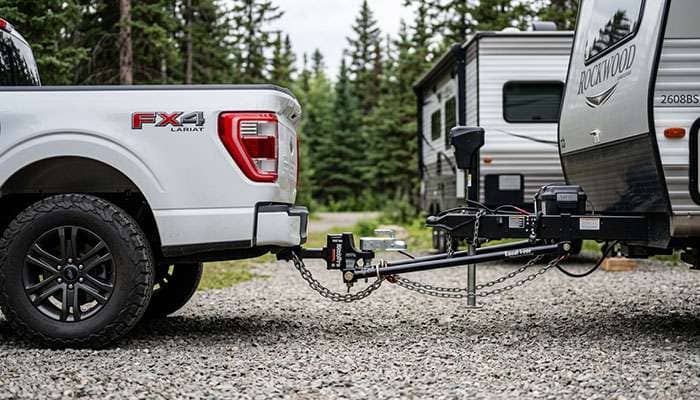
The bigger lever is the tire's construction. A P-metric sidewall flexes under tongue weight far more than an LT Load Range E sidewall built with more plies and a stiffer bead, and that squirm is what drivers feel as a loose, wandering rear end. An LT tire on an 18 usually feels more stable than a P-metric tire on a 20. An LT tire on either one, inflated for the load, beats both P-metric setups. A properly adjusted weight-distributing hitch usually does more for sway than any wheel swap.
The trade-off runs the other way on impacts. The shorter sidewall leaves less rubber between a pothole edge and the wheel lip, and a truck carrying tongue weight hits that edge harder. That's how loaded trucks pinch sidewalls and bend wheel lips, and our guide to whether tire sidewall damage is safe to drive on shows what to look for after a hit.
The cost of an undersized tire builds in stages. The FMCSA's tire safety guidance names the mechanism plainly: too much load or too little air builds heat and damages the tire's internal structure, and that damage can end in a failure.
The cheapest rung on that ladder is the first one: putting a tire with real load margin on the truck before the trip.
Before you shop, run your numbers in our tire load index calculator to see the minimum load index your truck needs per tire.
On a half-ton, 18s are usually the better towing wheel because the 18-inch sizes come with more sidewall, more air and more LT Load Range E choices at the same overall height, and they typically carry 225 to 329 lb more per tire. On a 3/4-ton or 1-ton, both diameters ship on LT Load Range E tires, so the 20 tows just as well and the choice comes down to ride, cushion and price. In both cases the wheel diameter isn't what decides it. The tire's construction and air volume do.
On a half-ton, 18s usually are, because the 18-inch sizes carry more load at the same overall height and offer more LT Load Range E tires. On a 3/4-ton or 1-ton, both sizes ship on LT Load Range E tires, so either one tows well.
Usually, if your trim offered 18s from the factory and your brakes clear them. Keep the overall tire height within about 3 percent of the original, move or replace your TPMS sensors, and set LT tire pressure from the tire maker's load table.
They're close. The LT275/65R20 Load Range E is typically rated at load index 126 (3,748 lb) and the LT275/70R18 E at 125 (3,640 lb), because the 20-inch tire is about an inch taller. The 18 usually costs less and gives more sidewall cushion.
Not the published rating, which is set by engine, cab, axle ratio and package. What bigger wheels can lower is the load your tires carry, if the 20-inch tire has a lower load index. A taller overall tire also acts like a lower axle ratio and makes the truck work harder.
Usually. In common truck sizes, an LT Load Range E tire for a 20-inch wheel typically costs about 15 to 23 percent more than the comparable 18-inch tire, though 275/55R20 and 275/65R18 run about even. The 18-inch half-ton sizes also offer far more LT choices.
At least half of your higher GAWR, plus margin for towing. A 4,400 lb rear GAWR needs 2,200 lb per wheel at minimum and about 2,600 lb with towing margin. Diameter doesn't change the requirement.