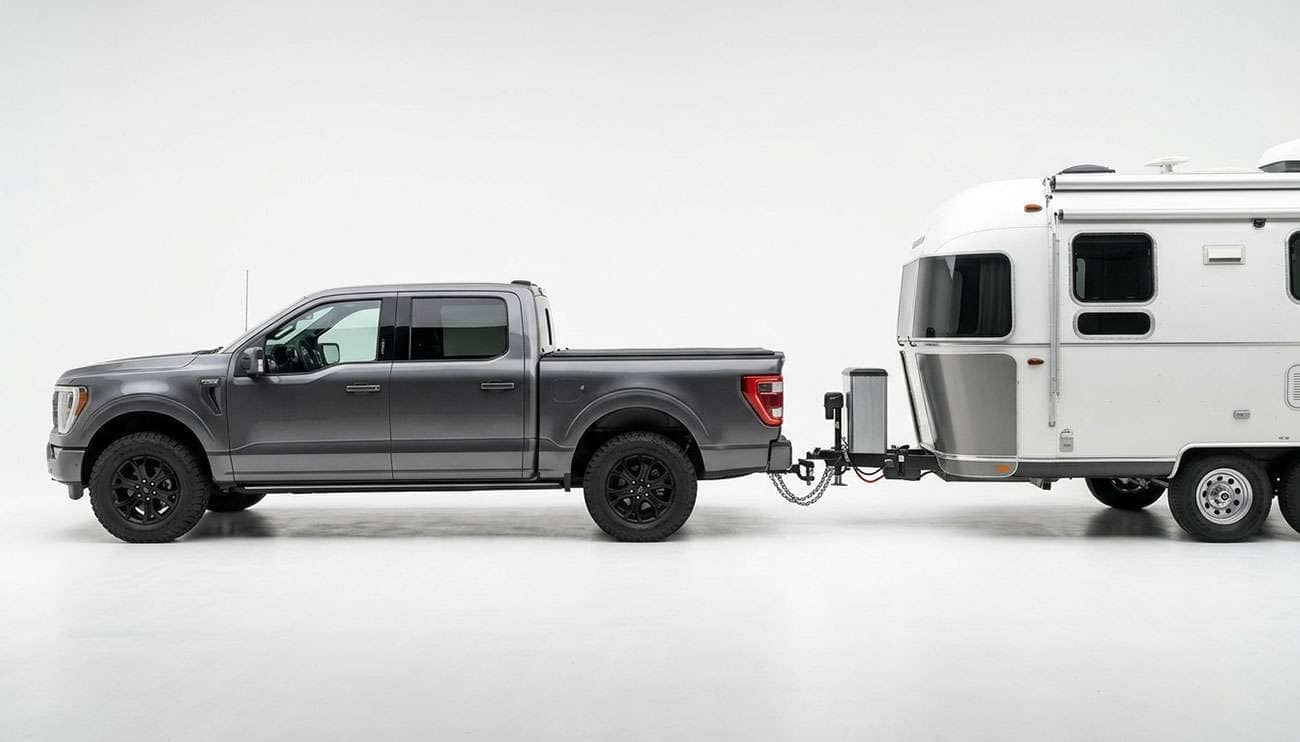
For most half-ton owners pulling a conventional travel trailer, the factory tires already cover it, and the load range question is the wrong question. The right one is what your rear axle actually weighs when the trailer is hooked up, because the hitch ball sits behind the axle and levers roughly a third more onto your rear tires than the tongue weight alone. The second right question is which wheel diameter you bought, because that quietly set a capacity ceiling you cannot buy past.
Most guides on this answer for the trailer's tires. Trailer tires matter and they have their own rules, but they are not what this question is asking. Of the guides that do cover the tow vehicle, most stop at "tongue weight counts against your payload." That is true and it is not the number your tires see. Payload is a bookkeeping figure spread across the whole truck. Your tires are bolted to one axle.
Here is what the rear axle is actually carrying, worked from the trailer out.
Loaded trailer weight |
Tongue weight at 12% |
Added to rear axle |
Lifted off front axle |
|---|---|---|---|
3,500 lb |
420 lb |
About 570 lb |
About 150 lb |
5,000 lb |
600 lb |
About 815 lb |
About 215 lb |
7,000 lb |
840 lb |
About 1,140 lb |
About 300 lb |
9,000 lb |
1,170 lb |
About 1,590 lb |
About 420 lb |
11,000 lb |
1,430 lb |
About 1,945 lb |
About 515 lb |
Figures assume a conventional ball hitch with no weight-distributing bars. A properly adjusted weight-distributing hitch changes these numbers substantially, which is the single biggest variable in the whole calculation and the one I'll come back to.
Your hitch ball does not sit over the rear axle. It sits several feet behind it, off the end of the frame. That makes the rear axle a fulcrum and the receiver a lever arm.
Push down on the end of that lever and two things happen at once. The rear axle takes on more than the weight you applied, and the front axle gets lighter by the difference. The arithmetic is straightforward:
Added rear axle load equals tongue weight multiplied by one plus the overhang divided by the wheelbase. Overhang is the distance from the center of the rear axle to the hitch ball.
On a typical half-ton crew cab, the wheelbase runs around 145 to 157 inches and the overhang from rear axle to ball runs roughly 50 to 56 inches. Run those through and the multiplier lands between about 1.33 and 1.40 across nearly every half-ton configuration on the road. Call it a third more, and you will be close on any of them.
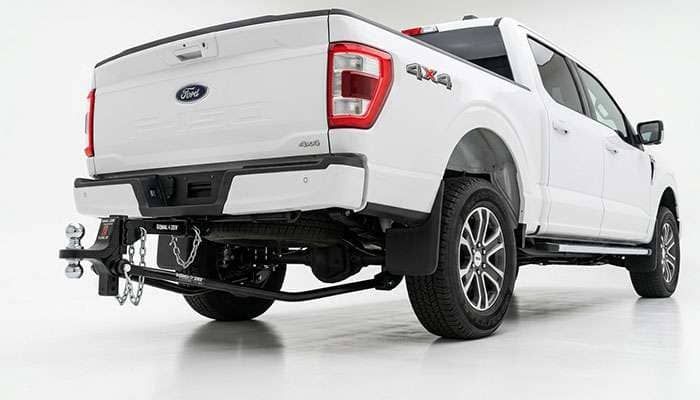
So an 840-pound tongue weight is not an 840-pound problem for your tires. It adds roughly 1,140 pounds to the rear axle and takes about 300 pounds off the front. That front-axle loss is worth a moment on its own, because it reduces steering authority and front brake bite exactly when you are hauling more mass, which is why a weight-distributing hitch is not a comfort accessory.
Take the rear axle number and divide by two. That is what each rear tire needs to carry, on top of whatever the truck itself already puts there. On a crew cab half-ton with fuel, passengers, and a modest amount of gear, the rear axle usually starts somewhere around 2,300 to 2,600 pounds before you hook up anything. Our article on what an overloaded rear axle does to your tires covers what that looks like when the number goes the wrong way.
Load range is a construction rating. It tells you how much air pressure the tire is built to hold, and the capacity it reaches at that pressure. It is not a capacity number by itself, which is where a lot of towing advice goes sideways.
A light truck tire in Load Range C is built for 50 psi. Load Range D is built for 65. Load Range E is built for 80. A passenger tire marked Standard Load is built for about 35 psi, and Extra Load for about 41. The tire delivers its rated capacity at that pressure and proportionally less below it.
The number that states the capacity is the load index, and that is the one to shop on. The load range letter tells you what it takes to get there. Our comparison of load range versus load index is worth five minutes if that distinction is new, and the breakdown of the E load rating covers what the heaviest common letter actually buys.
There is one more adjustment that catches people cross-shopping. Under Tire and Rim Association standards, a P-metric passenger tire fitted to a pickup, SUV, or van has its load rating divided by 1.10, a reduction of about nine percent. So a P-metric tire with a load index of 115 is rated for 2,679 pounds on a car and roughly 2,435 pounds on your truck. Compare that against a light truck tire's load index without applying the derate and you are comparing two numbers measured differently.
Under FMVSS 110, the combined load rating of the tires on an axle has to meet or exceed that axle's gross axle weight rating. Your door placard lists both the original tire and the rear GAWR. That is the compliance floor, and towing is where most half-tons get closest to it.
This is the part that surprises people, and it is decided at the dealership rather than at the tire counter.
Half-ton trucks ship on anything from 17-inch wheels up to 22s depending on trim. Those wheel diameters do not carry the same tire sizes, and those tire sizes are not offered in the same capacity bands. The higher trims with the big wheels generally have the least tire capacity available to them, and no amount of shopping fixes it without changing wheel diameter.
Common half-ton size |
Load index range available |
Capacity range per tire |
What's realistically on offer |
|---|---|---|---|
265/70R17 |
113 to 123 |
2,535 to 3,417 lb |
Deep light truck selection including Load Range E |
275/65R18 |
113 to 125 |
2,535 to 3,638 lb |
Strong light truck selection, the best all-round towing size |
275/60R20 |
114 to 126 |
2,601 to 3,748 lb |
Mostly passenger construction, with a real light truck option available |
275/55R20 |
111 to 122 |
2,403 to 3,306 lb |
Mostly Extra Load passenger; thin light truck choice |
275/50R22 |
111 to 122 |
2,403 to 3,306 lb |
Passenger construction dominates; very few light truck options |
285/45R22 |
110 to 117 |
2,337 to 2,833 lb |
Almost entirely Extra Load passenger; effectively no light truck option |
Read the bottom row against the top two. The 22-inch size tops out around 2,833 pounds before the nine percent derate, which lands near 2,575 pounds usable. The 18-inch size reaches 3,638 pounds in light truck construction with no derate at all. That is better than a thousand pounds per tire, two thousand per axle, decided entirely by which wheel package came on the truck.
For a lot of half-ton towing that ceiling is still comfortably above what the rear axle asks for. But if you bought the big-wheel trim and you are pulling near the top of the truck's rating with a loaded bed, you can end up in the position of having no tire on the market in your size that gives you the margin you want. The answer then is a smaller wheel diameter with a taller sidewall, or a lighter trailer. It is not a different brand in the same size.
Not automatically. Half-tons are delivered on passenger-construction tires and rated to tow on them under SAE J2807, the industry test standard every major manufacturer uses to publish tow ratings. If your rear axle load with the trailer attached sits comfortably under what your current tires carry after the derate, you do not need to change anything.
Light truck construction earns its place in three situations. The first is when the arithmetic says you need the capacity, which is the only reason that is really about numbers. The second is when you tow frequently rather than twice a summer, because the stiffer casing and heavier sidewall handle repeated heat cycling and sustained load better than a passenger casing does. The third is sidewall stiffness under lateral load, which shows up as less squirm when a trailer starts to push you around in a crosswind or a truck passes you.
The tradeoffs are honest and worth stating. A light truck tire on a half-ton is heavier, which costs a little fuel economy and a little acceleration. It rides firmer, especially empty. It often runs louder. And Load Range E in particular brings a pressure problem I'll get to next.
If you tow a few times a year with a trailer well under your truck's rating, a good Extra Load passenger tire with a high load index is a reasonable choice and rides better the other 350 days. If you tow monthly, pull near the rating, or spend time on gravel and job sites, light truck construction is the better tool. Our comparison of 10-ply versus 12-ply load ratings covers where the heavier letters start to make sense, and the guide to what XL load range means covers the passenger side of that decision.
Here is the practical consequence nobody puts in front of you when they tell you to buy Load Range E.
An E-rated tire reaches its rated capacity at 80 psi. At 80 psi on an unloaded half-ton it rides like a shop cart, wears the center rib, and gives up wet grip. So owners run them at 45 or 50, which is the right pressure for an empty truck and the wrong pressure the moment a trailer is attached. You bought capacity and then inflated it away.
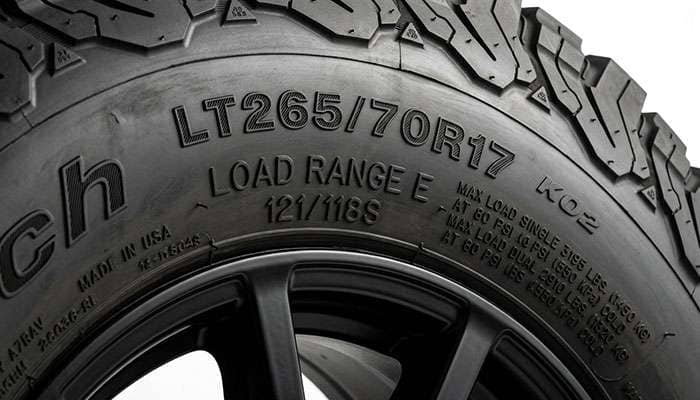
That is the real question hiding inside "what load range do I need." It is not just how much capacity you want. It is whether you are willing to change pressure before and after every tow.
If you are, Load Range E gives you the most headroom and you set your cold pressure from the manufacturer's load and inflation table for the axle weight you are actually running. Tow pressure up, daily pressure down, and reset your tire pressure monitoring thresholds so the system is not fighting you.
If you are not, a Load Range C or D light truck tire, or a high-load-index Extra Load passenger tire, gets you closer to one pressure that works in both states. Less peak capacity, more consistency, and far better odds you are actually running the right pressure on the day it matters. The Tire Industry Association has made this point in technician training for years: the tire that is correctly inflated beats the tire that is theoretically stronger and habitually under-pressurized.
An overloaded or underinflated tire does not fail the first day. It fails on the third afternoon of a long trip, at highway speed, in heat, which is the worst possible combination of circumstances.
The mechanism is heat. A tire carrying more than its inflation pressure supports deflects further on every revolution. That deflection is hysteresis, and hysteresis is heat generated inside the rubber and the belt package. At 35 miles an hour on a Saturday errand the tire sheds that heat. At 70 miles an hour for four hours with a trailer behind you in August, it does not.
The visible progression starts with shoulder wear, both outer ribs going before the center. Then the tire starts running noticeably hotter than its pair, which you can feel with the back of your hand at a fuel stop. Then you get belt edge separation, which is the belt package coming apart from the inside where you cannot inspect it. The tread comes off in one piece at speed, usually taking the rear fender liner, the bumper cover, and sometimes a brake line with it.
Underinflation also thins your sidewall's margin against impact. A tire running below the pressure its load requires pinches harder against the rim on a pothole, and that is where sidewall damage starts. Once the casing cords are compromised there is no repair, because a sidewall cannot be plugged or patched. Our guide on tire sidewall damage and whether it is safe to drive covers what to look for before a long trip.
NHTSA has identified underinflation as a leading contributor to tire failure for years, and towing is the condition that turns a marginal pressure into a genuine one. And remember that the trailer's own tires are running their own version of this problem on their own schedule, which is a separate calculation with separate rules. Our comparison of trailer tires versus car tires covers that side of the rig.
Twenty minutes with a scale ticket and a calculator settles this permanently.
Read your door placard. Write down the original tire size, the cold pressures, and the front and rear gross axle weight ratings. The rear GAWR is the number this whole exercise is measured against.
Get your tongue weight. Estimate at 12 to 13 percent of loaded trailer weight if you have nothing better, but a tongue weight scale or a CAT scale ticket is worth the trip. Loading the trailer differently changes this number more than most people expect.
Apply the lever. Multiply tongue weight by roughly 1.35 to get what lands on the rear axle. If you use a properly adjusted weight-distributing hitch, a meaningful share of that goes back to the front axle and the trailer axles, which is why the hitch is the highest-leverage purchase in this whole conversation.
Weigh the rig for real. Pull onto a CAT scale with the trailer attached and get individual axle weights. Everything above this step is estimation and this step is measurement. The rear axle number on that ticket is the answer.
Divide by two and compare. That is your per-tire load. Compare it against your tire's load index capacity, remembering the nine percent derate if you are on passenger construction. Aim to sit at or under about 85 percent of rated capacity rather than right at it.
Set pressure from the table, not the placard. Pull the load and inflation table for your exact tire, find the cold pressure that supports your measured axle load, and set it there before you leave. Reset it when you unhook.
What load range do you need to tow with a half-ton? If your measured rear axle load divided by two sits comfortably under your current tires' derated capacity, the answer is the one you already have. Most half-ton owners pulling a mid-size travel trailer with a weight-distributing hitch are in that group and do not need to spend anything.
If the numbers say you need more, move on load index rather than on the letter, and decide honestly whether you will manage pressure between towing and daily driving. If you will, Load Range E gives you the most room. If you will not, a C or D light truck tire or a high-load-index Extra Load passenger tire will serve you better in practice than an E you never inflate properly.
And check your wheel diameter before you shop, because on the biggest factory wheels the ceiling is lower than most owners realize and no tire in that size will raise it.
When you are ready to compare load index and construction side by side in your size, our truck tire selection lets you line them up before you commit.
Usually not. Half-tons are delivered on passenger-construction tires and rated to tow on them. Load Range E earns its place when your measured rear axle load needs the capacity, when you tow frequently rather than occasionally, or when you want the sidewall stiffness for crosswind stability. It also requires running 80 psi to deliver its rated capacity, which most owners do not do.
More than the tongue weight itself. Because the hitch ball sits behind the rear axle, the axle acts as a fulcrum. Added rear axle load equals tongue weight times one plus the overhang divided by the wheelbase, which works out to roughly 1.33 to 1.40 on most half-tons. An 840-pound tongue weight adds about 1,140 pounds to the rear axle and removes about 300 pounds from the front.
The pressure that supports your measured rear axle load on that specific tire, taken from the manufacturer's load and inflation table rather than from the door placard. The placard pressure is calibrated to the original tire under normal use and does not account for concentrated hitch load. Set cold pressures before you leave and adjust back down when you unhook.
They can be, within their derated capacity. A passenger tire on a pickup has its load rating divided by 1.10 under Tire and Rim Association standards, so apply that reduction first and compare the result against half your rear gross axle weight rating. Where they fall short is repeated heat cycling and sustained load, which is why frequent towing favors light truck construction even when the numbers technically clear.
It changes the numbers more than any tire choice does. Spring bars transfer a share of the tongue weight to the front axle and the trailer axles, reducing rear axle load and restoring steering and braking authority up front. Many owners who think they need heavier tires actually need a properly adjusted hitch, and it is worth weighing the rig both ways before spending on tires.
Weigh the rig on a CAT scale with the trailer attached and compare each axle's measured weight against its gross axle weight rating and against the combined rating of the tires on that axle. Between scale trips, watch for both outer ribs wearing before the center and for one tire running hotter than its pair at fuel stops. Both point to carrying more load than the current pressure supports.