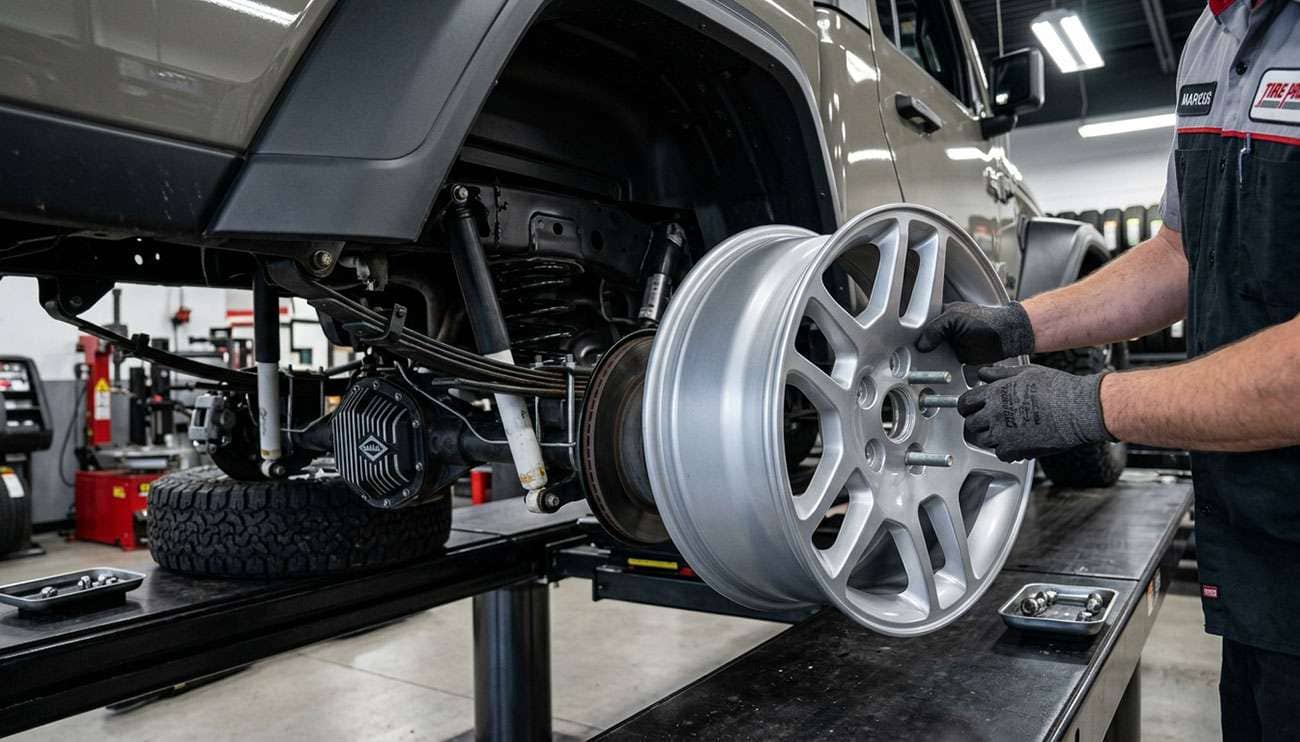
Yes, a JL Wrangler wheel bolts onto any Gladiator. Both Jeeps use the 5x5 bolt pattern, the same 71.5 mm hub, the same M14x1.5 lug nuts, and on most trims the same 17x7.5 factory wheel at a +44.45 mm offset. Here's what the "same bolt pattern" answers leave out. A Gladiator's rear axle is rated to carry 3,750 pounds, and a JL Unlimited's is rated for 3,100. A wheel needs half the axle rating, so a Gladiator calls for a wheel rated at least 1,875 pounds where a JL needs 1,550. A wheel that's plenty for the Wrangler can come up short on the truck.
Start with where the wheel came from.
Wheel From |
Bolts On a Gladiator? |
Lug Nuts |
What Decides It |
|---|---|---|---|
JL Wrangler, 17-inch (2018+) |
Yes |
Your Gladiator's M14x1.5 |
Load rating for the rear axle; TPMS build date |
JL Wrangler, 18- and 20-inch |
Yes |
Your Gladiator's M14x1.5 |
Load rating; TPMS build date |
JK Wrangler, 17- and 18-inch (2007-18) |
Yes, with Gladiator lug nuts |
M14x1.5; JK 1/2-20 nuts won't thread |
Load rating; TPMS sensors by year |
JK Wrangler, 16-inch |
No |
Not applicable |
Gladiator brakes need a 17-inch or larger wheel |
YJ or TJ Wrangler (1987-2006) |
No |
Not applicable |
5x4.5 bolt pattern |
Then find your Gladiator. The trim decides how far out the wheel sits, and the rear axle rating decides how strong it needs to be.
Jeep |
Track Width |
Factory Wheel |
Minimum Wheel Rating |
|---|---|---|---|
Gladiator Sport, Sport S, Willys |
62.9 in. |
17x7.5 at +44.45 mm |
1,875 lb (3,750 lb rear axle) |
Gladiator Rubicon, Sport S Max Tow |
64.4 in. |
17x7.5 at +44.45 mm |
1,875 lb (3,750 lb rear axle) |
Gladiator Mojave |
65.0 in. |
17x7.5 at about +36 mm |
Check your door sticker; plan on 1,875 lb |
JL Wrangler Unlimited (for comparison) |
62.9 in.; 64.4 in. on the Rubicon 392 |
17x7.5 at +44.45 mm |
1,550 lb (3,100 lb rear axle) |
We see a lot of Jeeps in our Long Beach shop, and this question comes in all the time. A guy upgrades his Gladiator and his buddy has a set of JL Rubicon takeoffs sitting in the garage. They'll bolt on. I just want you to know what you're bolting on before you hitch up the boat.
Yes. The Gladiator was built off the JL, and the parts that touch the wheel came along with it.
Owners do this all the time. Plenty of Gladiator Rubicon owners have picked up a set of JL Rubicon wheels and tires, including the spare, so they can run a five-wheel rotation.
The Gladiator's spare hangs under the bed instead of on a tailgate, and a JL wheel works there too. The 18- and 20-inch JL wheels from the Sahara and High Altitude bolt on the same way. If the wheels you're eyeing came off a JL with 35-inch tires, read whether 35s fit a Gladiator without a lift before you mount them as-is.
This is the part nobody puts in front of you, and it's the only real difference between the two Jeeps at the wheel.
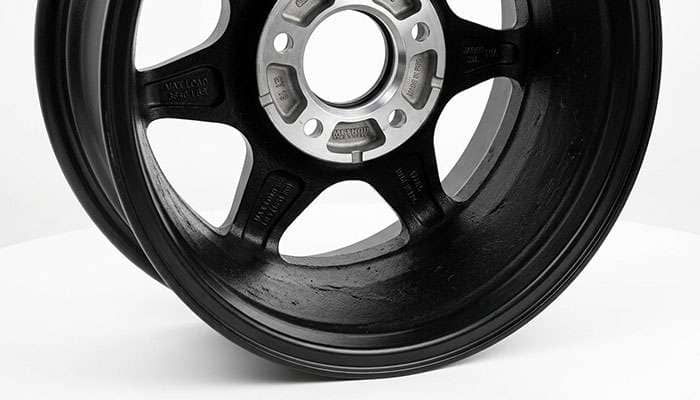
The rule the wheel industry uses is simple. Take the heavier of your two gross axle weight ratings, the GAWR on the driver's door sticker, and divide it by two. Each axle's load is carried by two wheels, so that's the least each wheel must be rated to carry. Wheel makers add one more rule: if you can't find a wheel's load rating, don't put it on the vehicle. Our wheel load rating guide walks through the math.
Here's how the two Jeeps work out:
That 325-pound gap is the whole story. The Gladiator's rear axle is built to carry a bed full of gear plus the tongue weight of a trailer, up to 7,700 pounds with the Max Tow package on recent trucks. A JL Unlimited is rated to tow 3,500.
Now the honest part. Jeep doesn't publish the load rating for its factory alloy wheels. Owners who asked report being told the number is proprietary. Some remember Jeep saying at the Gladiator's launch that its wheels got a higher rating than the JL's. Owners have also weighed the two factory wheels and found them identical. Mopar does publish a number for its 17x7.5 steel wheel sold for the Gladiator: 1,950 pounds. So a factory steel wheel clears the Gladiator's 1,875-pound mark, and for a JL alloy, you're taking it on faith.
On the aftermarket side, most 5x5 wheels clear the bar easily. The middle of the market sits at 2,500 pounds. But about 1 in 7 of the 17- to 20-inch 5x5 wheels out there is rated under 1,875 pounds. Only a few percent fall under the 1,550 a JL needs. So a wheel that was the right call on a Wrangler can be the wrong call on a Gladiator.
The tires aren't the weak link here. A load range C light-truck tire in the Rubicon's factory size carries well past what either Jeep's axle is rated for. It's the wheel that sets the limit.
If you drive your Gladiator empty and never tow, a JL wheel without a published rating may never give you trouble. But "may never" isn't a load rating. If you haul or tow, put wheels on the truck with a stamped rating of 1,875 pounds or more, and more is better.
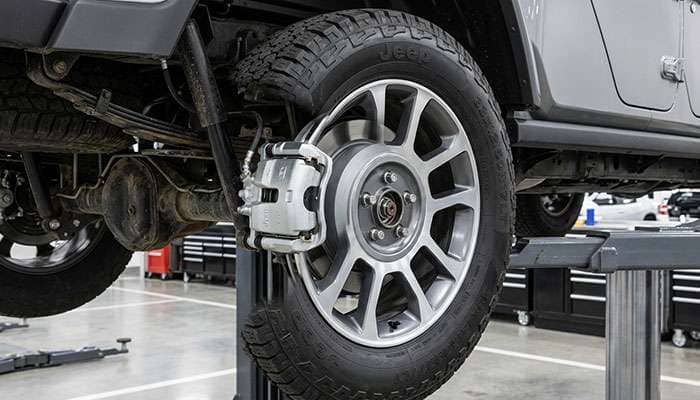
Every factory JL wheel does, because none of them is smaller than 17 inches.
Up front, the two Jeeps share the same brakes. The 12.99-inch (330 mm) front rotor kit sold for the Gladiator is the same kit sold for the JL Wrangler. In back, the Gladiator runs bigger hardware. Owners who measured them put the Gladiator's rear rotor at 13.6 inches with a 51 mm caliper, against 13.4 inches and a 48 mm caliper on the JL's heavy-duty rear brakes. Gladiator owners agree that 17 inches is the smallest wheel that clears any Gladiator.
The Gladiator is actually simpler than the Wrangler here. Over the years the JL got several rear brake packages depending on engine and options. Owners report every Gladiator trim uses the same rotors, so a wheel that clears one Gladiator clears them all.
That's why I always test-fit the rear first. If a wheel is going to touch anything, it's going to be the bigger rear caliper. Spin it by hand before you mount a tire.
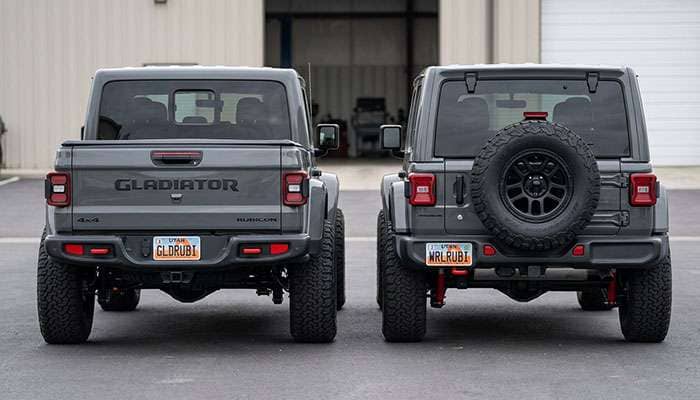
It changes where the wheel sits, not whether it fits. Jeep lists three track widths for the Gladiator:
On a wide-track Gladiator, each hub sits about 3/4 inch farther out than on a standard JL. Put a JL wheel on a Gladiator Rubicon and it sits right where the Rubicon's own +44.45 mm wheel sits, because the offsets match. The JL wheel just sits 3/4 inch farther out than it did on the Wrangler it came off.
The Mojave is the odd one. Owners report its factory wheel runs about +36 mm, so it sits roughly 5/16 inch farther out than a +44.45 mm wheel. Put a JL wheel on a Mojave and it tucks in that 5/16 inch. You won't hit anything, but it won't fill the flare quite like the Mojave wheel did.
The 17- and 18-inch ones do, with two catches. The 16s don't.
A 2007-2018 JK Wrangler has the same 5x5 pattern and 71.5 mm hub as the Gladiator. What changed is the stud. The JK runs 1/2-20 studs and lug nuts, and the JL and Gladiator went to M14x1.5. Your JK lug nuts won't thread onto a Gladiator stud, but your Gladiator's lug nuts work on a JK wheel, because the seat is the same 60-degree cone. Our article on whether JK wheels fit a JL covers the lug nut and offset details, and it all carries over to the Gladiator.
The two catches:
And the 16-inch JK steel wheels won't clear Gladiator brakes. Skip them.
Older Wranglers are a hard no. The 1987-1995 YJ and 1997-2006 TJ use 5x4.5, and a 5x4.5 wheel won't go on a 5x5 hub. The same goes for 1993-2004 Grand Cherokee wheels, which are 5x4.5 too. Our article on whether Grand Cherokee wheels fit a Wrangler covers the later ones.
Yes, if the build dates fall on the same side of early June 2021. The JL and Gladiator share tire pressure sensors, but the sensor changed partway through the 2021 model year. Mopar and the aftermarket list one sensor for JLs and Gladiators built before about June 5, 2021, and a different one for those built after. The parts catalogs treat them as two different parts, and so should you. The earlier sensor is also the one 2013-2018 JK Wranglers used.
So check two dates before you buy a set of JL wheels with sensors in them: the build date on the JL they came off, and the build date on your Gladiator. Both are on the driver's door sticker. If they don't match, budget for new sensors. Our guide to TPMS sensors for aftermarket wheels explains what to ask for.
They bolt on too. They just move the tire around more than a factory wheel does.
A factory JL or Gladiator wheel has roughly 6 inches of backspacing. Most aftermarket 17x8.5 and 17x9 wheels in 5x5 carry 4-1/2 to 5 inches, somewhere around zero to -12 mm offset. That moves the center of the tire about 1-3/4 to 2-1/4 inches farther out than stock on each side. That's the look most guys want, but on a wide-track Gladiator it starts with the hub already 3/4 inch farther out than on a JL.
Most aftermarket 5x5 wheels also have a center bore bigger than the 71.5 mm hub, so one wheel can fit several trucks. That's normal. The wheel centers on its cone-seat lug nuts, and a hub-centric ring takes up the gap if you want the wheel riding on the hub too. Just check which seat the wheel calls for and run lug nuts that match it.
Some aftermarket wheels are built to JL specs on purpose, with more positive offset to keep the tire tucked under the flare. Those sit on a Gladiator the same way they sat on the JL, plus that 3/4 inch on a wide-track truck.
The size of the tire matters more than the wheel at this point. If you're going big, read whether 37s fit a Gladiator. It covers backspacing, flares, and lift by trim. And check the load rating on every aftermarket wheel, JL-specific or not. The aftermarket listing will say what it fits. Only the rating tells you what it carries.
Yes, and this direction is the easy one. Everything that lets a JL wheel fit a Gladiator works in reverse: same 5x5 pattern, same 71.5 mm hub, same M14x1.5 lug nuts. A Gladiator Sport or Rubicon wheel at +44.45 mm sits on a JL exactly where the JL's own wheel does.
Load rating isn't a worry this way either. A wheel built for a Gladiator's 3,750-pound rear axle has plenty for a JL Unlimited's 3,100. If it was rated for the truck, it's rated for the Wrangler.
The one to think about is the Mojave wheel. At about +36 mm, it sits roughly 5/16 inch farther out on a JL than a stock wheel. That won't cause a rub on its own, but if you're already running the biggest tire your JL will take, that 5/16 inch is where you'll find out. The TPMS rule works the same both ways, too: match the build dates on either side of early June 2021. Gladiator takeoffs are a good find for a JL owner for exactly these reasons.
Here's how it goes wrong, starting with the cheap mistakes and ending with the expensive one.
Every one of those costs more than checking a stamp and a sticker.
A JL Wrangler wheel will bolt onto any Gladiator, and on most trims it sits right where the factory wheel did. The bolt pattern, hub, lug nuts, and offset all match. What doesn't match is the job. The Gladiator's rear axle is rated for 3,750 pounds, so its wheels need to carry 1,875 pounds each, and nobody publishes that number for the factory JL alloys. If you're running empty, JL wheels are a fine deal. If you're towing or hauling, buy wheels with a stamped rating that clears the bar.
When you're ready to shop, start with our 5x5 wheels, and check the load rating on every listing. Call us if you want a second set of eyes on it. We've been fitting wheels in Long Beach since 1971, and that's what we're here for.
JL Wrangler wheels bolt onto any Gladiator, and JK wheels 17 inches and larger fit with Gladiator lug nuts. YJ and TJ wheels use a 5x4.5 pattern and don't fit. The thing to check is the load rating: a Gladiator needs a wheel rated for at least 1,875 pounds.
On most trims the size and fitment are the same: 17x7.5 at +44.45 mm, 5x5, with a 71.5 mm hub bore. The Mojave's factory wheel runs about +36 mm. Jeep doesn't publish load ratings for the factory alloys, so you can't confirm the two are rated the same.
The Gladiator uses 5x5 (5x127 mm) with a 71.5 mm hub bore and M14x1.5 studs, the same as the JL Wrangler.
Divide the heavier axle rating on your door sticker by two. Gladiator stickers owners have posted show a 3,750-pound rear axle, which works out to 1,875 pounds per wheel. If you tow or haul near the limit, more is better.
Yes, when both Jeeps were built on the same side of early June 2021. The sensor changed then, and the parts catalogs list different sensors for trucks built before and after. Check the build dates on both door stickers.
JK wheels 17 inches and larger bolt on with Gladiator M14x1.5 lug nuts, since JK nuts are 1/2-20. JK 16-inch wheels won't clear Gladiator brakes, and only 2013-2018 JK sensors pair, and only with a Gladiator built before early June 2021.