
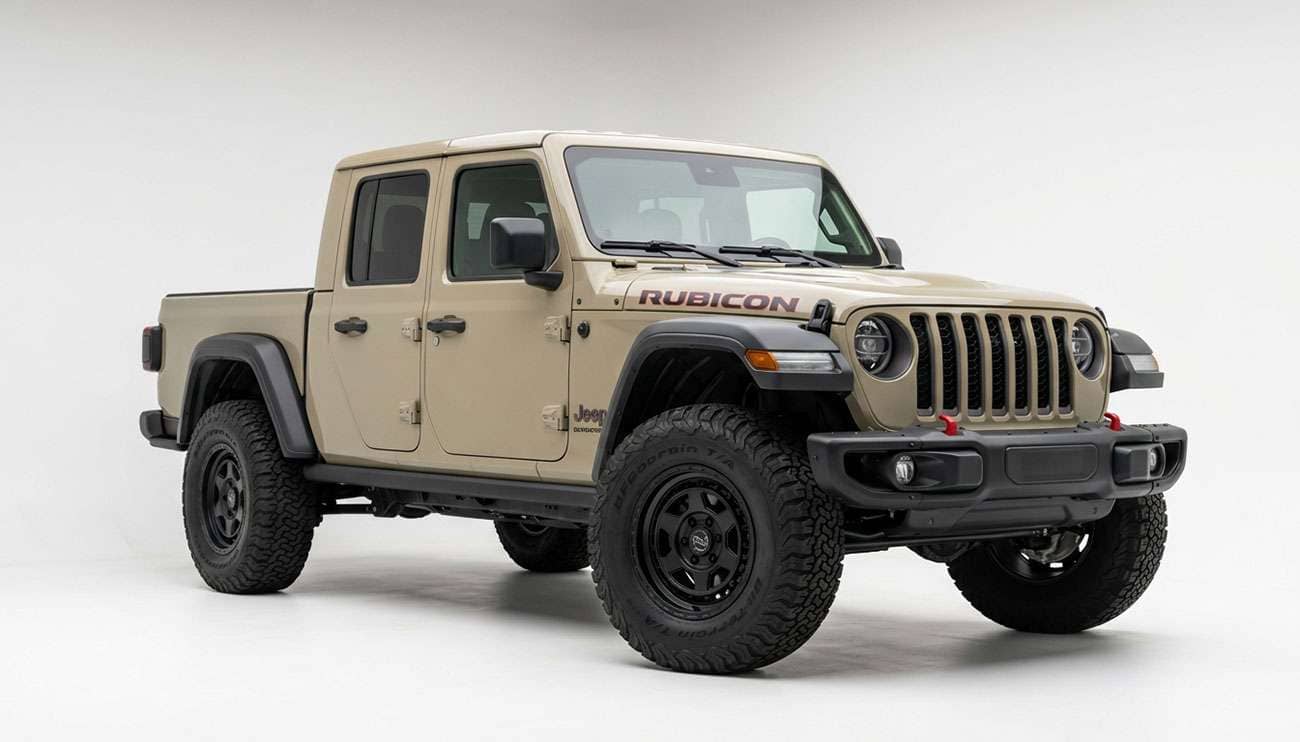
On a Gladiator Rubicon or Mojave, yes: 35s fit without a lift once you swap to a lower-offset wheel and add bump stop extensions, with some trimming at the front pinch seam. On a Sport, Willys, Overland, or Nighthawk, 35s rub at full compression unless you change fenders or add a lift. That much is in most answers. Most stop at "it depends on your trim." The piece they leave out is the one that makes a Gladiator different from a Wrangler: what is in the bed. A 35 that clears an empty truck can hit the rear fender with 1,000 pounds on board.
I'm Dennis Feldman, and I spec fitment for Performance Plus Tire. Gladiator owners ask about 35s more than any other upgrade, and the answer they usually get was written for a Wrangler. This table is the Gladiator version:
Feature |
Factory Tire |
35s With No Lift? |
What It Takes |
|---|---|---|---|
Rubicon / Rubicon X |
LT285/70R17 (32.7 in) |
Yes, with work |
Lower-offset wheel, bump stops, minor pinch seam trim |
Mojave / Mojave X |
LT285/70R17 (32.7 in) |
Yes, with work |
Same as Rubicon; 1-inch factory front lift helps |
Willys |
255/75R17 (32.1 in) |
Not without rub |
Wheels, bump stops, high-clearance fenders or a lift |
Sport / Sport S |
245/75R17 (31.5 in) |
Not without rub |
Wheels, bump stops, high-clearance fenders or a lift |
Overland / Sahara (18-in) |
255/70R18 (32.1 in) |
Not without rub |
Plan on a lift |
Nighthawk / High Altitude (20-in) |
275/55R20 (31.9 in) |
Not without rub |
Plan on a lift |
"Yes, with work" means the tire clears at ride height and through normal driving, and the bump stops keep it out of the fender when the suspension compresses. It does not mean bolt on and forget.
The second thing to sort out is how you use the truck. This table is keyed to load and setup, and it is where most people decide what to buy:
Feature |
Front |
Rear |
Verdict |
|---|---|---|---|
Rubicon, empty bed, stock wheels |
Rubs at lock and on the control arm side |
Usually clears |
Change wheels first |
Rubicon, empty bed, lower-offset wheels, bump stops |
Clears, light pinch seam trim |
Clears |
Works as a daily setup |
Rubicon, loaded bed or towing |
Clears |
Can contact rear fender over bumps |
Add rear bump stops or a lift |
Sport, empty bed, any wheel |
Contacts low fenders on compression |
Contacts on hard landings |
Fenders or lift needed |
Yes, and it is the trim that gets closest. The Rubicon ships on LT285/70R17 all-terrains or mud-terrains, about 32.7 inches tall, and has the high-clearance fenders that give the tire room to move up. Owners running 35s on unlifted Gladiator Rubicons report the tire clears at ride height and looks right, which is why so many skip the lift.
Where it goes wrong is articulation. As one forum owner put it, unlifted 35s on a Rubicon touch something as soon as the suspension starts working. The fix is not a taller spring. Spacers raise ride height, but the tire still travels up until something stops it. That something is the bump stop. Extending the bump stops limits how far the axle can travel toward the fender, and that is what keeps a 35 out of the bodywork. We covered that mechanism in detail for the Wrangler in will 35s fit a Wrangler JL without a lift, and it applies to the Gladiator's front axle the same way.
Up front, the other contact point is at full steering lock. The leading edge of a 35 meets the fender liner and the pinch seam where the body panels join. Fitment guides for the Gladiator commonly call for minor pinch seam trimming on the Rubicon, and a lower-offset wheel to move the tire away from the inner components. Neither is a big job, but neither is zero.
Yes, on the same terms as the Rubicon, with one advantage. The Mojave is Jeep's high-speed desert Gladiator, and it ships with a 1-inch front lift over the Rubicon, which acts like a factory leveling kit. It also gets FOX 2.5-inch internal bypass shocks, FOX hydraulic jounce bumpers up front, and 11.6 inches of ground clearance, half an inch more than the Rubicon. Its wheels are set with a little less positive offset than the Rubicon's, for a track about half an inch wider.
Those jounce bumpers matter here. They provide extra damping and bottom-out control in the last few inches of travel, exactly where a 35 starts looking for the fender. Mojave owners still add bump stop spacing for 35s, but they start from a truck built to handle the end of its travel.
The Mojave also ships on 33-inch tires, the same LT285/70R17 size as the Rubicon, so a Mojave owner is making the same 1.8-inch jump.
Not cleanly. The Sport and Sport S ship on 245/75R17, about 31.5 inches, and the Willys on 255/75R17, about 32.1 inches. Going to 35s is a 2.5- to 3-inch jump in diameter, not 1.8, and these trims use the standard fenders, which sit lower than the Rubicon's high-clearance fenders.
That said, owners do it. One Gladiator Sport S owner on the Gladiator forum ran 35x12.50R17s with no lift, no leveling kit, and no spacers, and reported rubbing only when the rear tires landed hard between rocks on technical trail. His fix was swapping to Rubicon fenders, which he said gave about an inch more clearance than his stock fenders. That is the real lesson: on a Sport or Willys, the fender is the variable, not the spring.
The Overland and Sahara on 18-inch wheels, and the Nighthawk and High Altitude on 20s, are a different case. Those are street-oriented trucks with standard fenders, and the larger factory wheel leaves less sidewall to flex in the tire you put on. Most owners of those trims who want 35s plan on a lift from the start. For a broader view of the size jump, see 31s vs. 33s vs. 35s.
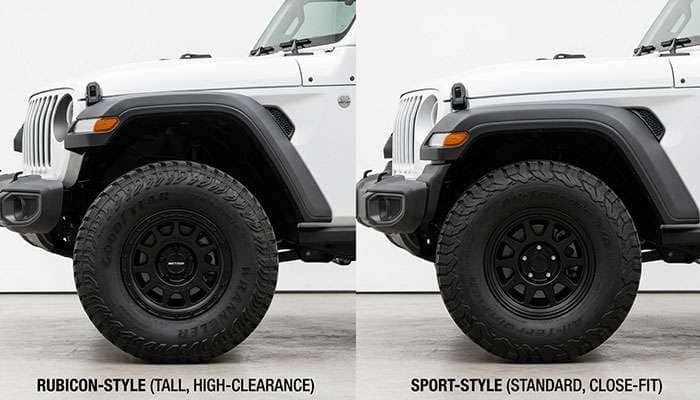
Yes, and this is the question that separates a Gladiator from a Wrangler. The Gladiator is a pickup. Put weight in the bed, or hook up a trailer, and the rear coil springs compress before you have driven a foot. That takes away part of the gap between the tire and the rear fender at rest.
Here is the mechanism. A coil spring compresses in proportion to load. Every pound of payload or tongue weight that lands on the rear axle lowers the rear of the truck a little. Now add a bump in the road. The suspension compresses further from an already lowered starting point. On an empty truck, a 35 might have a few inches of margin before it touches the rear fender. Loaded, that margin shrinks, and the bump that used to be nothing becomes a tire hitting the fender lip.
That is why the forum owner above heard his rear tires on rock landings, and why Gladiator owners who carry gear, camp, or tow report rear contact that Wrangler owners on the same tire never mention. The front axle barely notices what is in the bed. The rear notices everything.
The front end is closely related, so a lot of Wrangler fitment advice carries over up front. But three things change the answer.
First, the bed. As covered above, the rear axle on a Gladiator carries payload. A Wrangler's cargo area does not change its rear ride height nearly as much.
Second, the wheelbase. The Gladiator rides on a much longer wheelbase than even the four-door Wrangler. More length between the axles makes the truck heavier, and a heavier truck asks more of the gearing when you add tire height. A 35 that feels fine on a Wrangler can feel sluggish on a loaded Gladiator.
Third, Jeep never offered factory 35s on the Gladiator. Jeep's Xtreme Recon package put 35-inch tires on the Wrangler Rubicon from the factory, but it was a Wrangler-only option. Gladiator owners noticed. Every Gladiator on 35s is an aftermarket build, so the fitment work is on you rather than on a factory package.
If you want to compare how Ford approaches the same question on its own off-roader, see 35s on a Bronco without the Sasquatch package.
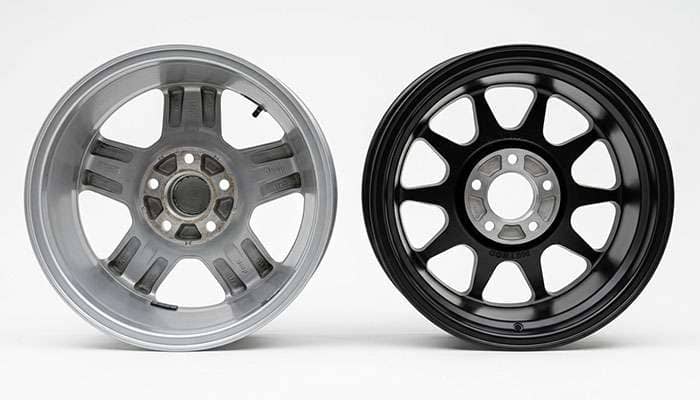
Less than the factory gives you. Stock Gladiator wheels are 17x7.5 with a high positive offset, around +44 mm on most trims, on a 5x5 (5x127) bolt pattern. That pulls the tire inward, toward the control arms, frame, and steering components. A 12.5-inch-wide 35 on that wheel puts its inner sidewall into parts it should not touch.
The fix is a wheel that moves the tire outboard. Gladiator fitment guides commonly suggest an offset in roughly the +5 to +18 mm range on 17- or 18-inch wheels. A 17x8.5 or 17x9 in that range moves the tire out enough to clear the inside, while keeping it mostly under the fender.
Go too far the other way and you trade inside rub for outside rub. Look at the aftermarket shelf: across 17x9 5x5 wheels, the median offset is -12 mm, and three in four sit at zero or negative. Almost none land in the factory-like +25 to +45 mm range. A -12 mm wheel pushes the tire well past where the factory wheel sat, which makes the tire hit the fender and flare on compression and at lock. On an unlifted truck, the aggressive-offset wheel can make 35s fit worse, not better.
Wheel spacers can move the tire out too, and plenty of owners use them. They also add leverage on the wheel bearings and studs, and they do not change backspacing on the wheel itself. If you go that route, buy hub-centric spacers and torque them correctly. For more on that trade-off, see why your tires are rubbing.
This decides a lot of unlifted builds, because the two sizes owners call "35s" are not the same tire.
A 35x12.50R17 is labeled 35 inches, but measured diameters usually come in around 34.5 to 34.8 inches, and the tread is 12.5 inches wide or a bit more. A 315/70R17 calculates to 34.4 inches tall and about 12.4 inches wide. It is a little shorter and a little narrower, which is often the difference between a light brush and clean clearance on an unlifted truck.
Both sizes are almost entirely light-truck construction, so expect heavier tires than the factory ones. That weight is rotating, unsprung mass. It shows up as slower acceleration, longer stopping, more load on the steering, and lower fuel economy.
If you are fitting 35s on an unlifted Gladiator, the 315/70R17 is the safer choice. If you want the most tire you can get and are willing to trim and stop-limit for it, the 35x12.50R17 is the one.
A 35 that rubs is a problem that grows. Here is how the costs stack up.
35s fit a Gladiator Rubicon or Mojave without a lift, with a lower-offset wheel, bump stops, and some trimming at the pinch seam. The Mojave's 1-inch front lift and hydraulic jounce bumpers give it a small head start. Sport, Willys, Overland, and Nighthawk trucks need high-clearance fenders or a lift to run 35s without contact.
The part to plan around is the bed. A Gladiator carries weight on its rear axle in a way a Wrangler does not, and a 35 that clears an empty truck can hit the rear fender with a load on board. Set up the rear for the heaviest load you carry, pick a moderate wheel offset instead of the most aggressive one, and the truck will look the part without wearing through its fenders.
Yes, with work. A Gladiator Rubicon can run 35s without a lift if you use a lower-offset wheel, add bump stop extensions, and trim the front pinch seam slightly. Without bump stops, the tires contact the fenders when the suspension articulates.
Not without some rubbing. The Sport's standard fenders sit lower than the Rubicon's high-clearance fenders. Owners who run 35s on an unlifted Sport usually swap to Rubicon or high-clearance fenders and add bump stops, or install a lift.
Yes. Bump stops limit how far the axle travels up toward the fender. Spring spacers and leveling kits raise ride height, but they do not stop the tire from reaching the fender at full compression. Bump stops do.
Gladiator fitment guides commonly suggest roughly +5 to +18 mm offset on 17- or 18-inch wheels, compared with about +44 mm on most factory wheels. Deep negative offset pushes the tire into the fender on an unlifted truck.
No. Jeep's Xtreme Recon package, which added 35-inch tires from the factory, was offered on the Wrangler Rubicon, not the Gladiator. The Gladiator Rubicon and Mojave top out at 33-inch LT285/70R17 tires from the factory.
Close, but not quite. A 315/70R17 calculates to about 34.4 inches tall and 12.4 inches wide, a little shorter and narrower than most 35x12.50R17 tires. That makes it an easier fit on an unlifted Gladiator.



