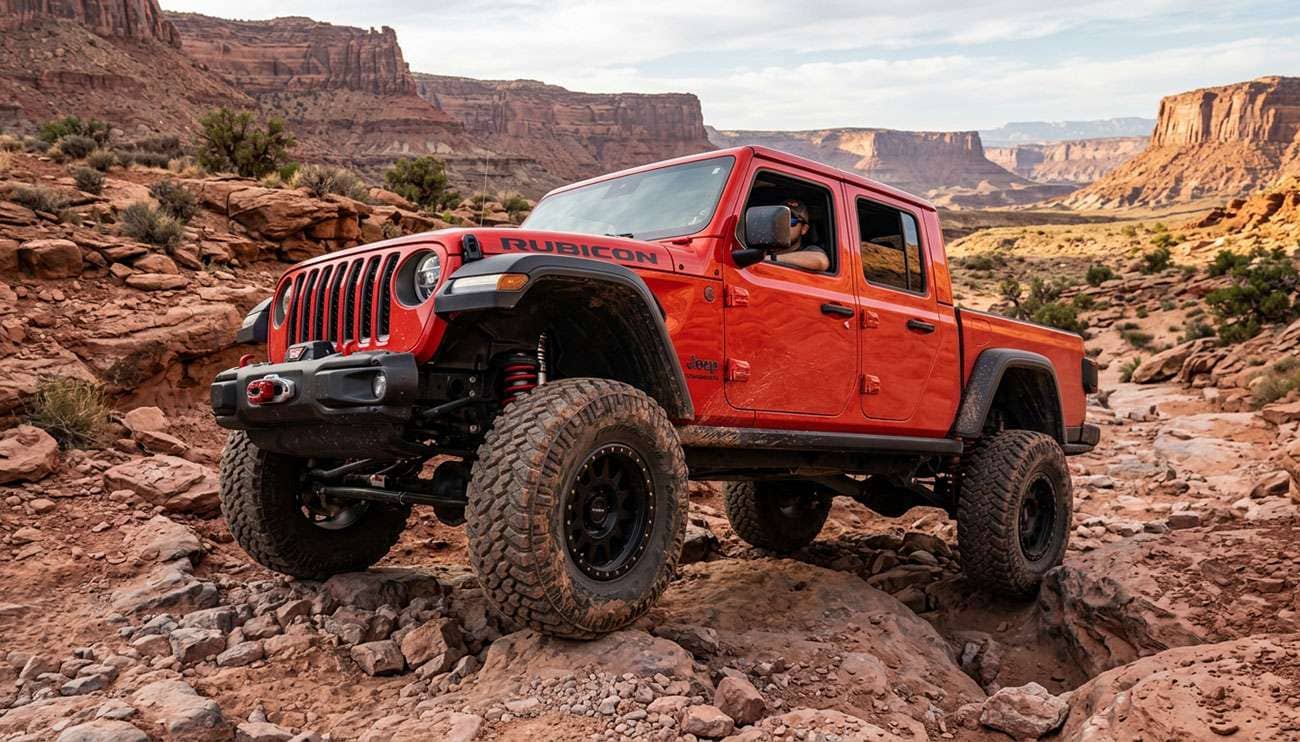
Yes. A Gladiator Rubicon fits 37s on about 2 to 2.5 inches of lift with added bump stops, and a Mojave does it on a Mojave-specific kit of about 1.5 to 2 inches. A Sport, Sport S or Willys needs about 3.5 inches or taller fender flares. Most answers stop at "it depends on your trim." What it depends on is the axle under the truck. Rubicon, Mojave and Max Tow Gladiators ride on axles 1.5 inches wider than the rest, and that moves the wheel backspacing a 37 needs by 3/4 inch.
I spec fitment for Performance Plus Tire, and the first thing I ask a Gladiator owner about 37s isn't the badge on the tailgate. It's which axles and gears are under the truck. A Sport S with Max Tow has more in common with a Rubicon at the hub than with the Sport S parked next to it.
Gladiator |
Axle Width (Track) |
Factory Flares |
Factory Gears |
Lift for 37s |
Wheel Backspacing |
|---|---|---|---|---|---|
Rubicon, Rubicon X |
Wide-track, 64.4 in |
High-clearance |
4.10 (3.73 on 2021-23 EcoDiesel) |
2 to 2.5 in, plus about 2 in of added front bump stop |
5.25 to 5.75 in |
Mojave, Mojave X |
Wide-track, 65.0 in |
High-clearance |
4.10 |
Mojave-specific 1.5 to 2 in kit |
5.25 to 5.75 in |
Sport or Sport S with Max Tow |
Wide-track, 64.4 in |
Standard height |
4.10 |
About 3.5 in, or high-clearance flares and 2 to 2.5 in |
5.25 to 5.75 in |
Sport, Sport S, Willys and other trims without Max Tow |
Standard, 62.9 in |
Standard height |
3.73 on most |
About 3.5 in, or high-clearance flares and 2 to 2.5 in |
4.5 to 5 in |
Track figures come from Jeep's published Gladiator specifications. Lift ranges are what lift makers and owners commonly pair with a true 37x12.50R17.
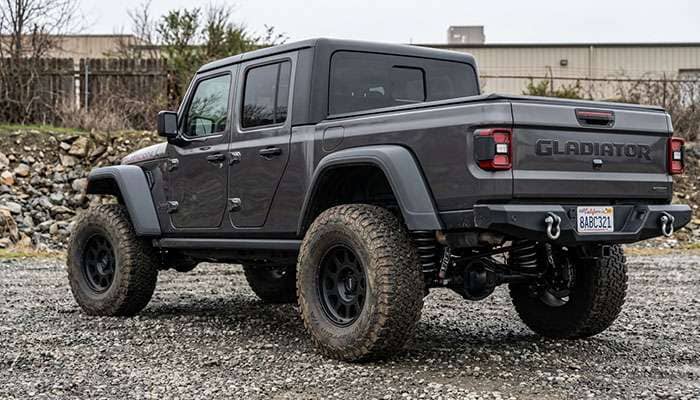
Every Rubicon, every Mojave, and any Sport or Sport S built with the Max Tow package. Jeep lists the standard Gladiator at a 62.9-inch track, the Rubicon and Max Tow trucks at 64.4 inches, and the Mojave at 65.0. A Max Tow Sport shows the difference is the axle: it rides on the same 245/75R17 tires as a base Sport and still measures 1.5 inches wider. Not sure what you have? Check the window sticker. Jeep's order guide lists the Max Tow package with the 4.10 axle ratio as order code AJQ.
Backspacing is measured from the wheel's mounting pad, which bolts to the hub face. On a wide-track axle, each hub face sits 3/4 inch further from the frame. The frame, liners and flares don't move. So the same wheel puts the tire 3/4 inch further out on a Rubicon than on a standard Sport.
That cuts both ways. The tire gains 3/4 inch of room from the frame, control arms and inner liner at full lock. It also sits closer to the outer edge of the flare and adds scrub radius, which is more leverage on the ball joints, wheel bearings and steering. Most 37-inch guides give 4.5 to 5 inches of backspacing, and that number fits the 62.9-inch track standard Gladiators share with most Wranglers. On a wide-track Gladiator, putting the tire in the same spot takes 3/4 inch more.
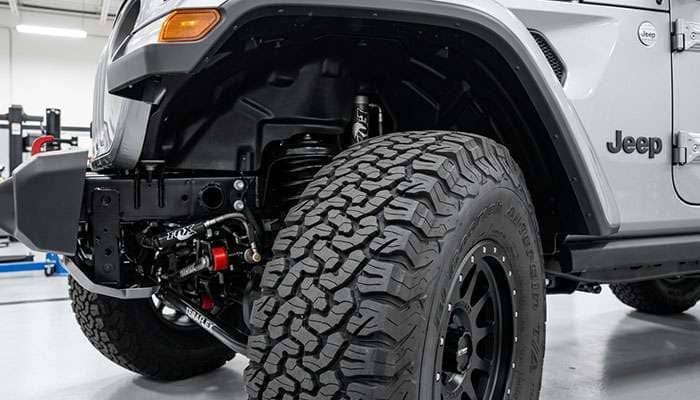
Rubicon and Mojave Gladiators come with high-clearance fender flares. Everything else uses standard-height flares. Max Tow trucks get an extra lip for width, but owners who have measured report it sits at the same height as a Sport flare. Aftermarket flare makers that publish both numbers put the factory high-clearance flare roughly 1 to 2 inches higher. The axle tells you which wheel to buy and usually which gears you have. The flare tells you how much lift and bump stop a 37 needs before it can flex.
Yes, on about 2 to 2.5 inches of lift with roughly 2 inches of added front bump stop. Lift makers' own charts pair a 2.5-inch lift with 37s on a Gladiator Rubicon, and plenty of owners run them on a 2-inch kit. The Rubicon starts with high-clearance flares, wide-track axles, 4.10 gears and lockers front and rear.
The lift isn't what makes the tire clear. Lift sets ride height. The bump stop sets how far the axle can travel up toward the fender, and that is where a 37 rubs. We covered that mechanism in will 37s fit a JL Wrangler with a 2.5-inch lift, and because the Gladiator shares the Wrangler's front end, the front numbers carry over: about 2 inches over stock under a high-clearance flare.
The rear wheel opening sits in a pickup bed, not a Wrangler tub, and it is more open. Owners running 37s report adding around 1.5 inches of rear bump stop and seeing only light liner contact on hard, crossed-up articulation. The catch is payload. A loaded bed compresses the rear springs, so the truck reaches its bump stops more often. The bump stop still sets the closest the tire can get, loaded or empty. We covered how bed load changes rear clearance in will 35s fit a Gladiator without a lift, and the same rule applies to 37s.
At ride height, yes. Some owners drive them that way with a small trim at the back of the front liner and washers under the steering stops. Once the suspension compresses, the tires find the flares and liners. Treat it as a stopgap until the lift goes in. One gear note: a 2021-23 Rubicon with the 3.0-liter EcoDiesel came with 3.73 gears, not 4.10.
Yes, and it needs the least lift of any Gladiator. The Mojave ships with a 1-inch front suspension lift, high-clearance flares and the widest track in the lineup. Mojave-specific kits of 1.5 to 2 inches are built and marketed to clear 37s. The catch is the suspension Jeep built the Mojave around.
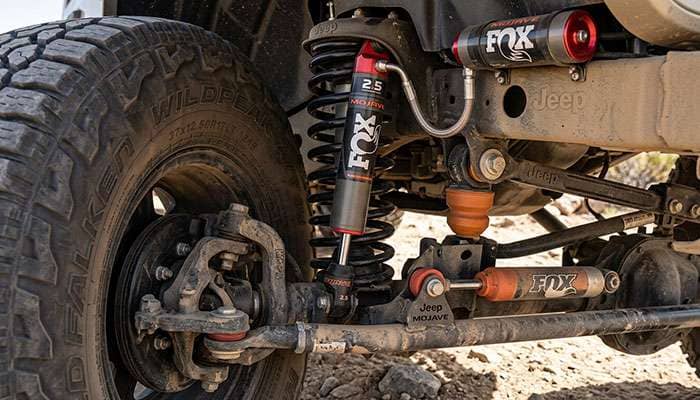
The Mojave runs FOX 2.5-inch internal bypass shocks with external reservoirs, plus FOX hydraulic jounce bumpers up front. An internal bypass shock has zones along its body: softer through the middle of its travel for ride, firmer toward the ends to control big hits. Those zones are tuned around the factory ride height. Add a generic 2-inch spacer and the shock sits about 2 inches more extended at ride height, working in a zone it wasn't tuned for.
Mojave-specific kits fix that with shock extension brackets that move the shock with the lift, and spacers at the axle bump pads that keep the hydraulic jounce bumpers working. Several common Gladiator kits, including Mopar's 2-inch kit, aren't built for the Mojave for exactly this reason. For wheels, the Mojave uses the Rubicon's wide-track numbers. It also carries a 3,300-pound front axle rating to other trims' 3,100.
Yes, but it is a bigger build. Plan on about 3.5 inches of lift, or high-clearance flares and 2 to 2.5 inches. Lift makers' charts that pair 37s with 2.5 inches on a Rubicon move the same tire to 3.5 inches on non-Rubicon trims, and at least one major lift maker rates its 3-inch Gladiator kit for 37s on Rubicons but only 35s on other trims. The standard flare sits lower, so stopping a 37 short of it takes more bump stop, and more bump stop means less up-travel unless lift gives it back.
The wheel math is easier. These trucks ride on the same 62.9-inch track as most Wranglers, so the common 4.5- to 5-inch backspacing numbers apply directly. The gears are the bigger gap. A Sport on 3.73 gears and 31.5-inch factory tires gives up about 15 percent of its gearing to a 37.
You have a hybrid. Your axles and 4.10 gears match a Rubicon, so use the Rubicon's wheel and gear numbers. Your flares match a Sport, so use the Sport's lift numbers or plan a flare swap. Some owners report that trimming the lower inner lip on standard and Max Tow flares buys back part of the gap.
Overland, High Altitude and similar trims also ride on standard-width axles, and most came with 3.73 gears. If yours rolls on factory 18s or 20s, plan on 17s. Nearly every 37x12.50R20 on the market is Load Range E or F, which rides stiff at Gladiator weights.
About 4.5 to 5 inches on a standard-width axle, and about 5.25 to 5.75 inches on a wide-track axle to put the tire in the same place. The factory 17x7.5 wheel runs about +44 mm offset, roughly 6 inches of backspacing, and it is too narrow for most 12.50-wide 37s anyway. Most builds go to a 17x8.5 or 17x9.
Axle |
Track |
Backspacing for a 37x12.50R17 |
17x9 Offset |
17x8.5 Offset |
On the Common -12 mm 17x9 |
|---|---|---|---|---|---|
Standard width (Sport, Sport S, Willys without Max Tow) |
62.9 in |
4.5 to 5 in |
About -12 to 0 mm |
About -6 to +6 mm |
Right in the window |
Wide-track (Rubicon, Mojave, Max Tow) |
64.4 to 65.0 in |
5.25 to 5.75 in |
About +6 to +19 mm |
About +13 to +25 mm |
Works, with the tire about 3/4 in further out |
Here is the part most wheel shopping skips. The aftermarket is built around the standard-width number. About two in three 17x8.5 and 17x9 wheels in the Jeep 5x5 pattern land between 4.5 and 5 inches of backspacing, and -12 mm is the most common 17x9 offset. Only about one in seven land in the window that tucks a 37 on a wide-track axle.
So many Rubicons and Mojaves end up on -12 wheels, and it works. You gain steering clearance and give up some flare coverage, and the front end carries more leverage. If you want the tire tucked, shop +6 to +19 mm on a 17x9, which lines up with the roughly +5 to +18 mm commonly suggested for bigger tires on a Gladiator. Our 17x9 negative offset setup guide covers what the -12 does to scrub radius and wear.
Whatever the offset: 5x5 (5x127 mm) bolt pattern, a 71.5 mm center bore or hub-centric rings, a load rating that covers the heaviest corner, and a wheel built to SAE J2530, the industry test standard for aftermarket wheels. Confirm the width sits inside the tire maker's approved rim range.
Less than you might expect on a Rubicon or Mojave with the right bump stops, more on standard flares. Almost every contact point is plastic.
Do it in order. Cycle each corner, ideally with the springs out so you can reach full compression, turn lock to lock and mark every touch. Trim plastic first, add bump stop next, and cut sheet metal last. Every inch of bump stop you add is an inch of up-travel you lose, so the goal is the balance that keeps the tire off the body without giving up the flex you lifted the truck for.
On 3.73 gears, yes. On 4.10s, almost everyone does. Jeep lists the 2026 Gladiator Rubicon at 5,069 pounds before a lift, armor or a loaded bed, and Max Tow trucks are rated to pull 7,700 pounds. Tall tires on factory gears leave the eight-speed hunting on every grade. Your effective ratio on 37s is the factory ratio times the factory tire height, divided by 37.
Factory Setup |
Factory Tire Height |
Effective Ratio on 37s |
Ratio That Restores Factory Feel |
Common Choice |
|---|---|---|---|---|
Sport, Sport S on 3.73 |
About 31.5 in |
About 3.17 |
About 4.39 |
4.88 |
Sport, Sport S with Max Tow, 4.10 |
About 31.5 in |
About 3.49 |
About 4.82 |
4.88 |
Willys on 3.73 |
About 32.1 in |
About 3.23 |
About 4.30 |
4.88 |
Rubicon, Mojave on 4.10 |
About 32.7 in |
About 3.62 |
About 4.64 |
4.88, or 5.13 for towing and heavy builds |
2021-23 EcoDiesel on 3.73 |
About 32.7 in (Rubicon) |
About 3.30 |
About 4.22 |
4.56 to 4.88 |
A Max Tow Sport is the closest thing to a perfect 4.88 swap: its restore number is about 4.82. A 3.73 truck going to 4.88 ends up about 11 to 13 percent deeper than factory, and that extra pull covers the weight of the tires and everything else that comes with a 37 build. Regear both axles to the same ratio, and plan the speedometer programming and alignment at the same time. Our regear after bigger tires guide walks through what changes when you skip it.
Load Range C carries a Gladiator's rated load. Load Range D gives a truck that tows or hauls room to add rear pressure. The part most 37 guides leave out: on a Gladiator, the rear axle is the heavy end. Jeep rates the 2026 Gladiator's rear axle at 3,750 pounds, 1,875 per tire, against 3,100 up front on most trims.
The Tire and Rim Association's flotation table ties load to pressure for sizes like 37x12.50R17. The floor comes from the rule tire makers and the Tire Industry Association teach installers: a replacement tire has to carry at least what the factory tire carried at placard pressure. A Rubicon or Mojave's factory LT285/70R17 at its 37 psi placard carries about 2,190 pounds.
Pressure |
37x12.50R17 Load per Tire |
vs. Rear Axle Share (1,875 lbs) |
vs. Factory Tire at 37 psi (about 2,190 lbs) |
|---|---|---|---|
26 psi |
About 2,215 lbs |
About 340 lbs over |
Matches it |
30 psi |
2,470 lbs |
595 lbs over |
About 280 lbs over |
35 psi (Load Range C maximum) |
2,755 lbs |
880 lbs over |
About 565 lbs over |
50 psi (Load Range D maximum) |
3,525 lbs |
1,650 lbs over |
About 1,335 lbs over |
So about 26 psi is the floor on a Rubicon or Mojave, and even there the tire clears the rear axle's full rating. Other trims need the same check against their own factory tire, and the floor can land a few psi higher. It is a floor, not a target. Expect to settle in the high 20s to low 30s on the street after a chalk test, with more rear pressure when the bed is full or a trailer is hooked up.
That is where load range matters on a truck. A Load Range C 37x12.50R17 tops out at 35 psi. A Load Range D goes to 50, so you can firm up the rear for tongue weight and highway heat. About three in four 37x12.50R17 tires on the market are Load Range D with a 124 load index. Our guide to load range vs. load index breaks those numbers down.
A 37 that rubs doesn't fail all at once. It costs you in steps, and each one costs more than the last.
When the axle, flare and wheel side of the build is sorted, compare tread types, load ranges and weights in our 37x12.50R17 tires lineup.
37s fit a Gladiator, and the trim name tells you less than the two parts under it. The axle decides the wheel: about 4.5 to 5 inches of backspacing on standard-width trucks, about 5.25 to 5.75 inches on Rubicon, Mojave and Max Tow trucks to put the tire in the same spot. The flare decides the lift: about 2 to 2.5 inches under a high-clearance flare, about 3.5 under a standard one, and a Mojave-specific kit on a Mojave.
After the fit, remember the Gladiator is a truck. Gear it for its weight and what you tow, set the bump stops for a loaded bed, and keep the pressure at or above the floor that matches what the factory tire carried.
On a Rubicon or Mojave, 37s fit at ride height, and some owners drive them that way with a small liner trim and steering stop washers. Once the suspension compresses, they rub. On trims with standard flares, 37s rub without a lift. Treat a stock-height 37 setup as temporary.
About 2 to 2.5 inches on a Rubicon, a Mojave-specific 1.5- to 2-inch kit on a Mojave, and about 3.5 inches on a Sport, Sport S, Willys or other trim with standard flares. High-clearance flares let a standard-flare truck run 37s on 2 to 2.5 inches.
On a Rubicon, yes, with about 2 inches of added front bump stop, the right backspacing and some liner trimming. On a Mojave, yes, if the kit is Mojave-specific. On a Sport, Sport S or Willys, a 2-inch lift usually needs high-clearance flares to clear 37s when the suspension flexes.
On 3.73 gears, yes. A 37 drops a Sport's effective ratio to about 3.17. On 4.10 gears, most owners still regear because a Gladiator is heavy and often tows. 4.88 is the common choice, with 5.13 for heavy builds and frequent towing.
About 4.5 to 5 inches on standard-width axles. Rubicon, Mojave and Max Tow Gladiators have wide-track axles, so about 5.25 to 5.75 inches puts the tire in the same place. A 4.5-inch wheel still works on a wide-track truck, with the tire about 3/4 inch further out.
It helps with the axles and gears, not the fenders. Max Tow adds wide-track axles and 4.10 gears, so a Max Tow Sport uses Rubicon wheel numbers, and a 4.88 regear puts it almost exactly back to factory feel. Its flares are standard height, so it still needs about 3.5 inches of lift or high-clearance flares.