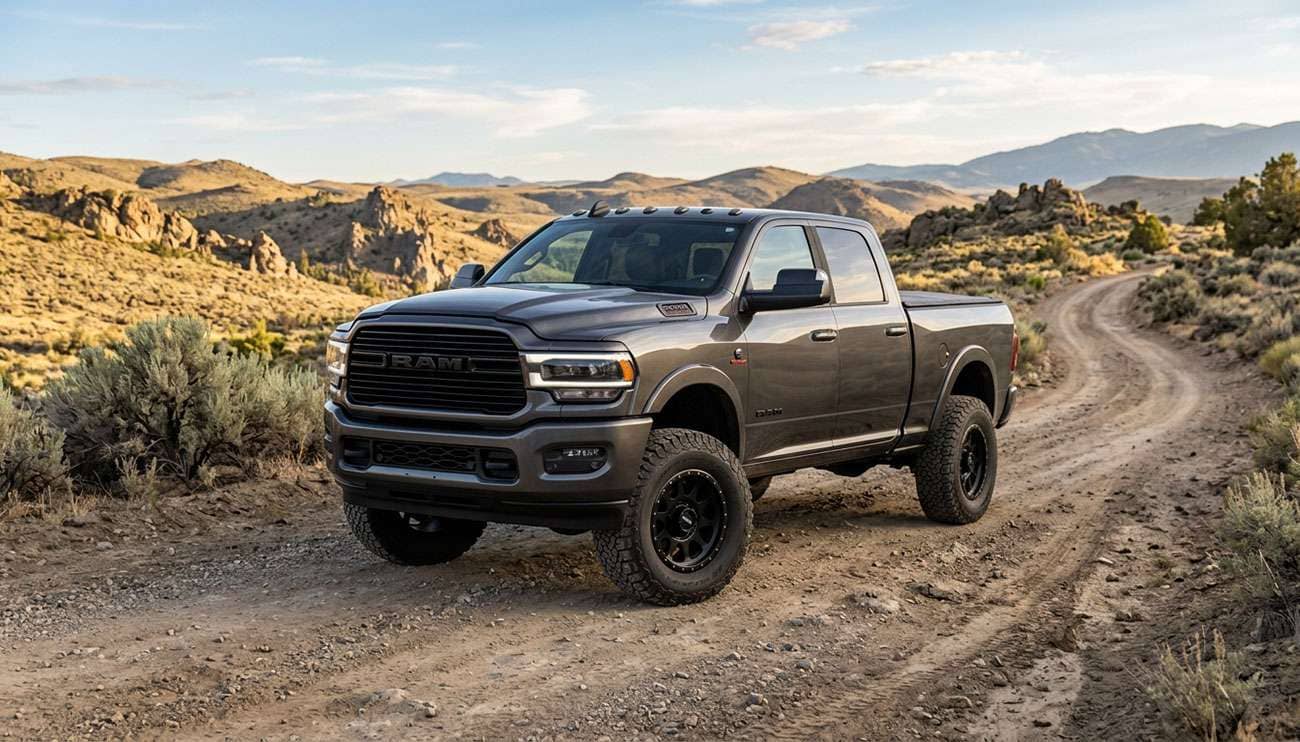
Yes, on a 2 to 2.5 inch level, with some trimming and wheels in roughly the +18 to +25 mm offset range. But "a Ram 2500" is really three different starting points. A Power Wagon already sits about 2 inches higher than a standard 2500 from the factory. A coil-spring 2500 sits nose-down and levels the usual way. A 2500 with the optional rear air sits closer to level from the factory, so a front-only kit leaves it nose-high. Which one you own decides how much work 37s take.
I have watched heavy-duty Rams roll into our shop in Long Beach on every size of tire you can name, and the 37 question always comes with the same assumption: that a leveling kit is a leveling kit and a 2500 is a 2500. Neither is true. Once you know which truck you have and what offset you are buying, the rest is trimming plastic, picking a load range and deciding about gears.
This table assumes a 37x12.50 on a 4x4 2019 or newer Ram 2500, which is where most of these builds happen. The 2014 to 2018 trucks use the same basic coil-spring front end and the same 8-lug pattern, and owners of those trucks describe much the same fitment. The 13.50-wide version needs more room at full lock.
Your Truck |
Front Height |
Will a 37x12.50 Fit? |
What It Takes |
|---|---|---|---|
Power Wagon (coil springs, factory lift) |
Stock |
Usually, with light trimming |
Wheels around +18 to +25 mm offset |
Power Wagon |
1 to 1.5 inch level |
Yes, light or no trimming |
Same offset range |
Coil-rear 2500 (most Tradesman and Big Horn trucks) |
2 to 2.5 inch level |
Yes, with trimming |
+18 to +25 mm wheels; trim the bumper and air dam corners, fender liner and pinch weld |
2500 with factory rear air |
2 inch level |
Front fits like a coil truck |
Rear ride-height sensor links, or live with a nose-high stance |
Any 2500 |
2 to 2.5 inch level on 0 or negative offset wheels |
Only with significant trimming |
Expect rubbing at full lock and full articulation |
Non-Power Wagon 2500 |
Stock height |
Rubs |
More trimming, or stop at 35s |
"Fits" here means the tire clears at ride height and in normal driving after the listed trimming. Almost every leveled 2500 on 37s will still touch something at full steering lock with the suspension stuffed off-road. If you want zero contact everywhere, you are shopping for a 3 inch or taller lift, and our lift kit tire size chart shows how the numbers step up.
The Power Wagon leaves the factory sitting about 2 inches taller than a standard 2500, on LT285/70R17 all-terrains (about 32.7 inches) on 17x8 wheels, with 4.10 gears, front and rear lockers and a disconnecting front sway bar. That factory height is the whole difference. A 1.5 inch level on a Power Wagon puts it about where a 3.5 inch lift would put a regular 2500.
Power Wagon owners commonly report 35s with no rubbing on the factory wheels and no level at all. On 37s, they report light rubbing that a little trimming takes care of, and some running 37s at stock height on wheels near +25 mm offset report no trimming at all. If you plan to go to 37s later, buy wheels now with about 5.75 inches of backspacing on a 9-inch-wide wheel, which is roughly +18 mm, and you will not need a second set.
Two cautions specific to the Power Wagon. Leveling kits built for regular 2500s are taller than a Power Wagon needs, so buy one listed for the Power Wagon. And kits engineered for factory rear air trucks typically exclude the Power Wagon, because it runs coil springs at both ends.
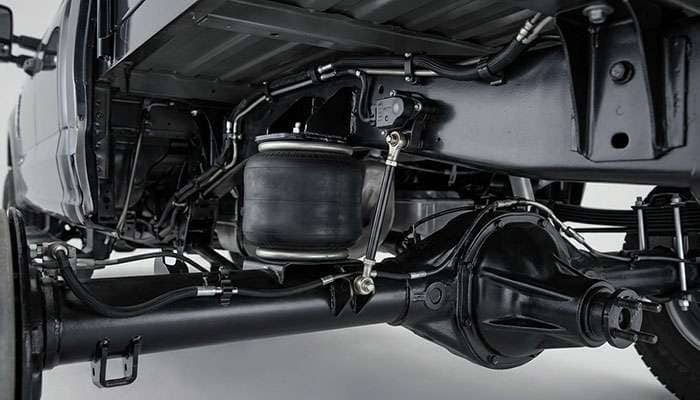
Yes, and this is the part of the question nobody puts in front of you. Ram has offered an auto-leveling rear air suspension on the 2500 since 2014. That system holds the rear at a set height using ride-height sensors on the rear axle, and suspension builders point out that rear-air trucks sit closer to level from the factory than coil-rear trucks.
That changes what a leveling kit does. On a coil truck, the nose sits lower than the tail, and a 2 inch front spacer evens it out. On an air truck, the same 2 inch spacer can leave the nose higher than the tail, and owners notice a rear that suddenly looks squatted. You cannot fix that with a rear spacer the way you would on coils, because the air system will simply hold the height it has been told to hold.
The fix is a set of rear ride-height sensor links or brackets. They change the angle the sensors read, so the air system holds the rear higher and keeps its automatic load leveling. Front leveling kits designed for air trucks usually include them. If you bought a coil-truck kit for an air truck, add the links before you judge the stance. If you have a 1500 instead, the 4-corner air option there works the same way, which we cover in our piece on whether 35s fit a Ram 1500 with a leveling kit.
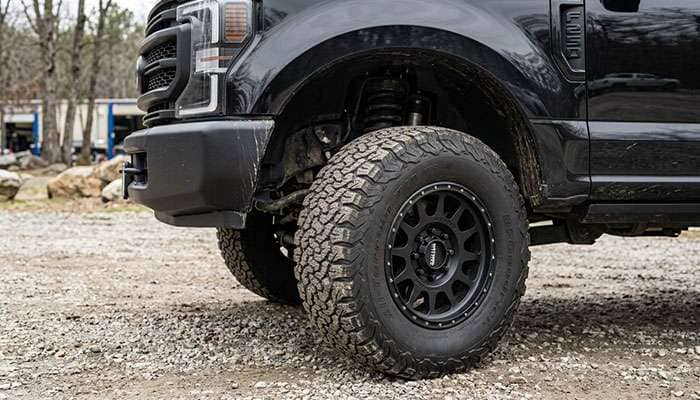
Offset is where 37s on a leveled 2500 either work or do not. Factory 2500 wheels run a high positive offset, generally in the +40s to +50s mm, which tucks the tire inward toward the frame and control arms. Go to 0 or negative offset and the tire swings outward into the bumper, air dam and cab mount area at full lock.
The range that comes up again and again for 37x12.50s on leveled 2500s is about +18 to +25 mm. On a 9-inch-wide wheel, +18 mm works out to about 5.75 inches of backspacing and +25 mm to about 6 inches. Owners running 37s on 0 offset wheels consistently report needing significant trimming, while those on +18 to +25 report the trimming staying mostly to plastic. If you want to understand how far you can move offset from stock before it causes problems, our guide on how much you can change offset walks through it.
The rest of the wheel spec is fixed. The 2500 uses an 8x165.1 bolt pattern, also called 8x6.5, with M14x1.5 lug nuts and a hub bore of about 121 mm. If a wheel's bore is larger, use hub-centric rings.
On a leveled 2500, the 12.50 is the easier fit, and the reason is simple geometry. A 13.50 is about an inch wider overall, so at the same offset it sits roughly half an inch closer to the bumper and pinch weld on the outside and half an inch closer to the frame and control arms on the inside. At full lock, that half inch is the difference between trimming plastic and trimming metal.
The wheel width follows the tire. Most 37x12.50 tires are approved for rims roughly 8.5 to 11 inches wide and are measured on a 10-inch rim, so a 9-inch or 10-inch wheel is right in the middle of the range. Most 37x13.50 tires are measured on an 11-inch rim, and a wider wheel at the same offset pushes the tire's outer edge out further still. Weight moves the same direction: most 37x12.50s weigh roughly 75 to 77 lbs, while most 37x13.50s weigh roughly 82 to 85 lbs.
The 13.50 does put a bit more rubber on the ground and fills the fender visually. If that look is the point of the build, plan on a taller lift, or on more trimming and more frequent contact at full lock on a leveled truck. If you want 37s with the least cutting, the 12.50 on a 9-inch wheel in the +18 to +25 mm range is the combination most leveled 2500s end up on.
On a leveled 2500 with the right offset, the trimming is less dramatic than most people expect. The usual list:
Do the trimming before the first long drive, not after. A tire that rubs at every parking lot turn wears its shoulder lugs and sidewall, and a scuffed sidewall is worth checking against our guide to tire sidewall damage.
That depends on what your truck came with and what you tow. A 37 is about 11.6 percent taller than the 33.2-inch LT275/70R18 that many 2500s wear, and about 13 percent taller than the Power Wagon's 32.7-inch factory tire. That much extra diameter acts like a taller axle ratio. Here is the math:
Factory Setup |
Factory Ratio |
Effective Ratio on 37s |
Ratio That Restores Stock |
Common Regear |
|---|---|---|---|---|
2025 and newer Cummins |
3.42 |
3.07 |
3.82 |
3.73, or 4.10 for heavy towing |
2019 to 2024 Cummins, most 6.4 Hemi trucks |
3.73 |
3.34 |
4.16 |
4.10 |
6.4 Hemi with optional 4.10 |
4.10 |
3.67 |
4.58 |
4.56 |
Power Wagon (from 32.7-inch tires) |
4.10 |
3.62 |
4.64 |
4.56 |
Ratios assume a 33.2-inch factory tire unless noted. Check your own ratio on the axle tag or build sheet, because dealers could order options.
How much it matters depends on the engine. The Cummins makes so much torque that plenty of owners run 37s unloaded on factory gears and are happy with it, especially with the newer 8-speed transmissions. Towing near your rating is where the taller effective ratio shows up: more time in lower gears, more heat and slower climbs. The 6.4 Hemi feels the change sooner, and the Power Wagon, which already started at 4.10 for crawling, loses some of the low-speed control it was built around. Our guide to when to regear after bigger tires covers the decision in more depth. If you regear, do both axles to the same ratio.
This is the spec that gets lost in the excitement. The 2500's factory tires are Load Range E. The common LT275/70R18 E is rated at 3,640 lbs per tire. Recent 2500s are rated at around 6,000 lbs on each axle, which works out to about 3,000 lbs per tire; your door sticker has your truck's exact numbers.
Here is what the 37 market looks like. Most 37x12.50R17 tires are Load Range D, typically rated 3,520 lbs at 65 psi. Most 37x12.50R18 and 37x12.50R20 tires are Load Range E or F, rated roughly 3,750 to 3,970 lbs at 80 psi. On paper, the Load Range D 37 clears a 6,000 lb axle rating at full pressure, but it carries less than the factory tire it replaces, and that margin shrinks fast at the lower pressures many people run big tires at for ride quality.
If the truck tows or hauls, buy Load Range E or F and run the pressure the load calls for. That is what a 2500 is for. Our guide to Load Range F tires on a three-quarter-ton explains when stepping past E makes sense.
The tire fitting in the wheel well is the start, not the end.
A 37 that is not quite sorted out sends the bill in stages.
Every rung is avoidable by sorting offset, trimming, load range and gearing before the build, not after.
When you are ready to price the package, you can see wheels and tires matched to your truck on our Ram 2500 wheels and tires page.
37s fit a leveled Ram 2500, but not by accident. The Power Wagon starts with about 2 inches of factory height and gets there with the least work. A coil-rear 2500 needs a 2 to 2.5 inch level, wheels around +18 to +25 mm offset and some plastic trimming. An air-rear 2500 needs the same front work plus rear sensor links to keep it from sitting nose-high.
After that, the build is about what the truck still has to do. Pick a load range that carries what you tow, decide on gears based on how you use the truck, and recalibrate so the truck knows how big its tires are. Get those right and a 2500 on 37s works as well as it looks.
Yes, a 37x12.50 fits a 2019 or newer Ram 2500 on a 2 to 2.5 inch level with wheels around +18 to +25 mm offset, plus trimming of the bumper and air dam corners, fender liner and sometimes the pinch weld. Trucks with factory rear air also need rear sensor links to avoid a nose-high stance.
On a Power Wagon, often yes, because it sits about 2 inches taller from the factory; expect light trimming. On other 2500 trims at stock height, 37s rub and need more trimming, and many owners stop at 35s without a level.
Usually, with light trimming, on wheels around +18 to +25 mm offset. Power Wagon owners commonly run 35s with no rubbing on factory wheels, and some running 37s near +25 mm offset report no trimming at all. A 1 to 1.5 inch level made for the Power Wagon adds margin.
About +18 to +25 mm is the range that keeps trimming mostly to plastic on a leveled 2500. On a 9-inch-wide wheel, that is roughly 5.75 to 6 inches of backspacing. Zero or negative offset pushes the tire outward and usually means significant trimming.
Not always. A 37 makes a 3.73 truck behave like a 3.34 and a 3.42 truck like a 3.07. Many Cummins owners run 37s unloaded on factory gears, but frequent heavy towing, a 6.4 Hemi or a Power Wagon used for crawling are good reasons to regear, usually to 4.10 or 4.56.
A 2 to 2.5 inch level on a standard 2500, or a 1 to 1.5 inch kit made specifically for the Power Wagon. On trucks with factory rear air, choose a kit that includes rear ride-height sensor links so the rear rises to match.