The phone call I take after the lift kit phone call goes something like this: "Dennis, I put 35s on the truck and now it feels like the engine got smaller. The transmission won't stay in gear on a hill. My MPG dropped four miles per gallon. What did I do wrong?"
You didn't do anything wrong. You changed one variable in a drivetrain that was carefully balanced around the factory tire size, and the rest of the system is now running outside its intended operating window. Whether you need to regear comes down to math and use case, not opinion.
This article gives you the formula your shop uses, the by-tire-size chart for target gear ratios, and a by-vehicle breakdown of where common stock gears land you. By the end you'll know whether your truck needs new ring and pinion gears or whether you can run the setup you've got. If you haven't sized the tires yet, the companion article on lift kit tire size by truck covers the front end of this decision.
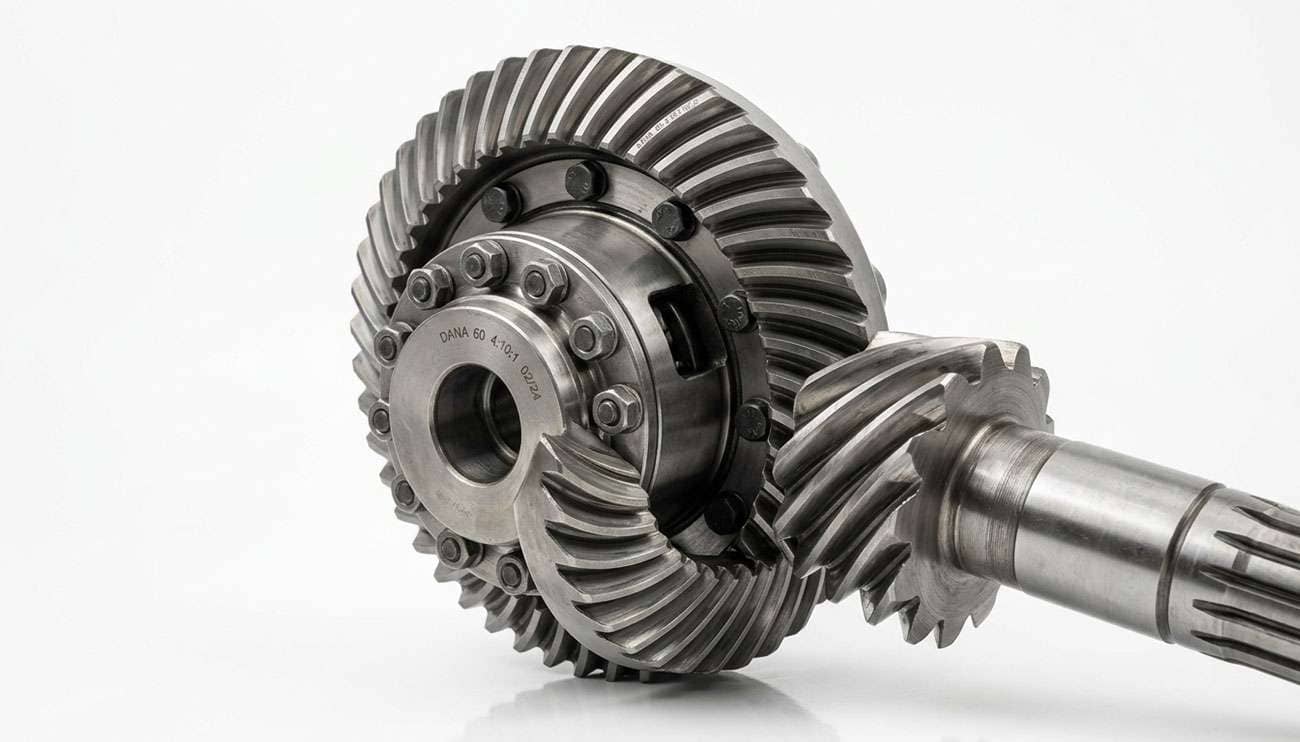
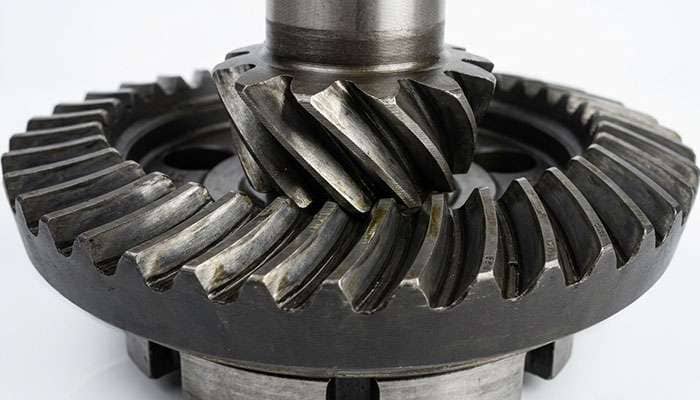
Regearing means replacing the ring and pinion gear set inside your vehicle's differential — the carrier that lives in the middle of each axle. The ring gear is the big round one bolted to the differential carrier; the pinion is the small one on the end of the driveshaft. Together they determine how many times the driveshaft has to spin to turn the wheels once.
On a 4WD truck or Jeep, regearing means swapping the ring and pinion on both axles, front and rear. The ratios have to match exactly or the front and rear axles fight each other in 4WD. This is why the regear bill on a 4x4 is double the bill on a 2WD pickup.
Regearing is not the same as changing transmission gears. Your transmission has fixed internal gear ratios that don't change. We're talking about the differential gear ratio, sometimes called the axle ratio or the final drive ratio.
The numerical convention trips people up. A 4.56 ratio is called a "shorter" or "deeper" gear than a 3.55 ratio, even though 4.56 is the bigger number. Shorter gears give you more torque multiplication and quicker acceleration but lower top speed and higher RPM at cruise. Taller gears (numerically smaller) do the opposite — lower RPM at cruise, better fuel economy, less aggressive launch. When you put bigger tires on a vehicle, you effectively make your gears taller without changing anything mechanical, because each turn of the wheel now covers more ground.
If you've upsized tires and you're not sure whether to regear, look for these three symptoms. One on its own is borderline. Two means you should probably regear. All three means the math is already telling you the answer.
1. Sluggish off-the-line acceleration. The truck feels like it's working harder to get up to speed, especially from a stop. You're pressing the throttle deeper than you used to for the same acceleration. On a steep entrance ramp, the truck struggles to merge at highway speed.
2. Transmission hunting at low loads. The automatic shifts down out of overdrive on minor inclines that never used to bother it. You see the transmission cycling between 5th and 6th, or between 7th and 8th, on flat roads with a light foot. Tow/haul mode comes on without you towing anything.
3. MPG drop bigger than tire weight alone explains. Going from 32s to 35s on a half-ton truck typically costs 1 to 3 MPG just from tire weight, rolling resistance, and aerodynamic profile. The MPG impact of larger tires breaks down further when the engine is running outside its efficiency window. If you're seeing 4 MPG or more, the gear ratio is doing real damage to your fuel curve.
The formula every regear shop uses is straightforward. You need three numbers: your current gear ratio, your old tire diameter, and your new tire diameter.
Target gear ratio = current gear ratio × (new tire diameter ÷ old tire diameter)
Here's a worked example. Stock 2022 F-150 with 3.55 gears and 32-inch tires. You upsize to 35-inch tires. The math:
Target ratio = 3.55 × (35 ÷ 32) = 3.55 × 1.094 = 3.88
Standard available gear ratios don't include 3.88. Your options are 3.73 (one step taller than target) or 4.10 (one step shorter than target). The closer match is 4.10, so that's your starting point. If you tow or do significant off-road work, jump up to 4.10. If you do almost all highway and prioritize fuel economy, you might choose to stay at 3.73 — but you'll still notice some sluggishness compared to a truly correct gear.
One more example. Stock 2023 Jeep Wrangler Rubicon with 4.10 gears and 33-inch tires. You upsize to 37-inch tires.
Target ratio = 4.10 × (37 ÷ 33) = 4.10 × 1.121 = 4.60
Available standard ratios near 4.60 are 4.56 and 4.88. The 4.56 is closer to your calculated target, but for 37s the consensus across off-road builders is 4.88 — the extra torque margin matters more once you're past 35". This is why off-road shops generally recommend rounding toward the shorter (deeper) gear when in doubt, especially for builds that see real trail use or towing.
This is the cheat sheet most builders work from. It assumes you're starting from a typical stock gear ratio in the 3.21 to 3.73 range, which covers the vast majority of half-ton trucks and stock Wranglers. If your truck came with shorter gears from the factory, you may not need to go as deep.
Tire Diameter |
Highway-Leaning |
Mixed-Use |
Off-Road / Towing |
Notes |
|---|---|---|---|---|
31–32" |
Stock |
3.73 |
4.10 |
Most stock gears work fine here |
33" |
3.73 |
4.10 |
4.56 |
Borderline — V8s usually fine; small engines benefit |
35" |
4.10 |
4.56 |
4.88 |
Regear recommended on most trucks at this size |
37" |
4.56 |
4.88 |
5.13 |
Regear required for drivability |
40"+ |
4.88 |
5.13 |
5.38+ |
Regear non-negotiable; crawl ratio matters here |
Two notes on this chart. First, "highway-leaning" still loses you about 1 MPG versus stock because you're spinning the engine harder at cruise. Second, "off-road / towing" gives up some top-end MPG in exchange for keeping the transmission in its happy zone and protecting the torque converter from heat damage. Pick the column that matches what you actually do, not what you wish you did.
Stock gear ratios vary by trim, engine, and tow package. Here's where most modern platforms land and how they pair with common upsized tires.
Stock options range from 3.45 (Sport with the V6) up to 4.88 (the 35-inch tire package on Rubicon). A JL Rubicon with factory 4.10 gears handles 33s with no issue. The 35-inch factory package ships with 4.56 — that's the right ratio. Going to 37s on stock 4.10s will feel sluggish; you want 4.88 or 5.13 at that size. If you're still sourcing wheels for the build, factor the gear cost in before you commit.
Stock gears are typically 3.31, 3.55, or 3.73 depending on engine and trim. The Ecoboost trucks often come with 3.55. A 35" tire upsize on 3.55 calculates to a 3.88 target — that's a 4.10 in practice. Most F-150 owners running 35s end up at 4.10, sometimes 4.56 for tow-heavy use. Stock 3.31 gears with 35s feel painfully slow.
The half-ton GM twins share gear options: 3.08, 3.23, 3.42, and 3.73. The 3.42 is the most common stock ratio. A 35" tire with 3.42 calculates to about 3.77 — close enough to 3.73 that some owners get away without regearing, especially on V8 trucks. The 5.3L and 6.2L have power headroom that masks the gear deficit. The 2.7L turbo doesn't — that engine needs the regear at 35".
Common stock ratios are 3.21, 3.55, and 3.92. The 3.92 is the towing-optimized ratio and handles 33s without complaint. For 35s, target 4.10 from 3.21 or 3.55, or stay with 3.92 if you're a light highway driver. The Hemi V8 has enough torque to compensate at the borderline; the V6 Pentastar doesn't.
Stock gears are typically 3.91 or 4.30 (TRD). The 3.5L V6 has narrow torque and needs all the gear help it can get. A Tacoma on 33s with stock 3.91 gears is sluggish; on 35s with 3.91 it's painful. Target 4.56 or 4.88. The Tacoma is the platform where regearing pays back the fastest.
The "I'll just live with it" choice has real consequences. None of them are catastrophic on day one, but they compound over time and tens of thousands of miles.
Measurable acceleration loss. A typical half-ton truck loses 1 to 2 seconds in 0-60 acceleration when you jump from 32s to 35s without regearing. That's not a feel thing — it's measurable. The engine is operating below its peak torque RPM at launch, so power delivery is soft.
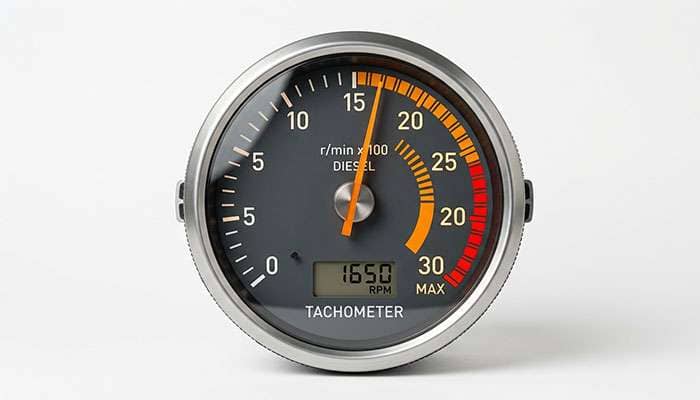
Fuel economy drops 2-4 MPG beyond the tire-weight penalty. The engine spends more time at higher load to make the same power, which puts you in the less efficient part of the BSFC map. Larger tire and wheel combinations also stress the transmission in ways the OEM didn't engineer for.
Transmission heat under load. This is the one that worries me most. Automatic transmissions generate heat from torque converter slip. With taller-than-intended effective gearing, the converter spends more time unlocked at low speeds and under load, which means more heat in the fluid. Over years, that shortens torque converter life and bakes the fluid earlier. Trucks driven hard with the wrong gearing kill transmissions early.
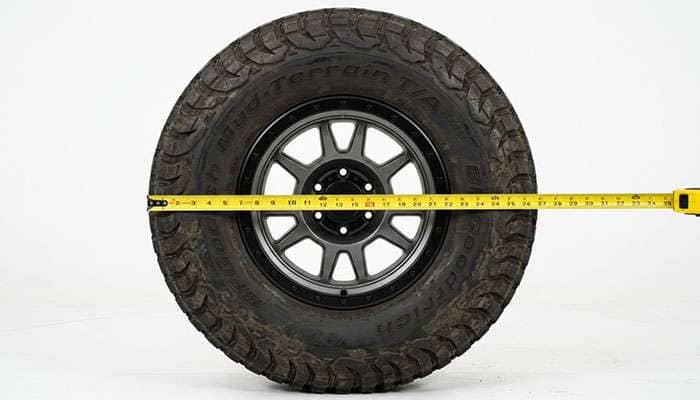
Speedometer error compounds. A 35" tire on a truck calibrated for 32s reads roughly 9% slow on the speedometer. The odometer under-reports mileage at the same rate, which means warranty miles, service intervals, and resale value all get distorted. A programmer fixes this, but most owners don't bother until they get pulled over.
Not every build needs a regear. Here's when you can leave it alone.
Mild tire upsize (under 10% diameter increase). Going from 31s to 33s, or from 32s to 33s, is small enough that most stock gearing absorbs the change. The 5-to-10 percent rule of thumb: if your new tire is less than 10% taller than your old tire, you probably don't need to regear unless other factors push you over. For more on the actual diameter differences between these common sizes, including how much you're really changing.
V8 with power headroom. A Hemi-equipped Ram or a 6.2L Silverado has enough torque to absorb a moderate gear deficit without the truck feeling broken. The V8 is doing more work to compensate, so MPG still suffers — but drivability stays acceptable. Smaller engines (V6, four-cylinder turbo) don't have the same buffer.
Light off-road duty with no towing. If the truck never sees a trailer hitch and you only off-road occasionally, the case for regearing weakens. The benefits of correct gearing show up most under load.
Highway-only driving with a daily commute focus. If your truck is a commuter that occasionally looks like an off-road build, you can sometimes live with the MPG hit and skip the regear cost. The math doesn't work out — but the budget might.
Regearing a 4WD truck typically costs $1,500 to $3,000 installed, depending on the platform and the shop. Two axle gear sets, two installer kits (bearings, races, seals, crush sleeves, shims), labor on both axles, gear oil. The work has to be done by someone who knows how to set pinion depth and backlash correctly — it's not a job to hand to a generalist shop.
The payback case is real but slow. A truck that recovers 3 MPG from a regear, driven 15,000 miles a year at $4 per gallon, saves about $700 per year in fuel. That's a 2-to-4 year payback on the regear cost from MPG alone. If you tow, the math accelerates — saved transmission rebuilds and torque converter replacements push the value up by thousands.
The case for regearing isn't always financial. For a serious off-road build, the gear change is what makes the truck drivable. You don't regear because of fuel economy — you regear because the truck has to climb, crawl, and pull, and stock gearing won't let it. For a daily-driven commuter that hit 35s for the look, the financial case is shakier. Run the numbers honestly before you write the check.
The rule of thumb: if your new tire is more than 10% taller than your old tire, you'll feel it. If it's more than 15% taller, you'll regret not regearing. Above 35" tires on most trucks, regearing isn't optional if you want the vehicle to drive correctly.
Use the formula. Pull your current gear ratio off the door jamb sticker or the differential tag. Multiply by the ratio of new tire diameter to old. Round to the nearest standard ratio, leaning shorter (deeper) if you tow or off-road, taller if you live on the highway. Then look at the chart, look at your use case, and decide.
The honest answer to "do I need to regear" is: usually yes, and the bigger the tire, the more obvious the answer becomes. The math doesn't lie about it. If your build needs new wheels to clear the tires, our off-road wheel category lets you filter by lug pattern and offset, so you can match the wheel to the lift kit and the lift kit to the tires before you spend on gears.
Check the door jamb sticker for an axle code, which maps to a gear ratio in your owner's manual or a manufacturer reference. You can also find a metal tag on the differential cover or housing with the ratio stamped on it. If neither is readable, jack one rear wheel off the ground, mark the tire and the driveshaft, and rotate the tire one full revolution while counting driveshaft turns — that count is your gear ratio.
Yes, but not back to stock. Regearing lets the engine operate in its efficiency window again, which typically recovers 2 to 4 MPG of the loss you took from upsizing tires. You won't recover all of it — the bigger, heavier tires still cost MPG from rolling resistance and aerodynamics. But you'll close most of the gap.
No. The front and rear axle gear ratios must match exactly on a 4WD vehicle, or the axles fight each other when 4WD is engaged. Mismatched ratios cause driveline binding, premature wear, and can damage the transfer case. If you regear, both axles get the same new ratio.
Typically $1,500 to $3,000 installed for a 4WD vehicle, covering both axles. The price varies by platform — Wrangler-class axles are cheaper to gear than full-size truck axles. The cost includes two ring and pinion sets, two install kits (bearings, seals, shims, crush sleeves), labor on both axles, and gear oil. Use a shop that specializes in differential work — pinion depth and backlash have to be set correctly or the gears whine and wear quickly.
No. A programmer recalibrates your speedometer for the new tire size and can adjust shift points, but it can't change the mechanical gear ratio in your differential. You can use a programmer to mask some symptoms — locking out top gear so the transmission doesn't hunt, holding lower gears longer for acceleration — but the underlying mechanical mismatch remains. Programmers are a complement to regearing, not a substitute.
Install the tires first, drive the truck for a few weeks, then decide. You'll have a real feel for how much the gear deficit actually bothers you and how much MPG you lost. Some owners think they need to regear based on chart math and then find the truck drives well enough with stock gears. Others underestimate the impact and end up regearing within a month. Drive it first.