
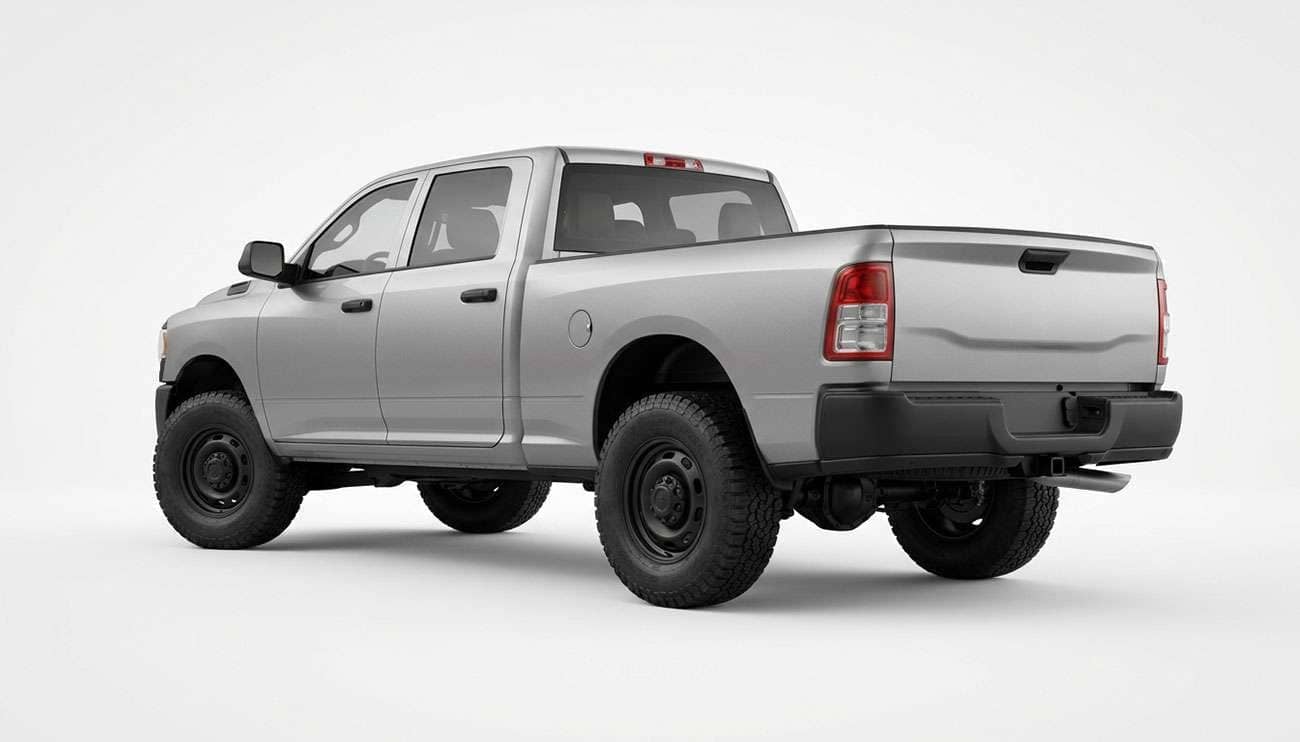
Almost certainly not. Here is the variable nobody puts in front of you: federal law already requires that the tires on your axle add up to at least that axle's weight rating. Both Federal Motor Vehicle Safety Standard No. 110 and No. 120 state that the sum of the maximum load ratings of the tires fitted to an axle shall be not less than the gross axle weight rating. Your factory tires are not a weak link that someone forgot to fix. They were selected to clear your axle rating by regulation. Load Range F raises a ceiling you are already not permitted to reach.
That single fact reorganizes the entire question. The useful question is not "is Load Range E enough," because by construction it is. The useful question is which of your truck's five load ratings runs out first, and on a 3/4-ton the answer is essentially never the tire.
Most guides on this topic name GVWR and axle ratings in passing and then decline to tell you which one governs. Below is the order they actually run out in, with the numbers and where to find each one on your specific truck.
Load Range E, in every mainstream configuration. An F-250 Super Duty ships on LT275/70R18, LT275/65R20, LT265/70R17 or LT245/75R17 depending on wheel package, and the standard build in those sizes is Load Range E with a maximum cold inflation pressure of 80 psi. Silverado 2500HD follows the same pattern, as does the Ram, whose fitments we cover in our Ram 2500 aftermarket tire fitment guide.
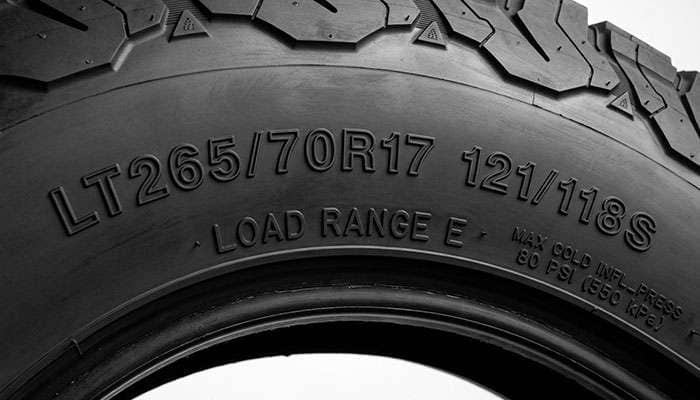
Load Range F exists. It is a 12-ply-rated construction carrying a 95 psi maximum. What it mostly does not do is appear in the sizes 3/4-tons actually wear. Across the current LT275/70R18 market, the overwhelming majority of tires are built at load index 125, which is Load Range E. Load index 128, the Load Range F equivalent, is available from only a handful of models in that size. The same holds in LT275/65R20, where load index 126 accounts for nearly the entire market.
That is worth sitting with. If 3/4-tons needed Load Range F to do their job, the tire industry would build it in the sizes 3/4-tons come with. It largely does not, because the trucks do not need it. Load Range F lives primarily in one-ton dually applications, commercial service, and a few specific heavy sizes.
Your truck carries five separate ceilings. They do not run out together, and only one of them is the tire.
Rating |
What It Limits |
Where to Find It |
Raised by Load Range F? |
|---|---|---|---|
Tire load rating |
Weight per tire at its rated pressure |
Tire sidewall |
Yes, and it was already above your axle rating |
Rear GAWR |
Total weight on the rear axle, springs and brakes |
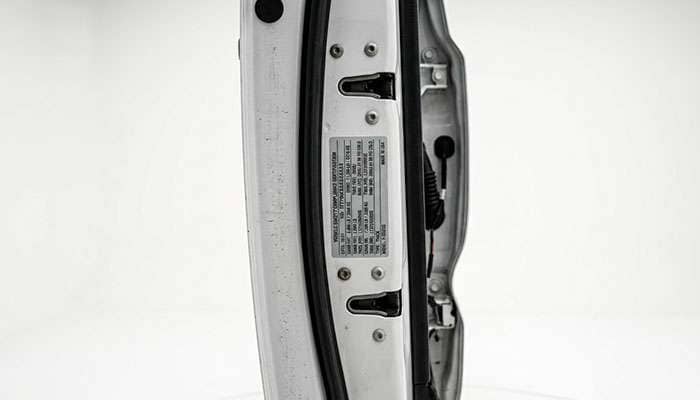
Door jamb certification label |
No |
GVWR |
Loaded truck including passengers, cargo and tongue weight |
Door jamb certification label |
No |
GCWR |
Truck and trailer combined |
Manufacturer towing guide, by powertrain and axle ratio |
No |
Hitch or receiver rating |
Tongue weight, or pin weight at the fifth wheel |
Stamped on the receiver or hitch |
No |
Only the first row moves when you buy heavier tires, and it is the row that already had margin. The four that actually stop you are structural, and no tire purchase touches any of them.
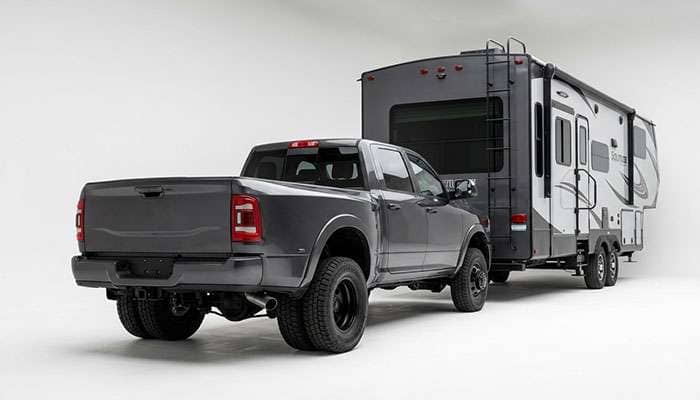
In practice, the ceiling that bites most 3/4-ton owners is GVWR, reached through payload. A current F-250 carries a maximum payload in the region of 3,800 pounds and an F-350 single-rear-wheel around 4,700. A fifth wheel putting 20 percent of its weight on the pin means a 15,000-pound trailer is placing roughly 3,000 pounds in your bed before you have added passengers, fuel, a hitch, or the generator in the toolbox. That is how people run out of truck, and none of it is the tire's doing.
No. Towing capacity is set by GCWR, and GCWR is a powertrain, frame and brake rating published by the manufacturer for your specific configuration. It does not have a tire term you can edit.
The same is true of your axle. Rear GAWR is a rating of the axle housing, bearings, springs and brakes. It appears on the certification label on your door jamb, and it is the legal limit on that axle regardless of what you bolt to the hubs. Fitting tires that could theoretically carry 8,000 pounds to an axle rated for 6,500 does not give you 8,000 pounds of axle. It gives you 6,500 pounds of axle and a great deal of unused tire.
There is one place the tire genuinely does govern, and it is worth knowing because it is the exception that proves the rule. Federal Motor Vehicle Safety Standard No. 120, which covers vehicles above 10,000 pounds GVWR, requires that when a passenger-car-construction tire is fitted to one of these vehicles, its load rating be reduced by dividing by 1.10 before the axle sum is calculated. That derate is why passenger-construction tires effectively disqualify themselves from heavy-duty service. It is also the mechanism behind the LT-versus-P-metric distinction covered in our guide to P-metric vs LT tires. On a 3/4-ton running LT tires, the derate never enters the picture.
Worth noting which standard your truck falls under, because it surprises people. A current F-250 carries a GVWR between roughly 10,000 and 11,400 pounds depending on configuration, and an F-350 single-rear-wheel runs to about 12,400. Above 10,000 pounds, your pickup is governed by Standard No. 120 rather than the Standard No. 110 that covers your car and your half-ton. Same core requirement on the axle sum, different standard.
More than your rear axle is rated to hold. The exact figure depends on size, so here is what the common heavy-duty fitments deliver at their rated cold pressure.
Size |
Load Range |
Load Index |
Capacity Per Tire |
Rear Axle Pair |
|---|---|---|---|---|
LT275/70R18 |
E |
125 |
3,638 lb |
7,276 lb |
LT275/70R18 |
F |
128 |
3,968 lb |
7,936 lb |
LT275/65R20 |
E |
126 |
3,748 lb |
7,496 lb |
LT265/70R17 |
E |
121 |
3,197 lb |
6,394 lb |
LT285/75R17 |
E |
121 |
3,197 lb |
6,394 lb |
Compare the right-hand column to the rear GAWR on your door jamb. On most 3/4-tons that axle rating sits in the 6,000 to 7,000 pound range, which means a Load Range E pair in the 18-inch or 20-inch OE size clears it with several hundred pounds to spare. Moving to Load Range F adds another 660 pounds of tire capacity above a number you still cannot legally exceed.
One caution on reading these figures. A tire's rated capacity is only valid at its rated cold inflation pressure. A Load Range E tire marked 3,638 pounds delivers that at 80 psi, not at the 65 psi you are running because the truck rode better. Capacity and pressure are a single specification, and our explainer on load range vs load index works through how the two interact.
Yes, and this is the failure mode that actually shows up in the shop. It is the mirror image of the question everyone asks.
Look again at the table. An F-250 leaving the factory on LT275/70R18 has 7,276 pounds under the rear axle. The owner decides he wants a more aggressive look, drops to a 17-inch wheel and fits LT285/75R17 at load index 121. He has just moved to 6,394 pounds, giving away 882 pounds of axle capacity, and depending on his configuration he may now be sitting at or below his rear GAWR rather than comfortably above it.
He did not buy a weaker tire on purpose. He bought a bigger, more aggressive-looking tire and assumed bigger meant stronger. Section width and load index are independent specifications. A taller, wider tire in a different size can carry less.
This is the real risk on a heavy-duty truck, and it is the opposite of what the internet worries about. Nobody gets into trouble by failing to buy Load Range F. People get into trouble by upsizing into a size where the common load index gives them less capacity than the tire that came on the truck. Before you change size, check the load index of the exact tire you intend to buy against the load index on your placard.
This is the one case where the answer turns from no to maybe, and the reason is thermal margin rather than legal capacity.
If you run a slide-in truck camper or a heavy fifth wheel, your rear axle lives near its rating continuously rather than occasionally. A tire operating at 95 percent of its capacity for eight hours in July runs hotter than the same tire at 70 percent, and heat is what degrades a casing over time. A Load Range F tire in the same size carries the identical load at a lower percentage of its rating, which means it runs cooler doing the same work.
That is a durability argument, not a capacity argument. It does not let you carry more, it lets you carry the same amount with more margin. For a truck that is loaded most days of its life, that trade is often worth making. For a truck that tows a boat eight weekends a year and commutes the rest of the time, it is not.
The second genuine benefit is sidewall stiffness. Higher inflation and heavier construction reduce sidewall flex, which shows up as less squat under pin weight and less lateral movement in crosswinds and passing maneuvers. Owners describe this as the truck feeling more planted, and it is real. Whether it justifies the daily cost is the subject of the next section.
If your rear axle is regularly near its limit, the more urgent reading is our breakdown of what happens when that axle goes over, in rear axle overloaded tires.
A heavy-duty pickup spends most of its life empty. Here is what the upgrade charges you for that time, in the order you notice it.
Ride quality, immediately. A Load Range F tire at its rated 95 psi on an unloaded truck is close to a solid object. Heavy-duty pickups already ride firmly because their rear springs are built for a load that is not there. Adding stiffer tires compounds it.
Then the contact patch. An over-inflated tire relative to its actual load crowns in the center, reducing the footprint. That lengthens wet stopping distance and reduces grip exactly when an empty rear axle is already light. This is the part of the trade that is a safety cost rather than a comfort cost.
Then irregular wear. That same crowned footprint wears the center rib ahead of the shoulders. You reach the wear bars in the middle of the tread with usable rubber on either side, and you replace the tire early.
Then unsprung weight and fuel. A Load Range F casing carries more material. That is more rotating mass for the brakes to stop and more rolling resistance at every mile, on a vehicle that was not going to win any efficiency awards to begin with.
Then availability. Because Load Range F is thinly built in 3/4-ton sizes, your replacement options are narrower and a road failure far from home is harder to solve. A tire you cannot replace in a small town on a Sunday has a cost that does not show up on the price tag.
And underneath all of it, casing damage you may not see. Running any tire at high pressure over broken pavement transmits impact into the sidewall rather than absorbing it. Impact breaks and sidewall bulges are a heavy-truck failure mode, and they are not always obvious. Our guide to tire sidewall damage and whether it is safe to drive covers how to tell a cosmetic mark from a casing that needs to come off the truck.
The fix for most of this is not a different load range. It is setting cold pressure from the load and inflation table for your measured axle weight instead of running the sidewall maximum year-round.
Fifteen minutes and a truck scale settle this for your specific truck.
1. Read your certification label. Open the driver's door and record GVWR, front GAWR and rear GAWR. These are specific to your truck as built, which is why no article can supply them for you.
2. Record your tire's load index. It is the number immediately after the size on the sidewall. Look up its capacity and note the cold pressure it applies at.
3. Multiply by two and compare to rear GAWR. If the pair exceeds your rear axle rating, and it almost certainly will, your tire is not your limit. Your axle is.
4. Weigh the truck loaded the way you actually tow it. Full fuel, passengers, gear, trailer connected. A CAT scale gives you steer, drive and trailer axle weights for a few dollars.
5. Compare measured rear axle weight to rear GAWR. This is the number that matters. If you are over, no tire fixes it, and you need to move weight forward or reduce it.
6. Set cold pressure from the load and inflation table. Use your measured axle weight, not the sidewall maximum. This is where most of the ride and wear penalty people blame on load range actually comes from.
7. Only then consider Load Range F. If your measured rear axle weight sits above about 85 percent of rear GAWR on most trips, the thermal margin argument applies. If it does not, buy the Load Range E tire with the tread pattern and warranty you want.
Owners doing this on a half-ton should start with towing tire load range for a half-ton, where the arithmetic differs because the hitch geometry multiplies tongue weight differently. If you are comparing constructions in general terms, 10 ply vs 12 ply tires covers the build differences.
The premise of the question is the problem. Load Range F is treated as an upgrade that unlocks capability, when it is a tire specification sitting above a structural ceiling set by your axle, your GVWR, your GCWR and your hitch. Federal Motor Vehicle Safety Standard No. 120 already required your tires to clear your axle rating before the truck left the line.
Buy Load Range F if your rear axle genuinely lives near its rating, because cooler operation over years of loaded service is a real benefit. Do not buy it expecting to tow more, because nothing about your truck's rated capacity changes when you do. And watch the direction of the mistake that actually happens, which is upsizing into a size with a lower load index and quietly giving away several hundred pounds of axle capacity you had from the factory.
When you are ready to shop the OE size, we stock LT275/70R18 tires with load index and load range listed on every product page, so you can check the capacity against your placard before you buy.
In almost all cases, no. Federal Motor Vehicle Safety Standard No. 120 requires that the sum of the tire load ratings on an axle be not less than that axle's GAWR, so your factory Load Range E tires already clear your axle rating. Towing capacity is set by GCWR and axle capacity by GAWR, and neither changes when you fit heavier tires. Load Range F is worth considering only for thermal margin on a truck that runs near its rear axle rating continuously.
It depends on size. LT275/70R18 at load index 125 carries 3,638 pounds per tire, or 7,276 pounds across a rear axle pair. LT275/65R20 at load index 126 carries 3,748 pounds. LT265/70R17 and LT285/75R17 at load index 121 carry 3,197 pounds each. Every one of those figures requires the tire's rated cold inflation pressure, which for Load Range E is 80 psi.
No. Towing capacity is governed by GCWR, a powertrain, frame and brake rating published by the manufacturer for your specific configuration. It contains no tire term. Rear axle capacity is governed by GAWR, which rates the housing, bearings, springs and brakes. Fitting tires rated above your GAWR gives you unused tire capacity, not additional axle capacity.
Load Range E is a 10-ply-rated construction with a maximum cold inflation pressure of 80 psi. Load Range F is 12-ply-rated at 95 psi. In the same size, F typically carries about 330 pounds more per tire, roughly three load index steps. F also runs a heavier casing, which means more unsprung weight, more rolling resistance and a firmer ride when the truck is empty.
Yes. Section width and load index are independent specifications, so a taller or wider tire can carry less than the one it replaced. Going from LT275/70R18 at load index 125 to LT285/75R17 at load index 121 costs 441 pounds per tire and 882 pounds across the rear axle. Always compare the load index of the exact tire you intend to buy against the load index listed on your door jamb placard.
On the safety compliance certification label inside the driver's door jamb. It lists GVWR alongside separate front and rear GAWR figures for your truck as it was built. These are configuration-specific, which is why manufacturer towing guides do not publish them. GCWR comes from the towing guide for your powertrain and axle ratio, and the hitch rating is stamped on the receiver.



