
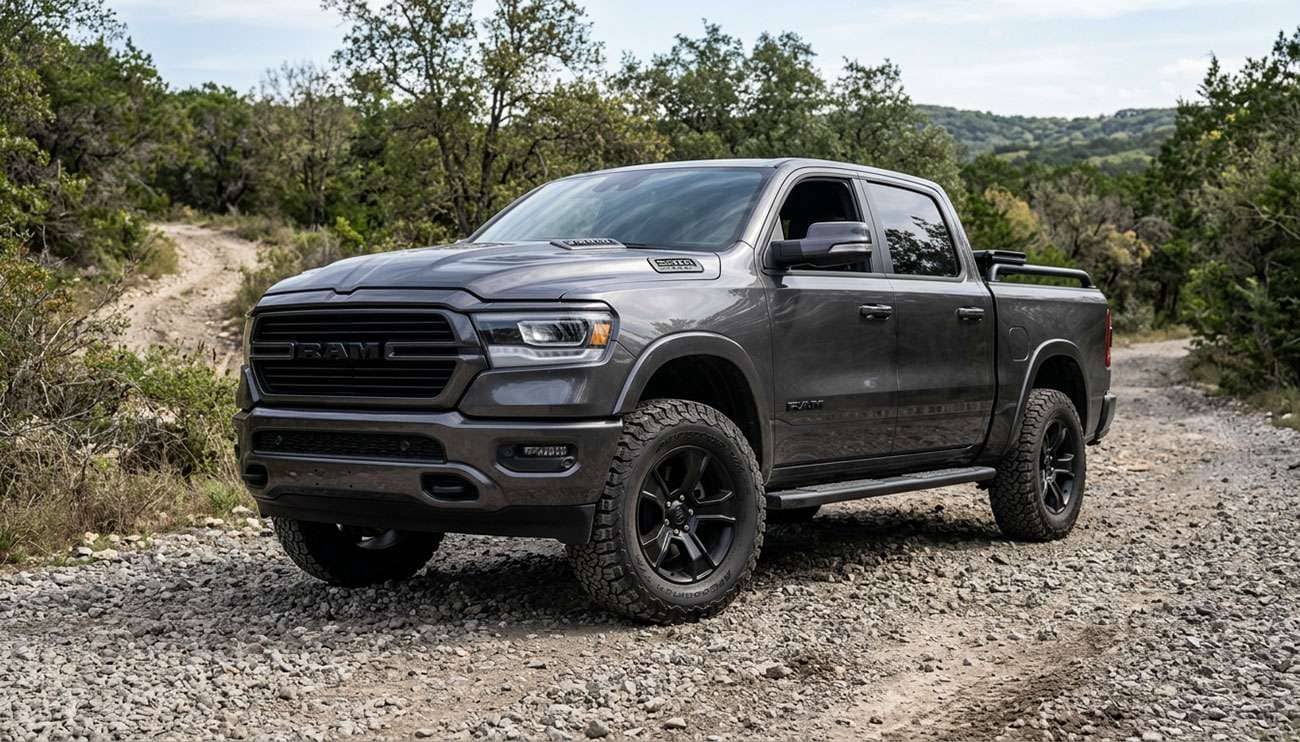
Yes, a 35 fits a leveled 2019-and-newer Ram 1500, but only the right 35. A metric 35 such as a 295/65R20 clears the factory 20x9 wheels after a 2-inch level. A full-width 35x12.50R20 on those same wheels hits the upper control arm at full steering lock. Most answers stop at "get a 2.5-inch leveling kit." They leave out the two things that actually decide it: how wide the tire is next to that control arm, and whether your truck rides on coil springs or four-corner air.
I check a Ram in a fixed order before anything gets mounted: generation, suspension type, tire width, then wheel offset. Start by finding your truck in this table.
Your Ram 1500 |
How the front gets leveled |
The 35 that fits on stock wheels |
What decides the rub |
|---|---|---|---|
2019+ (DT) with coil springs |
2 to 2.5 in. strut spacer or leveling coilover |
295/65R20 or 285/65R20 |
Tire width against the upper control arm |
2019+ (DT) with four-corner air |
Adjustable height-sensor links or recalibrated ride heights |
The same metric 35s |
Tire width, plus a ride height that changes with the mode |
Rebel (DT) |
Same as coil or air above, depending on how it was built |
Starts on a 33.2 in. tire, so the jump is smaller |
The same control arm limit on 18 in. wheels |
TRX (2021-2024) and RHO (2025+) |
Not a leveling platform |
Already on 325/65R18 (34.6 in.) |
Anything bigger is a lift decision |
Ram 1500 Classic (sold through 2024) |
2 to 2.5 in. strut spacer |
35x12.50R20 can clear the factory 20x8 with a 2.5 in. level |
A different 5x139.7 platform; DT fitment data does not transfer |
If your truck is a DT on factory wheels, the rest of this article is the detail behind the first two rows.
On a coil-spring Ram 1500, a leveling kit is either a spacer that sits on top of the front coilover or a replacement coilover set to a taller ride height. It raises the front 2 to 2.5 inches at rest and takes out most of the factory rake, the nose-down stance the truck leaves the plant with so it sits closer to level once you load the bed or hook up a trailer.
That buys you room between the top of the tire and the fender while the truck is sitting still. Here's what it doesn't do:
Plan on an alignment either way. Raising the front shifts camber and caster.
This is the question most 35s-on-a-Ram guides skip, and it changes the whole job. Ram offers Active-Level four-corner air suspension as an option on crew cab Laramie, Rebel, Limited, and Limited Longhorn trucks. The strut spacers sold for coil trucks are not built for the air strut assemblies, and the air system manages ride height on its own.
Two quick ways to tell which one you have. First, look for the ride-height controls on the dash with settings like Entry/Exit and Off-Road. Second, look behind a rear tire: a coil truck has a steel coil spring there, an air truck has a rubber air spring.
Here's why it matters: a coil truck has one ride height, and an air truck has five.
Air suspension mode |
Change from normal ride height |
When the truck uses it |
What it means for a 35 |
|---|---|---|---|
Normal |
0 in. |
Everyday driving |
The height your fitment check starts from |
Aero |
-0.6 in. |
Automatically at highway speed |
Less room above the tire when you hit a bump at speed |
Entry/Exit |
-2.0 in. |
Parked, for loading and getting in and out |
The tire sits 2 in. deeper in the wheel well; watch the liner if you turn the wheel while it's lowered |
Off-Road 1 |
+1.2 in. |
Selected for low-speed off-road use |
Extra clearance, but only while selected |
Off-Road 2 |
+2.0 in. |
Selected for slow crawling |
The most clearance the system offers, and it's speed-limited |
On a stock air truck, ground clearance runs from about 6.7 inches in Entry/Exit to about 10.7 inches in Off-Road 2, with roughly 8.7 inches at normal ride height. That spread is the variable. On a coil truck you measure clearance once. On an air truck, a 35 that clears at Normal has 0.6 inch less room at highway speed and 2 inches less when the truck squats for Entry/Exit. Check it in every mode, not just the one it happened to be in when you parked.
On an air truck you don't lift the front with a spacer. You change the height the computer is aiming for. Owners do it three ways.
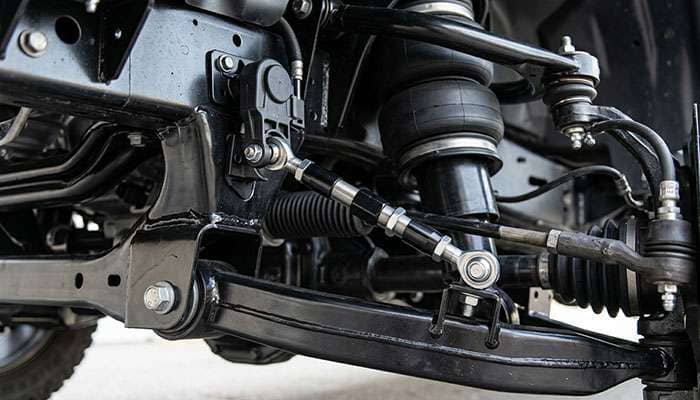
Each corner has a ride-height sensor connected to the suspension by a short link. Swap it for an adjustable link set a little longer, and the computer reads the truck as sitting low, so it adds air until the reading looks normal again. Owners report 1.5 to 2 inches of lift this way. Because the air system is still running the show, all five height modes keep working, and you can set the front and rear separately to get a true level instead of a nose-high stance.
With the right diagnostic software and cable, the factory height target for each mode can be edited directly. It's a clean result when it's done carefully. The catch is that a dealer software update or a replaced suspension module can put the truck back at factory heights.
Some kits raise the front of an air truck mechanically, usually with new upper control arms. The height sensors must be recalibrated afterward. Skip that step and the truck can throw a Service Air Suspension warning and lock you out of the height modes, which is the opposite of what you paid for.
Whichever route you take, check tire clearance in Entry/Exit, not just at Normal. The level raises every mode, but Entry/Exit is still the lowest the truck sits while you're turning the wheel in a parking lot.
The factory wheels on a 2019+ Ram 1500 come in 18x8, 20x9, and 22x9, and all of them run about +19 mm of offset. That positive offset tucks the wheel in toward the frame. It's the reason the upper control arm, not the fender, is the first thing a wide 35 finds.
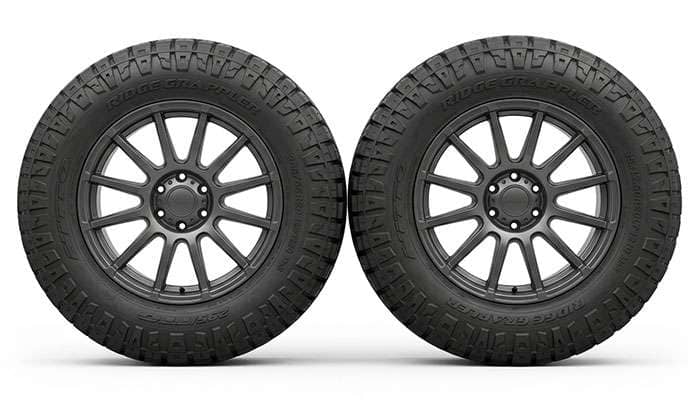
Look at the width column, not the height. A stock 275/55R20 is about 10.8 inches wide. A 295/65R20 is about 11.6 inches, which is 0.4 inch more per side. A 35x12.50R20 is 12.5 inches, about 0.85 inch more per side than stock. On leveled DTs with factory 20x9 wheels, owners running 295/65R20s report roughly 3/8 inch between the tire and the upper control arm at full lock. Add another 0.45 inch of width on each side and that gap is gone. That's the entire reason one "35" fits and the other doesn't.
Tire size |
Diameter |
Section width |
Construction and load |
Typical weight |
On a 2 in. leveled DT with factory 20x9 +19 wheels |
|---|---|---|---|---|---|
275/55R20 (stock) |
31.9 in. |
10.8 in. |
Passenger-type, 113 (2,535 lb) |
About 47 lb |
Factory fitment |
275/65R20 |
34.1 in. |
10.8 in. |
Mostly LT, load range E |
About 67 lb |
Stock width, so the arm isn't the issue |
285/65R20 |
34.6 in. |
11.2 in. |
LT, load range E, 127 (3,858 lb) |
About 67 lb |
Owners report no rub and no trimming |
295/65R20 |
35.1 in. |
11.6 in. |
LT, load range E, 129 (4,079 lb) |
About 69 lb |
About 3/8 in. to the arm at full lock; possible liner touch in reverse |
35x12.50R20 |
35.0 in. nominal |
12.5 in. |
LT, load range E (121) or F (125) |
About 79 lb |
Contacts the arm; needs lower offset, a spacer, or new arms |
Two things the sidewall label won't tell you. First, "35" is nominal: mounted 35-class tires often measure closer to 34.5 inches, depending on tread design and wheel width. Second, every upgrade size in that table is an LT tire, which changes pressure, weight, and ride. More on that below.
A 295/65R20 on a 2-inch level usually clears the control arm, but it gets close in two places: the front mud flap, which it narrowly misses, and the thin plastic inner fender liner, which owners report catching when backing up with the wheel turned all the way. A couple of inches trimmed from the liner fixes it. A 285/65R20, at 34.6 inches, is the size owners most often report running with no rub and no trimming at all on the factory 20x9 wheel. If you want a 35 that disappears into the truck with zero cutting, that's the one to measure first.
If you want a true 35x12.50, the tire has to move out, away from the control arm. You have three ways to do that: a lower-offset wheel, a hub-centric spacer, or an aftermarket upper control arm with more room at the tire.
Wheel |
Backspacing |
Tire centerline vs. factory |
What it does with a 35x12.50R20 |
|---|---|---|---|
20x9 +19 (factory) |
5.75 in. |
Baseline |
Inner shoulder contacts the upper control arm at full lock |
20x9 +1 |
5.04 in. |
0.71 in. out |
A common leveled-truck choice; clears the arm, may need air dam or valance trimming |
20x9 -12 |
4.53 in. |
1.22 in. out |
Clears the arm easily; the outer tread moves toward the bumper and liner at full lock |
20x10 -18 |
4.79 in. |
1.46 in. out |
Owners usually pair this with a 4 in. lift rather than a level |
Every millimeter of offset you take out moves the tire's outer edge the same amount toward the bumper. Push the tire out 0.71 inch and the inside clears the arm, but at full lock the outside reaches the plastic air dam and lower bumper valance. That's where leveled Rams on 35x12.50s usually get trimmed, and hard left turns are where owners report it most.
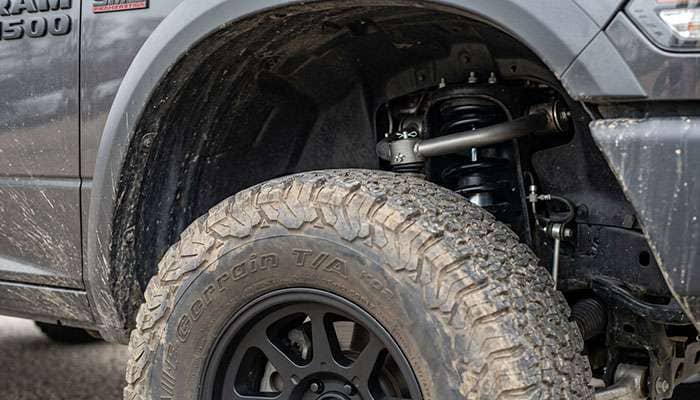
Lower offset also adds leverage. The farther the tire's centerline sits outside the hub face, the more load goes into the wheel bearing and the more the steering kicks back on rough ground. A +1 wheel is a mild change. A -18 belongs on a truck with a lift built around it.
A 3/4-inch hub-centric spacer on the factory +19 wheel lands you right around zero offset. That works when the spacer is hub-centric and torqued correctly; our guide to wheel spacers and tire rub covers when spacers solve rubbing and when they only move it.
Aftermarket upper control arms are the third route. Some are shaped with more room at the tire, and one owner running a 2-inch kit with new arms reported full 35s clearing with space to spare. They cost more than spacers, but they also correct the ball joint angle a taller level creates.
Yes. Three versions of this truck start from a different place.
The Rebel starts on LT275/70R18s, about 33.2 inches tall and already LT construction. Going to a 35 is a 1.8-inch jump in diameter, not the 3-inch jump a Laramie on 275/55R20s makes. The factory 18x8 wheel still runs about +19 mm of offset, so the width rule holds: a 295-wide tire clears more easily than a 12.50. Rebels can also be optioned with air suspension, so confirm which one yours has before you buy a kit.
The TRX (2021-2024) and the RHO (2025 and newer) already wear 325/65R18s, about 34.6 inches tall. That's the factory's own 35, on a wider-track, long-travel front end built for it. Going bigger on these trucks is a lift-and-trim decision, not a leveling question.
The Classic, sold new through 2024, is the previous-generation truck. It uses a 5x139.7 bolt pattern where the 2019+ DT uses 6x139.7, so the wheels don't swap, and the fitment data from one doesn't carry over to the other. If you're shopping wheels, our Ram 1500 aftermarket wheels guide walks through the specs to check.
On the Classic, one well-documented owner build with a 2.5-inch level ran 35x12.50R20s on the factory 20x8 wheel with about 1/2 inch to the upper control arm, no trimming, and only a light sway bar graze at full lock with the suspension compressed. Those tires measured about 34.25 inches mounted, which is part of why it worked. The narrower 8-inch factory wheel helps a little here, because it pulls the tire's shoulders in slightly compared with a 9-inch rim.
Rub doesn't announce itself as a failure. It starts as a noise and works its way up. Here's the order it usually goes on a Ram, from cheapest to most expensive.
Every step on that list costs more than getting the width and offset right the first time.
Clearance is only half the job. Three other numbers change the day the new tires go on.
The stock 275/55R20 is a passenger-type tire with a 113 load index, rated for 2,535 pounds. Every 35-class upgrade size is an LT tire. Most 295/65R20s are load range E with a 129 load index (4,079 pounds). 35x12.50R20s split between load range E at 121 (3,197 pounds) and load range F at 125 (3,638 pounds). Notice that the metric 35 carries more than the flotation 35 at the same load range, which is one more reason it's the smarter fit on this truck.
Those ratings only apply at maximum pressure: 80 psi for load range E, 95 psi for F. At door-placard pressure, an LT tire carries far less than its sidewall number. FMVSS 110, the federal standard behind that placard, requires a vehicle's tires to carry its maximum load at the recommended pressure; once you change tire construction, keeping that true is your job. The Tire and Rim Association load-and-inflation tables tell you what pressure an LT tire needs to match your original capacity. Our P-metric vs. LT tire breakdown covers what changes in ride and wear.
A typical 275/55R20 weighs around 47 pounds. A typical 295/65R20 is around 69, and a typical 35x12.50R20 is closer to 79. That's 22 to 32 pounds added at each corner, all of it rotating and unsprung. You'll feel it in braking distance, in how the truck pulls from a stop, and at the pump.
A 35.1-inch tire turns about 9 percent fewer times per mile than the 31.9-inch stock tire. At an indicated 65 mph you're really doing about 71. The speedometer, odometer, and transmission shift points all work from the tire size programmed into the truck, so that number needs updating. Our guide to bigger tires and speedometer error walks through it.
Gearing shifts by the same 9 percent. A truck with 3.21 axle gears behaves as if it had about 2.92s. Whether that's worth fixing depends on how much you tow and where you drive, and our regearing guide for bigger tires lays out where that line is.
Here's the order I'd work in, and most of it happens before you spend a dollar.
So, will 35s fit a Ram 1500 with a leveling kit? On a 2019+ truck, yes, and knowing which 35 is the part that saves you money. A metric 35 at 295 mm wide or narrower clears the factory wheel after a 2-inch level. A full 35x12.50 needs the tire moved out with offset, a spacer, or new control arms, and it brings trimming with it. On four-corner air, level through the ride-height system, not around it, and check clearance in every mode. Measure first, choose by width, and cycle the steering before you drive. Do it in that order and the only thing you'll hear at full lock is the tread, not a control arm working on your sidewall.
Not reliably on a 2019+ Ram 1500. A 35 needs the front raised about 2 inches, plus a tire narrow enough, or a wheel offset low enough, to clear the upper control arm at full lock. At stock height, even some 33s touch at full lock.
2 to 2.5 inches is the common range for coil-spring trucks. Air-suspension trucks are leveled with adjustable height-sensor links or recalibrated ride heights, usually 1.5 to 2 inches. The level alone doesn't make a 35x12.50 fit on factory wheels; tire width and offset do.
On a 2019+ DT, the factory 20x9 +19 mm wheel puts a 12.50-wide tire into the upper control arm at full lock. A 295/65R20, about 11.6 inches wide and 35.1 inches tall, is the 35-class size that fits the factory wheel after a 2-inch level.
Yes. The common methods are adjustable height-sensor links, reprogrammed ride-height targets, or a mechanical kit followed by sensor recalibration. Done right, all five height modes keep working. Done without calibration, the truck can set a Service Air Suspension warning and lock out the modes.
Yes. A 35-class LT tire adds roughly 22 to 32 pounds per corner and lowers your effective gearing by about 9 percent, which costs acceleration, braking distance, and fuel economy. What you can safely carry depends on the tire's load rating at the pressure you run, so set pressures from the load-and-inflation tables.
With a 2 to 2.5 inch level, 35 inches is the practical ceiling: a 295/65R20 or 285/65R20 on factory wheels, or a 35x12.50 on lower-offset wheels with trimming. Owners going to 35x12.50s on 20x10 negative-offset wheels, or to anything taller, generally step up to a 4-inch lift.



