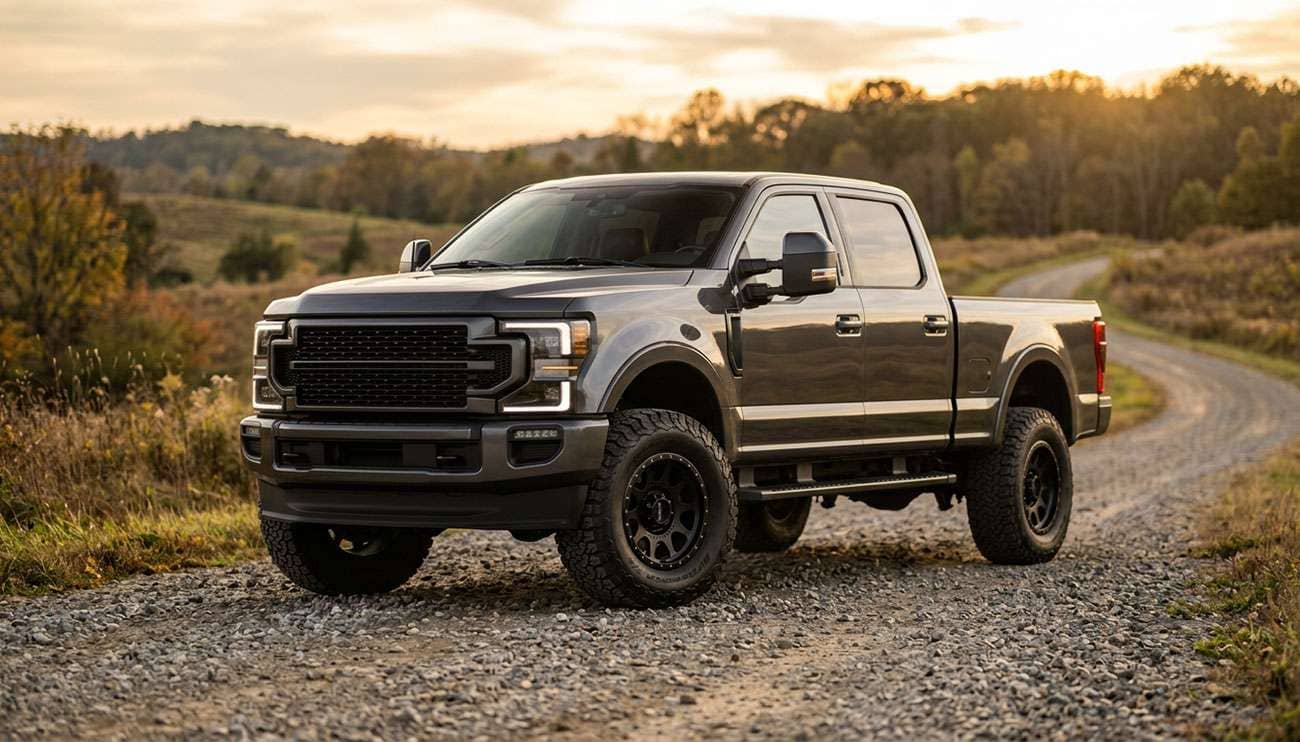
Yes, if your "leveling kit" includes aftermarket upper control arms and your wheels sit at roughly 5 to 5.75 inches of backspacing. A torsion-key-only kit is sold for 35s, and that is where the companies that build those kits draw their own line. The ZR2 is the exception, and it needs no keys at all. Most answers to this question say it depends on lift and offset and stop there. On a 2500HD, it depends on three things: what is holding the upper ball joint, how far inboard the wheel sits, and whether the 37 you buy is rated for what your rear axle carries.
We have been fitting trucks in Long Beach since 1971, and the 37 question on a Chevy heavy-duty comes in the door every week. Here is how I sort it out at the counter, starting with what is actually leveling your truck.
Your Setup |
Front Lift |
Will a 37x12.50 Fit? |
What It Takes |
|---|---|---|---|
Torsion keys only, factory wheels |
1.5 to 2.5 in. |
Not cleanly |
Expect arm and sway bar contact at full lock; stay at 35s or change wheels and arms |
Torsion keys only, 20x9 wheels at 0 to +18 mm |
2 to 2.5 in. |
With rubbing and trimming |
Liner and valance trim; factory arms sit near their droop limit |
Torsion keys plus aftermarket upper control arms |
2 to 3 in. |
Yes, the common 37 build |
Light liner trim; possible frame touch at full lock |
ZR2 with DSSV dampers |
Factory lift, no keys |
Owners report yes on factory wheels |
Most key kits exclude it; a 37x13.50 gets tight on the arm |
Any 2500HD on a 37x13.50 or under 4.75 in. backspacing |
Any level |
Only with real trimming |
Valance, liner and shroud cuts; a lift is the cleaner path |
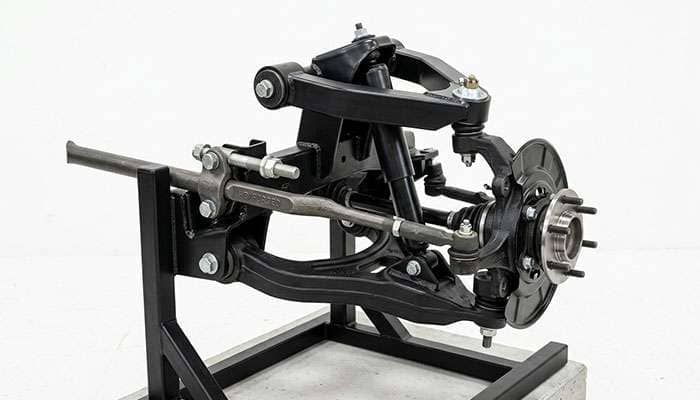
A Silverado 2500HD does not level the way a half-ton does. Every 2011 and newer HD runs independent front suspension sprung by torsion bars, and you raise the nose by changing the torsion key, the indexed piece that sets how much the bar is twisted at ride height. More preload rotates the lower control arm down, and the front of the truck comes up. We walked through those mechanics in detail in our piece on whether 35s fit a leveled 2500HD, so I will stick to what changes when the tire grows another two inches.
Here is the part that matters for 37s. Raising the truck with keys does not add suspension travel. It spends droop. The upper control arm now sits closer to the end of its swing at ride height, and the upper ball joint runs at a steeper angle. Crank far enough and the factory arm becomes the droop stop, which is the job no upper ball joint was designed to do. The ride gets stiff, and the joint starts wearing.
That is why the 2500HD leveling market splits into two kinds of kit:
So when someone tells you their buddy runs 37s on a leveled 2500HD, ask which kit. More often than not, there are new arms under there.
One more detail: torsion keys are indexed to the platform. Keys for a 2011 to 2019 truck are not the keys for a 2020 and newer truck, even though both generations share the 8x180 bolt pattern. Buy by model year.
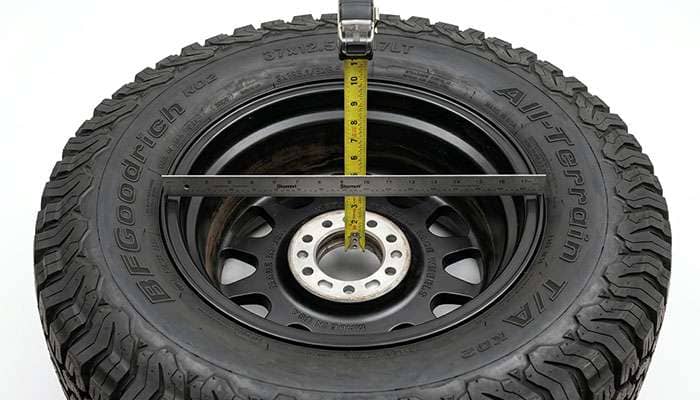
Offset gets all the attention, but on a 2500HD backspacing is the number that tells you where a 37 will hit. Backspacing is the distance from the wheel's mounting face to its inner lip. More backspacing tucks the tire in toward the upper control arm, sway bar and frame. Less backspacing pushes it out toward the bumper valance, fender liner and inner shroud. A 37 needs to live in the gap between those two walls at full steering lock, and that gap is narrow.
If you want the formulas, our guide to offset, backspacing and bolt patterns covers them. Here is what they work out to on common 8x180 wheels:
Wheel |
Backspacing |
Where a 37x12.50 Ends Up |
|---|---|---|
Factory 18 or 20 in., high positive offset |
About 6.25 in. or more |
Too far in; touches upper arm and sway bar at full lock |
20x9 at +18 mm |
About 5.75 in. |
Tucked; best with new arms |
20x9 at 0 or +1 mm |
About 5.0 in. |
Middle of the window; light liner trim |
20x10 at -18 mm |
About 4.8 in. |
Pokes past the fender; valance and liner trim |
20x12 at -44 mm |
About 4.75 in. |
Wide stance; real trimming and more steering load |
Look at the last two rows. They have nearly the same backspacing, so they clear the arm about the same. The 20x12 just carries two more inches of wheel and tire out past the fender, which is why it rubs the valance and why it loads your hubs and steering harder. Backspacing sets the inside. Width and offset together set how far the outside sticks out.
For a 37x12.50 on a leveled HD, the window most builds land in is a 9-inch-wide wheel between 0 and +18 mm, which is about 5 to 5.75 inches of backspacing. A 37x13.50 is about an inch wider overall, so it gives up roughly half an inch of room to the arm. Run it toward the 5-inch end. Factory wheels, with about 6.25 inches of backspacing, put a 37 right on top of the hardware you just spent money leveling.
The ZR2 is the 2500HD that does not play by the rules above, and it is the same lesson Ram owners learn about the Power Wagon in our article on whether 37s fit a leveled Ram 2500. When Chevrolet built the 2024 and newer HD ZR2, it did not just crank the bars. It gave the truck its own front upper and lower control arms, its own knuckles, about 1.5 inches of factory lift and Multimatic DSSV dampers. It ships on LT305/70R18 Load Range E tires, the Goodyear Wrangler Territory MT, which measure about 34.8 inches tall.
ZR2 owners report running 37x12.50 tires on the factory wheels with no torsion bar changes and no rubbing in normal use. One owner on a 37x13.50R18 reports it barely clears the upper arm at full lock, which lines up with the backspacing math: wider tire, same wheel, less room inboard.
Two cautions. First, most aftermarket key kits for 2020 and newer HD trucks specifically exclude the ZR2 and the GMC Sierra AT4X, which share the DSSV setup. Second, cranking the bars on a ZR2 brings back the ball joint and droop problems Chevrolet engineered out of it. If you have a ZR2, 37x12.50s are a tire swap. Leave the keys alone.
Less than you would think, if the wheel is right. More than anyone wants, if it is not. On a 2020 and newer HD with keys and upper arms and a wheel in the window above, the usual list is short:
What usually does not go away is contact at the absolute end of steering travel. Owners with 3-inch control arm kits on 37x12.50s report the tire touching the frame at full lock in a parking lot, and touching the upper arm and sway bar when the truck is off-camber with the wheel cranked. For a truck that lives on pavement, that is a nuisance. For a truck that crawls trails, it is a reason to look at a real lift.
If you are cutting metal to fit a 37 on a leveled HD, something upstream is wrong. Usually it is a wheel with too little backspacing for the width, or a 13.50-wide tire where a 12.50 belongs.
This is the part most fitment guides never get to, and on a three-quarter-ton it is the part that matters most. Open the driver's door and read the certification label. It lists a gross axle weight rating, or GAWR, for the front and for the rear. Most 2020 and newer 2500HDs are rated above 10,000 pounds GVWR, which puts them under the federal truck standard, FMVSS No. 120. Under it, the maximum load ratings of the tires on an axle, added together, cannot be less than that axle's GAWR. Trucks rated at 10,000 pounds or less fall under FMVSS No. 110, which carries the same axle rule.
Chevy has long rated the 2500HD rear axle around 6,200 pounds. Check your own label, because packages like the snow plow prep raise the front rating. At 6,200 pounds, every rear tire needs at least 3,100 pounds of capacity at its maximum load. Here is how 37s stack up against the factory tire, by wheel diameter, using the load index most 37s in that size actually carry:
Wheel Size |
Factory Tire |
Most Common 37 |
Change Per Tire |
Load Range F Option |
|---|---|---|---|---|
17 in. |
LT265/70R17 E, 121, 3,197 lb |
37x12.50R17 D, 124, 3,527 lb |
Up 330 lb |
128, 3,968 lb |
18 in. |
LT275/70R18 E, 125, 3,638 lb |
37x12.50R18 E, 128, 3,968 lb |
Up 330 lb |
128, 3,968 lb |
18 in. ZR2 |
LT305/70R18 E, 126, 3,748 lb |
37x12.50R18 E, 128, 3,968 lb |
Up 220 lb |
128, 3,968 lb |
20 in. |
LT275/65R20 E, 126, 3,748 lb |
37x12.50R20 E, 126, 3,748 lb |
None |
128, 3,968 lb |
22 in. (no factory 22) |
Compare to the 20 in. tire, 126 |
37x12.50R22 E, 123, 3,417 lb |
Down 331 lb |
127, 3,858 lb |
Good news first: on 17s, 18s and 20s, a properly chosen 37 matches or beats the factory tire. That is the opposite of the 35x12.50R20 problem, where the flotation 35 gives up capacity. Bigger air volume buys load.
Now the three traps:
Load range is a pressure rating, not a capacity number, so compare load index. If you tow heavy or carry a camper, our piece on Load Range F tires on a three-quarter-ton walks through when the step up earns its keep. And do not forget the wheel. An aftermarket 8x180 wheel carries its own load rating, and it should be at least equal to the tire it holds. Our guide to HD truck wheel load ratings shows where to find it.
Usually yes, and more easily than on the Chevy, because the hardware is completely different. A 4x4 F-250 Super Duty runs a solid front axle on coil springs, located by radius arms and a track bar. There is no upper control arm to run out of angle. You level it with a spacer on top of the coil, and 2 to 2.5 inches is the standard kit. Our article on whether 35s fit a leveled F-250 covers the kit side in depth.
On the Ford, the limit at full lock is the radius arm and sway bar, not a ball joint. That makes the model year the variable:
The Tremor is the Ford version of the ZR2 story. It comes with a factory lift and LT285/75R18 Load Range E tires on 18x8 wheels at about +40 mm, and that tire carries index 129, or 4,079 pounds. Swap to the most common 37x12.50R20 E at 126 and you give up 331 pounds per tire. Even Load Range F at 128 sits 111 pounds short. A few Load Range F 37x13.50R20s reach 129 or 130, if you want to keep the factory number.
One shopping note for anyone cross-shopping trucks: the F-250 uses an 8x170 bolt pattern and the Chevy HD uses 8x180. A set of wheels does not move between them.
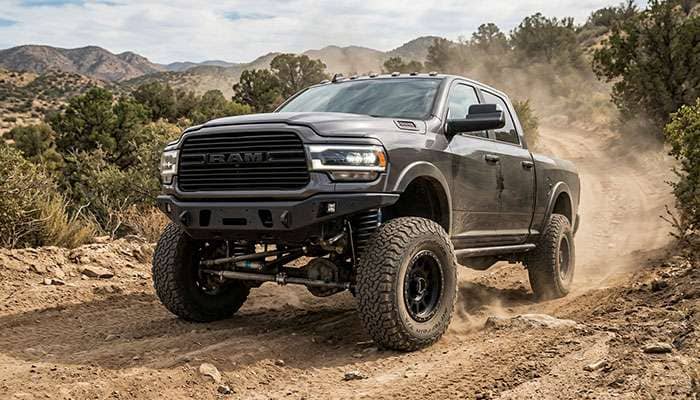
A 37 that fits on paper but not in a full-lock turn does not fail all at once. It works its way up the truck.
Every rung on that ladder ends at the same place: replacing a tire, a pair of ball joints, or a full set of 37s that should have been chosen differently the first time.
When you are ready to price it out, you can see wheels and tires matched to your truck on our Silverado 2500 HD wheel and tire page.
Will 37s fit a Silverado 2500HD with a leveling kit? They will, if the kit has upper control arms, the wheel has about 5 to 5.75 inches of backspacing, and you accept a light trim and a touch at full lock. A keys-only kit is built for 35s, and a ZR2 does not need keys at all. Then do the part nobody puts in front of you: add up the load index on your rear axle. A 37 can carry more than your factory tire, or fall hundreds of pounds short of your axle rating, depending on which one you buy.
A 2-inch keys-only level will not fit 37s cleanly on factory wheels. With wheels around 5 to 5.75 inches of backspacing and some trimming, a 37x12.50 can go on, but expect contact at full lock. Adding aftermarket upper control arms is what makes 37s work reliably.
For a truck you plan to keep, yes. Cranked torsion keys leave the factory upper ball joint at a steep angle and turn the arm into the droop stop. Aftermarket arms correct the angle, add bump stops and restore usable droop, which is why they are standard in the kits advertised for 37s.
On a 9-inch-wide wheel, 0 to +18 mm is the common window, which works out to about 5 to 5.75 inches of backspacing. Factory wheels put a 37 too close to the upper arm. Wide negative-offset wheels push it into the bumper valance and liner.
Owners report 37x12.50 tires on factory ZR2 wheels with no torsion bar changes. The ZR2 has its own control arms, knuckles, factory lift and DSSV dampers, and most aftermarket key kits exclude it. A 37x13.50 gets very close to the upper arm at full lock.
Check load index, not just the letter. Two rear tires must add up to at least the rear GAWR on your door label, often around 6,200 pounds. A Load Range D 37x12.50R17 at index 124 clears that; a Load Range C version does not. Consider Load Range F on 22-inch wheels or for heavy towing.
Yes. A taller tire lowers your effective gearing, reads slow on the speedometer, adds rotating weight for the brakes, and a softer sidewall can make a trailer feel looser. Choose a 37 with at least the factory load index, set pressure from the load tables and recalibrate the speedometer.