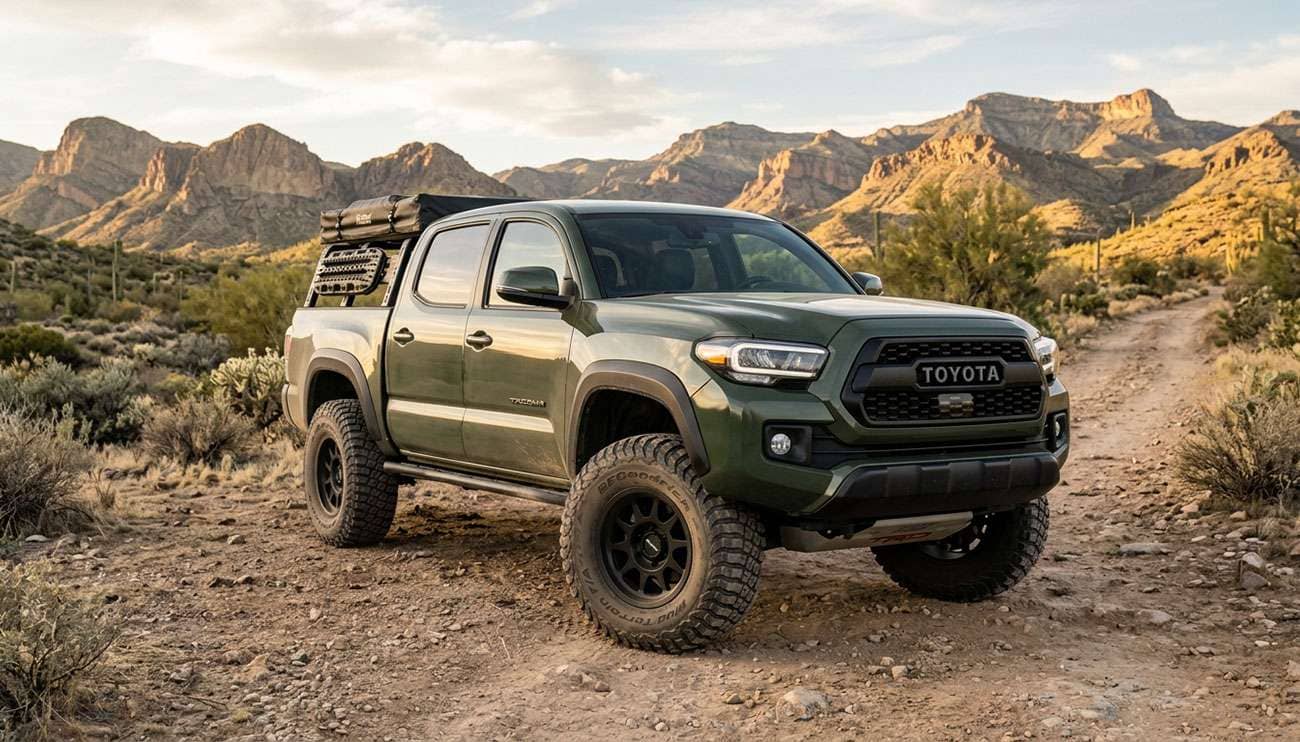
Short answer: not on a 2016-2023 Tacoma with a leveling kit alone. On that truck, 35s take about 3 inches of lift, a cab mount chop (cutting and welding the frame-mounted cab mount), and a few inches of fender liner trimming. On a 2024-and-newer Tacoma, Toyota moved the cab mount back, so it's a much closer call: a skinny 34 like a 285/75R17 goes on with a 2-inch level and the front crash plate unbolted, and a full 35 usually wants about 3 inches and the right wheel offset. The variable nobody names is the bump stop. A spacer-style leveling kit raises the truck at rest, but it doesn't move the bump stop, so at full compression the tire climbs exactly as far into the wheel well as it did stock. Most answers say "35s need a lift" and stop there. The lift is half the job. The cutting is the other half.
I'm Hank Feldman. I've been putting tires on trucks out of our Long Beach shop since 1971, and the Tacoma on 35s is one of the most asked-about builds we see. It's a great look. It's also the build where people spend the most money finding out what a leveling kit can't do. A leveling kit is a fine part. It just isn't a lift, and 35s know the difference.
Find your generation, then read across. "Level" here means a front spacer or strut-extension kit in the usual range for that truck.
Your Tacoma |
Factory Tire Height |
With a 2-3 Inch Level |
What a Full 35 Takes |
What Decides It |
|---|---|---|---|---|
2016-2023 (3rd gen) |
About 30.6 in |
33s (285/70R17) with liner trimming |
About 3 in of lift, cab mount chop, 2-3 in of liner and flare trimming, upper control arms |
The cab mount sits right behind the tire |
2005-2015 (2nd gen) |
About 30.5 to 31 in |
33s with liner trimming, often cab mount work |
The same path as a 3rd gen |
Same cab mount problem |
2024 and newer (4th gen), most trims |
30.5 to 31.6 in |
34s (285/75R17) with the crash plate removed |
About 3 in of lift, crash plate removed, +12 to +25 mm offset, alignment |
Offset and the bolt-on crash plate |
2024 and newer TRD Pro or Trailhunter |
33-inch class, already lifted 2 in front |
Kits are made for these trims; 35s are a common next step |
A trim-specific kit, crash plate removed, the right offset |
You're starting from a factory lift |
Read the 3rd gen row twice. The leveling kit is the cheap part of that build. The cab mount chop is the expensive part, and it's permanent.
"35" is a loose word. Several sizes get called 35s, and they don't fit the same, because width and weight change as much as height.
Size |
Height x Width |
Typical Weight |
Tacoma Notes |
|---|---|---|---|
285/75R17 |
33.8 x 11.2 in |
About 63 lb |
The "skinny 34"; the most a leveling kit realistically supports on a 4th gen |
315/70R17 |
34.4 x 12.4 in |
About 65 lb |
A metric 35 that's a little shorter and lighter than the flotation size |
35x12.50R17 |
35.0 x 12.5 in |
About 77 lb |
The true 35; widest and heaviest of the bunch |
285/75R18 |
34.8 x 11.2 in |
About 67 lb |
The narrow 35 for 18-inch 4th gen wheels |
35x12.50R18 |
35.0 x 12.5 in |
About 78 lb |
Same width problem as the 17-inch version |
For comparison, a factory 3rd gen 265/70R16 runs about 40 pounds, and a 4th gen 265/70R17 about 49. A true 35x12.50R17 nearly doubles the weight at each corner of a 3rd gen. That matters later, when we get to gears.
Not without cutting metal. The 3rd gen Tacoma came on tires about 30.6 inches tall: 245/75R16 or 265/70R16 on the SR, SR5, TRD Off-Road, and TRD Pro, 265/65R17 on the TRD Sport, and 265/60R18 on the Limited. A 35x12.50R17 is about 4.4 inches taller and 2.1 inches wider than the 265s. Front leveling kits for this truck typically run 2 to 3 inches. Do the math and you can see the problem before you touch a wrench.
The well-documented path to 35s on a 3rd gen is about 3 inches of lift as the bare minimum, a cab mount chop or relocation, roughly two to three inches of fender flare and inner liner trimming, and wheels around 0 mm offset. Guides that walk through the full build call 34s and 35s on this truck an advanced job, and I agree with them.
Here's the part nobody explains. Most Tacoma leveling kits are spacers or strut extensions. They push the front of the truck up at ride height, so the tire has more room while it's sitting in the driveway. What they don't change is the bump stop, the rubber stop on the frame that ends the suspension's upward travel. At full compression, over a dip or a curb or a whoop, the upper control arm hits the same bump stop it always did, and the tire ends up in the same spot inside the wheel well it did on a stock truck.
So a 35 that clears in the parking lot can still slam the liner, the pinch weld, and the cab mount the first time you hit a hard dip at speed. A leveling kit buys you clearance at ride height. It doesn't buy you clearance at full compression, and that's where a 35 lives off-road. Most front lifts on this truck's independent front suspension work the same way, which is why every 35 recipe for a 3rd gen includes cutting. The lift gets the tire off the liner at rest and adds height in the rear, which a front-only level doesn't. The trimming and the cab mount work make room for the tire at full compression.
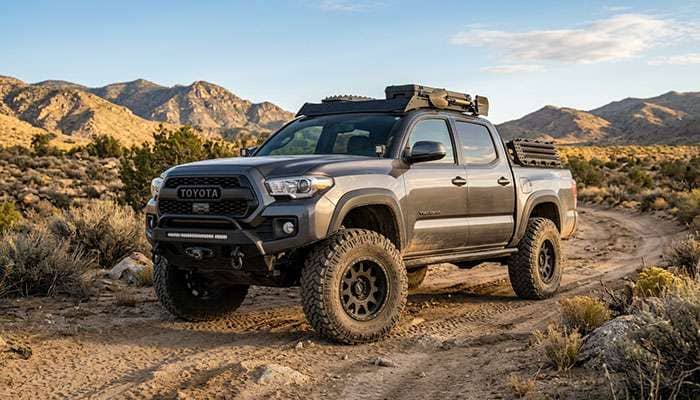
On the 2nd and 3rd gen Tacoma, the cab mount is a steel bracket on the frame just behind each front tire, and the rear of a big tire swings right into it at full lock. Even 33s can find it, depending on offset. For 35s, there are two fixes. A cab mount chop cuts the angled face off the mount and welds a flatter plate back on. A cab mount relocation moves the mount out of the way entirely. Builders who do this work say a chop clears 35s on the street but can still contact under articulation, and they point serious trail trucks toward relocation.
Either way, it's cutting and welding your frame. It doesn't come back off. Get it done by a shop that does them every week, and know before you start that the truck will never go back to stock.
Lift the front of a 3rd gen much past 2.5 inches and the factory upper control arms run out of adjustment. ICON's guidance is that above roughly 2.5 inches, the stock arms on some trucks have a hard time getting caster back into spec, and aftermarket arms solve it. Because 35s need about 3 inches, plan on upper control arms in the budget. That's also why most leveling kits for this truck stop around 3 inches: past that, you're into a lift whether you call it one or not.
A 2 to 3 inch level on a 3rd gen is a great match for 33s. A 285/70R17 at 32.7 inches is the classic pairing, usually with some liner trimming and the mud flaps off. If you want to stay bolt-on and keep the frame stock, that's where I'd stop. Our guide to 33s on a stock Tacoma covers where they rub before you level the truck at all.
Closer, and that's the big news with this truck. The 4th gen Tacoma is built on a new frame, and the cab mount sits further back than on the old trucks. A tire that would have needed a frame chop on a 3rd gen now runs into a bolt-on crash plate instead.
Factory tires are bigger to start. The SR and SR5 come on 245/70R17s at about 30.5 inches. The TRD PreRunner and TRD Off-Road get 265/70R17s at 31.6, and the TRD Sport and Limited get 265/65R18s, also about 31.6. The Trailhunter rides on a 265/70R18 at about 32.6, and the TRD Pro on a 33-inch-class Goodyear Territory R/T on 18-inch wheels.
Here's how the sizes stack up on a 4th gen. Suspension builders who sell kits for this truck rate a 34-inch tire like the 285/75R17 for a 2-inch level with the crash plate out, and a full 35 like the 35x12.50R17 for a 3-inch lift, the crash plate out, an alignment, and wheels in the +12 to +25 mm offset range. Owners have squeezed 35s onto 4th gens with less. One TRD Off-Road owner fit 35s on 0 mm offset, 8.5-inch-wide wheels and reported very minimal trimming after unbolting the mounts behind the tires. But "very minimal trimming" on a stock-height truck is the edge of the envelope, not the middle of it.
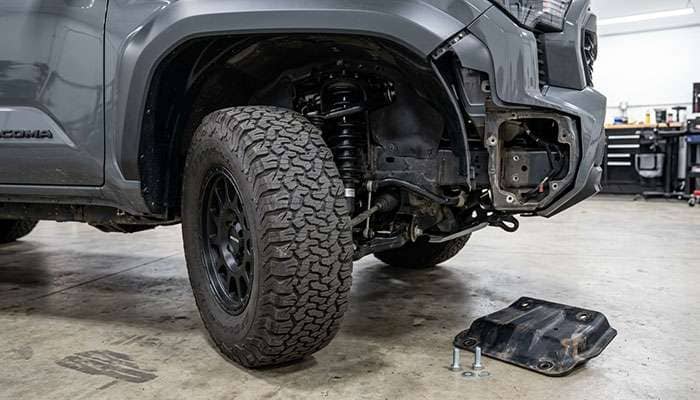
On the 4th gen, the first hard thing a big tire finds at full lock is a bolt-on plate behind the front wheel. It comes out with a couple of bolts per side, and builders say it gives back about four inches of room. That's why nearly every 34-and-up recipe for this truck starts with "remove the crash plate." It's reversible, which is a lot better than a frame chop.
I'll be straight with you, though. Toyota calls it a crash plate, and they put it there for a reason. Taking it off is common and it bolts right back on, but it's a factory piece in the front of your truck, not a splash shield. Make that call with your eyes open, and keep the plate and the bolts on the shelf.
Toyota says the TRD Pro sits two inches higher in front and an inch and a half higher in back, and the Trailhunter's suspension and tires add the same two inches in front and an inch and a half in back. Both come with forged aluminum upper control arms from the factory. So these trucks are already where a 3rd gen owner has to spend money to get. Kits made for these trims stack on top of that factory lift, and 35s are a common next step. Don't put a generic leveling kit meant for a TRD Off-Road on a TRD Pro or Trailhunter; buy the one built for your trim.
The Tundra owners on the shared platform are going through the same thing at a bigger scale. If you're curious how Toyota's full-size truck handles it, see 35s on a leveled Tundra.
It depends on the generation, and getting it wrong is how a 35 that fits turns into a 35 that rubs.
The 3rd gen came on low-offset wheels, roughly +10 to +30 mm depending on trim. The 35 builds that work on that truck generally run around 0 mm, pushing the tire out far enough to keep its inside edge off the upper control arm and frame. Go much lower and the outside edge of the tread starts hitting the fender, the bumper, and the cab mount at full lock, and you're cutting more.
The 4th gen is the opposite story. Factory wheels sit around +55 to +60 mm, which tucks the tire in deep. A wide 35 on factory-offset wheels runs the inside of the tire toward the suspension. Kit makers for this truck call for +12 to +25 mm with a 35, and warn that 0 mm and below starts rubbing at full lock, especially in reverse. Every millimeter of offset you take away moves the whole tire out by a millimeter. Our wheel offset and tire width package fitment guide walks through the math.
Because a spacer is offset you bolt on afterward, with an extra joint in the middle. On a 4th gen with factory wheels, a spacer will move a 35 out where it fits, but you've put more leverage on the wheel bearing and added another set of nuts to keep tight. I'd rather see the right wheel. If you're weighing it, read can wheel spacers stop tire rubbing first.
On a 3rd gen, plan on it. A taller tire acts like a taller final drive ratio. Going from a 30.6-inch factory tire to a 35 is about a 14 percent jump, which takes roughly 14 percent of your effective gearing away. Then add the weight. A 35x12.50R17 at about 77 pounds is nearly double the factory 265/70R16, and that's spinning mass the engine has to get moving every time you leave a light. The 3rd gen's V6 makes its power high in the rev range, so it feels that loss right away. Most owners going to 35s on that truck regear, and 4.88 is the common choice. Our guide to regearing after bigger tires covers the cost and how to pick a ratio.
On a 4th gen, the turbo four and the i-FORCE MAX hybrid make their torque much lower, and the factory tire is already bigger, so the jump to a 35 is about 11 percent on a TRD Off-Road and about 7 percent on a TRD Pro or Trailhunter. Many owners live with it. If you tow, carry a camper shell full of gear, or live at altitude, you'll feel it more.
A 35 on a 3rd gen that came on 30.6-inch tires reads about 60 when you're actually doing 69. On a 4th gen TRD Off-Road it's about 66, and on a TRD Pro or Trailhunter about 64. That's enough to get you a ticket, and enough to throw off shift points on some trucks. Have it recalibrated. Our guide to bigger tires and your speedometer explains why the error grows with speed.
No. On the 3rd gen, builders say anything over about 34 inches needs the spare relocated, and on the 4th gen, owners report that even a 33-inch 275/70R18 barely fits in the factory spot and has to be deflated to get it in. A 35 won't go. Budget for a bed-mounted or hitch-mounted carrier, and get a sixth wheel if you want the spare in your rotation. A truck on 35s with a 31-inch spare under the bed is a truck that limps home on a mismatched tire, and on a 4x4 that's not a great idea for long.
When 35s are jammed onto a Tacoma that isn't set up for them, the damage doesn't show up in the parking lot. It shows up over the next few thousand miles.
Every rung costs more than building the truck for 35s the first time. When you're ready to shop, start with your year and trim in our Toyota Tacoma tire and wheel finder; you can switch the year to match your truck.
A leveling kit is a good part on a Tacoma. On a 3rd gen it makes room for 33s, and on a 4th gen it gets you to a skinny 34. What it can't do is make room at full compression, because it doesn't move the bump stop, and that's where a 35 on a Tacoma gets into trouble.
On a 2016-2023 truck, 35s mean about 3 inches of lift, upper control arms, a cab mount chop, and real trimming, and the chop is permanent. On a 2024-and-newer truck, Toyota moved the cab mount out of the way, so it's 3 inches, the crash plate off, and the right offset, with the TRD Pro and Trailhunter starting two inches up already. Build it on purpose and the truck will thank you. When you're ready, start with our Toyota Tacoma tire and wheel finder.
On a 2016-2023 Tacoma, only with a cab mount chop, significant fender liner trimming, and aftermarket upper control arms. On a 2024-and-newer Tacoma, a 3-inch lift with the front crash plate removed and +12 to +25 mm offset wheels is the usual recipe.
On a 3rd gen, a 33 like 285/70R17, usually with some plastic liner trimming. On a 4th gen, a 34 like 285/75R17 with a 2-inch level and the bolt-on crash plate removed.
On a 2005-2023 Tacoma, yes, or a cab mount relocation. On a 2024-and-newer Tacoma, no; the cab mount sits further back, and the bolt-on crash plate is what you remove instead.
The true 35 is 35x12.50R17 or 35x12.50R18. Narrower options are 315/70R17 at about 34.4 inches and 285/75R18 at about 34.8, which fit more easily and weigh less.
On a 3rd gen, most owners do, and 4.88 is the common ratio. On a 4th gen, the lower-torque turbo engines and larger factory tires make it optional for many drivers, especially on the TRD Pro and Trailhunter.
No. Plan on a bed-mounted or hitch-mounted carrier. On a 4th gen, even a 33-inch spare barely fits in the factory location.