
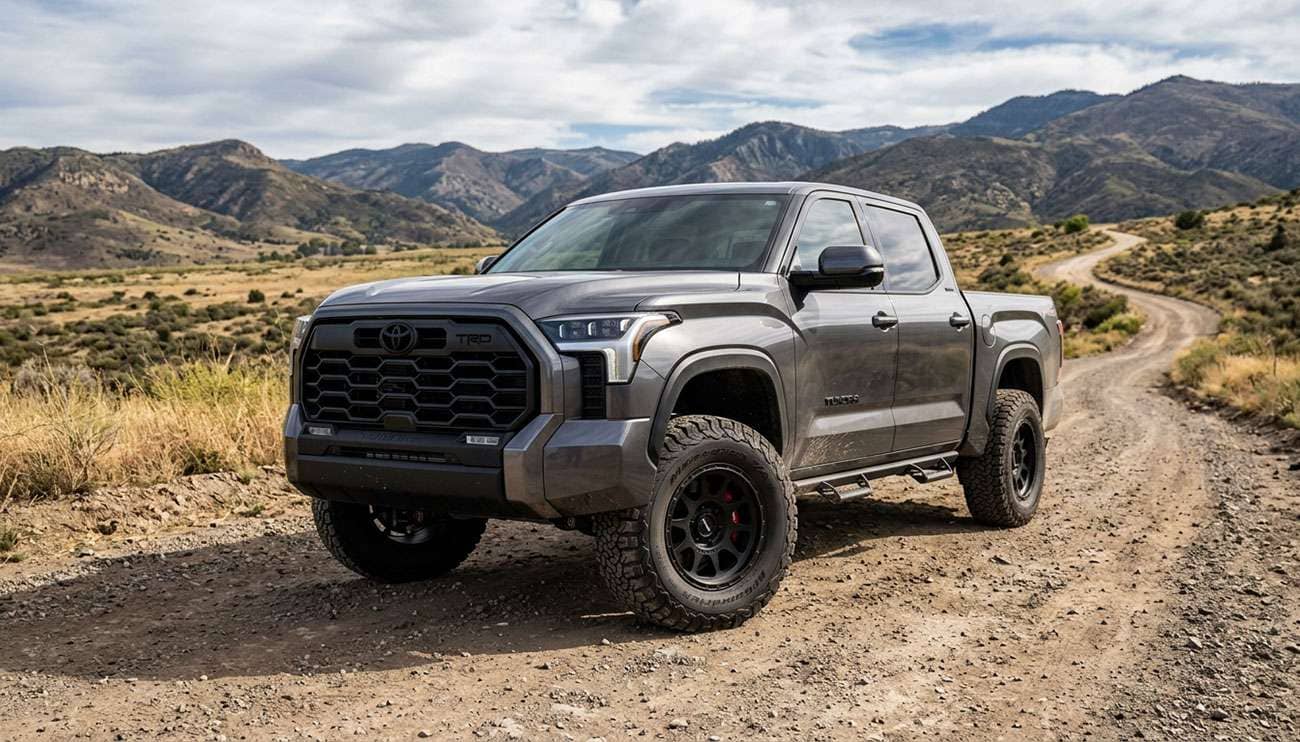
Yes, 35s fit a leveled Tundra, but a level alone rarely makes room for a full 35x12.50. Both the 2007-2021 truck and the 2022-and-newer truck ship on wheels with about +60 mm of offset, which tucks the tire in toward the cab mount and the upper control arm. A narrower 35, like a 285/75R18 at 11.2 inches wide, is the size that works with a level. A 35x12.50R20 on a 20x9 wheel is the practical limit, and it usually brings trimming with it. Most answers stop at the lift height. The width and the wheel are what decide it.
Here's how I sort a Tundra before anything gets mounted: generation, rear suspension, wheel offset, then tire width. Find your truck first.
Your Tundra |
Suspension |
How it levels |
Size that fits with a 2 in. level |
What a 35 takes |
|---|---|---|---|---|
2nd gen (2007-2021) |
Coilover front, leaf spring rear |
Front strut spacer, often with a rear block |
285/70R18 (33.7 in.), the most common leveled setup |
A narrow 285/75R18, or a 35x12.50 with a likely cab mount chop |
3rd gen with rear coils (2022+) |
Coilover front, coil spring rear |
Front strut spacer, optional rear coil spacer |
305/65R18 (33.6 in.) or 305/55R20 (33.2 in.) |
35x12.50R20 on a 20x9, with air dam and liner trimming |
3rd gen with rear air (2022+) |
Coilover front, load-leveling air rear |
Front strut spacer plus air-specific rear hardware |
About 34 in. on a 20x9 +18 wheel |
The same trimming, with a kit built for the air system |
TRD Pro (either generation) |
Factory off-road suspension; 2014-2021 has about 2 in. of front lift |
Often left alone; trim-specific kits exist |
Starts on 285/65R18 (32.6 in.) on the 3rd gen |
285/75R18 or 295/70R18 is the usual next step |
On both generations, a front leveling kit is a spacer on top of the front coilover, or a coilover set at a taller preload. It lifts the front 2 to 3 inches at rest and takes out the nose-down rake the truck leaves the factory with. Tundra kits are often sold by front-and-rear numbers, like "3/1" or "3/2," where the second number is a rear lift for owners who tow or haul and want to keep some rake.
The rear is where the two generations split. The 2nd gen rides on leaf springs, so rear lift comes from a block or longer shackles. The 3rd gen moved to a multi-link rear with coil springs, and Toyota offers a load-leveling rear air suspension on several upper trims. On those air trucks, leveling hardware has to work with the air springs and the rear ride-height sensor. Kits built for rear-air trucks use airbag spacers and an adjustable sensor bracket, and they aren't interchangeable with coil-spring kits.
What a level doesn't do matters more for 35s. It doesn't move the tire sideways, so the tire's inner shoulder still meets the cab mount and control arm at full lock. And it doesn't change where the tire goes at full compression, because the bump stop sets that. I walked through that second point in our breakdown of 35s on a leveled Silverado 1500, and the same physics apply to the Tundra.
Get an alignment after any level. Raising the front changes camber and caster, and a heavy 35 wears the edges fast when the alignment is off.
This is the variable nobody puts in front of you. Toyota builds both Tundra generations around high-offset wheels. The 2nd gen's 18x8 and 20x8 wheels run +60 mm, and the 17x8 runs +50. The 3rd gen's standard 18-, 20-, and 22-inch wheels run about +60 mm as well. A +60 mm wheel sits deep under the truck, and that puts a wide tire's inner shoulder close to the cab mount behind the tire and the upper control arm above it.
Wheel |
Backspacing |
Tire centerline vs. factory |
What it means for a 35 |
|---|---|---|---|
20x8 +60 (factory) |
6.86 in. |
Baseline |
A 12.50-wide tire tucks toward the cab mount and control arm |
20x9 +25 |
5.98 in. |
1.38 in. out |
A common wheel-builder pick for a leveled 2nd gen on 35s |
20x9 +18 |
5.71 in. |
1.65 in. out |
The offset most 3rd gen fitment guides and kit makers build around |
20x9 0 |
5.00 in. |
2.36 in. out |
Clears the inside easily; pushes the tread into the air dam and fender at full lock |
Every millimeter you take out of the offset moves the tire's outer edge the same distance toward the bumper and fender. That's the trade: lower offset clears the cab mount and control arm, then shifts the contact to the air dam, the fender liner, and the front of the wheel opening at full lock. It also adds leverage on the wheel bearing and the steering. Somewhere between +15 and +25 mm is where most Tundra builds on 35s land, because it splits that difference. If you're shopping wheels in that range, our Tundra wheel picks are a good start.
A hub-centric spacer on the factory wheel does the same thing a lower offset does. It's a legitimate option when it's done right, and our guide to wheel spacers and tire rub covers when a spacer solves rubbing and when it only moves it.
The 2nd gen came on tires right around 32 inches: 255/70R18 on the SR, 275/65R18 on the SR5, and 275/55R20 on the Limited and Platinum. It uses a 5x150 bolt pattern, which the 3rd gen dropped, so wheels don't carry over between generations. If you're matching wheels to that pattern, our 5x150 bolt pattern guide covers what shares it.
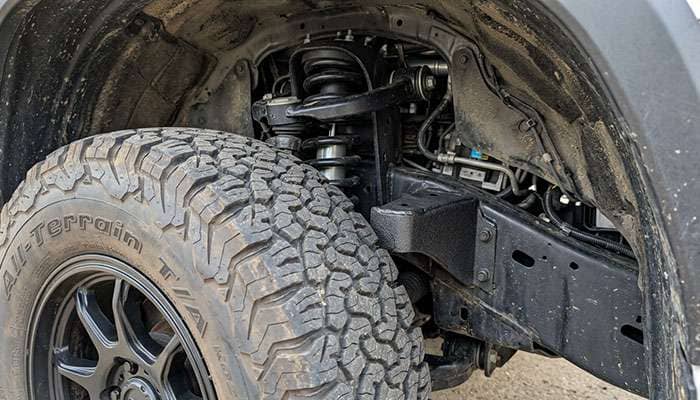
With a front level, a 285/70R18 at 33.7 inches is the most common setup on these trucks. It's a big step up in look without much cutting.
A 285/75R18 is 34.8 inches tall and 11.2 inches wide, about 1.3 inches narrower than a 35x12.50. That width difference is the whole story at the cab mount. One owner who had planned on 35x12.50s went with 285/75R18s on the factory +60 wheels specifically to avoid chopping the cab mount, and reported no rub on or off road. His truck was lifted, not just leveled, so treat it as a best case, but it shows what taking an inch-plus of width out does.
This is where the cab mount chop comes in. On a leveled 2nd gen, a 12.50-wide tire at full lock reaches the front cab mount, the steel bracket just behind the front wheel. One Tundra owner running 35x12.50R17s on 17x8.5 +25 wheels reported the tire hitting the body mount and chopped it. Expect to pull the front mud flaps and trim or remove the air dam too. Aggressive setups sometimes add aftermarket upper control arms.
A cab mount chop, or CMC, means cutting away the outer part of that bracket and welding a plate over it. It's permanent, and it's a job for someone who welds for a living.
The 3rd gen came on tires right around 32.5 inches on every trim: 245/75R18 on the SR, 265/70R18 or 265/60R20 on the SR5, 265/60R20 on the Limited, Platinum, and 1794, 285/65R18 on the TRD Pro, and 265/50R22 on the Capstone. It uses a 6x139.7 bolt pattern, the same as a lot of other half-tons; our 6x139.7 bolt pattern guide lists them.
Tire size |
Diameter |
Section width |
Construction and load |
Typical weight |
On a 2 in. leveled 3rd gen |
|---|---|---|---|---|---|
265/60R20 (common stock) |
32.5 in. |
10.4 in. |
Passenger-type from the factory |
About 45 lb |
Factory fitment |
305/55R20 |
33.2 in. |
12.0 in. |
Mostly LT, load range E or F |
About 61 lb |
Listed as no-rub on 20s |
305/65R18 |
33.6 in. |
12.0 in. |
LT, load range E or F |
About 67 lb |
Listed as no-rub on 18s |
295/70R18 |
34.3 in. |
11.6 in. |
LT, load range E, 129 (4,079 lb) |
About 66 lb |
Mud flaps off, liners re-pinned, +15 to +20 mm wheel |
285/75R18 |
34.8 in. |
11.2 in. |
LT, load range E, 129 (4,079 lb) |
About 67 lb |
The narrowest near-35; the easiest on the cab mount |
35x12.50R20 |
35.0 in. nominal |
12.5 in. |
LT, load range E (121) or F (125) |
About 79 lb |
Practical max on a 20x9; air dam and liner trimming, cab mount chop depending on offset |
Look at the two 305s. They're 12 inches wide and still listed as no-rub on a 2-inch level because they're only about 33.5 inches tall. Height and width both matter here, and the 35x12.50 is the only size in the table that's at the top of both.
For the full 35x12.50R20, published fitment guides for the 3rd gen call it the maximum on a 20x9 wheel "without major rubbing" on a 2-inch level. The work is pinning back the front and rear fender liners and trimming the front air dam, and depending on the wheel offset, a body mount chop. Step up to about a 3-inch lift and the same guides move a 35x12.50R18 into the recommended column on a +18 or +19 mm wheel.
Check the kit before you check the tire. One major rear-air leveling kit lists a 295/60R20 on a 20x9 +18 wheel, about 34 inches, as its no-trim maximum, and excludes the hybrid and TRD Pro trucks. Rear-air hardware is specific to that system, so confirm which rear suspension your truck has and buy the kit made for it.
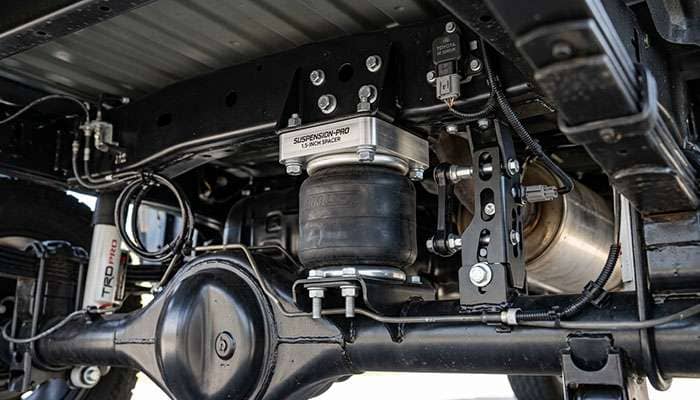
Yes, because it starts from a different place. The 2014-2021 TRD Pro came with about 2 inches of factory front lift, so many owners skip the level entirely and go straight to tires. The 2022-and-newer TRD Pro rides on FOX shocks with coil springs at all four corners and ships on 285/65R18 Falken Wildpeak A/T3W tires at about 32.6 inches.
On either TRD Pro, the natural next step is a 285/75R18 or a 295/70R18. You keep the 18-inch wheel, you gain more than 2 inches of height, and you stay narrower than a 35x12.50. Leveling kits for the TRD Pro are trim-specific, so don't assume a kit for an SR5 will fit.
Rub starts as a noise and works its way up. Here's the usual order on a Tundra, from cheapest to most expensive.
Every step on that list costs more than getting the width and offset right up front.
Most factory Tundra tires are passenger-type. A stock 275/65R18 in passenger construction is typically a 116 load index, 2,756 pounds. The 35-class sizes are LT tires: most 285/75R18s and 295/70R18s are load range E at a 129 load index, 4,079 pounds, and 35x12.50R20s split between load range E at 121 (3,197 pounds) and F at 125 (3,638 pounds). Those numbers only apply at maximum pressure, 80 psi for E and 95 psi for F.
FMVSS 110, the federal standard behind your door placard, requires a vehicle's tires to carry its maximum load at the recommended pressure. When you switch to LT construction, keeping that true is your job. Use the Tire and Rim Association load-and-inflation tables to set a pressure that matches your original capacity, especially if you tow. Our Tundra tire fitment guide covers the load side in more detail.
A typical 275/55R20 is around 47 pounds. A typical 285/75R18 is about 67, and a typical 35x12.50R20 is about 79. That's 20 to 32 pounds added at every corner, all of it rotating and unsprung, and you'll feel it in braking, acceleration, and fuel economy.
Going from a 32-inch stock tire to a 34.8-inch 285/75R18 makes the tire turn about 8 percent fewer times per mile. At an indicated 65, you're doing about 70. A true 35 puts you closer to 71. Program the new size into the truck so the speedometer and odometer read correctly, and expect the truck to feel about 8 to 9 percent softer off the line, the same as if the axle gears were that much taller.
Here's the order I'd work in, and most of it happens before you spend a dollar.
So, will 35s fit a Tundra with a leveling kit? Yes, if you choose the 35 around the wheel. On factory +60 mm wheels, a narrow 285/75R18 or a 295/70R18 is the realistic near-35 on a level. A full 35x12.50R20 needs a wheel in the +15 to +25 mm range, liner and air dam work, and on some trucks a cab mount chop. On a 3rd gen, check whether the rear is coil or air before you buy a kit, and on a TRD Pro, start from the taller front end it already has. Get the generation, the wheel, and the width right, and the level does the rest.
Not on a standard Tundra. Stock suspension tops out around 33 inches of tire. A 35 needs at least a front level, and on factory +60 mm wheels it needs to be a narrower size like a 285/75R18.
Most setups use 2 to 3 inches of front lift. On a 2022-and-newer Tundra, a 2-inch level with a 20x9 wheel is the published maximum for a 35x12.50R20 without major rubbing. The level alone doesn't clear the cab mount; tire width and wheel offset do.
It's a tight fit. The factory 20x8 +60 mm wheel tucks a 12.50-wide tire toward the cab mount and upper control arm. Most builds use a 20x9 wheel between +15 and +25 mm, or choose a narrower 285/75R18 or 295/70R18 on the factory 18-inch wheels.
Often with a full 35x12.50, especially on a leveled 2nd gen. A narrower 285/75R18 usually avoids it. On a 3rd gen, fitment guides say a body mount chop may be needed depending on wheel offset.
Yes, with a kit made for it. Rear-air kits use front strut spacers plus rear airbag spacers and an adjustable ride-height sensor bracket, so the air system keeps working. Coil-spring kits aren't interchangeable, and some rear-air kits exclude the hybrid and TRD Pro trucks.
About 35 inches. On a 2-inch leveled 3rd gen, a 35x12.50R20 on a 20x9 wheel is the practical maximum with trimming. For 35x12.50R18s without major trimming, or anything taller, plan on a 3-inch or larger lift.



