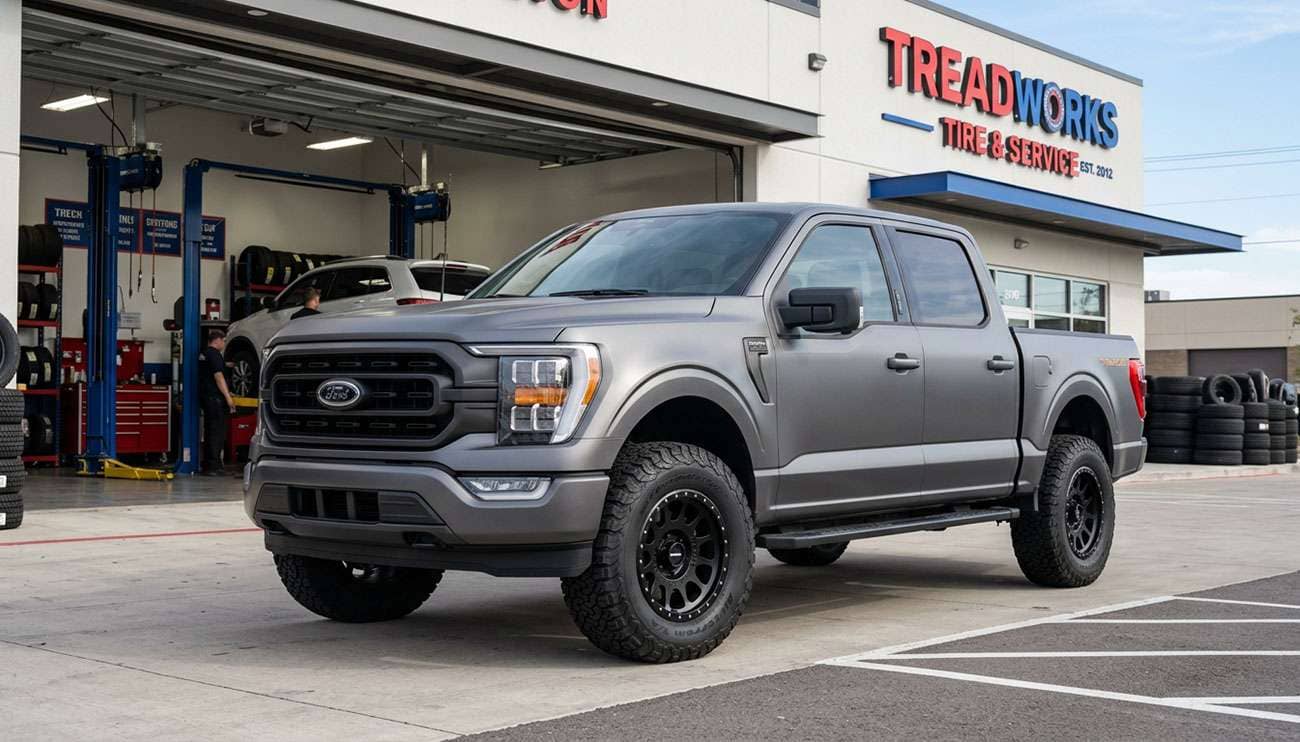
Short answer: plan on about $2,800 to $6,200 for most trucks, and anywhere from $1,400 to more than $15,000 at the ends of the range. The tires are the predictable part, roughly $1,200 to $2,000 for a set of four. What swings the bill is what your truck has to change to clear and turn them: nothing, a level, a lift, or new gears. Most price guides give you one big range and stop. Here is what moves you from one end of it to the other.
I'm Hank Feldman. I opened the doors in Long Beach in 1971, and I've quoted a lot of 35s since. The customer who walks in with a tire budget is rarely the one who gets surprised. The one who gets surprised is the guy who budgeted for tires and wheels and then found out his truck needed a level, a trim job, an alignment, and maybe gears. Let's put all of it on the table up front.
What Your Truck Needs |
Typical Trucks |
What You're Paying For |
Ballpark All-In |
|---|---|---|---|
Nothing; it already runs 35s |
F-150 Raptor, Bronco Sasquatch, Colorado ZR2 Bison, Silverado HD ZR2 Bison, Super Duty Tremor |
Tires, mounting, balancing |
About $1,400 to $2,400 |
Level, new wheels, light trimming |
Most half-tons and 3/4-tons on a 2 to 2.5 in level |
Tires, wheels, leveling kit, alignment, liner trim |
About $2,800 to $6,200 |
4 to 6 in suspension lift |
Trucks that won't clear on a level, or owners who won't trim |
Tires, wheels, lift kit and install, lifted alignment |
About $4,200 to $12,100 |
Lift plus regear |
Trucks with tall factory gears, or that tow |
Everything above, plus ring and pinion on both axles |
About $5,700 to $15,100 |
Those totals assume middle-of-the-market tires and wheels and shop installation. They leave out sales tax, state tire fees, a fifth tire for the spare, and speedometer calibration, which I'll cover below.
Most 35s on the market run about $290 to $490 a tire, which puts a set of four at roughly $1,200 to $2,000. That's the middle half of the market. Budget tires start lower and premium tires in 22-inch sizes go higher.
The wheel diameter moves the price more than people expect, and so does the load range. Here's where the money lands by wheel size.
Wheel Size |
Common 35 |
Tire, Each (Middle of Market) |
Wheel, Each (Middle of Market) |
Load Range Mix |
|---|---|---|---|---|
17-inch |
35x12.50R17, 315/70R17 |
About $290 to $420 |
About $220 to $345 (17x9) |
Mostly Load Range E |
18-inch |
35x12.50R18 |
About $295 to $455 |
About $235 to $370 (18x9) |
About half E, a large share F |
20-inch |
35x12.50R20 |
About $305 to $490 |
About $260 to $450 (20x9 to 20x10) |
Roughly half E, half F |
22-inch |
35x12.50R22 |
About $305 to $560 |
About $345 to $535 (22x10) |
Slightly more F than E |
Tread type matters less than you'd think at this size. All-terrain, rugged-terrain, and mud-terrain 35s overlap heavily in price. The bigger swings come from the brand tier, the wheel diameter, and the load range, which gets its own section below.
One more option worth pricing: a narrower 35. A 295/65R20 is about 35.1 inches tall but close to an inch narrower than a 35x12.50R20. It usually costs more per tire, but on a lot of trucks that inch of width is the difference between trimming the fender liner and not.
Not always, but the wheels decide more of the fit than the tires do. A 35x12.50 wants a wheel about 8.5 to 11 inches wide, and most factory truck wheels are in that range, so a 35 will usually mount on what you have. Whether it fits the truck is a different question.
Factory truck wheels sit at positive offset; on most half-tons it lands somewhere around +18 to +44 mm. That tucks the tire inboard, which is great for a stock tire and bad for a 12.5-inch-wide one, because the inside edge heads straight for the upper control arm and the frame at full lock. Most aftermarket off-road wheels go the other way. The middle of the market in 17x9 runs around -6 mm, and in 20x10 it runs around -18 mm. That pushes the tire out, clear of the suspension and right into the fender liner and the bumper corner.
That is the trade every 35 buyer makes: offset decides whether you're paying for trimming or for a lift. Our guide to wheel offset and tire width as a package shows how the two numbers work together.
If you do buy new wheels, budget for these:
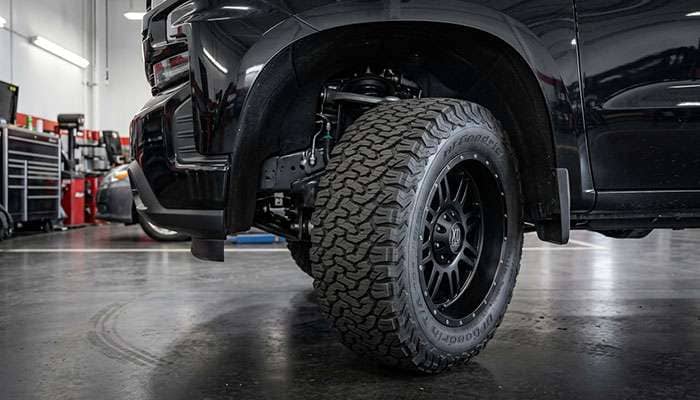
A leveling kit usually runs about $100 to $400 in parts, and about $400 to $900 installed. It raises the front of the truck 2 to 2.5 inches to match the rear, which most trucks come with from the factory as rake. That front lift is the cheapest clearance you will ever buy.
On most half-tons and a lot of 3/4-tons, a level gets a 35 under the truck. It does not usually make it rub-free. Owners running 35s on a 2-inch level commonly pull the mud flaps and trim the plastic fender liner, because the level does nothing about full-lock clearance at the back of the wheel opening. Our piece on leveling a Silverado for 35s walks through exactly where they touch. Trimming is a DIY job for a lot of guys, or an hour or two of shop time at the going labor rate, which runs roughly $85 to $160 an hour depending on where you live.
The kit type depends on the front suspension, and that changes the price:
After any level, add an alignment. A standard four-wheel alignment runs about $100 to $175 at a mainstream shop, and our 2026 wheel alignment cost guide has the full breakdown. Skipping it is how you wear out a new set of 35s years early.
When the truck won't clear on a level, or when you don't want to cut anything. Some trucks hit the frame, the upper control arm, or the body mount with a 35 no matter how much you trim, and a level does not move the tire away from those parts. Others clear with trimming, but the owner would rather keep the plastic intact.
A suspension lift costs real money:
Which trucks need it is a fitment question, and it varies more by model than by brand. Our lift kit tire size chart lays out how much lift each common truck needs for each tire size.
Sometimes, and it is the line item that can double the job. A 35 is roughly 2 to 3 inches taller than the tire most half-tons ship on, which makes your gearing effectively taller by about 6 to 9 percent. The truck feels slower, the transmission hunts for gears on hills, and towing gets harder on the transmission.
Whether you need gears depends on what your truck came with. A Silverado 1500 on its factory 3.42 gears is close enough that a lot of owners skip it, especially with a V8. A Ram 1500 on 3.21s or an F-150 on 3.31s is a different story. A regear on a 4WD truck, both axles, runs about $1,500 to $3,000 installed, and our article on regearing after bigger tires has the ratio chart by truck.
If you are going to need gears eventually, do them with the lift. The axles are already apart and you only pay for the alignment once.
This is the cheapest place to save money, and almost nobody looks at it. Nearly every 35 is an LT tire, but they come in Load Range E (10-ply rated) and Load Range F (12-ply rated). On 17-inch wheels, most 35s are E. On 20-inch and 22-inch wheels, a big share are F.
On a half-ton that doesn't tow heavy, F is more tire than the truck needs. It's heavier, it rides stiffer, and it wants more air. It also costs more: in 20-inch, the Load Range F versions of 35x12.50R20 typically run about $70 more per tire than the E versions. That's close to $300 a set for capacity a light truck may never use. On a 3/4-ton or a truck that pulls a camper, the F earns its keep.
Whichever you buy, don't run it at the pressure on your door sticker. That sticker was set for the factory tire. An LT tire gets its pressure from the tire maker's load-inflation table, at the load your truck actually puts on it. If you want the bigger picture on how load range drives tire prices, our article on whether $1,000 is a good price for four tires runs the numbers on E versus P-metric.
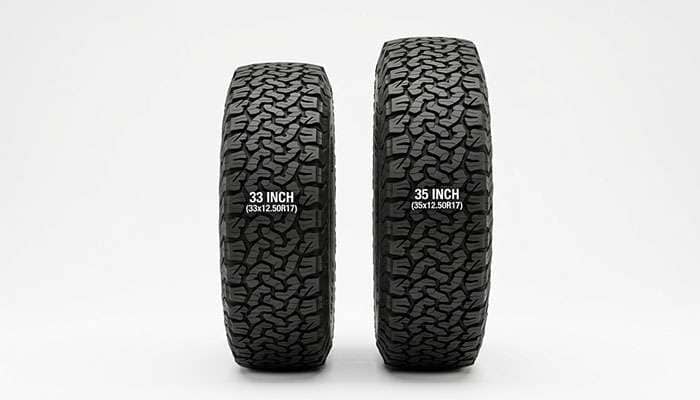
Before you spend a dime on 35s, price out 33s. Not because 33s are better, but because the difference is a lot bigger than the tire price makes it look.
On the tires alone, the gap is real but modest. A 285/70R17, the most common 33 on 17-inch wheels, typically runs about $90 less per tire than a 35x12.50R17. A 275/60R20 typically runs about $125 less per tire than a 35x12.50R20. That's roughly $350 to $500 on a set of four.
The bigger savings is what the truck doesn't need. A 275-wide 33 fits a lot of half-tons stock or on a level with little or no trimming, the factory gears usually handle it fine, and most 33s on 20-inch wheels are passenger-type tires that ride softer and cost less than Load Range E or F. On some trucks and SUVs, a 33 is already the factory size. Moving from the lift-and-gears row of the table at the top to the level-only row is a several-thousand-dollar decision, and the tire size is usually what makes it.
If what you want is the stance and a little more ground clearance, a 33 often gets you there. If you want the clearance off-road, the look of a big sidewall, or you're already planning a lift, 35s are where most builds land. Just know which of those you're paying for.
The spare is the line item almost everybody leaves off the first quote. A fifth tire runs the same $290 to $490 as the other four, and a fifth matching wheel adds another $220 to $450.
Skipping it has a cost too. Tire makers say the tires on a 4WD truck should be closely matched in diameter, because a mismatch makes the drivetrain work against itself. A factory 32-inch spare under a truck on 35s is close to three inches shorter, so treat it as a get-you-home tire at low speed, not a tire to drive on for days. And check whether a 35 will even fit your spare carrier before you buy one. Some trucks need a bed-mounted or rear carrier to hold it.
Every one of the line items above is optional on paper. Here is what skipping them costs once the tires are on the truck.
Skip the trimming: you pay for liners and sidewalls. A 35 that rubs at full lock chews the fender liner first, pops its clips, and then finds the pinch weld and the bumper brackets behind it. Metal cuts rubber, and a cut sidewall is a new tire, not a patch.
Skip the alignment: you pay for tires. A level or lift changes camber and toe. Skipping the alignment can cost you $300 to $800 in premature tire wear, and on 35s it costs more than that, because the tires cost more.
Skip the speedometer: you pay at the pump and on the odometer. A 35 on a truck that came on a 32 reads about 9 percent slow. At an indicated 65, you're doing about 71. Calibration runs roughly $50 to $400 depending on whether a dealer can reprogram it or you need a programmer. Some newer trucks can't be reprogrammed by the dealer at all, so ask before you buy.
Skip the gears when you need them: you pay in transmission heat. A truck that's hunting between gears on every grade and running hot when it tows is wearing out a transmission that costs far more than a regear.
Buy the wrong load range: you pay every day. Too little and you're overloading the tire when you tow. Too much and you're riding on a stiff, heavy tire you paid extra for.
Expect to lose roughly 1 to 3 mpg on 35s no matter what you do right. That's the cost of a bigger, heavier, more aggressive tire, and it's worth knowing before you buy.
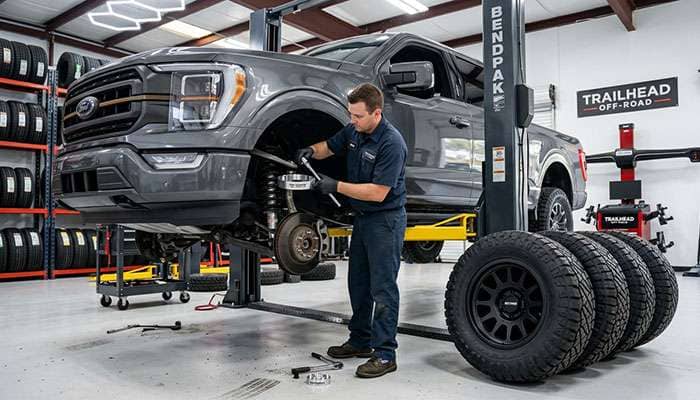
Get a real number before you start, not after.
Step 1: Find out what your truck needs to clear them. Nothing, a level, a lift, or trimming. That one answer sets most of the budget.
Step 2: Check your gears. Look up your axle ratio from the build sheet or the axle tag, and decide if you need to regear now or later. If it's likely, plan it with the lift.
Step 3: Pick the wheel diameter. 17s give you the most sidewall, the most tire choices, and usually the lowest price. 20s and 22s cost more and lean toward Load Range F.
Step 4: Pick the load range for how you use the truck. E for most half-tons. F if you're on a 3/4-ton or tow heavy.
Step 5: Pick the offset for the path you chose. Lower offset means more trimming on a leveled truck. Closer to factory offset keeps the tire inboard but may need a lift to clear the suspension.
Step 6: Add the line items. Mounting and balancing, TPMS, alignment, a fifth tire if you want a matching spare, speedometer calibration, and tax.
Step 7: Price it as a package. Tires and wheels bought together usually arrive mounted and balanced, with the size and offset already matched. Start with our wheel and tire packages for your truck. Our side-by-side on whether wheel and tire packages are cheaper shows where the savings come from.
Putting 35s on a truck costs about $1,400 if your truck already runs them, about $2,800 to $6,200 for the most common route of a level, wheels, and some trimming, and $4,200 to more than $15,000 once you add a lift and gears. The tires themselves are about $1,200 to $2,000 a set in the middle of the market, and they're the one number that doesn't move much.
What moves it is the truck. Find out what yours needs to clear and turn a 35 before you price a single tire, pick an offset that matches the path you chose, and don't pay for Load Range F unless you'll use it. I've been doing this since 1971, and the customers who end up happy are the ones who knew the whole number before the first lug nut came off.
On a truck that clears 35s with a leveling kit, plan on about $2,800 to $6,200 for tires, wheels, the level, an alignment, and some fender liner trimming. If your truck already runs 35s from the factory, replacing them costs about $1,400 to $2,400 installed.
Most 35-inch tires run about $290 to $490 each in the middle of the market, or roughly $1,200 to $2,000 for a set of four. 17-inch sizes tend to cost the least and 22-inch sizes the most.
Not always. Many half-tons and 3/4-tons fit 35s on a 2 to 2.5 inch leveling kit with some fender liner trimming and the right wheel offset. Trucks that hit the frame or control arms, or owners who don't want to trim, need a suspension lift, usually 4 to 6 inches.
It depends on your factory gears and how you use the truck. Trucks with numerically low gears, like 3.21 or 3.31, usually benefit from a regear, especially if they tow. A regear on a 4WD truck runs about $1,500 to $3,000 installed.
Often, yes. A package usually arrives mounted and balanced, which can save a separate mounting bill, and the wheel offset and tire size are matched before anything ships.
Yes. Expect to lose roughly 1 to 3 mpg from the added weight, rolling resistance, and taller effective gearing. Heavier Load Range F tires and aggressive mud-terrain treads sit at the worse end of that range.