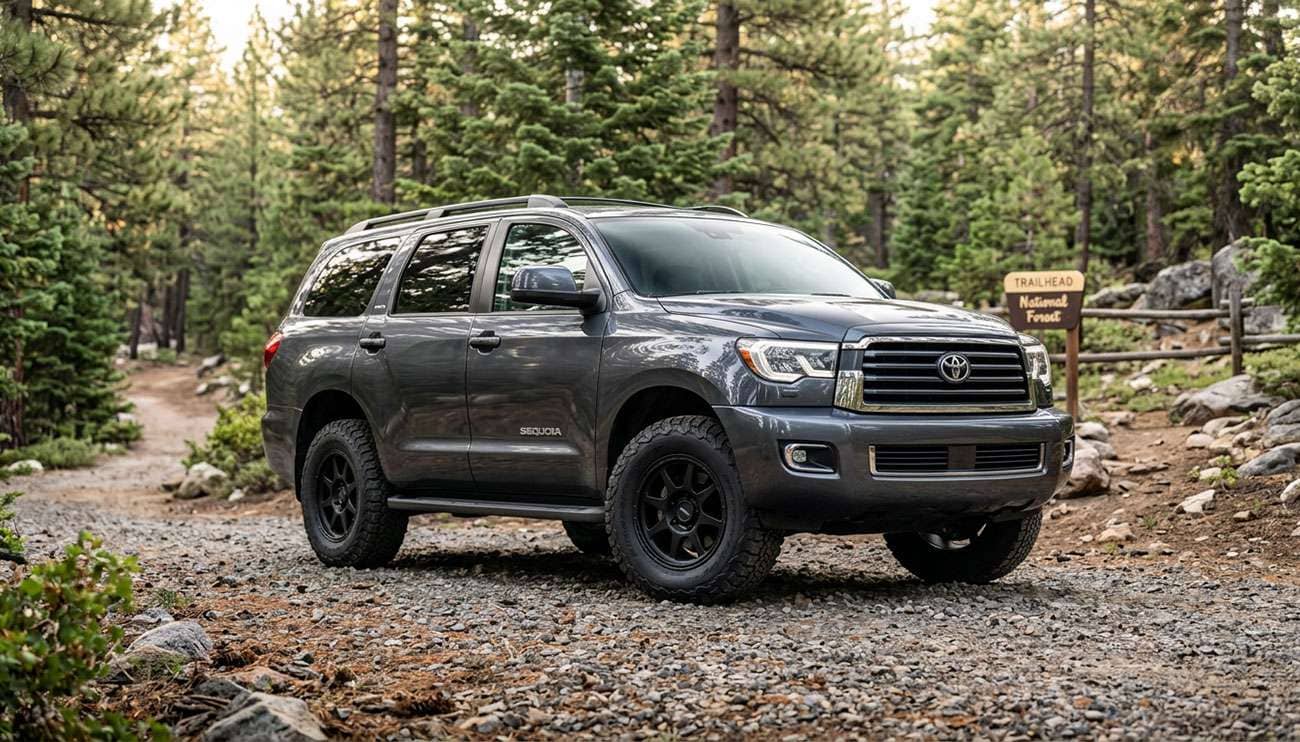
Short answer: yes, at stock height, on every Sequoia built since 2008. On a 2008-2022 Sequoia, a 275/70R18 (33.2 inches) fits on factory-offset 18-inch wheels, and owners report no rubbing. On a 2023-and-newer Sequoia, the factory tire is already about 32.6 inches, so a 33 is barely a half-inch step. The 2001-2007 Sequoia is the exception: 33s rub there without a lift. The variable nobody names is construction. Nearly every 33-inch tire is LT Load Range E, and the 2008-2022 Sequoia came on passenger tires at 33 psi. An LT 33 needs about 43 psi to carry what the factory tire did. Most answers stop at "33s fit, no lift needed." That's true, and it's the smaller half of the job.
I'm Dennis Feldman, and I run fitment at Performance Plus Tire. Sequoia owners ask this one a lot, usually right after they've priced a lift. The good news is that a Sequoia has big wheel wells, and a 33 is a modest step. What trips people up is that "Sequoia" means three different trucks with three different wheel setups, and "33" means at least five tire sizes with different widths. Pick the right pair and it's a bolt-on. Pick the wrong pair and you're trimming plastic.
Start with your model year and wheel size. The "33 that fits" column is the size owner reports and the numbers support at stock height on factory-offset wheels.
Your Sequoia |
Factory Tire and Wheel |
Factory Height |
33 That Fits Stock |
What Decides It |
|---|---|---|---|---|
2008-2022, 18-inch (SR5, TRD Pro, some Limited) |
P275/65R18 114 on 18x8 +60 |
32.1 in |
275/70R18 (33.2 in) |
Nearly all are LT; run about 43 psi, not the 33 on the placard |
2008-2022, 20-inch (Limited, Platinum, TRD Sport) |
P275/55R20 on 20x8 +60 |
31.9 in |
275/60R20 (33.0 in) |
Mostly sold as passenger tires, so placard pressure still works |
2023 and newer, 18-inch (SR5, TRD Off-Road) |
265/70R18 on 18x7.5 +60 |
32.6 in |
275/70R18 (33.2 in) |
Whether your factory tire says LT on the sidewall |
2023 and newer TRD Pro |
285/65R18 on 18-inch BBS, about +47.5 |
32.6 in |
285/70R18 (33.7 in) or 33x12.50R18 |
Already the widest factory tire; owners report no rubbing at 33 |
2023 and newer, 20- or 22-inch (Limited, Platinum, 1794, Capstone) |
265/60R20 on 20x8 +60, or 265/50R22 |
32.4 to 32.5 in |
275/60R20 (33.0 in) |
Match the construction on your factory tire |
2001-2007, 16-inch |
265/70R16 on 16x7 +14 (some later trucks on 265/65R17) |
30.6 in |
None; 285s rub the upper control arm |
A 285/75R16 needs different wheels or a lift |
"33" covers several sizes, and they aren't interchangeable. Width and offset matter more than height for rubbing, and construction matters more than either for how much air you run.
33-Inch Size |
Height x Width |
What the Market Mostly Sells |
Sequoia Notes |
|---|---|---|---|
275/70R18 |
33.2 x 10.8 in |
LT Load Range E, 125/122 (nearly all of them) |
The easy fit on any 2008-and-newer Sequoia on 18s |
275/60R20 |
33.0 x 10.8 in |
Passenger, 115 (about 4 in 5) |
The 33 for 20-inch trucks that want to stay on passenger tires |
285/70R18 |
33.7 x 11.2 in |
LT Load Range E, 127/124 |
Owners report it clearing at stock height on both later generations; tighter than the 275 |
33x12.50R20 |
33.0 x 12.5 in |
LT, all of them |
The widest 33; owner-reported clear on factory 20s, offset decides the rest |
285/70R17 |
32.7 x 11.2 in |
LT Load Range E, 121/118 (about 4 in 5) |
Only on a 17-inch wheel that clears the brakes |
Yes. The second-generation Sequoia came on a P275/65R18 at 32.1 inches on 18x8 wheels, or a P275/55R20 at 31.9 inches on 20x8s, both at +60 mm offset. Going to a 275/70R18 adds 1.1 inches of height and no width, since both tires are 275 mm across. Only half of that extra height is below the axle, so the truck sits about half an inch higher, and the tire grows about half an inch toward the fender at the top.
The owner reports line up. On a long-running thread about the biggest tires on a stock second-gen, one owner ran 275/70R18 Falken Wildpeaks on factory-offset Tundra TRD 18s at stock height and reported no rubbing at all. Another ran LT275/70R18s with no lift and no rub. A 2020 TRD Pro owner at stock height went a step further with 285/70R18s and reported no contact with the upper control arms or skid plate at full lock. Another owner on factory +60 wheels measured about an inch of clearance to the upper control arm and sway bar, which is where it gets tight as tires get wider.
Width and offset, not height. The clearest rubbing report in the owner threads came from a 285/60R20 on 20x9.5 wheels at 0 mm offset. That tire is only about 33.5 inches tall, but it's 11.2 inches wide and pushed 60 mm further out than a factory wheel. The owner had to remove the front lower bumper flap and the mud guards, and it still touched the body at full lock over a dip.
That's the rule on every Sequoia: a 275-wide 33 near the factory +60 mm offset is the easy fit. Every 10 mm of extra width and every millimeter of lower offset moves the tread closer to the bumper cover and mud flaps at full lock. If you want the wider, pushed-out look, plan on trimming or leveling. The trade-off is laid out in wheel offset and tire width package fitment.
The 2008-2022 Sequoia shares its front end with the 2007-2021 Tundra, and P275/65R18 to 275/70R18 is one of the most common upgrades on those trucks too. We walked through that exact pair in 275/70R18 instead of 275/65R18. The second-gen Sequoia uses the Tundra's 5x150 bolt pattern, a 110 mm hub bore, and M14 x 1.5 studs, so Tundra wheels from those years bolt straight on. Few other vehicles use 5x150, as the 5x150 bolt pattern guide shows, so Tundra take-offs are the deepest pool of used wheels.
Yes, and it's a smaller step than most people expect. The third-gen Sequoia rides on the same platform as the 2022-and-newer Tundra, and Toyota already put near-33s on it. The SR5 and TRD Off-Road get a 265/70R18 at 32.6 inches on 18x7.5 wheels. The 20-inch trims get a 265/60R20 at 32.5. The Capstone's 265/50R22 is 32.4. The TRD Pro's 285/65R18 is 32.6. A 275/70R18 adds about half an inch of height and 10 mm of width.
Owners report plenty of room. A 2023 TRD Pro owner ran 33x12.50 all-terrains with no lift or leveling kit and reported no rubbing or contact at all. A 2024 Platinum owner put 275/65R20s on the factory 20s, about 34 inches tall, with no rubbing and nothing removed. At the far end, one owner squeezed 35x12.50R18s onto a stock TRD Off-Road on 18x9 wheels at +20 mm, but had to trim about a quarter inch from the inner fender flares and still rubbed over fast dips. That's the ceiling. A 33 is well under it.
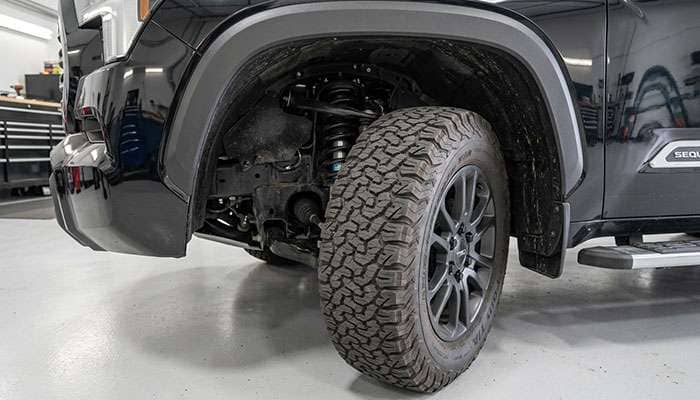
The 2023-and-newer Sequoia uses a 6x139.7 bolt pattern with a 95 mm hub bore, the same as the current Tundra. Nothing from a 2008-2022 Sequoia bolts on. Wheels from a 2022-and-newer Tundra do, and the 6x139.7 bolt pattern guide covers what else shares the pattern and where the hub bores differ.
The third-gen TRD Pro comes on a 285/65R18, already the widest factory tire on the truck and within half an inch of a 33. Toyota doesn't list a lift for it; its extra ground clearance comes with the FOX internal-bypass coilovers and the wider tire package. The natural next step is a 285/70R18 at 33.7 inches, same width, about 1.1 inches taller, and owners report 285/70R18s clearing at stock height on third-gens too. If you want to go past 34, that's leveling-kit territory, and the 35s on a leveled Tundra guide covers the shared platform.
Only on a 17-inch wheel built to clear the brakes. A 285/70R17 is 32.7 inches tall and 11.2 wide, the classic 33 on Tacomas, 4Runners, and Jeeps. No 2008-and-newer Sequoia came on 17-inch wheels from the factory, and both later generations carry big brakes. Aftermarket wheel makers have built specific 17-inch designs with a reshaped barrel just to clear the 2007-2021 Tundra's brake package, which the second-gen Sequoia shares.
Owner evidence is thin and mixed. One second-gen owner runs 285/70R17s on aftermarket 17s but had to bevel a lip to make them seat, and another described 17s as fitting, but very close to the caliper. On the third-gen, every Sequoia is a hybrid with larger calipers, and one supplier notes its 17x7 TRD Pro-style wheels need spacers or about an eighth of an inch ground off the caliper to clear. Some aftermarket 17s do fit.
If you want a 33 on a smaller wheel for more sidewall off-road, buy a 17 that the maker lists specifically for your Sequoia generation, and bolt one bare wheel on and spin it before you mount tires. Otherwise, a 275/70R18 gets you the same height on the wheels you already own.
Not at stock height without work. The first-gen Sequoia came on a 265/70R16, about 30.6 inches, on 16x7 wheels at +14 mm offset, and some later trucks got a 265/65R17 of about the same height. The common 16-inch 33, a 285/75R16, is about 32.8 inches tall and 11.2 wide, more than two inches taller than stock.
Owners report that 285s on the stock wheels rub the upper control arm. One shop told an owner a 285/75R16 wouldn't work on the factory rims without different-offset wheels or a suspension change, and owners running 285/70R17s on later first-gens reported minor rubbing when turning. A 265/75R16 at about 31.6 inches is the realistic stock-height step on these trucks. The first-gen uses 6x139.7 like the third-gen, but with a 106 mm hub bore, so check before assuming a newer Toyota wheel will seat. The progression is a lot like a 4Runner's, and our guide to 33s on a stock 4Runner walks through the same kind of steps.
On a 2008-2022 Sequoia, more than the door placard says. This is the part of the swap the forum threads skip.
The second-gen placard calls for 33 psi front and rear with the P275/65R18, and 30 front, 33 rear with the P275/55R20. Those numbers were set for passenger tires. A P275/65R18 is rated 114, which is 2,601 pounds, and on an SUV the tire industry counts a passenger tire at its rating divided by 1.10, about 2,365 pounds.
Nearly every 275/70R18 you'll be offered is an LT Load Range E, and an LT tire's capacity depends on its air pressure. Under the tire industry's light truck load table, an LT275/70R18 carries 2,070 pounds at 35 psi, 2,270 at 40, and 2,470 at 45. To match the factory tire's 2,365 pounds, you need about 43 psi. At the placard's 33 psi, each tire carries less than 2,070, roughly 300 pounds short per corner on a truck that weighs about 5,700 pounds empty. Why LT and passenger tires behave so differently at the same pressure is covered in P-metric vs LT tires.
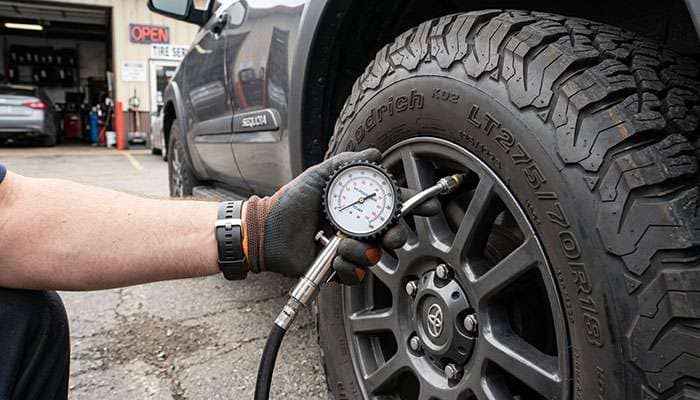
Your TPMS won't catch it. Under NHTSA's FMVSS 138, the low-pressure light comes on at 25 percent below placard, which on a 33 psi Sequoia is about 25 psi. An LT tire that needs 43 can sit at 30 all day without a warning. Check it with a gauge.
A 275/60R20 is the one 33 that's mostly sold in passenger construction, typically rated 115. That's 2,679 pounds, about 2,435 counted on the Sequoia, which is more than the factory P275/55R20 carried. On a 20-inch second-gen, a passenger 275/60R20 runs at the placard pressure with no math at all.
The third-gen placard calls for 35 psi with the 265/70R18 and 285/65R18, and 36 with the 265/60R20. Toyota has fitted both LT and passenger 265/70R18s from the factory, so read yours. If it starts with LT, an LT275/70R18 keeps the same construction, carries more at the same pressure because it holds more air, and runs fine at the placard. If it's a passenger tire rated 116, the same math applies as on a second-gen: an LT275/70R18 needs about 46 psi to match it. These are heavy trucks, 5,620 to 6,185 pounds at the curb with GVWRs up to 7,615, so the load math matters.
A little on a second-gen, barely on a third-gen. Going from the factory P275/65R18 to a 275/70R18 is a 3.4 percent increase in diameter, so when the speedometer reads 60, you're doing about 62. On a 2023-and-newer, the factory 265/70R18 is already 32.6 inches, so the 275/70R18 is only 1.7 percent bigger, and 60 on the dash is about 61 on the road. TRD Pro owners going from 285/65R18 to 285/70R18 see the same 3.4 percent as a second-gen. None of these steps is big enough to call for a regear. A shop with the right programmer can recalibrate if the 2 mph gap bothers you.
A 33 that's wrong for your truck doesn't announce itself in the driveway. It shows up at full lock in a parking lot, or 300 miles into a loaded road trip.
Every rung costs more than getting the size, offset, and pressure right the first time. When you're ready, start with your model year and trim in our Toyota Sequoia tire and wheel finder, and switch the year to match your truck.
A 33 is one of the easiest upgrades you can make to a 2008-and-newer Sequoia. On a second-gen, a 275/70R18 on factory-offset 18s or a 275/60R20 on 20s fits at stock height, and owners report no rubbing. On a third-gen, the factory tire is already within half an inch of a 33, and owners report 33s and even 34s clearing with nothing trimmed. The 2001-2007 trucks are the exception, and wheels never carry across generations.
The part that needs attention is the air. Nearly every 33 is LT Load Range E. On a Sequoia that came on passenger tires, that means about 43 to 46 psi instead of the number on the door, or you're short on load at every corner with no warning light to tell you. Get the width, the offset, and the pressure right, and the truck won't know the difference. Start with your year and trim in our Toyota Sequoia tire and wheel finder.
On 2008-and-newer Sequoias, owners report 33-inch tires fitting at stock height with no rubbing, and some report 34-inch sizes like 275/65R20 clearing as well. Past that, expect trimming or a leveling kit. On a 2001-2007 Sequoia, even 33s rub without changes.
Yes. Owners of 2008-2022 Sequoias report no rubbing with 275/70R18 on factory-offset 18-inch wheels, and on a 2023-and-newer Sequoia it's only about half an inch taller than the factory tire.
On 18-inch wheels, 275/70R18 (33.2 inches). On 20-inch wheels, 275/60R20 (33.0 inches). Both keep a 275 mm width, which is the easiest fit at stock height.
If your factory tires were passenger tires, LT Load Range E 33s need about 43 psi on a 2008-2022 Sequoia and about 46 psi on a 2023-and-newer to carry the same load. If your factory tires were already LT, or you choose a passenger 275/60R20, use the placard pressure.
Within the same platform, yes. 2007-2021 Tundra wheels fit a 2008-2022 Sequoia (5x150), and 2022-and-newer Tundra wheels fit a 2023-and-newer Sequoia (6x139.7). Wheels do not cross between generations.
On a 2008-2022, a 275/70R18 reads about 2 mph slow at 60. On a 2023-and-newer, the change is about 1 mph at 60, because the factory tire is already close to 33 inches.