
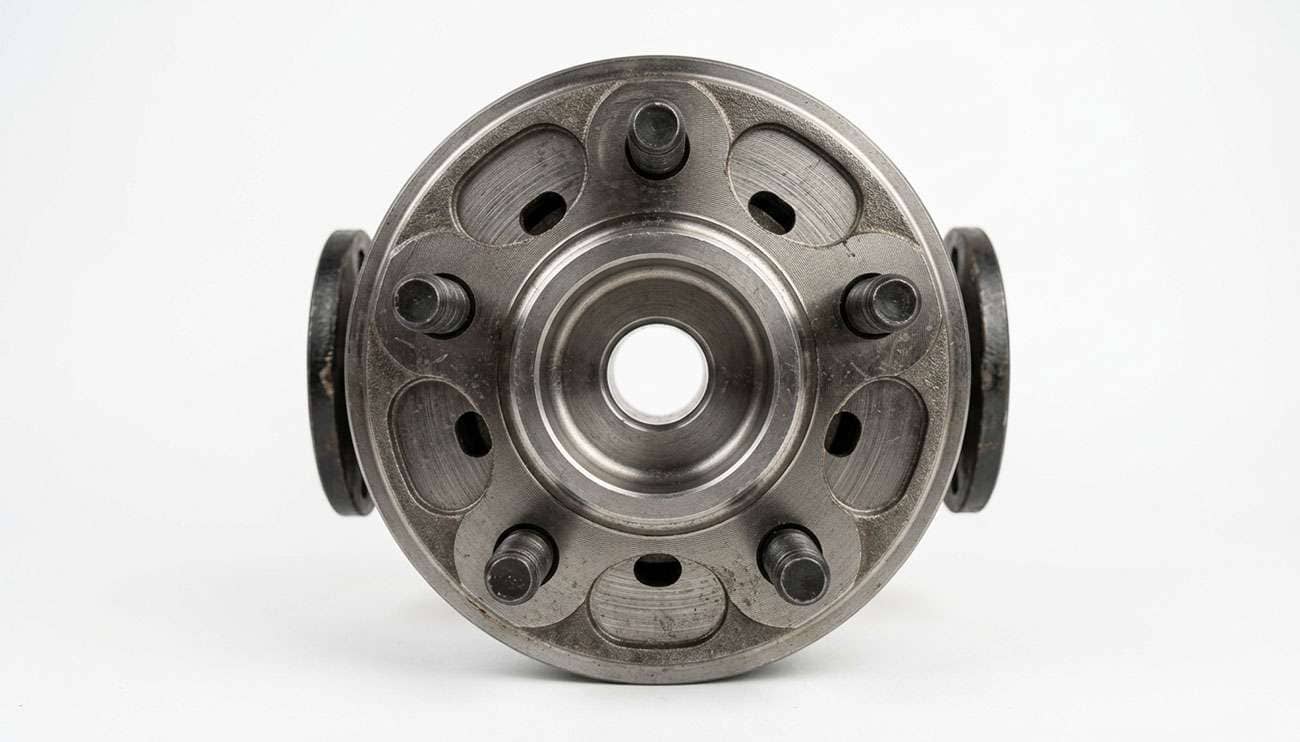
Four nameplates, and only in specific model years: the Toyota Tundra from 2007 to 2021, the Toyota Sequoia from 2008 to 2022, the Toyota Land Cruiser from 1998 to 2021, and the Lexus LX470 and LX570 from 1998 to 2021. That is the whole list. The Lexus GX has never used 5x150 in any year, despite showing up on nearly every list you will find. And no vehicle currently in production uses it, because Toyota moved the entire family back to six lugs starting in 2021.
I have been fitting wheels to Toyota trucks since the eighties, and this pattern generates more returned wheels than any other five-lug on the board. Not because it is complicated. Because every list that ranks for this question tells you the model and skips the year.
Go look at the answer Google is showing right now. It names the Sequoia, Land Cruiser, Tundra, LX, and GX. Four of those five are right some of the time and wrong the rest of the time, depending entirely on the model year. The fifth, the GX, is flat wrong in every year it has ever been built. A guy reads that, buys a set of 5x150 wheels for his GX460, and they will not go on the truck. I have had that phone call more times than I want to count.
So here is the list with the years attached, which is the only way this list is worth anything.
Vehicle |
Years With 5x150 |
Generation |
Hub Bore |
|---|---|---|---|
Toyota Tundra |
2007 to 2021 |
Second generation, XK50 |
110mm |
Toyota Sequoia |
2008 to 2022 |
Second generation |
110mm |
Toyota Land Cruiser |
1998 to 2021 |
100 series and 200 series |
110mm |
Lexus LX470 |
1998 to 2007 |
100 series platform |
110mm |
Lexus LX570 |
2008 to 2021 |
200 series platform |
110mm |
That is it. Not a partial list, not a starting point. Five entries covering four nameplates, all of them Toyota Motor Corporation, all of them body-on-frame, all of them built in a roughly 24-year window that has now closed.
You will occasionally see 5x150 turn up on a Land Cruiser 70 series or a 105 series in export markets, and on a handful of heavy trailer hubs. Neither of those is going to be sitting in a driveway in Long Beach. For anything sold in the United States, the table above is complete.
What makes this pattern worth understanding rather than just looking up is that 5x150 is genuinely rare. Out of the 73 distinct bolt patterns we carry in our wheel catalog, this one is the only five-lug that sits out this far. Nothing else is close to it. That cuts both ways: your wheel selection is narrower than an F-150 owner's, but every wheel that fits your Tundra also fits a Land Cruiser and an LX570, which quietly widens your options for factory takeoffs and used sets.
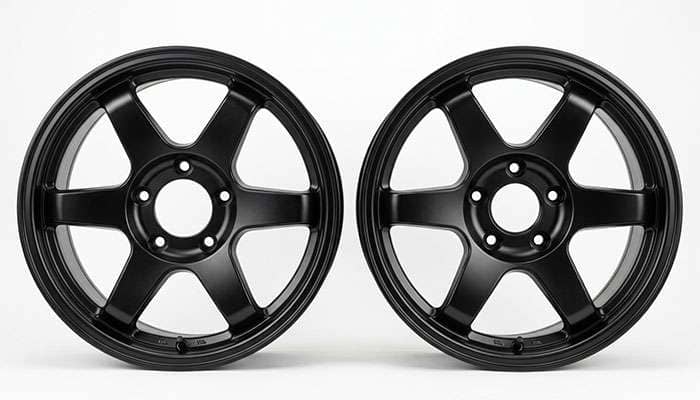
Here is the part nobody puts in front of you. Every one of those four nameplates ran a different bolt pattern before it ran 5x150, and three of the four have already switched back. Same badge on the tailgate, different pattern on the hub.
Vehicle |
Before 5x150 |
5x150 Years |
After 5x150 |
|---|---|---|---|
Tundra |
2000 to 2006: 6x139.7 |
2007 to 2021 |
2022 and up: 6x139.7, 95mm bore |
Sequoia |
2001 to 2007: 6x139.7 |
2008 to 2022 |
2023 and up: 6x139.7, 95mm bore |
Land Cruiser |
80 series and earlier: 6x139.7 |
1998 to 2021 |
2024 and up US 250 series: 6x139.7 |
Lexus LX |
LX450, 1996 to 1997: 6x139.7 |
LX470 and LX570, 1998 to 2021 |
LX600, 2022 and up: 6x139.7 |
Read that table sideways and you will see the trap. A 2006 Tundra and a 2007 Tundra are one model year apart and share nothing at the hub. A 2021 Tundra and a 2022 Tundra, same thing. That is two separate cliff edges on one nameplate, fifteen years apart, and a guy shopping used wheels on a marketplace listing that just says "Tundra wheels" has a real chance of landing on the wrong side of one of them.
The Land Cruiser is the worst of the bunch, because the model went away from the US market for a few years and came back on a completely different platform. If you have a 200 series, you are 5x150. If you bought the new one, you are six lug, and it shares its wheels with a Tacoma. Our Land Cruiser wheel fitment guide covers the offset side of that for both platforms.
Same story on the Lexus side. LX450 owners are six lug, LX470 and LX570 owners are 5x150, LX600 owners are back to six lug. Three patterns across one nameplate. If you are shopping for any Lexus truck, our Lexus aftermarket wheel guide is worth reading before you buy anything.
I want to spend a minute on this one because it is the single most common bad piece of information about 5x150, and it is sitting in the answer box on Google as I write this.
The Lexus GX has used 6x139.7 in every year it has ever been produced. GX470 from 2003 to 2009, GX460 from 2010 to 2023, GX550 from 2024 forward. All six lug, all 6x139.7. It has never been offered with 5x150 in any market, any trim, any year.
The confusion is easy enough to explain. The GX wears a Lexus badge and sits next to the LX in the showroom, and the LX genuinely was 5x150 for a long stretch. But under the sheet metal they were never the same truck. The GX has always ridden on the Prado platform, which is the same bones as the 4Runner and the FJ Cruiser, and that whole family has always been 6x139.7. The LX rode on the full-size Land Cruiser platform, which is where 5x150 lived.
If you own a GX of any year, you want 6x139.7, and our 6x139.7 compatibility guide is the page you need instead of this one. Do not order 5x150 wheels for a GX. They will not go on, and no adapter you buy at a swap meet is going to make it right.
5x150 equals 5x5.9 inches. Five lugs on a bolt circle 150 millimeters across, which converts to 5.9055 inches. You will see it printed as 5x5.9 or occasionally 5x5.91, and both mean the same pattern.
That first number is the stud count and the second is the pitch circle diameter, which is the diameter of the imaginary circle running through the center of all five stud holes. On a five-lug wheel you cannot measure that circle straight across from one hole to the one opposite, because there is no hole directly opposite. You measure from the back edge of one hole to the center of the hole two positions over. Our walkthrough on how to measure a lug bolt pattern shows the technique with a tape.
Here is why the conversion is worth knowing rather than just filing away. 5x150 is the widest common five-lug pattern in production. For comparison, 5x139.7 is 5x5.5 inches, 5x127 is 5x5 inches, and 5x114.3 is 5x4.5 inches. Toyota went out to 5.9 inches because a 24-inch bolt circle spread across five studs on a truck rated for real payload needs the leverage. The wider you spread the studs, the better the clamp load resists the twisting force the wheel puts into the hub under load and braking.
That is also why nobody else uses it. 5x150 was Toyota solving a Toyota problem on a Toyota platform. It was never an industry standard, and no other manufacturer adopted it.
This is where I have to give you an answer with two halves, because the honest answer is no and also frequently yes, and which one applies has nothing to do with either number.
The straight answer: 5x5.5 is 5x139.7, and 5x139.7 is not 5x150. The two bolt circles are 10.3 millimeters apart. If you take a wheel drilled only for 5x139.7 and hold it up to a 5x150 hub, the studs do not line up and never will. You cannot force it, you cannot wallow the holes out, and there is no wobble bolt or offset lug that closes a 10.3mm gap safely. Anybody who tells you different is going to get somebody hurt.
The reason people keep asking: a lot of 5x150 wheels are drilled for both. When we ran our own catalog, 1,526 of the 3,808 in-stock 5x150 wheels we carry are dual-drilled 5x139.7 and 5x150. That is 40 percent of them. Ten holes around the face, two patterns, one wheel.
So a guy sees a wheel listed as 5x139.7 / 5x150, correctly concludes it fits both, and comes away thinking the two patterns are interchangeable. They are not. The wheel is interchangeable. The pattern is not.
What that means practically:
If you are cross-shopping between the two patterns, our rundown on 5x5.5 wheels lays out what that pattern covers so you can tell quickly which side of the line your truck falls on.
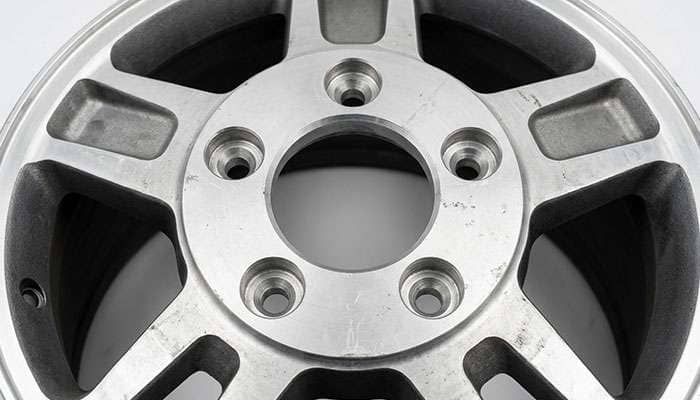
The bolt pattern is the first gate, not the only one. Four things have to line up before a wheel actually fits one of these trucks.
Bolt pattern: 5x150. Non-negotiable, either drilled for it or drilled for it as part of a dual pattern.
Hub bore: 110mm. This is the one people skip. Toyota's hub on all five vehicles in the table is a 110mm register, and across our own 5x150 inventory, 96 percent of the wheels come bored at 110mm or within a few tenths of it. The hub bore is what actually carries the weight of the truck. The studs clamp the wheel against the hub face; they are not meant to carry the vehicle in shear. If the wheel's bore is larger than 110mm, which happens on aftermarket wheels built to fit multiple platforms, you need hub-centric rings to fill that gap. Skip the rings and you get a vibration at highway speed that no amount of balancing will fix, and eventually you get stud fatigue. Our piece on hub-centric versus lug-centric wheels explains exactly why this matters.
Thread and seat: M14x1.5, conical seat on most aftermarket wheels. Factory Toyota alloys on these trucks use a different seat arrangement than a lot of aftermarket wheels, so the lug nuts that came off your OE wheels are frequently not the right nuts for your new ones. Buy the nuts with the wheels. This is a twenty dollar item that people try to save on and then wonder why the wheel keeps coming loose.
Load rating. These are heavy trucks. A loaded Tundra or a Land Cruiser with a family and gear in it puts real weight on each corner. Most 5x150 wheels we carry are rated at 2,500 pounds per wheel, with a substantial group rated at 3,200 pounds for heavier applications. Do not buy a wheel rated below what your truck needs because you liked the finish. Check the sticker on the door jamb for your gross axle weight rating and divide by two.
Offset and diameter. Across the 5x150 wheels in our catalog, offsets run from -106mm all the way to +60mm, and the most common sizes are 20 inch by a wide margin, followed by 18, 22, and 17. The offset spread is enormous, so the pattern being right does not mean the stance will be. If you want the offset discussion specific to the Tundra, our Tundra wheel guide gets into what actually clears without rubbing.
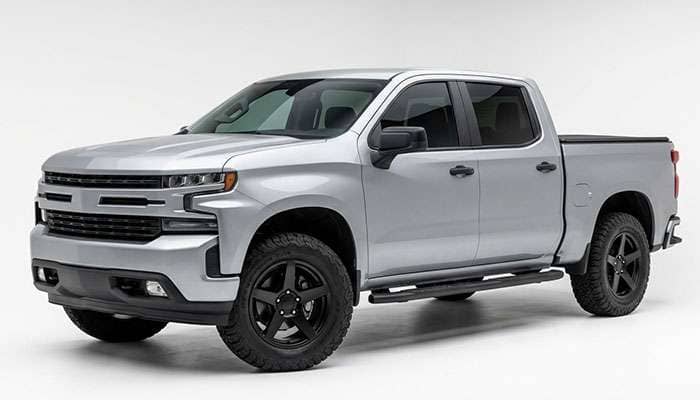
Worth understanding, because it tells you what happens to your wheel options over the next ten years.
Starting in 2021, Toyota moved its entire body-on-frame lineup onto one shared platform architecture. The new Tundra, the new Sequoia, the new Land Cruiser, the new Tacoma, the new 4Runner, the LX600, and the GX550 all sit on it. Building one hub for the whole family is cheaper than building two, and the six-lug 6x139.7 pattern with a 95mm bore was already what the Tacoma and 4Runner used and what the rest of the truck industry uses.
So 5x150 went away. Not because it was a bad pattern, it was a perfectly good pattern, but because it was the odd one out in a lineup that was consolidating.
What that means for you if you own one of these trucks: 5x150 is now a legacy pattern with a fixed, non-growing installed base. The newest vehicle that uses it is a 2022 Sequoia. In practical terms you have got a solid decade before selection starts thinning, and right now the aftermarket support is still strong, but it is not going to get better. If you have been putting off a wheel purchase on a 200 series or a second-gen Tundra, that is worth knowing.
The upside is that the pattern is shared cleanly across four desirable trucks with overlapping ownership. Takeoff wheels from a Land Cruiser bolt to a Tundra. LX570 factory alloys bolt to a Sequoia. That is a real advantage, and it is the reason the used market for 5x150 wheels stays healthy.
I have seen every version of this go bad. Here is the order it usually happens in.
The best case is you catch it in the driveway. You hold the wheel up to the hub, the studs do not line up, and you are out a restocking fee and a return shipment. Annoying, cheap, over with.
The next case is the bore. Pattern is right, wheel goes on, torque feels fine, and you get a vibration above 55 that shows up a week later. You take it back for a balance, it does not help. You take it somewhere else, they balance it again, it still does not help. Two or three visits in, somebody finally measures the bore and finds it is 110 on the hub and 106 or 116 on the wheel with no ring in it. You have now paid for three balances you did not need.
Then it gets expensive. A wheel that is riding on the studs instead of the hub register puts cyclic shear load into five pieces of hardware that were never designed to carry it. Studs stretch. Lug nuts back off, and they back off unevenly, which loads the remaining ones worse. If you have ever heard somebody say their lug nuts keep coming loose no matter how carefully they torque them, this is usually why. Left alone long enough, studs snap.
The bad ending is a wheel separation at speed, and I am not being dramatic. That is what a sheared set of studs on a three-ton truck actually looks like. It is rare because it takes a chain of ignored warnings to get there, but every single link in that chain starts with a wheel that was not right at the hub.
None of this is exotic. It is a bolt pattern, a bore, and a set of nuts, and all three take about four minutes to verify before you order.
5x150 is a small, closed club: second-generation Tundras from 2007 to 2021, second-generation Sequoias from 2008 to 2022, Land Cruisers from 1998 to 2021, and the LX470 and LX570 across the same span. No Lexus GX, no first-generation Tundra, no new truck built in the last few years.
The mistake almost everyone makes with this pattern is treating it as a property of the model when it is a property of the model year. Toyota changed it twice on the same nameplates, and the lists floating around the internet mostly have not caught up to the second change, let alone gotten the GX right.
Know your year, verify your bore, and buy the nuts with the wheels. Do those three things and this pattern will never give you a minute of trouble.
Ready to shop? Browse our 5x150 bolt pattern wheels, or call the shop with your year and model and we will confirm the fitment before anything ships. That call is free and it has saved a lot of people a return shipment.
The Toyota Tundra from 2007 to 2021, the Toyota Sequoia from 2008 to 2022, the Toyota Land Cruiser from 1998 to 2021, and the Lexus LX470 and LX570 from 1998 to 2021. All five use a 110mm hub bore. No vehicle currently in production uses 5x150, because Toyota moved its truck lineup back to 6x139.7 starting in 2021.
5x150 equals 5x5.9 inches. The 150 is the pitch circle diameter in millimeters, which converts to 5.9055 inches. You will sometimes see it written as 5x5.91. It is the widest common five-lug pattern in production, wider than 5x139.7 which is 5x5.5 inches.
No. 5x5.5 is 5x139.7, and the two bolt circles are 10.3mm apart, so a wheel drilled only for 5x139.7 will not mount to a 5x150 hub. The confusion comes from dual-drilled wheels: roughly 40 percent of the 5x150 wheels in our catalog are drilled for both 5x139.7 and 5x150. Those wheels fit either hub, but that does not make the patterns interchangeable. Check the stamp on the back of the wheel.
A wheel drilled 5x150 or dual-drilled including 5x150, with a 110mm hub bore or hub-centric rings to fill the gap, M14x1.5 lug nuts with a seat type matching the wheel, and a load rating that meets or exceeds half your gross axle weight rating. Bolt pattern alone is not enough; the bore is what actually carries the truck.
No. The Lexus GX has used 6x139.7 in every model year, across the GX470, GX460, and GX550. It rides on the Prado platform shared with the 4Runner, not the full-size Land Cruiser platform where 5x150 was used. The GX appears on many 5x150 vehicle lists in error.
6x139.7 with a 95mm hub bore. The third-generation Tundra returned to six lugs, so wheels from a 2007 to 2021 Tundra will not fit it and vice versa. The 2023 and newer Sequoia and the 2024 and newer US Land Cruiser made the same change.
If both are in their 5x150 years, yes, the pattern and the 110mm bore match. A 1998 to 2021 Land Cruiser wheel will bolt to a 2007 to 2021 Tundra. Offset and width still need to work for your setup, but the mounting is a direct fit. This overlap is one of the practical advantages of owning a 5x150 vehicle.



