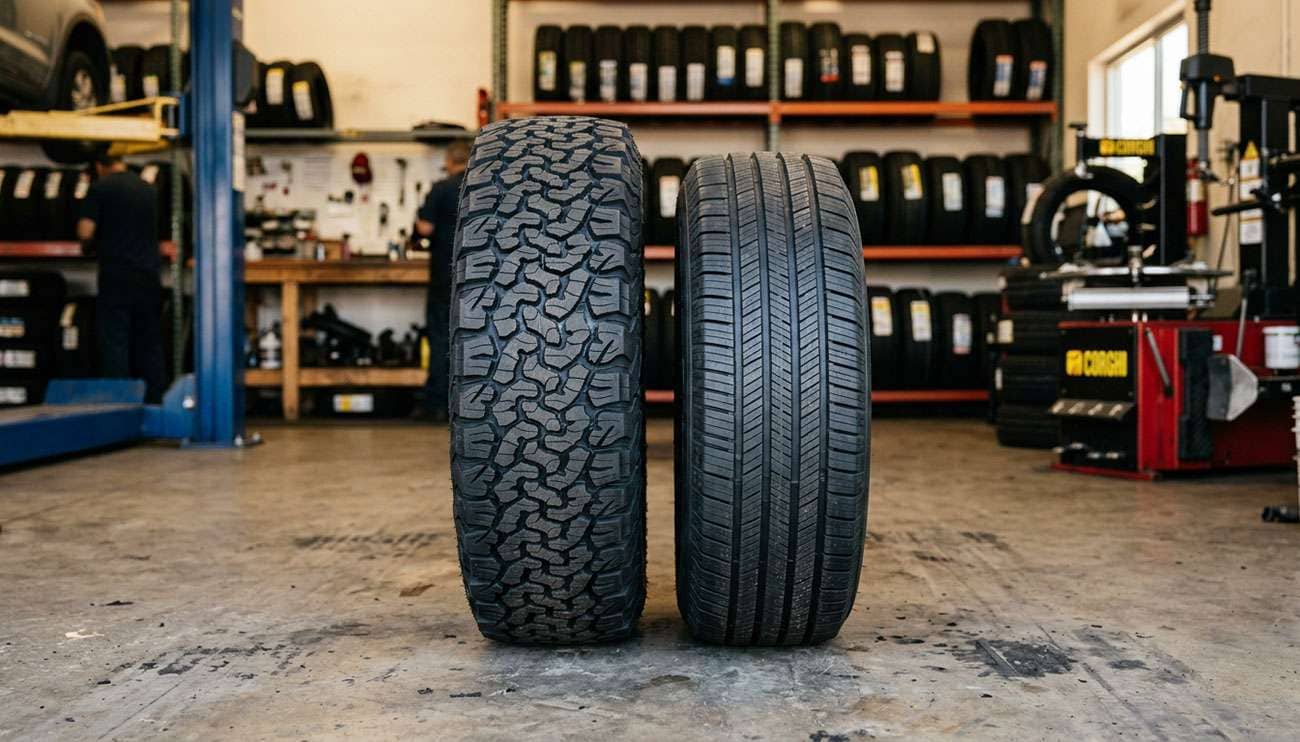
Short answer: yes, on most half-ton pickups that came on 275/65R18, and Ford, Ram, and GM all prove it by putting 275/70R18 on their own off-road trims. The 275/70R18 is about 1.1 inches taller, 33.2 inches against 32.1, on the same 18-inch wheel. The part almost nobody tells you is about construction, not size. Nearly every 275/70R18 sold is an LT Load Range E tire, and at the pressure on your door sticker it carries less weight than the factory tire it replaces. So the swap works, but only if you change the air pressure along with the tires. Most answers stop at "it's a common upgrade." That's the easy half.
I'm Hank Feldman. I started mounting tires in Long Beach in 1971, and this is one of the most common size changes that rolls through our doors. Somebody sees a Rebel or a Tremor in a parking lot, likes the stance, and wants that 33-inch look on their own truck. Good instinct. The tire will usually fit. What catches people is driving out of the shop at 35 psi on a tire that wants 46.
Your Truck on 275/65R18 |
Factory Trim on 275/70R18 |
At Stock Height |
What to Check |
|---|---|---|---|
2019 and newer Ram 1500, 18-inch trims |
Rebel and 2025 Warlock |
Usually fits; the Rebel gets a 1-inch factory lift for it |
Full lock both ways with your wheel's offset |
F-150 4x4 on 18-inch wheels |
Tremor |
Usually fits; about 33 inches is the stock ceiling |
Full lock and the front liner with wider wheels |
2019 and newer Silverado or Sierra 1500 |
Silverado ZR2, Sierra AT4X |
Commonly rubs at full lock or under compression |
Plan on a leveling kit |
2007-2021 Tundra on 18-inch wheels |
None |
Usually fits; one of the roomier wheel wells |
Mud flaps and full lock |
2022 and newer Tundra on 18-inch wheels |
None |
Test-fit; tighter than the older truck |
Full lock and full droop |
Tahoe, Yukon, Suburban on 18-inch wheels |
None |
Mixed reports; many owners level first |
Test-fit before mounting four |
Find your truck first. Then look at the second table, because the tire you'll actually be offered in 275/70R18 is almost never built like the one you're taking off.
Tire |
Load Index |
Pounds at 35 psi |
Pressure to Match the Factory Tire |
|---|---|---|---|
Factory 275/65R18 116, passenger construction |
116 |
2,756 rated; 2,505 counted on a truck |
Your door placard |
275/70R18 116, passenger construction (rare) |
116 |
2,756 rated; 2,505 counted on a truck |
Your door placard |
LT275/70R18 Load Range C |
115 |
2,070 |
About 46 psi |
LT275/70R18 Load Range E (most of the market) |
125 |
2,070 |
About 46 psi |
About 1.1 inches taller and exactly as wide. Both tires are 275 millimeters across, about 10.8 inches, and both mount on an 18-inch wheel. The only number that changes is the aspect ratio, the sidewall height as a percentage of width. Go from 65 to 70 percent and each sidewall grows from about 7.0 inches to 7.6.
Stack two sidewalls on an 18-inch wheel and you get the overall diameter: about 32.1 inches for the 275/65R18 and 33.2 for the 275/70R18. That's a 3.4 percent increase. The axle sits about half an inch higher off the ground, since only half of the extra diameter is below the hub. And the tire turns about 608 times per mile instead of 629, which is where the speedometer, the gearing, and the fuel numbers all come from.
If you came to the 275/65R18 from a 265, you've already done the half-inch step. Our guide to 275/65R18 instead of 265/65R18 covers that one. This step is twice as big, and it's the one where the truck starts telling you about it.
Same section width means the tire doesn't get wider in the wheel well. But a taller tire sweeps a bigger arc when you turn the wheel and when the suspension compresses. The extra half inch at the top and the front edge of the tread is what finds the fender liner, not the sides.
On most half-tons that came on 275/65R18, yes, and the best evidence isn't a forum post. It's the factory. Three of the big four put this exact size on a trim of the same truck, which tells you the body and frame have room for it. What it doesn't tell you is how much extra suspension they put under that trim.
On 2019 and newer Rams, the 18-inch trims leave the factory on 275/65R18 116. The Rebel runs LT275/70R18, and so does the DT Warlock from 2025. When the 2019 Rebel launched, Ram listed a standard one-inch factory lift and 33-inch Goodyear Wrangler DuraTrac tires on 18-inch wheels. So a standard-height Big Horn running the same tire has an inch less margin than the truck it was designed for. Ram owners commonly treat 275/70R18 as the size to stop at on factory 18s without a level. Turn to full lock both ways before you call it done. Our Ram 1500 tire size by trim guide lists which trims carry which size.
The F-150 4x4 on 18-inch wheels runs 275/65R18. The Tremor runs 275/70R18 on a standard body with no flares, and Ford gives it its own shocks and a wider front track. About 33 inches is where a stock F-150 tops out, which is right where this tire lands. Stay close to factory offset and you're in good shape. A wide, low-offset aftermarket wheel moves the tire out to where it meets the liner at full lock. Our article on the biggest tire on a stock F-150 with no lift walks through what Ford changed on the Tremor and what you can copy.
This is the tight one. GM puts LT275/70R18 on the Silverado ZR2 and the Sierra AT4X, and both sit on lifted, purpose-built suspensions. On a standard-height 2019 and newer Silverado or Sierra, a 33-inch tire commonly rubs the front liner at full lock or when the front end compresses over a dip. Most owners put in a leveling kit to run it cleanly. If your truck is a Trail Boss or AT4 that already sits higher from the factory, you're starting with room the standard truck doesn't have.
The 2007-2021 Tundra on 18s runs 275/65R18 on an 18x8 wheel, and it has one of the roomier front wheel wells in the class. Owners run the wider 285/70R18 there with a small level or a little liner trimming, and the 275 is narrower, which makes it the easier 33. Watch the mud flaps. The 2022 and newer Tundra is tighter, and a test-fit comes before a purchase. On Tahoes, Yukons, and Suburbans, owner reports on 275/70R18 go both ways, and a lot of the clean installs had a 2-inch level.
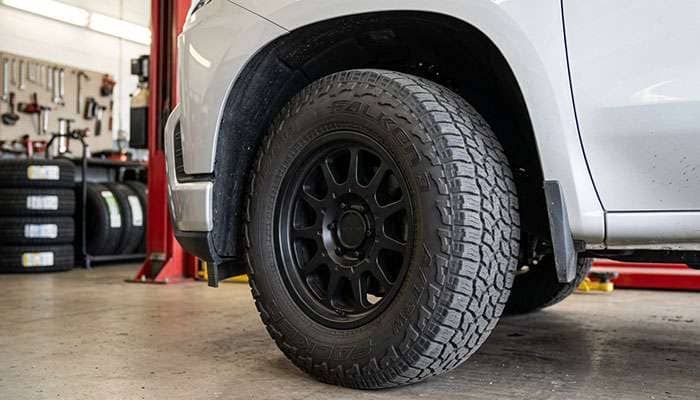
Because the people who buy a 33-inch 18 are mostly buying it for work, towing, or dirt, and the tire makers build for that. Look at the market and it splits clean. The 275/65R18 is about half passenger tires and half LT tires, with plenty of standard-load highway and all-terrain choices. The 275/70R18 is almost all LT, and nearly all of that is Load Range E with a 125 load index. A few passenger-construction 275/70R18s exist at a 116, and a handful of C, D, and F range tires round it out, but if you walk in and ask for this size, you're getting an E.
That's not a bad thing. An E-range LT tire has a tougher casing and more sidewall plies, so it shrugs off rock cuts and curb hits a passenger tire won't. Most E-range 275/70R18 all-terrains start around 16/32 of an inch of tread, where most passenger 275/65R18s start around 12/32. The E-range casing is also noticeably heavier than a passenger tire. You feel that weight, and you feel the stiffer sidewall over expansion joints.
The speed rating usually drops too. Most passenger 275/65R18s are rated T, good for 118 mph. Most 275/70R18 LT tires are rated S, R, or Q, which is 112, 106, or 99 mph. None of that matters at legal speeds. It does mean the tire was built for load and durability rather than highway response. Our guide to P-metric vs. LT tires goes deeper on what changes inside the casing.
More than the number on your door, and here's the mechanism. Your factory 275/65R18 is a passenger tire with a 116 load index, which is 2,756 pounds at its rated pressure. A standard-load passenger tire reaches its full rated load at about 35 psi, so at the pressure on a typical half-ton door placard, it's already carrying everything it can. Under FMVSS 120, a passenger tire's rating gets divided by 1.10 when it's used on a truck, so your 116 counts for about 2,505 pounds. That's the number your axle ratings were matched against.
An LT tire works on a different curve. Industry load tables built on Tire and Rim Association standards list an LT275/70R18 at 2,070 pounds at 35 psi. That's about 435 pounds less than the factory tire was counted for, on the bigger tire. The E rating doesn't help at 35 psi, either. A Load Range C, D, or E tire in this size carries the same weight at the same pressure. The load range only tells you how high you're allowed to go: 50 psi for C, 65 for D, 80 for E, where the E reaches its full 3,640 pounds.
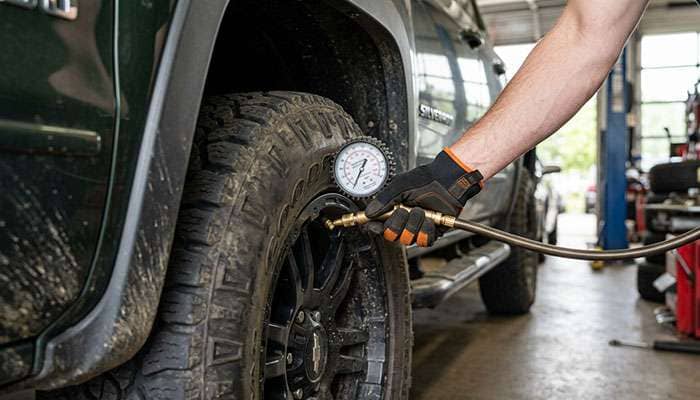
Read up the table until the LT tire matches what the factory tire was counted for. On those tables, the LT275/70R18 reaches 2,470 pounds at 45 psi and 2,680 at 50. It passes 2,505 at about 46 psi. That's the floor for an empty half-ton that came on a 116. If your factory tire was a P-metric 114, the floor works out to about 42 psi. Load the bed or hook up a trailer and you go higher. Never go below the door placard, and never past the maximum on the sidewall.
Use the load table from the maker of the tire you actually bought, because the numbers vary a little from brand to brand. Your TPMS won't catch it for you. NHTSA's TPMS rule, FMVSS 138, only requires a warning at 25 percent below the placard pressure, so an LT tire sitting 10 psi under what it needs never lights the dash. You have to.
Firmer. An E-range tire at 46 psi rides stiffer than a passenger tire at 35, and that's the honest trade for the toughness. It's not a reason to run it soft. A light truck tire run low flexes more with every revolution, and that flex is heat.
Yes, by about 3.4 percent, and it reads slow. When the speedometer shows 60 you're doing about 62. At an indicated 65 you're doing about 67, and at 70 you're doing about 72. The odometer under-counts the same way: 10,000 miles on the dash is about 10,340 on the road. That matters for warranty mileage and service intervals as much as it does for tickets.
Modern trucks feed that same wheel-speed signal to the transmission shift schedule, the ABS, and the stability control, so a recalibration is worth doing. Most dealers can update the tire size setting, and owners also use handheld programmers. Our article on bigger tires and your speedometer covers how much error is too much and how to correct it.
A little, from three directions. The taller tire acts like a numerically lower axle ratio. A 3.55 gear on 275/70R18 behaves about like a 3.43, a 3.21 like a 3.11, and a 3.92 like a 3.79. Add the heavier E-range casing, which is rotating weight at the far edge of the wheel, and the more aggressive tread most 275/70R18s carry, and you've got a truck that's a hair slower off the line and usually a bit thirstier.
Don't trust the mpg on your dash to tell you how much, though. It reads about 3.4 percent low, because the computer is counting fewer miles than you drove. Check it against GPS miles before you decide what the swap cost you.
Is it enough to need new gears? Rarely, on a half-ton with a modern multi-speed automatic. That conversation usually starts at 35s. Our guide on whether to regear after bigger tires lays out where the line is.
On most half-tons, yes. Tire makers publish an approved rim-width range for every size, and both of these are measured on an 8-inch rim. Most 275/65R18s list a range of about 7.5 to 9.5 inches. Most 275/70R18s list 7 to 9, and many list 7 to 8.5. An 18x8 factory wheel, like the older Tundra's, sits right in the middle of both. GM's 18x8.5 factory wheel sits inside the range of most 275/70R18s and at the very top for a few, so check your exact tire.
Your TPMS sensors move over with the wheels. Just remember what I said about the warning threshold. The sensors will tell you when a tire is way down from the factory pressure, not when an LT tire is 10 psi below what it needs.
If you're buying aftermarket wheels for the swap, offset matters more than width. A lower-offset wheel pushes the tire outboard, and that's what turns a clean fit into a full-lock rub.
The swap itself is safe. Running an LT tire at a passenger tire's pressure is where it goes wrong, and it goes wrong in this order.
1. Mushy steering and sloppy handling. An LT casing at 35 psi rolls over on its sidewall in a lane change. Most people blame the tread pattern.
2. Shoulder wear. An underinflated tire carries the load on its outer edges. Both shoulders wear fast and the center stays tall.
3. Heat. Every revolution flexes the sidewall more than it was built for, and that flex turns into heat. Hot tires age faster from the inside, where you can't see it.
4. Sidewall fatigue. Months of extra flex weaken the casing. That's when you start seeing bulges, cracking in the lower sidewall, or a tire that won't hold air at the bead. If you find any of that, read our guide on tire sidewall damage and whether it's safe to drive before the next trip.
5. Separation or a blowout. Load the bed or tow on an underinflated tire on a hot day, and the casing gives up. That's the end of the ladder, and it isn't a cost measured in dollars.
6. A new set of tires. Every rung above ends with tires replaced early. Setting the pressure right on day one is the cheapest point on the list.
Step 1: Read your door placard and your factory tire. The Tire and Loading Information label required under FMVSS 110 gives you the factory size and cold pressure. The load index is on the sidewall of the factory tire.
Step 2: Check your truck against the first table. If you're on a standard-height Silverado or Sierra, budget for a leveling kit. If you're on a Ram, F-150, or older Tundra, plan on a full-lock check.
Step 3: Pick the construction on purpose. Load Range E for towing, hauling, and rocky roads. A passenger 275/70R18, if you can find one in a tread you like, rides softer and runs at your placard pressure.
Step 4: Get the tire maker's load table. Find the pressure where the new tire carries at least what your factory tire was counted for. For a factory 116, that's about 46 psi on an LT275/70R18.
Step 5: Mount one and turn it. Lock to lock, both directions, then roll over a driveway lip with someone watching the liner.
Step 6: Set pressure, recalibrate, and write it down. Set the cold pressure from the load table, have the tire size updated in the truck's computer, and put the new pressure somewhere you'll see it. Tire Industry Association training on size changes comes down to the same rule: keep the load capacity, and use the load table to get there. It's the one step people skip.
When you're ready to compare tread patterns in this size, browse our all-terrain tires and filter for 275/70R18.
The 275/70R18 is about 1.1 inches taller than the 275/65R18 on the same wheel, and Ford, Ram, and GM each put it on an off-road trim of the truck you probably own. It usually fits a Ram, an F-150, or an older Tundra at stock height. A standard Silverado or Sierra usually wants a level. The speedometer reads 3.4 percent slow, and the truck gives up a little off the line.
The part that matters most is the air. Nearly every 275/70R18 is an LT Load Range E, and at your door pressure it carries less than the tire you took off. Run it at about 46 psi empty, more loaded, from the tire maker's table. Do that and it's one of the best-looking, toughest upgrades you can put on a half-ton.
Yes. A 275/70R18 calculates to about 33.2 inches tall and 10.8 inches wide, which is why it's sold as an 18-inch 33. Actual mounted height varies a little by brand and tread.
About 1.1 inches taller overall, 33.2 inches against 32.1. That raises the axle about half an inch and makes the speedometer read about 3.4 percent slow.
On a standard-height 2019 and newer Silverado 1500, a 275/70R18 commonly rubs the front liner at full lock or under compression, and most owners add a leveling kit. GM's own ZR2 runs the size on a lifted suspension.
Usually, on a 2019 and newer Ram 1500 with factory 18-inch wheels. Ram puts LT275/70R18 on the Rebel, which also gets a one-inch factory lift, so check full-lock clearance on a standard-height truck.
On a half-ton that came on a 275/65R18 116, start around 46 psi cold, which is where an LT275/70R18 matches the factory tire's capacity on a truck. Go higher when loaded or towing, using the tire maker's load table, and never exceed the sidewall maximum.
It's a good idea. The 3.4 percent change makes the speedometer and odometer read low, and the transmission, ABS, and stability control use the same wheel-speed signal. A dealer or a handheld programmer can update the tire size.