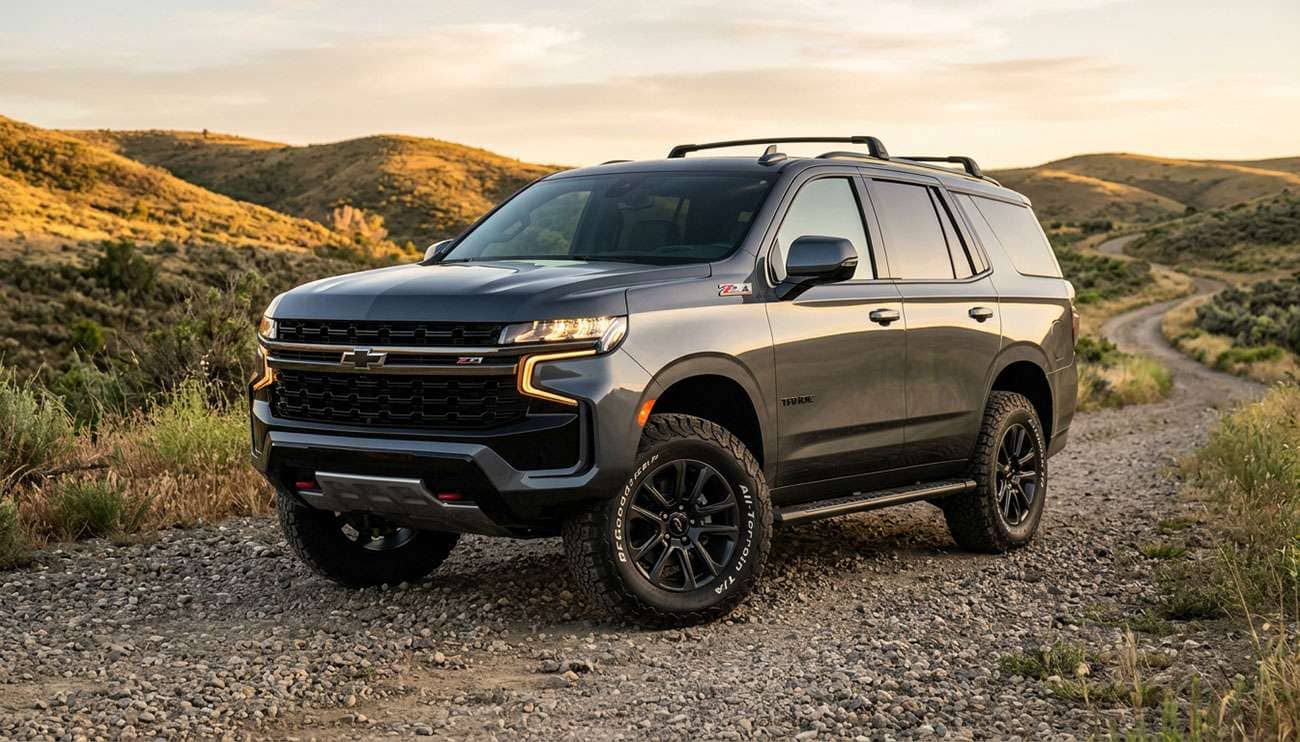
Short answer: it depends on the model year, and the model year is the part most answers leave out. A 2021 or newer Tahoe on 20-inch wheels already rides on 33s from the factory, because the 275/60R20 GM puts on it is 33.0 inches tall. A 2015 to 2020 Tahoe tops out around 32 inches stock, but a 275-wide 33 usually fits it on the factory wheels. After the year, width and wheel offset decide whether a 33 rubs, not height. Most answers stop at "it depends." Here is what it depends on.
I'm Hank Feldman. I started fitting tires in Long Beach in 1971, and I have been putting bigger rubber on Chevy SUVs since they were called Blazers. Half the Tahoe owners who ask me this are asking about a size their truck already has. The other half are about to buy a 12.5-inch-wide tire for a truck built around an 11-inch one. Let's sort out which one you are.
Your Tahoe |
Factory Tire (Height) |
What a 33 Adds |
33s With No Level? |
|---|---|---|---|
2015-2020 on 18s (LS, LT, Z71 package) |
265/65R18 (31.6 in) |
About 1.6 in of height |
Usually, as a 275/70R18 on factory wheels; 12.50-wide tires rub |
2015-2020 on 20s (LT, LTZ, Premier) |
275/55R20 (31.9 in) |
About 1.1 in of height |
Usually, as a 275/60R20 on factory wheels; aftermarket offset or wider tires rub at full lock |
2015-2020 on 22s (LTZ, Premier, RST) |
285/45R22 (32.1 in) |
About 1.1 in of height |
Stay at 285 width or narrower and check full lock; 305-wide 22s have rubbed |
2021 and newer on 18s (LS, LT) |
265/65R18 (31.6 in) |
About 1.6 in of height |
A 275-wide 33 on stock-offset wheels uses the space the Z71's tire already uses |
2021 and newer on 20s (LT, Z71, Premier) |
275/60R20 (33.0 in) |
Nothing; you already have 33s |
Yes; owners report a 285/60R20 clearing factory wheels too, while 12.50-wide tires call for a level |
2021 and newer on 22s or 24s (RST, Premier, High Country) |
275/50R22 (32.8 in) or 285/40R24 (33.0 in) |
A few tenths of an inch, at most |
Already at 33; owners report 285/50R22 and 305/45R22 clearing factory 22s |
On the 2015 to 2020 truck, a 33 is a real step up. GM shipped these Tahoes on 265/65R18, 275/55R20, or 285/45R22, and the tallest of those is 32.1 inches. Move to a 275/60R20 and you add about an inch of height, which puts about half an inch more rubber above the axle centerline and half an inch more ahead of and behind it.
That half inch fits, as long as you keep the tire narrow and the wheel where GM put it. Owners running a 275/60R20 on factory 20s, or a 275/70R18 on factory 18s, report no rub at stock height. Where it goes wrong is the wheel: the same 275/60R20 has rubbed badly on aftermarket 20s with less offset. The contact point is the rear of the front wheel opening at full lock, usually while backing out of a parking space: first the plastic fender liner, then the pinch-weld seam behind it.
The front is the tight end because GM builds these trucks with rake: the rear sits higher than the front from the factory. The rear of a 2015 to 2020 Tahoe rides on a solid axle with five-link location and coil springs, and it has room to spare. The independent front, with coilover shocks, runs out of room first. Worn front struts make it worse. A tired front end on one of these trucks can sit noticeably lower than new, and owners chasing a sudden rub often find the struts changed, not the tires.
Here is the surprise: going wider without going taller does not buy you clearance. One owner's 2015 Suburban needed about an inch trimmed off the inner fender for a 285/55R20, which is shorter than a 275/60R20 but wider. A 33x12.50R20 rubs on a full turn even on factory-offset wheels, and once the truck is leveled it can find the sway bar and upper control arm. On this truck, width runs out before height does.
You only need a level here for wider tires, sizes past 33, or aftermarket offsets, and then you need to know your suspension. Base trucks ride on plain coil springs and take a strut spacer. Many LTZ and Premier trucks have Magnetic Ride Control, some also had rear auto-leveling, and those trucks need a kit built for them. GM used the same basic front end on its half-ton pickups, and our piece on leveling a Silverado for 35s walks through how that front end responds to a spacer.
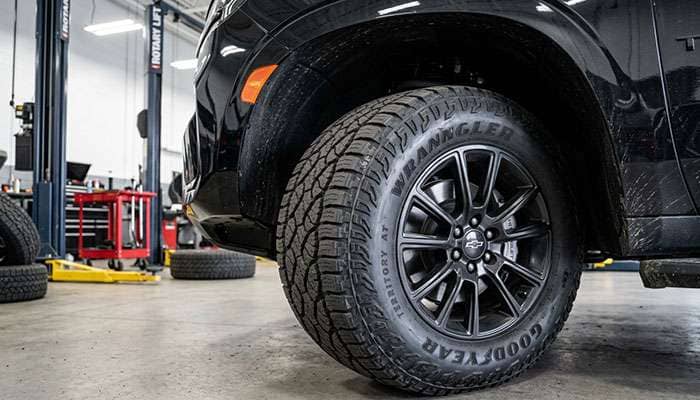
If it is on 20-inch wheels, yes. When GM redesigned the Tahoe for 2021, the 20-inch tire became a 275/60R20, which measures 33.0 inches tall. The Z71 launched on it as a Goodyear Wrangler TrailRunner AT, the Premier wears it standard, and the LT can get it.
The 22-inch size on the 2021 and newer truck is a 275/50R22 at 32.8 inches, and the 24-inch option added for 2025 is a 285/40R24 at 33.0 inches. Only the 18-inch tire on the LS and LT, a 265/65R18 at 31.6 inches, sits clearly under 33.
So on a 2021 or newer truck the question changes. GM already answered whether it holds a 33. The real question is how much past the factory 33 it will take, and owners report more room than you might expect. A 285/60R20 (33.5 inches) and even a 275/65R20 (34.1 inches) have cleared factory 20s with no level, sometimes with a light touch at full lock over bumps, and a 285/50R22 or 305/45R22 clears the factory 22s. The 12.50-wide sizes, 285/65R20, 295/60R20, and 285/55R22 are where owners start trimming liners and leveling.
Underneath, the 2021 Tahoe traded the solid rear axle for an independent multi-link rear, and the front still runs out of room first. The Z71 gets its own front fascia, a front skid plate, and a much steeper approach angle, but GM's spec sheet shows the same 8.0 inches of ground clearance for the coil-spring Z71 as the other coil-spring trims. The Z71 is not lifted. It just gets the 33 the other trims could have had.
That is good news if you have an 18-inch LS or LT. A 275/70R18 is 33.2 inches tall and the same 275 width as the Z71's tire, so on a stock-offset 18-inch wheel it occupies almost exactly the space GM already cleared for the Z71. One owner on a zero-offset 18 reported only the slightest rub at full lock in reverse, and a factory-offset wheel has more room than that. It is not quite free: nearly every 275/70R18 on the market is built as an LT tire, and that changes the ride and the pressure, which I will get to below.
Yes, and this is the part nobody puts in front of you. Starting in 2021, GM offered Air Ride Adaptive Suspension, with air springs at all four corners, in an off-road package on the Z71 and a package on the High Country, and later on more trims. On an Air Ride truck, the height you measure in the driveway is not the height you drive at.
GM's service information spells out the heights. Entry and Exit drops the truck 2 inches below Normal when it is in Park. Increased Ground Clearance raises it 1 inch in 4WD High or the off-road modes, and Maximum Ground Clearance raises it 2 inches in 4WD Low. And above 65 mph for a while, the truck lowers itself about three-quarters of an inch for aerodynamics.
Aero lowering is the smaller worry. It happens at highway speed with the wheels close to straight, and I have not seen an owner report a 33 rubbing because of it. It does leave a setup that barely clears at Normal with less margin over a hard bump at 70.
Entry and Exit is the one that bites. If you use the automatic setting, the truck drops 2 inches the moment you put it in Park and open the door. One owner running 35s on an air-ride Yukon reports rubbing only at that height, including backing out of parking spaces before the truck comes back up. Owners on 285/50R22s and 305/45R22s report no rub when lowered. If you go bigger than that, park with the wheels straight and let the truck rise before you crank the wheel.
Air Ride also changes how you level. A coil-spring truck takes a strut spacer. A Magnetic Ride truck needs its own kit. An Air Ride truck uses front strut extensions plus brackets that reposition the ride height sensors, so the computer holds the new height in every mode. Those kits are not interchangeable, and air-ride kits are made only for air-ride trucks. Check your window sticker before you order. And go easy on adjustable height-sensor links: GM's TechLink, its service publication for dealer technicians, has warned that aftermarket links can set a Service Leveling System message, change driveshaft angles, and leave the damage outside warranty coverage.
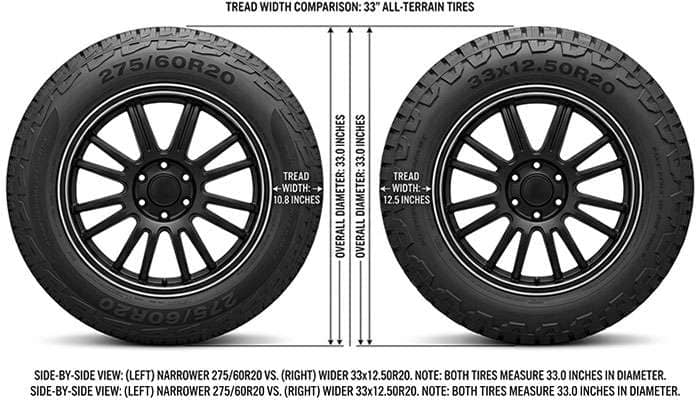
"33-inch tire" is not one tire. It is a dozen sizes within a few tenths of 33 inches tall, and they are not the same width. A 275/60R20 is about 10.8 inches wide. A 33x12.50R20 is 12.5 inches wide. On a stock Tahoe, width finds the plastic before height does.
Construction changes too. On 20-inch wheels, most 275/60R20s are built as passenger or Euro-metric tires, the same family GM put on the truck. On 18-inch wheels the market flips: nearly every 275/70R18, 285/65R18, and 33x12.50R18 is an LT tire. Pick your wheel diameter and you have mostly picked your construction.
Size |
Height |
Width |
Usual Construction |
On a Stock Tahoe |
|---|---|---|---|---|
275/70R18 |
33.2 in |
10.8 in |
Mostly LT |
Owners report no rub on a stock 2015-2020; same width as the 2021+ Z71 tire |
285/65R18 |
32.6 in |
11.2 in |
Mostly LT |
Shorter but wider; mixed reports, so check full lock |
33x12.50R18 |
33.0 in |
12.5 in |
LT |
Has rubbed badly on a 2015-2020 even after a 2 in level |
275/60R20 |
33.0 in |
10.8 in |
Mostly passenger or Euro-metric |
Factory size on 2021+; fits a 2015-2020 on factory-offset wheels |
285/60R20 |
33.5 in |
11.2 in |
Mostly LT |
Owners report it clearing 2021+ factory wheels; level a 2015-2020 first |
33x12.50R20 |
33.0 in |
12.5 in |
LT |
Rubs at full turn on factory offset; level and trim |
285/50R22 |
33.2 in |
11.2 in |
Mostly LT |
Owners report no rub on 2021+ factory 22s |
My rule for a stock Tahoe: take the 33 in 275 width first. Go to 285 only on a stock-offset wheel, after you have checked full lock. Save the 12.50-wide sizes for a truck that has been leveled and trimmed.
More than most people think. Factory Tahoe wheels sit at positive offset: about +24 to +27 mm on the 2015 to 2020 truck and about +26 to +28 mm on the 2021 and newer truck. That puts the tire tucked in under the fender where GM designed the wheel well around it.
Most aftermarket truck wheels in the Tahoe's 6x139.7 bolt pattern do not sit there. In a 20x9, the middle of the market runs around +10 mm, and about a third of those wheels are zero offset or negative. Go to a 20x10 and most run well below zero. Every 25 mm you drop in offset moves the whole tire about an inch farther out.
Moving the tire out pulls the inner edge away from the frame and upper control arm, but it pushes the outer edge toward the fender lip and bumper corner and makes the tire swing a wider arc when you turn. On a Tahoe, the full-lock rub at the rear of the front wheel opening gets worse as offset drops. Owner reports bear this out: a 33x12.50R20 on a -12 offset wheel still rubbed a little after the liner was trimmed, and a 295/60R20 on a zero-offset 20x9 touched at full lock even after a 2-inch level.
Check the hub bore too. The Tahoe's hub is 78.1 mm, and many 6x139.7 wheels are bored to 106 mm or larger to fit Toyotas, so they need a hub-centric ring. Only about one in six wheels in this pattern is bored to 78.1 mm out of the box. Most 20-inch wheels in this pattern carry a load rating of about 2,500 pounds, plenty for a Tahoe. For the long version of how offset and width work together, read our guide on wheel offset and tire width as a package.
They need at least the load rating the factory tire had, and on a Tahoe that check has a twist. A 4WD 2021 to 2024 Tahoe is rated at 7,500 pounds gross, with 4,300 pounds allowed on the rear axle. That is about 2,150 pounds on each rear tire when the truck is full. The 2015 to 2020 truck is rated at 7,300 pounds gross, with 4,100 on the rear.
Here is the twist. Under the Tire and Rim Association's rules, when a passenger tire goes on a light truck or SUV, its load capacity is divided by 1.10. The factory 275/60R20 on a 2021 Tahoe carries a 115 load index, worth 2,679 pounds on paper. Divide by 1.10 and it is good for about 2,435 pounds on a Tahoe. That still clears 2,150, but not by the margin the sidewall makes it look like. On a 2015 to 2020 truck, the factory 275/55R20 is a 111, about 2,185 pounds after the divide, against about 2,050 needed. There is not much room there.
The simple rule: match or beat the load index printed on your door placard. Most 275/60R20s on the market run a 114 or higher, so a passenger 33 in that size is not a problem.
LT tires are where it gets tricky. An LT tire's sidewall number is its capacity at maximum pressure, often 80 psi for Load Range E, and at the 35 or so psi on most Tahoe placards it carries a lot less. The tire maker's load-inflation table, not the door, gives you the pressure. The Tire and Rim Association tables, for example, rate an LT285/60R20 Load Range E at 2,410 pounds at 45 psi. Expect a higher pressure, a firmer ride, and a heavier tire. Our breakdown of P-metric vs. LT tires covers the trade in detail.
If you rarely tow or leave the pavement, a passenger or Euro-metric 33 is the right call. If you tow a camper or run gravel every week, the LT is worth the ride penalty.
Mostly, yes. The GMC Yukon is the same truck under different sheet metal, and the 2021 and newer Yukon AT4 rides on the same 275/60R20 all-terrain the Z71 gets. The Suburban and Yukon XL share the front end, so the clearance answer carries over. What changes is weight: the long trucks carry more on the rear axle, so the load check matters more.
A rub at full lock sounds harmless. Here is how it climbs.
Stage 1: the liner scuffs. The tread shoulder brushes the plastic fender liner at full lock, in parking lots and nowhere else. Cheap so far.
Stage 2: the liner lets go. Every rub pushes on the liner's plastic clips. Eventually one pops, the liner hangs lower, and now it touches the tire going straight down the road, heating and wearing the shoulder at 70 mph. Our guide to why tires rub will help you pin down exactly where it is touching.
Stage 3: the tire finds metal. Behind the liner are brackets, the pinch weld, and the body mount, and metal cuts rubber. A cut on the shoulder or sidewall is not something you can patch. Read our piece on tire sidewall damage and whether it is safe to drive before you decide to ride it out.
Stage 4: you buy the tire again. A damaged sidewall means a new tire, and on a 4WD Tahoe one new tire next to three worn ones no longer matches in diameter. Now you are pricing a set of four, plus the level you skipped.
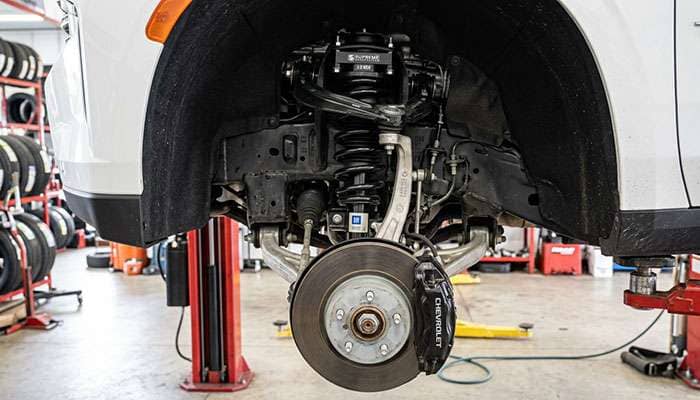
If you are going up from a factory size, yes. The Tire Industry Association's guideline for plus sizing is to stay within 3 percent of the original diameter, and a 33 on a Tahoe sits right at or past that line almost every time.
The fix depends on the generation again. On a 2015 to 2020 Tahoe, a handheld programmer or an inline calibrator can set the new tire size, and some dealers will do it. On a 2021 and newer truck, owners report that dealers cannot change it and aftermarket support is thin, so plan on living with the error. That is one more reason to stay close to the factory 33 on a newer truck. Our article on how bigger tires change your speedometer explains why it reads low and what that does to your odometer.
As for gearing, a 33 is not a regear tire on a Tahoe. Expect a slightly softer launch and a small fuel economy hit, more with heavy LT tires.
Do this before you buy, not in the driveway after.
Step 1: Confirm your generation. 2015 to 2020 and 2021 and newer are different trucks under the wheel wells.
Step 2: Read the door placard. It lists your factory size, load index, and pressure. If it says 275/60R20, you already have 33s.
Step 3: Find out which suspension you have. Coil springs, Magnetic Ride Control, or Air Ride. The window sticker shows it, and it decides which leveling kit fits.
Step 4: Pick the 33 by width. Start with a 275-wide size: 275/70R18 on 18s, 275/60R20 on 20s. Move wider only with a plan.
Step 5: Keep the offset close to stock. If you are not leveling, stay in the positive 20s. Check the hub bore and plan on hub-centric rings if the wheel is bored larger than 78.1 mm.
Step 6: Check the load. Match or beat the placard load index. If you pick an LT tire, get the pressure from the tire maker's load-inflation table, not the door.
Step 7: Test at full lock, both ways. Mount the tires, turn lock to lock with the truck at Normal height, and back up at full lock both ways, since reverse is where these trucks usually rub. On an Air Ride truck, check again at Entry height. Then drive it, re-torque the lug nuts after the first 50 miles, and on a 2015 to 2020 truck, have the speedometer set to the new size.
When you are ready to shop, start with the Tahoe wheel and tire search and pick your trim, so every size and wheel you see is matched to your truck. For a wider look at tire choices, our Tahoe tire buying guide covers tread types and seasons.
"Will 33s fit a stock Tahoe" has two answers, and the model year picks yours. On a 2021 or newer Tahoe with 20-inch wheels, GM already put 33s on it. On a 2015 to 2020 Tahoe, a 33 adds about an inch over the tallest factory tire, and a 275-wide 33 on the factory wheels usually clears. Wider tires and aftermarket offsets are what rub at full lock and send you to a level.
After the year, width and offset decide it. A 275-wide 33 on a stock-offset wheel is the easy one. A 12.50-wide 33 on a low-offset wheel is a leveling and trimming job on either generation. And on an Air Ride truck, check clearance at Entry height, not just Normal. The trucks that come back to my shop unhappy almost never went too tall. They went too wide.
GM's tallest factory Tahoe tire is about 33.0 inches, the 275/60R20 on 2021 and newer trucks. On 2021 and newer trucks, owners report a 285/60R20 or 275/65R20 clearing factory wheels with no level, sometimes with a light rub at full lock. On a 2015 to 2020 Tahoe, a 275/60R20 or 275/70R18 on factory wheels is about the limit before leveling.
Yes. GM already ships the 2021 Tahoe on a 33-inch 275/60R20, and owners report a wider 285/60R20 clearing the factory wheels. The 12.50-wide 33s and aftermarket wheels with low or negative offset are where rubbing starts.
Not always. A 275/60R20 on factory 20s or a 275/70R18 on factory 18s usually clears at stock height. Aftermarket wheels with less offset, and wider tires like a 33x12.50R20, rub at the rear of the front wheel opening at full lock, and that is when owners level about 2 inches and trim the liner. Buy a kit made for your suspension, coil spring or Magnetic Ride.
The common 33s on 20-inch wheels are 275/60R20 at 33.0 inches and 10.8 inches wide, 285/60R20 at 33.5 inches, and 33x12.50R20 at 33.0 inches and 12.5 inches wide. On a stock Tahoe, the 275/60R20 is the easiest to fit.
A 275/65R20 is about 34.1 inches tall, a full inch over the factory 33. On a 2021 or newer Tahoe, owners report it clearing factory wheels with no level, though some get a slight rub at full lock over bumps. On a 2015 to 2020 Tahoe, plan on a level.
If you go up from a smaller factory size, yes. A 275/60R20 on a 2015 to 2020 Tahoe that came on 275/55R20s is about 3.4 percent taller, so the speedometer reads about 65 when you are doing 67. A handheld programmer or inline calibrator can correct it on a 2015 to 2020 truck, but owners report 2021 and newer trucks can't be reprogrammed. A 2021 or newer Tahoe that already came on 275/60R20s sees no change if it stays in that size.