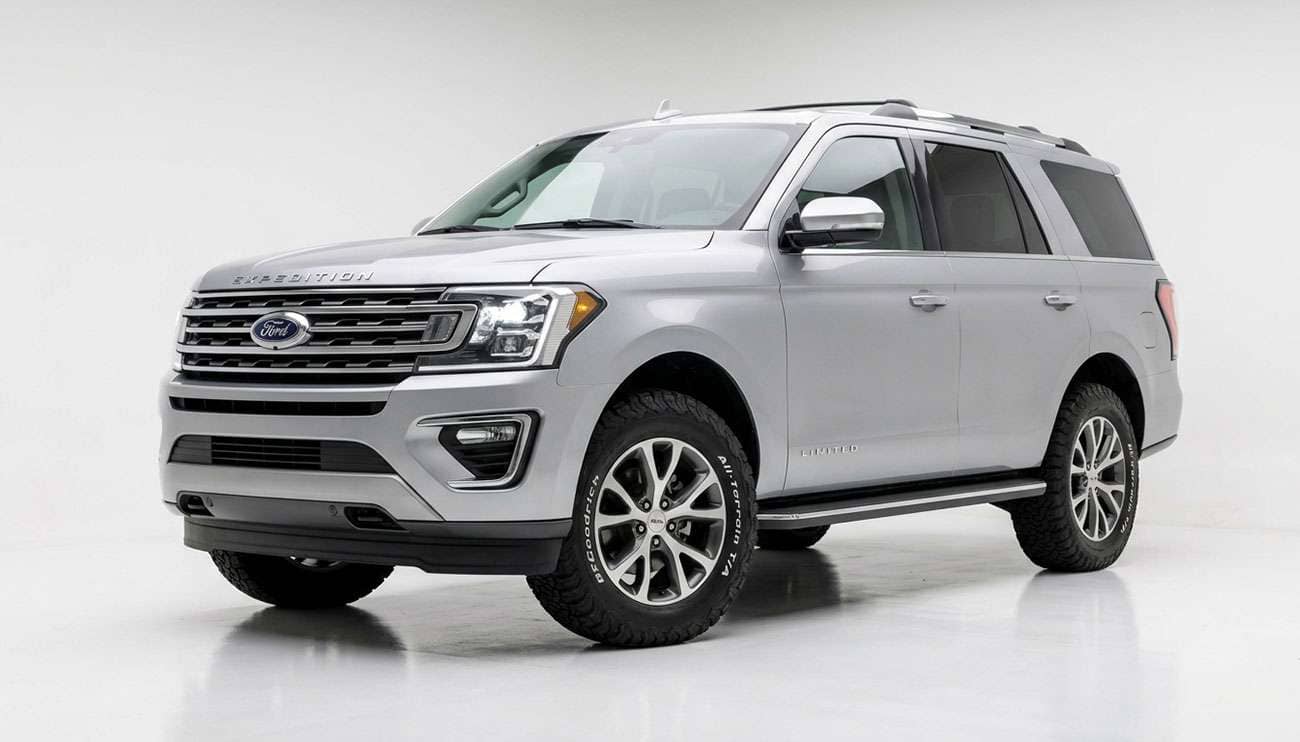
Yes. A 2018-2024 Expedition takes a 33 with no lift, as long as it stays 275 wide and rides on factory wheels: 275/70R18 on 18s or 275/60R20 on 20s. A 2025 or newer Expedition is a different conversation, because every factory size is already about 33 inches tall. When a 33 goes wrong on this truck, height is rarely the reason. Wheel offset, width, and tire build are.
I started fitting tires in Long Beach in 1971, and full-size SUVs taught me early that height gets blamed for problems width and offset caused. So find your truck in this chart first.
Your Expedition |
Factory Tire (Height) |
The 33 to Buy |
33s With No Lift? |
|---|---|---|---|
2018-2024, 18-inch wheels |
275/65R18 (32.1 in.) |
275/70R18 (33.2 in.) |
Yes, on factory wheels |
2018-2024, 20-inch wheels |
275/55R20 (31.9 in.) |
275/60R20 (33.0 in.) |
Yes, on factory wheels |
2018-2024, 22-inch wheels |
285/45R22 (32.1 in.) |
275/50R22 XL 115 (32.8 in.) |
Likely, with fewer owner reports |
2022-2024 Timberline |
265/70R18 (32.6 in.) |
Already a 33 |
Factory setup |
2025-2027, 18-inch wheels |
265/70R18 (32.6 in.) |
Already a 33 |
Factory setup |
2025-2027, 20-inch wheels |
275/60R20 (33.0 in.) |
Already a 33 |
Factory setup |
2025-2027, 22- or 24-inch wheels |
275/50R22 (32.8 in.) or 285/40R24 (33.0 in.) |
Already a 33 |
Factory setup |
2025-2027 Tremor |
275/70R18 (33.2 in.) |
Already a 33 |
Factory setup, about 2 in. higher |
2007-2017, 18- or 20-inch wheels |
275/65R18 or 265/55R20 |
275/70R18 or 275/60R20 |
Usually, with less proof |
Those heights are calculated from the size, and the fit calls come from what owners report at stock height. Ford's approved sizes are the ones on your door placard, the label FMVSS 110 requires. Anything else is your decision, so here is what that decision involves.
Yes, and the wheel you already have tells you which one. Ford built these trucks on 275/65R18, 275/55R20, or 285/45R22 tires, on 18x8.5, 20x8.5, or 22x9.5 wheels at about +44 mm offset. All three sizes land around 32 inches, so a 33 only asks for about an inch more tire. Ford's own Timberline sold a 265/70R18 as a 33-inch tire. That size is 32.6 inches, which tells you how loosely this business uses the number.
275/70R18 is your tire. It keeps the factory 10.8-inch width and adds 1.1 inches of height, all of it sidewall. An owner running this size on factory FX4 wheels reports no rubbing. It is also the size Ford fits to the Expedition Tremor, though the Tremor rides about two inches higher, so I give the stock-height owner more weight. For the full math, read 275/70R18 instead of 275/65R18.
275/60R20 is the best-proven 33 on this truck. It is exactly 33.0 inches, and owners have been running it for years. One 2019 owner runs it on stock rims at stock height, with and without 5 mm spacers, and reports no rub. Another reports "Factory height no spacers, no rub." A 2021 Max XLT owner went the same way. The only complaint I found was a 2018 owner on an all-stock truck who rubbed once on a full turn in the driveway. On a truck this size, I can live with that.
275/50R22 is the 33 for a 22-inch truck, at 32.8 inches and a little narrower than your factory 285. Ford uses this size on 2025-and-newer trucks, but you won't find many owners reporting it on the 2018-2024 body. Your 9.5-inch wheel also sits at the wide end of its approved range. It should work. Watch the load index, though, which I'll get to below. If you want real sidewall and more tire choices, a set of factory 20s from the same generation is the cleaner road.
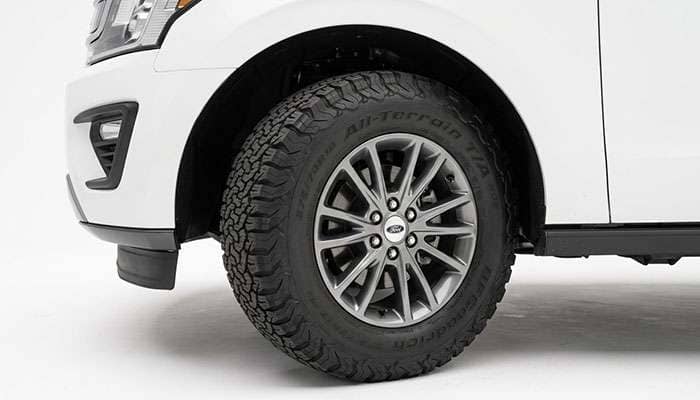
Yes, every one of them. Run the numbers on the factory sizes and you'll see it. The 18-inch XL and Active use 265/70R18 at 32.6 inches. The 20-inch trucks use 275/60R20 at 33.0. The 22-inch trucks use 275/50R22 at 32.8. Even the 24-inch Platinum Ultimate wheel carries a 285/40R24 at 33.0 inches.
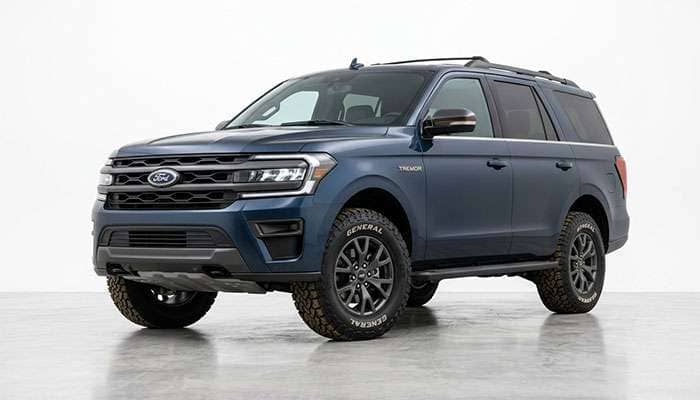
The Tremor gets the tallest of the bunch, a 275/70R18 at 33.2 inches, wrapped in General Grabber all-terrains. It also sits about two inches higher than a standard Expedition, with 10.6 inches of ground clearance. Don't read that as permission for a bigger tire on a standard truck, because that clearance is part of how the Tremor carries its tire.
So on a new truck, the real question is which 33 you want. An Active owner moving from 265/70R18 to 275/70R18 picks up about half an inch of height and 10 mm of width on the same 18x8.5 wheel. That is a sensible step. Just turn the wheel to full lock in the driveway before you call it finished, since you're not on a Tremor's ride height.
"33" is a rounded-off sales word, not a measurement. Anything from about 32.6 to 33.2 inches gets called one. What separates these sizes on an Expedition is width and how the tire is built.
Size |
Height |
Width |
Usual Construction |
On a Stock 2018-2024 Truck |
|---|---|---|---|---|
275/70R18 |
33.2 in. |
10.8 in. |
Almost all LT Load Range E |
Best 18-inch 33 |
285/65R18 |
32.6 in. |
11.2 in. |
Mostly LT Load Range E |
Shorter and wider, so offset matters more |
285/70R18 |
33.7 in. |
11.2 in. |
LT Load Range E |
Past the clean zone, expect contact |
275/60R20 |
33.0 in. |
10.8 in. |
Mostly passenger, 115 or 116 |
Best 20-inch 33 |
285/55R20 |
32.3 in. |
11.2 in. |
Mostly LT Load Range E |
No rub reported on +30 mm wheels |
285/60R20 |
33.5 in. |
11.2 in. |
LT Load Range E |
Owners warn it may rub |
275/50R22 |
32.8 in. |
10.8 in. |
Passenger 111 or XL 115 |
Buy the XL 115 |
My rule for a stock Expedition: take the 33 in 275 width first. One 2019 Max XLT owner runs LT285/55R20 on 20x8.5 +30 mm wheels with no lift and reports no rubbing, so 285 can work. But that size is only 32.3 inches tall, and other owners warned a 2021 Platinum owner that the taller 285/60R20 might rub. The Expedition shares a lot with the F-150, and our guide to the biggest tire on a stock F-150 reaches the same place: about 33 inches is the practical limit at stock height.
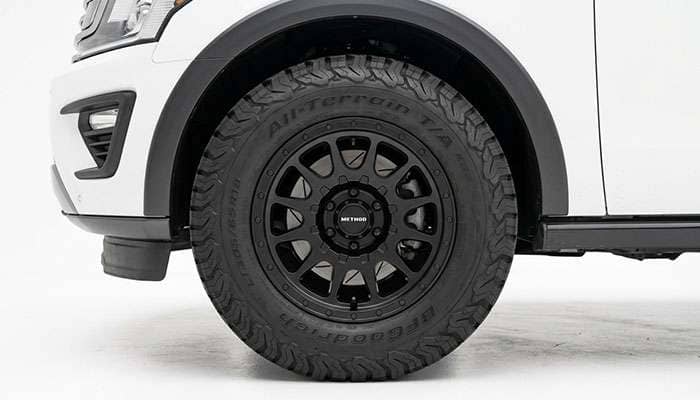
More than anything else on this page. Every clean report above is on factory wheels or a high-offset wheel. Now look at what happens on the other end. An owner on a 2007-2017 truck put the same 275/60R20 on 20x9 +18 mm wheels at stock height. It rubbed "pretty badly" off-road, and he ended up cutting all four top fender trims with a razor blade. That is an older body, so it isn't a lab test, but the wheel is the obvious suspect.
Here is the arithmetic. Going from +44 mm to +18 mm moves the wheel 26 mm outboard, about an inch. The extra half inch of wheel width pushes the outer lip another quarter inch. So the tire's outside edge sits about 1.25 inches closer to the fender lip, and it swings through a wider arc every time the suspension moves.
That matters because of what's for sale. Most 18x9 and 20x9 wheels in 6x135 run between 0 and +24 mm, because that is what the truck crowd wants. Hardly any come close to the factory +44. If you want aftermarket wheels at stock height, shop for +30 mm or higher, and keep the width at 8.5 or 9 inches. Our guide on how much you can change offset walks through the trade-offs.
While you're at it, confirm the basics. The Expedition is 6x135 with an 87.1 mm hub and M14x1.5 lug threads. Plenty of 6x135 wheels are bored to 87.1 mm, but others run around 106 mm and need hub-centric rings.
On a 2018-or-newer Expedition, you can stop worrying about it. Unlike a Tahoe with Air Ride, this truck runs coil springs, so there's no height mode that drops the truck onto your new tires. Ford's equipment lists show coils front and rear, and hitch suppliers treat the rear as a coil setup.
What some of these trucks do have is Continuously Controlled Damping, adaptive shocks that Ford fits to trims like the Platinum. CCD doesn't change what fits at stock height. It matters if you ever lift or level, because kits are built specifically for CCD or non-CCD trucks. Order the wrong one and it won't fit.
Older trucks are different. A 2009 EL Limited, for example, had rear air load-leveling, and by 2015 Ford was offering mechanical self-leveling rear shocks. If your older truck sags in back, fix that before you judge any tire fit, because a tired rear end takes away clearance you thought you had.
They need at least the rating you have now, and there are two traps in getting there. An Expedition is heavy. Recent trucks carry a GVWR of about 7,450 to 7,625 pounds, and that is before a trailer tongue goes on the hitch. The door placard calls for about 35 to 36 psi on 18s and 20s.
The 18-inch trap is LT construction. Almost every 275/70R18 on the market is an LT Load Range E, rated 125, or 3,640 pounds. That looks like a huge win over the factory 116 at 2,756 pounds. But the 3,640 only arrives at 80 psi. At 35 psi, an LT275/70R18 carries about 2,070 pounds. The factory passenger tire counts for about 2,505 pounds on a truck, once you apply the Tire and Rim Association's 1.10 factor. So at placard pressure, your bigger tire carries about 435 pounds less per corner.
The fix is simple: run more air. It takes about 46 psi to match the factory tire. Expedition owners on Load E tires report running about 38 to 48 psi cold, with a firmer ride and usually 2 mpg or less of penalty. Most of them are glad they did it, especially the ones who tow. Just use the tire maker's load and inflation table, not the door sticker.
The 22-inch trap goes the other way. Your factory 285/45R22 is a 114, good for 2,601 pounds. Many 275/50R22 tires are a 111 at 2,403 pounds. That is 198 pounds per tire, or 792 pounds across the truck, that you just gave away for a taller look. Buy the XL 115 at 2,679 pounds.
The 20-inch 33 is the easy one. Factory 275/55R20 is a 113, and most 275/60R20 tires are passenger 115s or 116s, so you gain capacity without moving to an LT tire. Watch speed ratings on LT tires too. The factory 18- and 20-inch tires are T-rated, while many LT 33s are S, R, or even Q, which is only 99 mph.
Yes, but this is the part nobody puts in front of you. Ford's towing guide says a "conventional, identical full-size spare tire is required for trailer towing," and it rules out mini, compact, and dissimilar spares. Your factory spare just became dissimilar, because it is now roughly an inch shorter than the other four.
If you tow, budget a fifth tire. Your spare hangs under the body on a crank-down carrier, so check that the taller tire stows properly before you count on it. Add it to the bill now rather than finding out on the shoulder of the 15 with a trailer behind you.
Three more things to check if you tow:
Yes. The Max has a longer body behind the rear doors, and the front wheel opening, where a 33 first gets tight, doesn't care about that. The owner reports here include a 2019 Max XLT with no rub at stock height and a 2021 Max XLT owner who chose 275/60R20.
The difference is weight. A 2023 Max Platinum 4x4 carries a curb weight of 5,793 pounds, and Ford's Max tow ratings run a little lower than the short-wheelbase truck's. That gives you one more reason to take load index seriously on a Max.
Usually, but I have less to go on. One 2015 Expedition EL XLT thread reports that 285/65R18 clears and that 33s fit, while 35s hit the retractable steps. On a 2012 EL Limited with 20s, one forum member figured 275/60R20 would fit stock with roughly three-quarters of an inch to spare. The owner who cut his fender trims was on a truck from this generation too, on +18 mm wheels.
Stick to 275 width and factory wheels here. These trucks came on a mix of wheel sizes, so read your own sidewall before you order. Check suspension condition as well, because worn shocks and springs on a truck this age change the answer.
A 34 is a maybe, and a 35 is a no. 275/65R20 is 34.1 inches and keeps the 275 width, so it is the only step past 33 I'd consider at stock height. It's an easy swap on many F-150s, but I can't show you enough Expedition owners running it to promise you a clean fit. Nearly every one is an LT Load Range E as well, so all the pressure work above applies.
A 35 needs a lift, and larger tires will need fender work beyond that. One owner reported 35s hitting the retractable steps, so check power running boards on any truck that has them. If you go that way, buy the lift for your exact truck, CCD or not.
The unhappy trucks are rarely the ones that went a little taller. They went too wide or too far out. Here's how a small rub turns expensive.
You don't have to, but you'll want to know the number. Going from 275/65R18 to 275/70R18, or from 275/55R20 to 275/60R20, adds about 3.4 percent. Your speedometer and odometer both read low by that much, so an indicated 70 mph is about 72.4 on the road. On a 22-inch truck moving to 275/50R22, the gap is only 2.3 percent.
On these Fords, the fix is usually a software change. A shop with the right scan tool can often update the tire size setting. Plenty of owners leave it alone, since about 2 mph at highway speed doesn't hurt anything. Expect some fuel economy loss as well, mostly from heavier tires. One owner who went from P275/55R20s to heavier 275/60R20s saw his highway number fall from about 19 to 16 mpg, and LT owners more often report 1 to 2 mpg.
A stock Expedition is one of the easier trucks to put on 33s. On 2018-2024 trucks, stay 275 wide, keep the factory wheels, and buy 275/70R18 or 275/60R20. On 2025-and-newer trucks, you're already there.
Trouble comes from the parts of the job people skip. A low-offset wheel will rub a tire that was fine on the factory wheel. An LT tire at door-sticker pressure carries less than you think. A 22-inch 33 can quietly lower your load rating. And if you tow, your old spare no longer counts. Get those four right and you'll never think about your tires again, which is exactly how it should be.
About 33 inches is the safe limit at stock height. Use 275/70R18 on 18-inch wheels or 275/60R20 on 20-inch wheels. 275/65R20 at 34.1 inches is possible but unproven, and 35s need a lift.
Yes. It fits factory 18x8.5 wheels with no lift, and Ford uses this size on the Expedition Tremor. Most 275/70R18 tires are LT Load Range E, so plan on about 46 psi to match the factory tire's capacity.
Yes. Owners report no rubbing on factory 20-inch wheels at stock height. It is exactly 33 inches tall and is the factory size on 2025-and-newer Platinum trucks, which makes it the best-proven 33 for this Expedition.
No, not on factory wheels in 275 width. A leveling kit may help with low-offset aftermarket wheels or wider tires. If you buy one, match it to your truck, because kits differ for trucks with Continuously Controlled Damping.
A little. On most trucks a 33 adds about 3.4 percent, so an indicated 70 mph is really about 72.4 mph. A shop with the right scan tool can often correct it, and many owners simply leave it alone.
2018-and-newer Expeditions use 6x135 with an 87.1 mm hub bore and M14x1.5 lug threads. Factory offset is about +44 mm, while most aftermarket 6x135 wheels run much lower, so check offset before you buy.