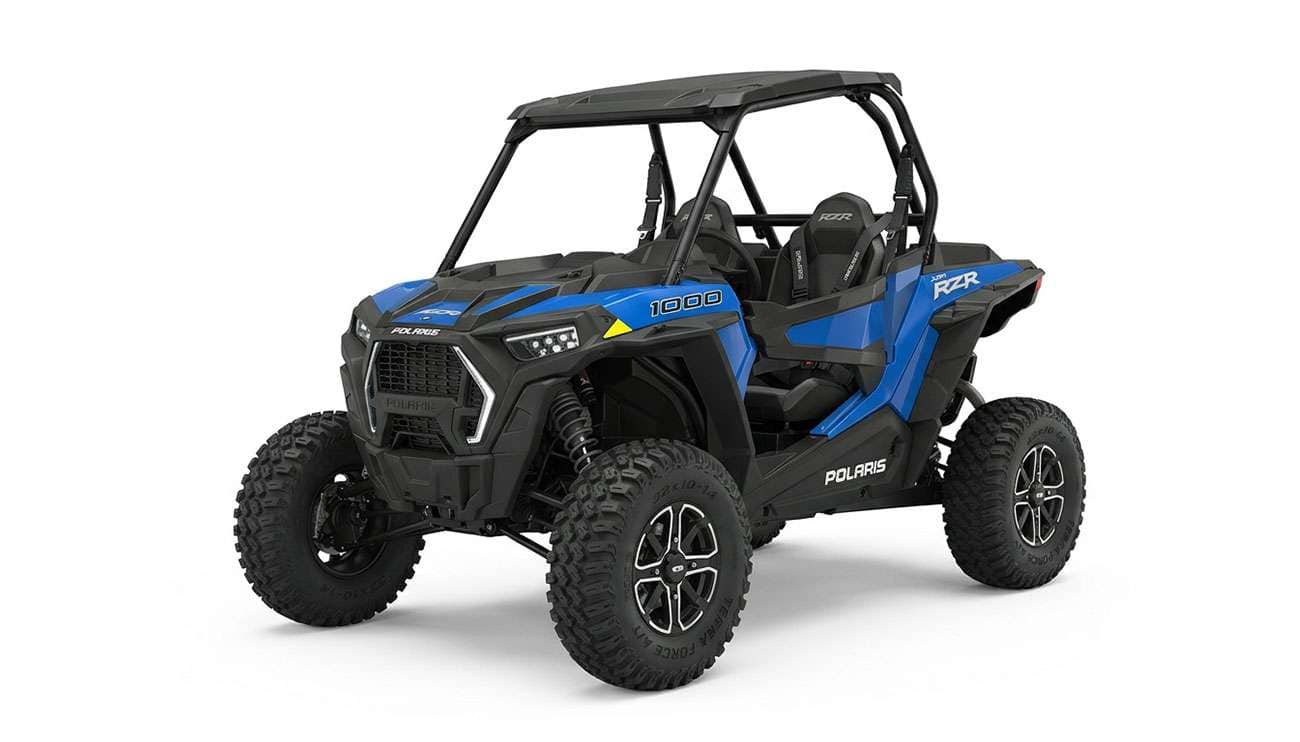
On a 72- or 74-inch RZR, 32s are the factory tire. On a 64-inch RZR XP 1000, XP Turbo, or Pro XP, yes, a 32x10 runs without a lift if you stay on stock-offset or 5+2 wheels and accept possible light contact at full bump and full lock. On a Trail or Trail S, no. Two things decide the rest: what you mean by "fit," and whether your clutching can carry a taller, heavier tire.
I'm Dennis Feldman, and I spec fitment for Performance Plus Tire. Look this question up and you will find limits of 31, 32, 33, and 35 inches for what looks like the same chassis. Most answers stop at "it depends." This one tells you what it depends on, starting with your machine.
Feature |
Width |
Factory Tire |
32s With No Lift? |
What It Takes |
|---|---|---|---|---|
RZR Trail, Trail S, older XP 900 |
50 to 64 in. |
26s and 27s on 12-in. wheels |
No |
New wheels, suspension work, clutching, likely gearing |
RZR XP 1000, XP Turbo (2014-23) |
64 in. |
29s or 30s on 14-in. wheels |
Yes, light contact possible |
32x10 only, stock-offset or 5+2 wheels, clutch kit for most riding |
RZR XP (2024 and newer) |
64 in. |
29s on Sport, 30s on other trims |
Yes, light contact possible |
Same recipe, and cycle yours before you ride |
RZR Pro XP |
64 in. |
30x10-14 |
Yes |
Same recipe, more thought about low-range gearing |
RZR Turbo S (2018-21) |
72 in. |
32x10-15 |
Factory size |
Nothing |
RZR XP S, Pro S, Turbo R, Pro R |
72 to 74 in. |
32x10-15 |
Factory size |
Nothing, but these are five-lug cars |
Can-Am X3, 64-inch |
64 in. |
30x10-14 |
Tight |
Forward-offset A-arms are the clean fix |
Can-Am X3, 72-inch |
72 in. |
30x10-14 or 32x10-15 |
Yes, factory on X rs and X rc |
Clutch check if your car shipped on 30s |
Two honest tests give you two honest numbers, and that gap explains every conflicting answer you have read.
The bench test. One major UTV suspension manufacturer removes the shock, mounts a sizing tool to the hub, fully compresses the suspension, and turns the front wheels lock to lock. Any contact fails. By that standard, a stock 2014-2023 RZR XP 1000 tops out at 31 inches, and 32s call for a 3-inch lift. The company describes its own numbers as conservative and says you can probably go a little bigger if you accept some rubbing.
The ride test. This one asks whether the tire touches anything in normal riding. UTV builders report that stock A-arms carry up to 32 inches, depending on the tire, the air pressure, and the wheel offset. One published fitment note for the 2024-2026 RZR XP 1000 puts a 32x10-14 at about half an inch of front fender clearance at full lock and maximum shock compression, with no lift and no forward-offset arms.
Both numbers are right. They answer different questions. Full compression and full steering lock rarely happen at the same instant, so a tire that misses the bench number by an inch can still run clean on most trails. Drop a front corner into a rock hole at full lock, though, and you will hear it touch.
The mechanism is simple. As the suspension compresses, the tire rises into the fender. As you steer, its back edge swings rearward and inward. A 32 adds an inch of radius over a 30 and an inch and a half over a 29, and those two movements stack at the worst possible moment.
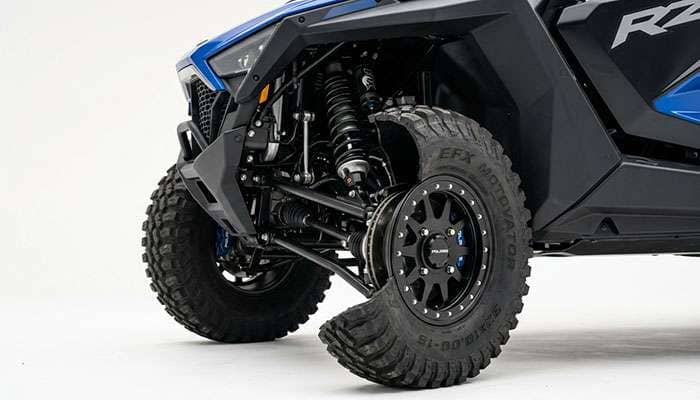
That is also why a no-lift route exists. A lift moves the tire down, away from the fender. Forward-offset A-arms move the hub ahead of the problem instead. The same manufacturer lists 1.5-inch forward-offset arms for 33-inch tires on an XP 1000 with no lift at all, one inch more than it gets from its 3-inch lift kit. If you hate the idea of a lift, that is the part to price.
Yes, in a 32x10. Early XP 1000s left the factory on 29x9-14 fronts and 29x11-14 rears, and later trims moved up to 30s. That history tells you where the new tire will and will not bother you.
The rear is the easy end. A 32x10 is an inch narrower than a factory 29x11, which leaves more room at the trailing arm, not less. The front is the tight end. You are adding height, and on a 29-inch car an inch of width, at the corner that also steers.
Stay at 10 inches wide. A 32x11 or 32x12 gives back the rear clearance you just gained and takes more from the front. How big the step feels depends on where you start:
Feature |
From 29s to 32s |
From 30s to 32s |
|---|---|---|
Height added |
3 in. |
2 in. |
Radius and ground clearance added |
1.5 in. |
1 in. |
Effective gearing |
10.3 percent taller |
6.7 percent taller |
Indicated 60 mph is really |
About 66 mph |
64 mph |
Those figures use stamped sizes, and our guide to bigger tires and your speedometer walks through the math.
The current RZR XP stays at 64 inches, with 29s on the Sport trim and 30s on the rest. Clearance data for this generation is thinner, because the best-known bench numbers cover 2023 and older cars. Start from the half-inch figure above, and cycle your own car before you ride.
Yes, and this is the best-documented no-lift case. The Pro XP is still a 64-inch car, on factory 30x10-14s with 181 turbocharged horsepower. Published limits for it run from 31 inches to 35-plus, because they come from different tests.
The most useful data point is a published rock-crawling review of a 2020 Pro XP Ultimate. The only modifications were 32-inch tires and 15-inch beadlock wheels. The car ran hours of granite at about 15 psi, picked up ground clearance, and the review reported no rubbing problem.
The same review called factory low range taller than ideal, especially after the switch to 32s. Read that as the real Pro XP limit. The tire fits before the gearing likes it.
If you own one of these, 32s are a replacement tire, not an upgrade:
Two details matter here. First, a five-lug car will not take a four-lug RZR wheel, and 5x114.3 is the same pattern as 5x4.5. Every 64-inch RZR in this guide runs 4/156, and our 4x156 bolt pattern guide covers that fitment.
Second, look at the XP S. It carries factory 32s on a naturally aspirated 114-horsepower 1000. So the engine can spin a 32. The factory simply clutches each car for the tire it ships on, and your 64-inch car got clutched for 29s or 30s. That is the whole reason the clutch section below exists.
No. The Trail is 50 inches wide on 26x8-12 fronts and 26x9-12 rears. The Trail S is 60 inches wide on 27x9-12 fronts and 27x11-12 rears. A 32 is 23 percent taller than a 26 and about 19 percent taller than a 27.
The wheels stop you first. Most 32s are built for 14-, 15-, and 16-inch wheels, so a 12-inch car buys wheels on top of everything else. Polaris's own accessory catalog lists 26- and 28-inch sets for the Trail S, which shows you where the factory draws the line. The older 64-inch XP 900 on 27s and 12-inch wheels is the same story.
If you want 32s on a car this size, you are planning wheels, suspension, clutching, and probably gearing. Price that against a machine that ships on them.
On a 72-inch X3, yes. On a 64-inch X3, it is the tightest fit in this guide.
Can-Am's current lineup ships the 72-inch X rs and X rc on 32x10-15s, and its 2022 spec sheet for the X rs Turbo RR lists 32x10-14s at 72.7 inches of width with 16 inches of ground clearance. The 72-inch RS runs 30x10-14s in that same width class, so 32s are a natural step there.
The 64-inch DS and X models ship on 30x10-14s with 14 inches of ground clearance, and the published numbers tell a clear story. One manufacturer's 3-inch lift kit lists tire clearance of only 29.5 inches on 64-inch cars and 32 inches on 72-inch cars. Its 1.5-inch forward-offset A-arms list 34 inches on the 64 and 35 inches on the 72, with no lift. On this car, moving the hub forward buys far more room than raising it. Spend there, and expect more front contact than a RZR if you skip it.
The X3 uses 4/137 with 12 mm studs and a 4+3 factory offset, so RZR wheels do not cross over. Our 4x137 bolt pattern guide has the details. Stock X3 clutching is generally described as good up to about 32s, and kits calibrated for 32-inch tires are widely sold if you ride hard or high.
Stock offset or 5+2. UTV wheels use a shorthand: the first number is inches behind the mounting pad, the second is inches in front of it. Factory RZR wheels sit close to 5+2 or 6+1.
On a 7-inch wheel, 5+2 works out to about +38 mm of offset and 4+3 to about +13 mm. That 25 mm is an inch per corner and 2 inches across the axle. Pushing a 32 outboard does clear the shock and trailing arm. It also adds steering kickback, loads the wheel bearings, and puts the tire into the fender during body roll, which is the contact you are trying to avoid. On a 64-inch car running 32s, 4+3 is the one to skip.
Width matters too. One XP 1000 owner's test with 14x7 wheels and 3.5 inches of backspace widened the car about 5.2 inches in front and 4 inches in back. If your trail system has a width limit, that is a dealbreaker, so measure before you buy.
Spacers do the same thing by a different route. Our piece on whether wheel spacers stop tire rubbing explains why they help inboard rub and make fender rub worse.
If your wheels are in good shape, a 32x10-14 is the shortest path. It mounts on your factory 14s, so offset, lug hardware, and track width stay exactly where Polaris set them. You also keep more sidewall: 9 inches, against 8.5 on a 15-inch wheel.
The 15-inch version can also run bigger than its label. Maxxis publishes the Carnivore 32x10R14 at 32.0 inches tall and 10.0 wide, the 32x10R15 at 32.3 tall and 10.3 wide, and the 30x10R14 at 30.5 tall. Another maker's 32x10-15 lists 32.2 tall and 10.5 wide. When your margin at full lock is half an inch, those tenths are real. Buy from the overall diameter on the spec sheet, not the size on the label.
You do not need one to bolt the tires on. You need one if you ride slow, soft, heavy, or high.
A CVT has no gear to drop into, so extra load shows up as belt slip and heat. A published XP 1000 test shows how fast it adds up. On stock tires the car ran 14.23 seconds at 56.7 mph in the quarter mile. On 30-inch tires with stock clutching, and 46 pounds of added rotating mass from the new wheels and tires, it ran 14.47 at 55.6, and RPM spikes at 60 mph pointed to belt slip. With a clutch kit on those same tires, it ran 13.98 at 60.4. That was a 29-to-30-inch change, and the kit more than bought it back.
Published weights for an 8-ply 32x10 run from about 36 pounds to about 54 pounds. That spread sits inside a single stamped size. Polaris's own Pro Armor catalog shows one tire family going from 38 pounds in a 30x10-14 to 42 pounds in a 32x10-15.
Model that as mass at the tread and the 42-pound 32 carries about 26 percent more rotational inertia than the 38-pound 30 it replaced. A 54-pound 32 carries about 61 percent more. The clutch spins that up every time you touch the throttle. Our breakdown of unsprung weight covers the general case, and on a belt-drive machine the bill lands on the belt. A light 32 asks far less of it than a heavy one.
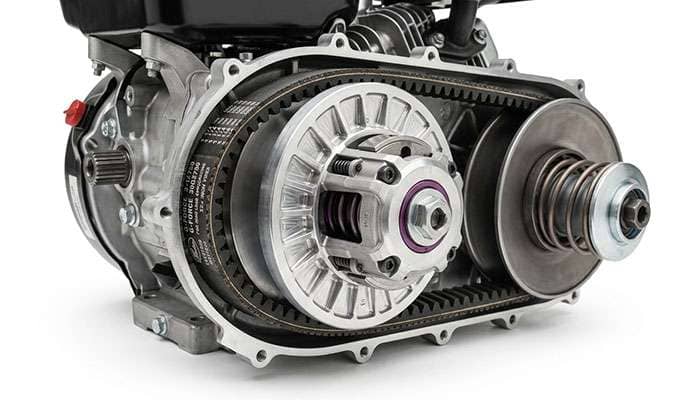
The RZR XP 1000 owner's manual never has to mention 32s to make the point. It names driving at 3 to 7 mph as a belt-wear condition and tells you to drive faster or use low gear more often. It calls for low gear when loading onto a trailer, starting up a steep incline, hauling, pushing, plowing, or climbing large objects from a stop. Every one of those loads a 32 harder than a 29.
The warm-up matters too: under 30 mph for at least a mile, and 5 miles or more below freezing. Polaris also ties many belt failures to skipping low gear when stuck in mud or sand, or when loading. On 32s, make low range your habit.
Clutch kits are sold by tire size and elevation together, in bands like 0-3,000 and 3,000-6,000 feet. As a rule of thumb, a naturally aspirated engine loses about 3 percent of its power per 1,000 feet. A 114-horsepower 1000 at 6,000 feet is working with roughly 93. Turbo cars hold their power better at altitude.
Use your riding, not your tire, to decide:
Feature |
Clutch Kit? |
Tire Target |
Wheel Call |
|---|---|---|---|
Hardpack trails, under 3,000 ft |
Optional at first, watch the belt |
Lightest 8-ply 32x10 that suits the terrain |
Factory 14s with a 32x10-14 |
Rocks and slow crawling |
Yes, and stay in low range |
8- or 10-ply, watch the weight |
5+2 beadlock for low-pressure riding |
Sand or deep mud |
Yes |
Under 45 lb each |
Lightest 5+2 wheel with the right rating |
Above 4,000 ft, naturally aspirated |
Yes, calibrated for your elevation |
As light as the terrain allows |
Stock offset or 5+2 |
Four seats or heavy gear |
Yes |
Load rating above your loaded corner weight |
Wheel rating above your loaded corner weight |
Treat 32 as the last stop on clutch work alone. Published clutching guidance calls regearing nearly required on Polaris XP 1000, XP Turbo, Pro XP, and Turbo S models once you go past 32 inches.
Clearance gets all the attention, but load is the number to check before you order, because a 32x10 label tells you nothing about capacity. Load indexes on 32x10 tires run from the high 60s, about 680 pounds, to around 101, about 1,820 pounds. Polaris's Pro Armor catalog lists 1,390 pounds on its 8-ply 32x10-15s and 1,650 pounds on a 10-ply.
Read the pressure beside the number. One 8-ply 32x10-15 lists 937 pounds at 38 psi, while another maker caps its 32x10 at 18 psi. Two load figures only compare if the pressures match. Ply is not a load rating either, as our ATV vs. UTV tire guide explains.
Then do your own math. Take the dry weight, add fluids, riders, and gear, and divide by four:
Those are static averages. The rear corners carry more, and every landing multiplies the load. A four-seat build needs real margin, and that goes for the wheel as well. Most UTV wheels in these sizes are rated 1,000 to 1,600 pounds, with some light wheels closer to 700.
The bill comes in order, and each step costs more than the last:
32s fit a 64-inch RZR without a lift. The honest version of that sentence comes with three conditions: a 10-inch width, stock or 5+2 offset, and a clear idea of how much contact you will accept at full bump and full lock. Wide RZRs already live there, and Trail cars are a different project. On a 64-inch X3, forward-offset arms beat a lift.
The tire is the easy part. The belt is what you end up living with, so spec the weight, the load rating, and the clutching with the same care you put into the clearance.
Yes, in a 32x10 on stock-offset or 5+2 wheels, with light contact possible at full compression and full steering lock. A strict zero-contact test limits a stock 2014-2023 XP 1000 to 31 inches.
On a 64-inch XP 1000, 31 inches with zero contact and 32 inches with possible contact at the extremes. Add 1.5-inch forward-offset A-arms and the listed limit rises to 33 inches with no lift. Wide RZRs ship on 32s, and Polaris sells 33-inch wheel and tire sets for the Turbo R and Pro R.
Not for light trail riding at low elevation on a light tire. You do want one for sand, mud, rocks, four-seat loads, tires over 45 pounds each, or riding above about 4,000 feet on a naturally aspirated car.
On a 14-inch XP or Pro XP wheel, yes, a 32x10-14 mounts directly and keeps your offset and track width at stock. A 32x10-15 needs 15-inch wheels, and 12-inch Trail wheels are not an option.
On a 72-inch X3, yes, and the X rs and X rc ship on them. On a 64-inch X3 the fit is tight, and 1.5-inch forward-offset A-arms are the clean fix.
None on a 64-inch RZR if you accept possible light contact. For zero contact on a 2014-2023 XP 1000, a 3-inch lift clears 32s, or 1.5-inch forward-offset A-arms clear 33s with no lift.