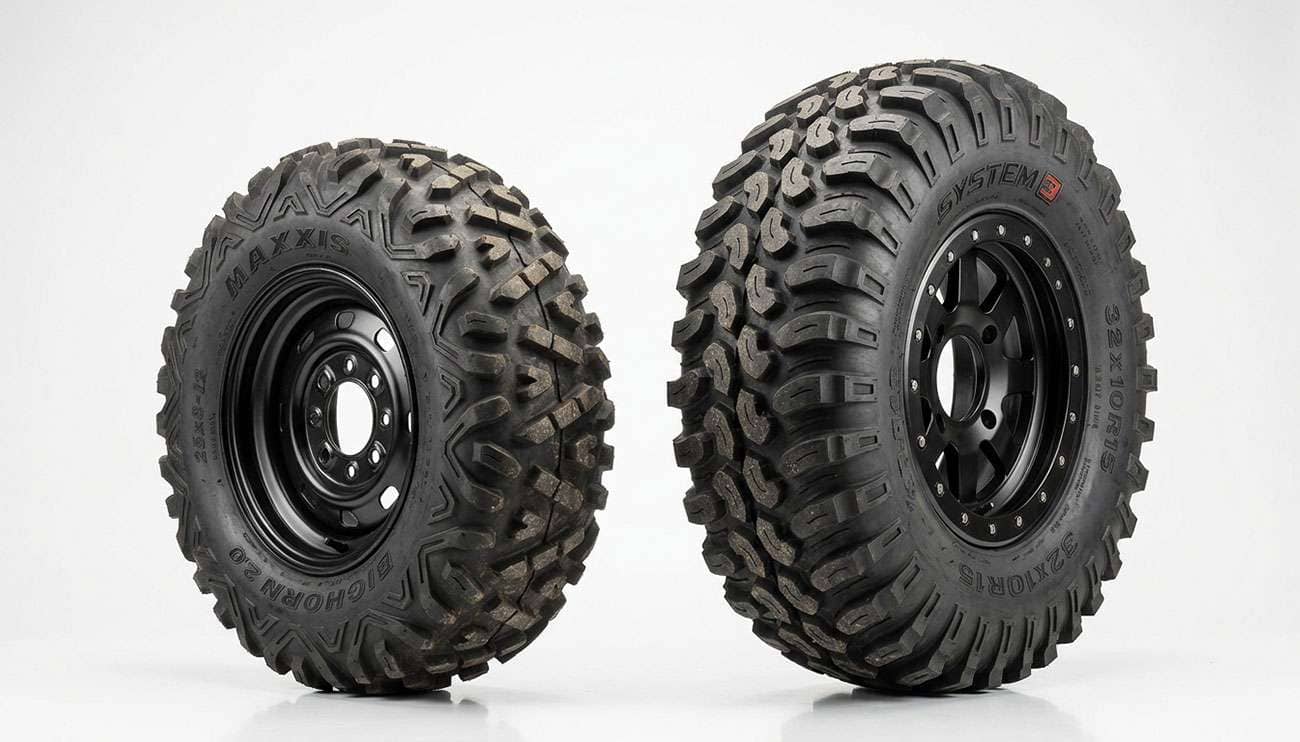
I've had this exact conversation more times than I can count. A fella walks up to the counter, scratches his head, and says, "I've got a quad and a side-by-side sitting in the garage. The tires look the same to me — can I just throw the spares back and forth?" And I get it. Stand them next to each other and they sure do look like littermates. Same chunky tread, same funny three-number sizing, same general attitude.
But looking the same and being the same are two different animals. After enough years turning wrenches and mounting these things, I can tell you the answer matters — because guessing wrong doesn't just give you a rough ride. It can leave you stranded out on the trail or, worse, with a tire that gives up under a load it was never built to carry. So let's settle it the way I'd settle it for a customer leaning on my counter.
Here's the honest version, no runaround: ATV and UTV tires are cousins, not twins. They're built the same way, on the same kind of machinery, with the same construction ideas behind them. What separates them is what they're asked to do. An ATV — your classic quad — is usually carrying one rider and maybe a little gear. A UTV, also called a side-by-side or SxS, is a bigger, heavier beast hauling two or three people plus cargo and sometimes a trailer hitched on the back.
That difference in job changes the spec. UTV tires get beefed up to handle the weight and the load, and that beefing-up is the whole ballgame. So when somebody asks "are they the same?" the truthful answer is: same recipe, different serving size. Get that idea in your head and everything else falls into place.
Let me give the "same" side its due, because there's real overlap here and it's why folks get confused in the first place.
First, the sizing system is identical. Both ATV and UTV tires use that three-number callout you'll find stamped right on the sidewall — something like 27x9-14. The first number is the tire's height in inches, the second is the width in inches, and the third is the wheel diameter it mounts to. If you've ever puzzled over those numbers, my rundown on the most common ATV wheel size walks through how they all fit together.
Second, the tread families are shared. All-terrain, mud, sand, hard-pack racing — those tread categories exist for both vehicles, and they look the part regardless of which machine they're bolted to. If you want the long version on why tread is shaped the way it is, I got into that in my piece on why tires have tread.
Third, both worlds use the same two construction types — bias ply and radial. Bias tires have stiff sidewalls that off-roaders love for rough, rocky stuff. Radials run cooler, ride smoother, and tend to wear longer. That trade-off plays out exactly the same on a quad as it does on a side-by-side, and it's worth understanding before you buy — I broke down the difference in how to tell a bias-look tire from a radial.
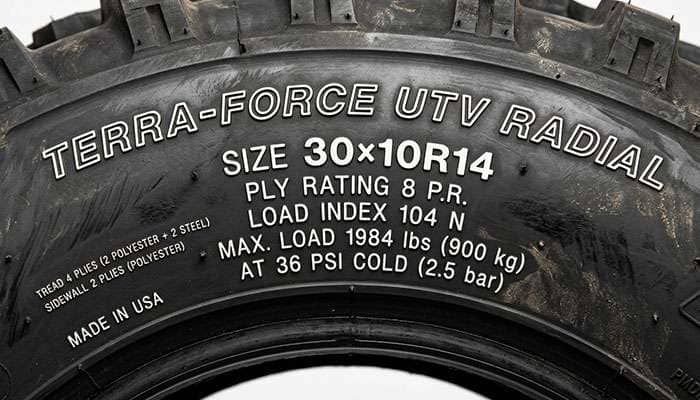
Now we get to the part that actually matters. The real divider between an ATV tire and a UTV tire comes down to one word: load. Everything else flows from there.
Put some real numbers on it. A Polaris Sportsman — a popular ATV — tips the scales around 911 pounds. A Polaris RZR Pro R Ultimate, which is a UTV, weighs in north of 2,180 pounds. That's more than double. Now add two passengers, a cooler, and a bed full of gear to the UTV, and you start to see why its tires can't just be scaled-up quad tires. They're built from the ground up for a heavier job.
To carry that weight without folding, UTV tires get higher ply ratings, stronger sidewalls, and more rigid construction. Most ATV tires live in the 2-to-6-ply range, while UTV tires often start at 6-ply and climb to 8 or even 10. That extra structure is exactly what keeps a loaded side-by-side stable through a corner and resists punctures from sharp rocks. Run an under-spec'd tire on a heavy machine and you'll feel it as body roll, longer stopping distances, and a tire that wears out — or blows out — before its time. If you're curious how all this construction affects how long a tire actually lasts, I dug into that in my write-up on off-road tire tread life.
This is the question that brings most folks to the counter, so here's my rule of thumb, and it only runs one direction.
You can usually run a UTV-spec tire on an ATV — as long as the size fits your wheel and your machine. A UTV tire is over-built for an ATV's lighter load, so you're erring on the side of too much strength, not too little. The penalty is a stiffer ride and a little extra rotating weight, which can nibble at your acceleration and fuel use, but it won't put you in a bad spot.
Going the other way is where people get hurt. Bolting a lightweight ATV tire onto a UTV asks a tire to carry a load it was never engineered for. That's how you end up with blown beads, torn sidewalls, and a machine that handles like a noodle. Don't do it. If the size happens to match, that's a coincidence, not a green light — the internal load rating is what counts.
There's a smart middle ground, too: dual-purpose tires marketed for both ATV and UTV use. The reason those work is simple — they're built to the tougher UTV standard, so they're plenty strong for either machine. Most powersports tires are slightly over-engineered toward UTV duty anyway, which is why you'll see plenty of models labeled for both. When in doubt, buying up to the UTV spec is never the wrong call.
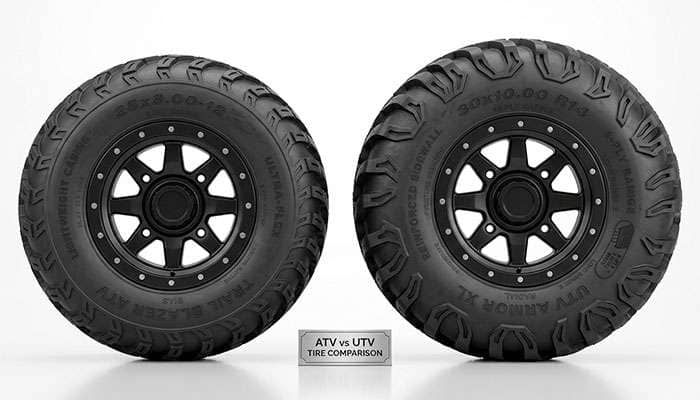
You don't have to take anybody's word for it — including mine. The tire tells you what it's for if you know where to look. Walk over to your machine and read the sidewall.
Start with the ply rating. It's usually stamped right there. Just know that these days the ply rating is about strength, not a literal count of layers. Modern materials let a tire labeled "6-ply" actually use fewer plies while still hitting that strength target. So treat the number as a relative toughness scale within a brand: higher number, tougher tire, more money, fewer flats.
Next, look for the load and pressure markings. Most ATV and UTV tires list a maximum load and a max PSI. A lot of them also carry a star rating — the stars correspond to the tire's maximum operating pressure and load capacity, which is a handy shorthand once you know it's there. The big lesson here is the one a lot of old hands learned the hard way: the actual stamped load rating matters more than the marketing ply number. A tire "rated" at 8-ply doesn't help you if its real load number is too low for your loaded-down side-by-side.
One more practical note — none of this matters if the tire's mounted on the wrong wheel. The wheel has to handle the same loads. If you're rethinking your setup, my guide to what off-road wheels actually are and our hands-on look at the top ATV and UTV wheels we tested will keep you out of trouble.
Once you've sorted out the load question, picking the actual tire comes down to terrain and how you ride. Here's how I steer folks at the counter.
If you're running a heavier side-by-side hard, you want a real UTV-spec tire with serious sidewall. Something like the Atturo Trail Blade Boss SXS in 8-ply is a good example of a tire purpose-built for the job, and the BFGoodrich Mud Terrain T/A KM3 UTV brings that famous truck-tire toughness down to side-by-side sizing. For the heaviest, most punishing utility work, a 10-ply option like the Fuel UTV Gripper gives you the extra carcass strength to haul and tow without sweating a puncture.
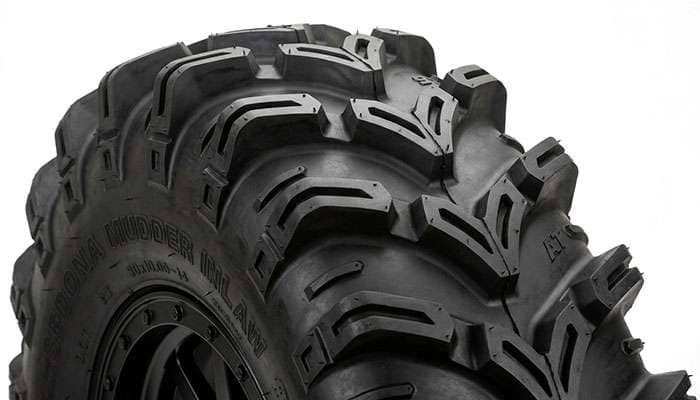
For a lighter trail quad, you've got more freedom to chase ride quality and nimbleness, and you don't necessarily need to pay for 10-ply armor you'll never use. If mud's your thing, a deeper, more aggressive tread is worth it — our ATV mud tires lineup is built exactly for that slop. And if you want to see how the popular models actually stack up before you spend, two pieces will save you time: our ATV and UTV tires tested for road safety and performance and our breakdown of who makes the best ATV tires, with the top brands ranked.
Here's a quick side-by-side of how the two shake out, so you can see it at a glance:
Feature |
ATV Tires |
UTV Tires |
|---|---|---|
Typical vehicle weight |
Lighter (~700–950 lb) |
Heavier (1,500–2,200+ lb) |
Typical load |
One rider, light gear |
Multiple passengers + cargo |
Common ply rating |
2–6 ply |
6–10 ply |
Sidewall construction |
Lighter, more flexible |
Stronger, more rigid |
Sizing system |
Three-number (e.g., 27x9-14) |
Three-number (e.g., 30x10-15) |
Safe to swap? |
UTV tire onto ATV: usually fine |
ATV tire onto UTV: no |
So, are ATV and UTV tires the same? Same family, same recipe, same sizing language — but built to do different jobs. The line that separates them is load: a UTV hauls more weight, so its tires carry higher ply ratings and stronger sidewalls to match. Remember the one-way rule — you can step up to a UTV-spec tire on an ATV, but never the reverse — and when in doubt, read the sidewall and buy up to the tougher spec. Do that, and you'll never be the fella stranded out on the trail wondering where it all went wrong. When you're ready, our full lineup of ATV and UTV tires has the right tire for whatever you ride.
It's not recommended. A UTV is much heavier and carries more load than an ATV, so an ATV tire's lower ply rating and lighter sidewall can be overwhelmed — leading to poor handling, faster wear, and a higher risk of blowouts. Even if the size matches, the internal load rating usually doesn't. Stick with UTV-spec or dual-purpose tires.
Generally yes, as long as the size fits your wheels and clears your machine. A UTV tire is over-built for an ATV's lighter load, so you gain durability. The trade-offs are a stiffer ride and a bit more rotating weight, which can slightly reduce acceleration and efficiency.
Load capacity. UTVs weigh more and carry passengers and cargo, so their tires have higher ply ratings, stronger sidewalls, and more rigid construction. ATV tires are lighter and built for the lower loads of a single-rider quad.
Not necessarily. A higher ply rating means more strength and puncture resistance, but also a stiffer, heavier tire that rides rougher and can sap a little performance. Match the ply rating to your machine's weight and your terrain rather than just buying the highest number.
Yes. Both use a three-number system stamped on the sidewall — height x width x wheel diameter, all in inches (for example, 27x9-14). UTV sizes simply tend to run larger and wider to suit the bigger vehicle.