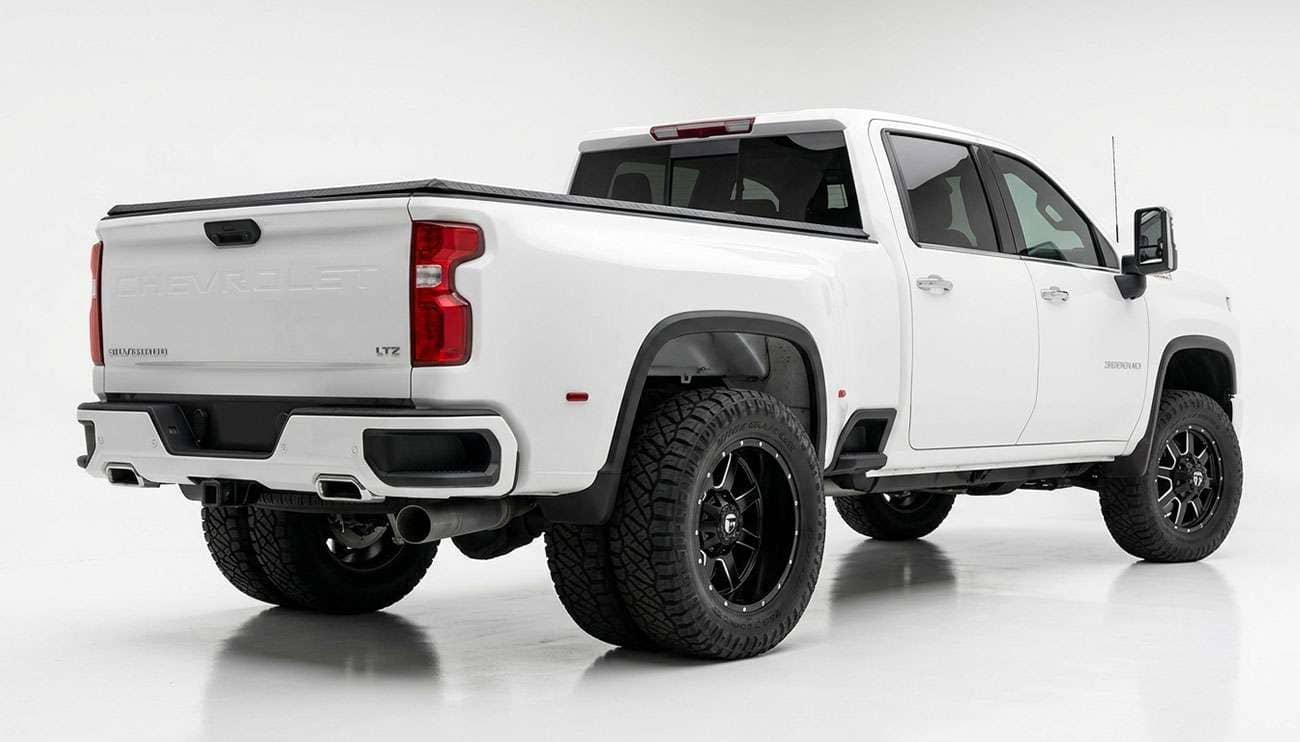
The point of dually wheels is load. Four tires under the rear axle instead of two spreads the weight across twice the contact patch, which raises how much the truck can legally and safely carry, widens the rear track for stability under a heavy trailer, and gives you a spare tire that is already bolted on if one lets go at speed. Payload, stability, redundancy. That is the whole list.
What dually wheels do not do is make the truck faster, stronger in the engine, or better off-road. The extra rolling assembly adds weight, adds width, and adds two more tires to buy. Folks who put duals on a truck that never carries anything are buying the look and paying the tax that comes with it, and there is nothing wrong with that as long as they know that is the trade they made.
I have been fitting these things for decades and the question underneath the question is almost always the same: does this particular truck need them. So let me walk through what you actually get, what it costs you, and how to tell which side of the line you are on.
Three real benefits, and they are worth understanding separately because most people only know about the first one.
Benefit |
What It Means in Practice |
|---|---|
Payload capacity |
Four rear tires carry more than two, so the rear axle rating and the truck's overall payload go up substantially. One-ton dually pickups commonly carry several thousand pounds in the bed and pull heavy gooseneck and fifth wheel loads |
Lateral stability |
The rear track widens by roughly eight inches or more, which resists trailer sway and crosswind push. The difference shows up most on windy days and with tall fifth wheels |
Blowout redundancy |
Lose a rear tire on a single-wheel truck under load and you are along for the ride. Lose one on a dually and the mate holds long enough to get you stopped on the shoulder |
That third one does not get talked about enough. A rear blowout on a loaded single rear wheel truck at highway speed is a genuinely dangerous event. On a dually it is usually a noise, a pull, and a slow drive to the shoulder. If you tow heavy for a living, that alone justifies the configuration.
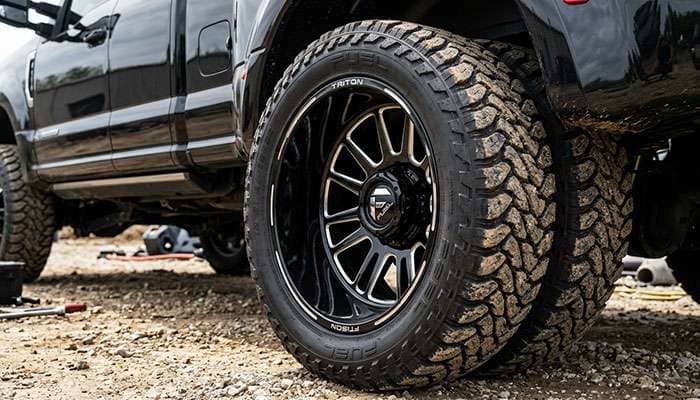
Now the part the brochures skip. A dually is about eight inches wider at the hips, which you will feel in every parking garage, every drive-through, and every narrow mountain road. Unloaded, the ride is firmer because the suspension is sprung for weight that is not there. You buy six tires instead of four. And fuel economy takes a hit from the extra rolling resistance and weight.
None of that is a reason to avoid a dually. It is a reason to be honest about whether you need one.
Neither is better in the abstract. It depends entirely on what the truck does, and the deciding number is how close you run to your rated capacity and how often.
Your Situation |
Better Choice |
Why |
|---|---|---|
Towing heavy gooseneck or fifth wheel loads regularly |
Dually |
Pin weight lands directly on the rear axle, which is exactly where the extra capacity lives |
Carrying a heavy slide-in camper |
Dually |
All of that weight sits in the bed over the rear axle, and campers routinely exceed single-wheel ratings |
Commercial or fleet work at capacity daily |
Dually |
Redundancy and load margin matter more when the truck is a tool that runs loaded every day |
Occasional towing well under the single-wheel limit |
Single |
You gain nothing and give up maneuverability, ride comfort, and two tires worth of expense |
Mostly daily driving with occasional loads |
Single |
The width penalty is a daily cost for a benefit you collect twice a year |
Serious off-road and trail use |
Single |
The rear duals pack mud, catch on ruts, and the extra width hurts on tight trails |
The honest test is this: look at your heaviest regular load, weigh it if you can at a scale, and compare that to the rear axle rating on your door jamb placard. If you are routinely inside eighty percent of that number on a single-wheel truck, you have outgrown it. If you are at half, you have not.
No, and this is where a lot of money gets wasted.
A dually is not a wheel choice, it is an axle. Factory dual rear wheel trucks come with a wider rear axle, longer axle shafts, different hubs, wider rear fenders, and a rear axle rating engineered for the additional load. You cannot bolt a second set of wheels onto a single rear wheel truck and have a dually. What you would have is a single-wheel axle carrying loads it was never rated for, on adapters, with fenders that do not cover the tires.
Conversion kits exist. They involve swapping in a dually axle or fitting adapters and aftermarket fenders, and they are real work with real cost. More importantly, a conversion does not raise your truck's gross vehicle weight rating. That number is set by the manufacturer based on the frame, brakes, suspension, and axles as a system. Bolting on more rubber does not change what the truck is legally rated to carry.
So the practical answer: if you need dually capability, buy a factory dually. If you already have one and you are shopping wheels, you need wheels built specifically for your truck's dually application, and that is a narrower shopping problem than it looks. Our dually wheels buying guide walks through what to confirm first.
Not remotely, and this trips up more buyers than anything else on this page. Counting eight lug holes tells you almost nothing.
Eight lug refers only to how many studs are on the hub. What matters is the bolt circle, meaning the diameter of the circle those studs sit on. Looking across our current dually inventory, the patterns in stock include 8x165.1, 8x170, 8x200, and 8x210, plus 10x225 for heavier applications and 6x205 on some van chassis. Every one of those has eight lugs except the last two, and not one of them will interchange with another.
Bolt Pattern |
Typical Application |
|---|---|
8x165.1 |
Common on GM and older Ram heavy duty trucks |
8x170 |
Ford Super Duty applications |
8x200 |
Newer Ford dually applications |
8x210 |
Heavier GM dually and cab chassis applications |
10x225 |
Cab chassis and commercial platforms |
There is a second thing nobody tells first-time dually buyers, and it costs people money at checkout. Dually wheels are sold as separate front, rear, and sometimes inner part numbers. The rear wheels carry a deep offset that creates the spacing between the pair. The fronts are a different offset entirely. Some models list a third inner part number as well. You are buying six wheels across two or three different part numbers, not a set of four.
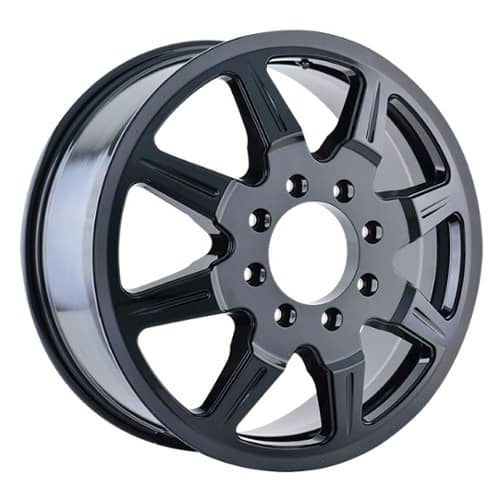
Get the bolt pattern confirmed before anything else. Our guide on dually bolt patterns decoded shows how to measure yours, and our overview of 8 lug wheels for truck owners covers why the lug count alone is a trap.
You can physically drive it. You should not, and here is the specific reason rather than the usual hand-waving.
Pulling the inner rear tires cuts your rear axle load capacity roughly in half. The truck's gross vehicle weight rating and rear axle weight rating were calculated with four tires under the back. Take two away and the remaining pair is carrying loads the tire's own sidewall rating may not permit, and you have no way to know without weighing the truck at a scale.
There is a second issue that matters mechanically. Running only the outer wheels moves the load further out from the wheel bearing centerline, which increases the bending load on the axle shaft. Empty and driving gently, you are probably inside the margins. Loaded, you are asking a component to do something it was not designed to do.
And there is the redundancy point. The single best safety feature of a dually is that a rear tire failure is survivable. Remove the inners and you have thrown that away while keeping all the width and weight penalties.
Where this comes up legitimately is a roadside emergency. If you lose an inner tire out on the road, limping to a shop on the remaining tires at low speed with the truck unloaded is a reasonable way to get off the shoulder. That is not the same as running it that way as a lifestyle. Get it fixed.
Ask ten dually owners and you will get roughly five who swear the inners go first and five who swear it is the outers. They are not lying to you. Both patterns are real, because the wear is driven by conditions rather than by position.
Here is the mechanism that actually matters. Two tires paired on the same hub never share load equally. Road crown puts more weight on one side of the pair. Any difference in inflation pressure shifts load to the harder tire. Any difference in rolling diameter shifts load to the taller tire. And these effects are not small. Industry guidance on dual assemblies indicates that a fifteen psi difference between paired tires can shift roughly five hundred pounds of load, and as little as a quarter inch of diameter difference can shift about six hundred pounds.
Once load shifts, the overloaded tire wears faster, which makes it shorter, which shifts load again. The mismatch compounds. Meanwhile the two tires are locked to the same hub and must turn at the same speed, so the smaller one scuffs. That is why mismatched duals chew themselves up.
The practical upshot is that the tire wearing faster on your truck is the one carrying more load, and which one that is depends on your pressures, your road crown, and your alignment. The inner is usually the one that gets neglected because the valve stem is harder to reach, which is a maintenance problem masquerading as a wear pattern.
So: check all six pressures cold on the same schedule, match diameters when replacing, and rotate on a real interval rather than when you remember. Our guide on how often to rotate tires covers intervals, and on a dually I would be at the tighter end of any range you read.
Yes, in a specific and important sense. You need tires rated for dual application, and that rating is different from the single-tire rating on the same tire.
Look at the sidewall of a light truck tire and you will typically find two maximum load figures: one for single application and one for dual. The dual figure is lower, commonly by something in the range of five to ten percent. That is not a printing quirk. It exists precisely because of the unequal load sharing described above. Manufacturers derate the tire in dual service because they know one of the pair will always be carrying more than its arithmetic share.
What that means for you is that you cannot size your tires off the single-application number. Add up what your rear axle actually carries, divide by four, and confirm that figure against the dual rating on the sidewall, not the single rating. If you are unclear on how those numbers work together, our explainer on load range versus load index sorts out the difference.
Beyond the rating, a few dually-specific rules. Run matched tires across each pair, same brand, same model, same size, ideally similar wear. Do not mix radial and bias construction on the same axle. Watch overall diameter closely when replacing just one, because a new tire next to a half-worn mate is the exact mismatch scenario that causes trouble. And consider metal valve stems or extenders that let you actually reach the inner tire, because a pressure you cannot check is a pressure you will not check.
For fitment specifics by platform, our guides on aftermarket tires for the Ford F-250 and F-350 and Ram 2500 aftermarket tire fitment get into the details.
Best depends on your bolt pattern first and your budget second, because a beautiful wheel in the wrong pattern is a paperweight. That said, here is what is currently moving, with real pricing per wheel.
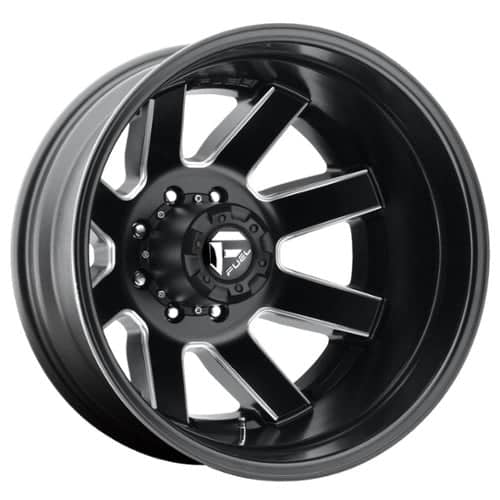
Model |
Price Range Per Wheel |
Diameters |
Notes |
|---|---|---|---|
XD Series XD130 Machete Dually |
105.26 to 423.84 |
17, 20 inch |
The value entry point, with front and rear part numbers available |
XD Series XD845 Pike Dually |
198.41 to 502.08 |
20, 22 inch |
Cleaner face design for owners who want less aggressive styling |
Mayhem 8101 Monstir Dually |
235.52 to 671.10 |
17, 19, 20, 22 inch |
One of the few offered in front, rear, and inner part numbers across a wide diameter range |
Fuel Maverick Dually Rear D538 |
266.63 to 660.32 |
17, 20, 22, 24 inch |
The widest diameter coverage of the group and broad bolt pattern availability |
Fuel Flux Dually |
460.00 to 798.11 |
20, 22 inch |
Modern blackout styling that has been selling well on newer trucks |
Cali Off-Road Summit Dually 9110D |
549.35 to 900.00 |
20, 22 inch |
Polished and milled finishes for owners building a show-level truck |
Remember to multiply by six rather than four, and check whether your chosen model requires a separate inner part number. A set of Mavericks at the median works out considerably higher than a first-time buyer expects because of that sixth wheel.
Start by deciding whether you actually need a dually, and use weight rather than opinion. Take your heaviest regular load to a scale, get the rear axle number, and compare it to the rear axle rating on your door jamb. That comparison answers the question better than any article can.
If you already own a dually and you are shopping wheels, measure your bolt pattern before you look at a single photo. Eight lugs is not a specification.
Confirm you are buying the right part numbers. Front, rear, and possibly inner, six wheels total.
Check the dual load rating on any tire you are considering, not the single rating, and make sure four times that number covers your rear axle weight with margin.
And set a pressure and rotation schedule you will actually keep, including the inner tires. That habit is worth more tire life than any brand decision you will make. You can browse current dually wheels filtered to your bolt pattern and position.
The point of dually wheels is that some jobs put more weight on the rear axle than two tires can safely carry. When that describes your truck, duals are not a style choice, they are the correct engineering answer, and the redundancy they provide on a blowout is worth real money in peace of mind.
When it does not describe your truck, you are paying width, ride quality, fuel economy, and two extra tires for a capability you will not use. Weigh your load, read your placard, and let the numbers decide. Then get the bolt pattern right, buy the correct front and rear part numbers, and keep all six pressures matched. Do that and a dually will outlast most things you bolt to it.
Dually wheels put four tires under the rear axle instead of two, which raises payload capacity, widens the rear track for stability under heavy trailers, and provides redundancy if a rear tire fails at speed. They do not add engine power or improve off-road capability, and they add width, weight, and two more tires to buy.
It depends on how close you run to capacity and how often. Choose a dually for regular heavy gooseneck or fifth wheel towing, slide-in campers, and commercial work at capacity. Choose single rear wheel for occasional towing well under the limit, daily driving, and off-road use, where the extra width and firmer ride are daily costs for a rare benefit.
No. A dually is an axle configuration, not a wheel choice. Factory dual rear wheel trucks have a wider rear axle, different hubs, wider fenders, and a rear axle rating engineered for the load. Conversion kits exist but involve significant work, and critically they do not raise the truck's manufacturer-assigned gross vehicle weight rating.
No. Eight lug describes only the number of studs, not the bolt circle diameter. Current dually applications include 8x165.1, 8x170, 8x200, and 8x210 patterns, and none of them interchange. Dually wheels also carry different offsets for front and rear positions, sold under separate part numbers, so measure your pattern before shopping.
Removing the inner rear tires cuts rear axle load capacity roughly in half and moves the load further outboard of the wheel bearing, increasing bending load on the axle shaft. It also eliminates the blowout redundancy that is a dually's main safety advantage. Limping to a shop unloaded after a roadside failure is reasonable; running that way regularly is not.
You need tires rated for dual application. Light truck tire sidewalls list separate maximum load figures for single and dual use, with the dual figure lower by commonly five to ten percent because paired tires never share load equally. Size your tires against the dual rating, keep pairs matched in brand, model, size, and diameter, and never mix radial with bias construction on the same axle.