
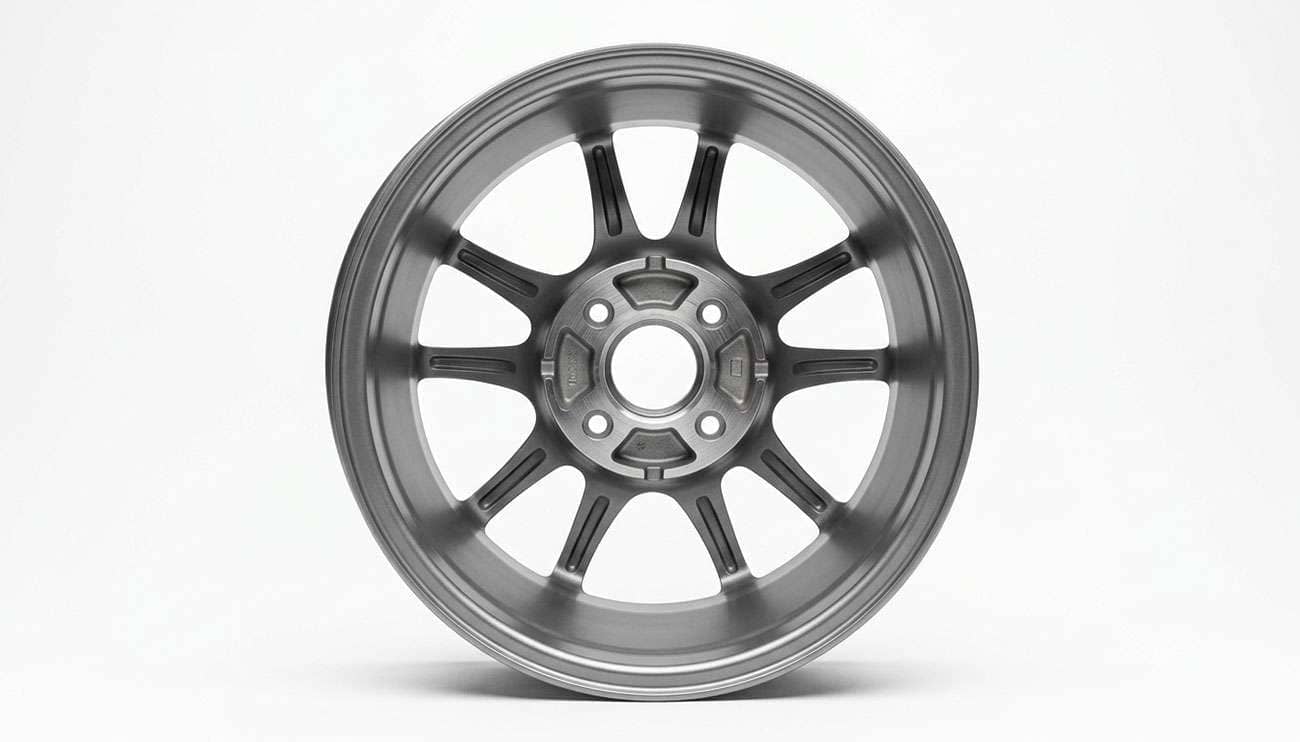
The 4x114.3 pattern runs across two worlds that never meet. On one side you have 1960s Mustangs and Falcons, Datsun 240Zs and 510s, early Mazdas and Toyotas. On the other you have Nissan Sentras and Versas, Hyundai Tiburons, Kia Optimas and Spectras, Suzuki Forenzas, and Hondas up through 2001. Same four studs, same 114.3 millimeter circle. And a wheel off one will very often not go on the other, for reasons that have nothing to do with the bolt pattern.
I have watched this go wrong in the shop more than once. Somebody shows up with a nice set of 15-inch wheels he bought off a guy, the ad said 4x114.3, his car is 4x114.3, and the wheels will not go on. He is convinced somebody lied to him. Nobody lied. The bolt pattern is exactly what it said.
Here is what is actually happening. The 4x114.3 pattern has been in continuous use for about sixty years across two populations of cars that have almost nothing else in common. American and Japanese classics from the sixties and seventies picked it. Then the compact import market picked it again in the eighties and nineties and stayed on it until the industry moved to five lugs. Both groups are legitimately 4x114.3. Everything around the bolt circle is different.
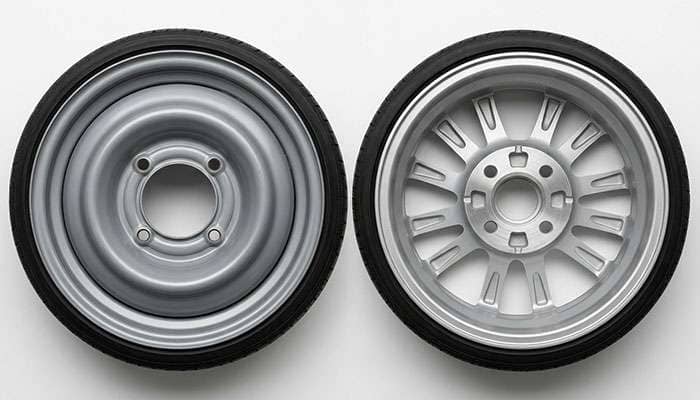
What Differs |
Classic Era Cars |
Modern Import Era Cars |
|---|---|---|
Centering method |
Lug-centric. The nut tapers position the wheel |
Hub-centric. The hub flange positions the wheel |
Center bore |
Large and loose, often well over 70 mm |
Machined close, commonly 59 to 67 mm |
Stud thread |
Imperial on American cars, such as 1/2 inch-20 |
Metric, typically M12x1.25 or M12x1.5 |
Typical wheel diameter |
14 and 15 inch |
15 through 18 inch |
What the aftermarket builds |
Steel wheels and vintage-style reproductions |
Lightweight cast and flow-formed tuner wheels |
Read that table in both directions, because the failure mode reverses depending on which way you are crossing.
Put a modern import wheel on a classic and the center bore is the wall you hit. A wheel machined to slip over a 59 millimeter Datsun hub will not clear the hub flange or the axle end on a sixties American car. It simply will not seat flat, and if it will not seat flat, no amount of torque makes it safe.
Go the other way and the wheel goes on easily, which is the more dangerous outcome. A classic wheel with a big open bore will drop right over a modern hub with room to spare. Nothing stops it. But that car was engineered to be centered by the hub flange, and you have just handed that job to four lug nut tapers instead. You will feel it as a vibration at speed that survives every balance job you throw at it, and the underlying problem is that the wheel is not actually concentric with the axle. That distinction is worth understanding fully, and our guide on hub-centric versus lug-centric wheels covers it properly.
Four lug studs spaced evenly around a circle 114.3 millimeters across. That is 4.5 inches, which is why you will hear old-timers call it "four on four and a half."
The comma you sometimes see, as in 4x114,3, is just European decimal notation. Same number, same pattern, nothing different about it.
The first figure is the stud count. The second is the bolt circle diameter, also called the pitch circle diameter, measured through the middle of the hub from the center of one stud to the center of the stud directly across from it.
Four-lug patterns are the easiest of all to measure, and that is genuinely useful. With four studs, every stud has one directly opposite. Put a caliper across the pair, measure center to center rather than edge to edge, and you have your answer in one shot. Five-lug patterns have no opposite stud and need either a gauge or a correction formula, which is where most measurement mistakes come from. Our walkthrough on how to measure lug bolt pattern covers both cases.
One thing four lugs tell you that five do not: this is a light car. Four studs carry less load than five, which is why you find this pattern under compacts, small sports cars, and six-cylinder versions of cars whose V8 siblings got five lugs. It is not a limitation to work around. It is information about what the chassis was designed to carry.
Here is the practical list, split the way it actually matters.
Group |
Vehicles |
What to Watch |
|---|---|---|
American classics |
Ford Mustang 1964 to 1968 six-cylinder cars, Falcon, Fairlane, Comet, Maverick, Pinto |
Imperial studs and large bores. Do not assume a metric lug nut will thread |
Japanese classics |
Datsun 240Z, 260Z, 280Z, 510, Roadster, 620 and 720 pickups, early Mazda and Toyota compacts |
Metric M12x1.25 studs with small bores. Vintage-style wheels may need bore work |
Nissan four-lug era |
Sentra before 2013, Versa, Cube, four-lug 240SX, older Altima |
66.1 mm bore is the common figure. Hub-centric rings needed on most aftermarket wheels |
Honda four-lug era |
Accord 1993 through 2001, and various Preludes |
Accord moved to five lugs from 2002, so year matters more than model |
Korean compacts |
Hyundai Tiburon 1997 to 2002, Kia Optima and Spectra |
Thread pitch differs from the Japanese cars. Confirm before reusing nuts |
Suzuki |
Forenza, Reno, Swift, Verona |
Small bores and low load ratings. Check the wheel stamp |
The Honda and Nissan rows are worth a second look, because they are the same story I told in the last section but inside a single nameplate. The Accord ran 4x114.3 through 2001 and switched to five lugs for 2002. The Sentra ran four lugs for years before moving to 5x114.3. In both cases the car kept its name and changed its wheels, so a model-only lookup gives you a coin flip. Check the year.
This is the question that trips up more people than any other on this topic, because 114.3 by itself is not a bolt pattern. It is half of one.
The 114.3 millimeter bolt circle gets used with four studs, five studs, and six studs, and all three are common. They are entirely separate patterns with zero interchange between them, even though a parts listing will sometimes just say "114.3" and leave you to guess.
Four on 114.3 is the compact and classic pattern this article covers. Five on 114.3 is one of the most widely used patterns in the world, covering most modern Hondas, Toyotas, Nissans, Fords, Mazdas, and Hyundais. Six on 114.3 shows up on midsize trucks and SUVs like the Nissan Frontier and Honda Ridgeline.
If a seller tells you a wheel is "114.3," the next question is always how many studs. We have full guides on the 5x114.3 bolt pattern and the 6x114.3 bolt pattern if you are trying to work out which one you have.
Both kinds, sixty years apart, and that is exactly why this question needs a careful answer.
In four-lug form, 4x114.3 covers the early Mustang from 1964 through 1968 in six-cylinder trim, along with the Falcon, Fairlane, Comet, and Maverick from the same era. These are lug-centric wheels with imperial threads. The V8 Mustangs of that period generally went to five lugs, which is one of the reasons a four-lug to five-lug conversion is such a common project on those cars.
In five-lug form, 5x114.3 covers an enormous share of the modern Ford lineup, including the Mustang from 1994 forward, the Fusion, Escape, Edge, Explorer, Taurus, and Focus.
So if you own a Ford and someone tells you it is "114.3," they have told you something true and not yet useful. Count the studs on your hub. That single detail decides which half of the Ford catalog you are shopping.
No, and this one is not close. The gap is 14.3 millimeters on the bolt circle, which works out to more than 7 millimeters of position error at each stud.
That is a large enough difference that the wheel will not go over the studs at all in most cases. Where a hole happens to line up enough to start a nut, you would be threading into a stud sitting hard against the edge of the hole with the remaining three badly out of position. There is no version of this that works.
It is a common question because 4x100 and 4x114.3 are the two dominant four-lug patterns and they sit next to each other in every catalog. The 4x100 pattern covers a lot of Hondas, older Civics, Miatas, BMW 3 Series of a certain vintage, and various VWs. If you want the detail on that side, see our guide to 4x100 wheels.
The legitimate route between the two is a bolt-on wheel adapter, a machined plate that bolts to your hub with one pattern and presents the other. Properly specified and torqued they are real hardware, but they add stack height, push the wheel outboard, and give you a second clamped joint to keep an eye on. On a light four-lug car with modest studs, I would rather you buy the right wheels.
Watch out for the near neighbors on the other side, too. The 4x115 pattern sits only 0.7 millimeters from 4x114.3, and 4x110 sits 4.3 millimeters away. Those are close enough that lug nuts will start, which makes them more dangerous than 4x100, not less.
Once the bolt pattern is confirmed, three things remain. Each of them has stopped a correctly patterned wheel in my shop.
Center bore. Covered above, and it is the single most common reason a matching wheel will not go on. Measure the machined circular boss your wheel slides over and compare it to the wheel's bore. Bore too small and the wheel is stopped. Bore too large and the wheel goes on but is not centered, which needs hub-centric rings to fix.
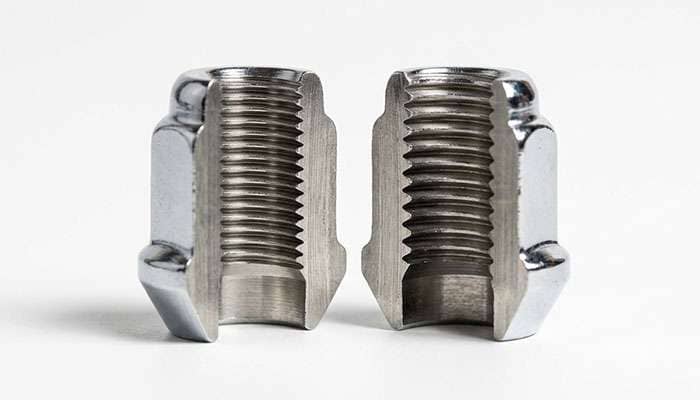
Thread pitch. Four-lug 4x114.3 cars use at least three different stud threads across the range covered here. Imperial on the American classics. M12x1.25 on most of the Japanese cars. M12x1.5 on several of the Korean ones. The difference between 1.25 and 1.5 millimeter pitch is small enough that a wrong nut will start and feel like it is threading, then gall the stud and seize partway down. If you are reusing lug nuts from a previous set, confirm the pitch rather than assume.
Load rating. Every wheel carries a stamped maximum load. Four-lug cars are light, so this rarely bites in the normal direction, but it does bite if you put a lightweight tuner wheel built for a compact under something heavier, or if you load a car for a track weekend. Check the stamp against your door jamb placard.
The wheel that does not fit at all is the safe outcome. It is the one that mostly fits that writes the bill.
The first drive, you feel a shimmy. A lug-centric wheel on a hub-centric car is not concentric with the axle. That off-center mass shows up as a vibration that comes and goes with speed. Most people assume it needs balancing.
The balance shop cannot fix it. Balancing corrects mass distribution around the wheel's own axis. It cannot correct a wheel that is mounted off-center to begin with. You can chase this through three shops and a new set of weights and still have it.
The nuts start backing off. An off-center wheel loads its four nuts unevenly through every rotation. Uneven cyclic loading is what works fasteners loose, and four studs means each one carries a quarter of the job rather than a fifth. There is less margin here than on a five-lug car.
The seats and studs deform. A cross-threaded nut from a wrong-pitch set does not just fail to torque properly. It carries its clamping load on damaged threads, which strip progressively rather than all at once. You retorque, it feels fine, and the engagement underneath is getting shorter every time.
Then a stud lets go. With four studs there is no comfortable margin. When one fails the remaining three take a third more load each, and the next one goes sooner. The interval shortens, and by the time you hear anything the sequence is already well along.
I am not trying to scare anybody off four-lug cars. I have owned plenty. I am saying the margin is thinner than on a five-lug car, so the shortcuts that a heavy truck might absorb are shortcuts a light car will not.
One. Count the studs, then measure across. Four studs, caliper across an opposite pair, center to center. You want 114.3 millimeters or 4.5 inches. If you read 115, you have a different pattern.
Two. Measure the hub flange. Put the caliper on the machined boss the wheel slides over. Write that number down. It determines both whether a wheel will physically seat and what size hub-centric rings you need.
Three. Identify the thread. A thread pitch gauge costs a few dollars and settles it in ten seconds. On an American classic expect imperial. On the imports expect metric, and confirm whether it is 1.25 or 1.5 pitch before you order nuts.
Four. Check the bore on the wheel you are buying, not just the pattern. This is the step people skip. Ask the seller for the bore measurement before money changes hands, especially on a used set with no box.
Five. Confirm offset against what you are running. Find the ET stamp on the back of a spoke. Staying within about ten millimeters keeps your steering geometry close to stock. If you are working on a classic where nothing is stamped, our guide on how to measure backspacing on classic car rims walks through doing it with a straightedge.
The 4x114.3 pattern covers early Mustangs and Falcons, Datsun Zs and 510s, Nissan Sentras and Versas, Hondas through 2001, Hyundai Tiburons, Kia Optimas and Spectras, and the Suzuki compacts. It is one of the longest-running four-lug patterns in the business.
What it is not is a guarantee. The bolt circle matching means the studs will line up with the holes and nothing more. Center bore, thread pitch, and load rating all vary across that list, and on a light four-lug car those three carry more weight than they would on a truck. Measure the bore, check the thread, and then buy with confidence. If you are pairing new wheels with period-correct rubber, our guide on what size tires vintage cars use covers the other half of that job.
When you are ready, browse the full 4x114.3 bolt pattern wheel selection and filter by the bore and offset your measurements call for.
Four lug studs arranged evenly around a bolt circle 114.3 millimeters in diameter, which is 4.5 inches. The comma is European decimal notation and means the same thing as a decimal point. Because four-lug patterns have directly opposite studs, you can measure it with a single caliper reading across the hub, center of stud to center of stud.
On the classic side, the Ford Mustang from 1964 to 1968 in six-cylinder trim, plus the Falcon, Fairlane, Comet, Maverick, and Pinto, and the Datsun 240Z, 260Z, 280Z, 510, and small pickups. On the modern side, the Nissan Sentra before 2013, Versa and Cube, Honda Accord from 1993 to 2001, Hyundai Tiburon from 1997 to 2002, Kia Optima and Spectra, and the Suzuki Forenza, Reno, Swift, and Verona.
That depends on the stud count, because 114.3 is a bolt circle diameter used with four, five, and six studs. Four on 114.3 covers compacts and classics. Five on 114.3 is one of the most common patterns worldwide, covering most modern Hondas, Toyotas, Nissans, Fords, and Hyundais. Six on 114.3 appears on midsize trucks such as the Nissan Frontier and Honda Ridgeline. None of the three interchange.
Ford uses the 114.3 bolt circle in both four-lug and five-lug form. In four-lug it covers the 1964 to 1968 six-cylinder Mustang, Falcon, Fairlane, Comet, and Maverick. In five-lug it covers a large share of the modern lineup including the Mustang from 1994 forward, Fusion, Escape, Edge, Explorer, Taurus, and Focus. Count the studs on your hub to know which one applies.
No. The bolt circles are 14.3 millimeters apart, which is over 7 millimeters of position error at every stud. In most cases the wheel will not go over the studs at all. The only correct way to move between the two is a properly specified bolt-on wheel adapter, which adds stack height and pushes the wheel outboard.
Almost always the center bore. The 4x114.3 pattern spans cars with hub bores from around 59 millimeters up past 70, so a wheel machined for one can be physically stopped by the hub flange on another. Measure the machined boss on your hub and compare it to the wheel's bore. A wheel with too large a bore will mount but needs hub-centric rings to sit concentric; a wheel with too small a bore cannot be used without machining.



