
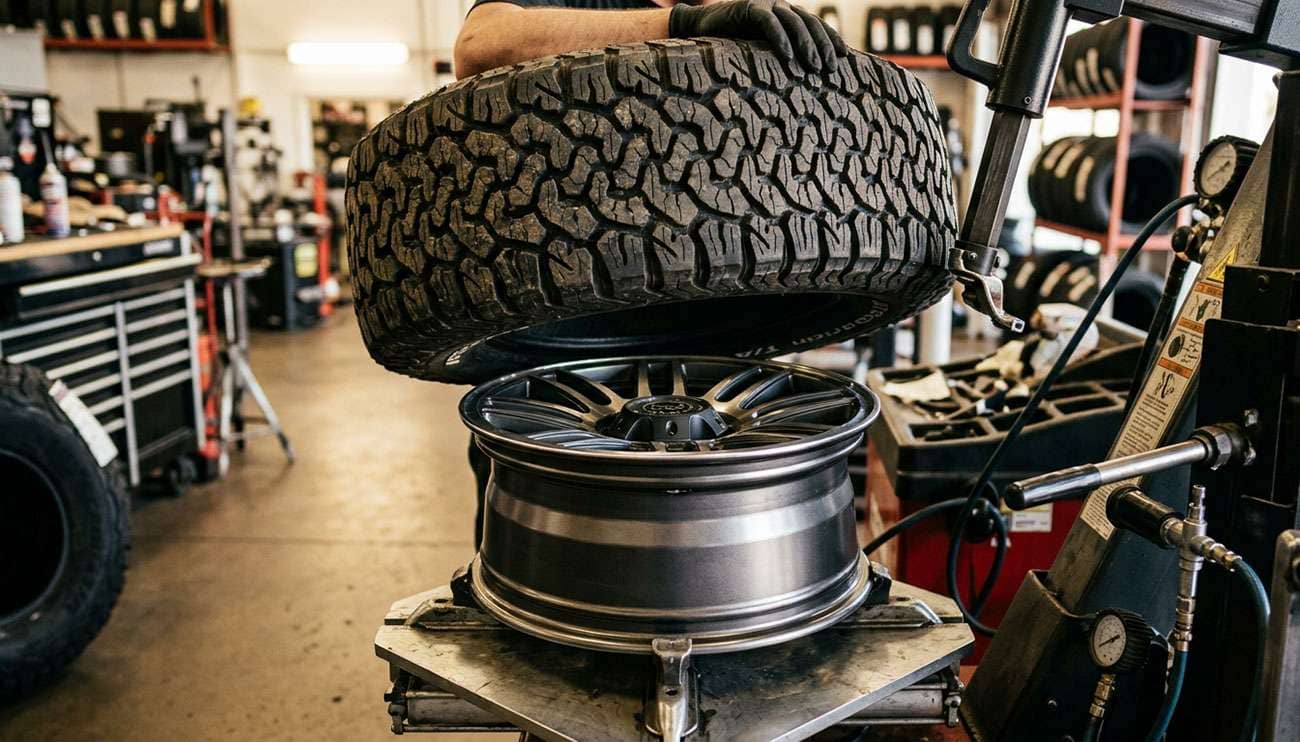
Tire widths from 255 to 305 will fit a 20x9 rim, with 275 sitting closest to perfect across the most aspect ratios. But the number that actually decides your fit is one nobody quotes: where a 9.0-inch rim lands inside each tire's approved rim range, and that position moves with the aspect ratio, not just the width. A 275/60R20 is approved for 7.5 to 9.5 inch rims, so your 20x9 sits near the top of its range. A 275/40R20, the exact same 275 width, is approved for 9.0 to 11.0 inch rims, so the same wheel sits at the very bottom. One tire runs slightly pinched, the other slightly stretched, and they wear and handle accordingly.
Every fitment chart on the internet will tell you whether a size is approved. Approved is a pass-fail grade. After forty-some years of mounting tires I can tell you the interesting information is where in the range you land, because a tire at the middle of its approved range sits flat and wears even, and a tire at either extreme is making a compromise the chart never mentions. Here is the full map, and then we will get into why it looks the way it does.
Feature |
Tire Size |
Approved Rim Range |
20x9 Sits |
|---|---|---|---|
Half-ton truck, stock height |
275/60R20 or 275/55R20 |
7.5 to 9.5 in |
Upper middle, excellent |
Leveled truck, bigger look |
285/55R20 |
8.0 to 10.0 in |
Middle, ideal |
Max size on stock-style 20x9 |
305/55R20 |
8.5 to 11.0 in |
Low end, mild crown |
SUV and street crossover |
255/50R20 or 265/50R20 |
7.0 to 9.0 / 7.5 to 9.5 in |
Top end / upper middle |
Lowered street truck |
275/45R20 |
8.5 to 10.5 in |
Lower middle, good |
Muscle and performance car |
275/40R20 |
9.0 to 11.0 in |
Bottom of range, mild bulge |
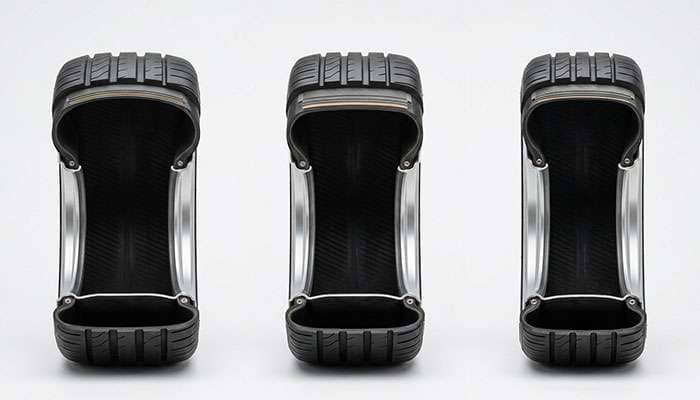
Every tire sold in this country has two rim width numbers published for it. The approved range, set by the Tire and Rim Association, is the span of wheel widths the tire may legally and safely be mounted on. The measuring rim width, sometimes called the design rim, is the single wheel width the tire was engineered around, where the engineers intended the tread to sit dead flat and the sidewall to stand at its designed angle.
The approved range is what the charts show you. The measuring rim is what determines how the tire actually behaves on your wheel. Mount below the measuring width and the bead seats pull inward, the sidewalls lean in, and the tread face crowns like a loaf of bread. The center of the tread carries more than its share and wears first. Mount above it and the beads pull outward, the sidewalls tension flat, and the shoulders carry the extra load while the sidewall loses some of its curve, which is the curve that absorbs impacts.
Now run the 275 example again with that in mind. The 275/60R20 measures around 8 inches, so a 20x9 pulls it one inch wide of design: taut sidewall, crisp steering, shoulders working slightly harder. The 275/40R20 measures around 9.5 to 10 inches, so the same 20x9 leaves it half an inch to an inch pinched: a touch of crown, a hair of squirm at the limit. Both are approved. Both are fine. Neither is the same tire it would be on its measuring rim, and no pass-fail chart will ever tell you which direction your compromise runs. Our guide to matching tire size to wheel width covers the general rule; this article is that rule applied to one very popular wheel.
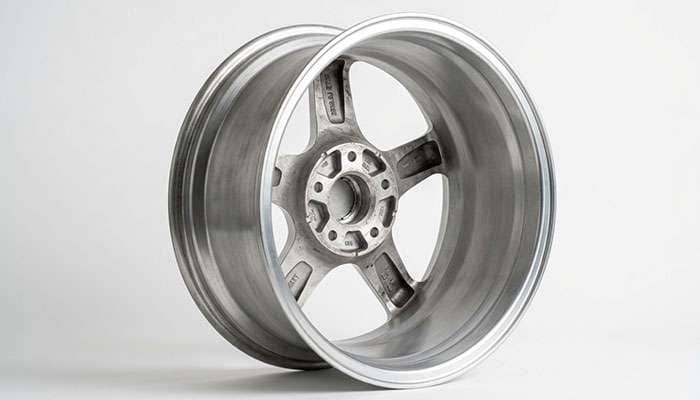
Twenty is the diameter in inches and nine is the width in inches, and here is the part that trips people up: both are measured at the bead seats, the shelves inside the rim flanges where the tire actually sits, not at the outer lips. Put a tape measure across the face of a 20x9 and you will read closer to ten inches, because the flanges add roughly half an inch per side. The wheel is not mislabeled. You measured the wrong spot.
Why does 20x9 matter enough to write about? Because it is the single most common wheel size we sell, by a wide margin. We currently stock over 14,000 SKUs in 20x9 across 106 brands and more than 2,100 wheel models. It is the factory-plus size on half-ton trucks, the default upgrade on SUVs, and a square-setup staple on muscle cars, which is exactly why the what-fits question has so many right answers. One wheel size, three completely different vehicles. If you are still weighing whether 20s belong on your vehicle at all, we made the honest case in what 20-inch wheels are good for, and our breakdown of how big 20x10 wheels really are covers the next width up.
A 275, and I will defend that answer. Across the aspect ratios that matter on this wheel, 275 is the width that keeps a 9.0-inch rim closest to the meat of the approved range, which means a flat tread face, even wear, and a sidewall doing its job from the angle it was designed to work at.
Which 275 depends on the vehicle. On a stock-height F-150 or Ram, the 275/60R20 is the factory-blessed answer, and the Falken Wildpeak A/T4W and Nitto Recon Grappler A/T are the two I mount most in it, with the Toyo Open Country A/T III right there with them. On the Silverado and Tundra side of the aisle it is the 275/55R20, where the Nitto Ridge Grappler has become the default answer for guys who split time between pavement and dirt. On a performance car running 20x9 square, the 275/40R20 is the size, and the Michelin Pilot Sport A/S 4 is the tire I would put on my own.
The one caveat on perfect: if your 20x9s came on an SUV that specs a 255 or 265, stay there. A 255/50R20 with a 9.0-inch rim at the top of its range is a deliberate factory choice for crisp steering response, and the Continental ExtremeContact DWS06 Plus in that size shows you exactly why. Wider is not an upgrade when the engineers already spent your margin on purpose.
Yes, and not just barely. Every common 275 on a 20-inch wheel includes 9.0 inches in its approved range, so this is the rare fitment question with a clean answer. The nuance is which end of the range you occupy, and it flips with the sidewall.
On the tall side, the 275/60R20 and 275/55R20 run 7.5 to 9.5 approved, so your 20x9 sits high in the range: tread pulled taut, sidewall firm, steering a touch sharper than the same tire on the factory 8-inch wheel. This is the setup on tens of thousands of half-ton trucks and it is arguably better than stock. A 275/60R20 stands a true 33 inches tall, and if you want every measurement on that one, we broke it down in our guide to 275/60R20 in inches.
On the short side, the 275/45R20 runs 8.5 to 10.5 and the 275/40R20 runs 9.0 to 11.0, so the same wheel sits at the low end: a slightly rounder tread face and a bit more sidewall bulge protecting the rim lip. On the street that is a fair trade. If you road-course the car, know that the front end will feel a half-step lazier than the same tire on a 9.5 or 10.
By the book: 305. The 305/55R20 and 305/50R20 both publish approved ranges of roughly 8.5 to 11 inches, so a 9.0-inch rim clears the minimum with half an inch to spare. That is the widest metric width where a 20x9 sits legitimately inside the range rather than at its absolute floor. A few 315s technically open their range at 9.0, but at the floor of the range on a tire that wide you are buying all crown and no benefit, and I will not mount one on a 9 for a customer without saying so out loud first.
The same logic disqualifies the 12.50-wide floats. A 33x12.50R20 publishes 8.5 to 11 as well, so yes, it fits, in the sense that the beads will seat and the assembly will hold air. But 12.5 inches of tread on 9 inches of rim crowns the center so hard that you will wear out the middle third of a $450 tire while the shoulders still look new, and the tread blocks squirm under braking because the casing beneath them is pinched. Fits and belongs are different words.
So the honest ladder on a 20x9 runs like this: 275 is the sweet spot, 285 is comfortable, 305 is the defensible maximum with a mild crown you accept on purpose, and the Nitto Recon Grappler A/T in 285/55R20 is where I steer most leveled-truck guys who ask for the widest thing that will not bite them.
Everything above answers whether a tire fits the wheel. Whether the combination fits your truck is a second question, and offset owns it.
A 20x9 with a high positive offset around +25 to +35 tucks inboard, so a 305 that clears the fender lip may kiss the upper control arm or the sway bar at full lock. The same wheel at 0 to -12 pushes the assembly outboard, buying frame-side clearance while spending fender-side clearance and adding poke. Same wheel size, same tire size, opposite rub points. That is why two guys on the same forum swear the same setup does and does not fit: they are both right, on different offsets.
The working rule I give people: on a 20x9, every width from the table fits some offset, but 285 and up demands you know your number before you order, not after. If offset and backspacing are still fuzzy concepts, read our plain-English guide to wheel offset, backspacing, and bolt patterns before you spend a dime, and if you are running different widths front and rear, our 20x8.5 and 20x10 staggered setup guide shows how the two-width version of this math works.
Nobody's truck bursts into flames over a width mismatch inside the approved range. The cost is quieter than that, and it compounds.
First thousand miles. A heavily crowned tire starts wearing its center band. You cannot see it yet, but a tread depth gauge across the face already reads two different numbers. A stretched tire shows nothing yet either, but its shoulders are running warmer than design.
First hard corner in the rain. Crown reduces the working contact patch, so the wide tire you bought for grip is putting less rubber on the road than the narrower one you replaced. The extra width you paid for is standing in the air on both shoulders.
First curb and first big pothole. A stretched sidewall has less curvature in reserve, so an impact that a properly mounted tire shrugs off can pinch the casing against the rim flange or unseat a bead on a hard lateral hit. Once a sidewall is cut or bulged internally there is no repair, only replacement, and our guide to tire sidewall damage and whether it is safe to drive explains why the sidewall never gets a second chance.
At 25,000 miles. The crowned tire's center hits the wear bars while its shoulders show half their tread remaining. You bought, say, 50,000 miles of rubber and you are throwing away the un-worn half of it. On a $350 truck tire, times four, the wrong width quietly cost you the price of a fifth and sixth tire.
One. Confirm the wheel is actually a 20x9. It is stamped on the back of a spoke or inside the barrel. Do not trust the tape measure across the face and do not trust the guy who sold you the truck.
Two. Find the stamped offset while you are back there, marked ET followed by a number. Every fitment answer past 285 wide depends on it.
Three. Pick your width from the table by vehicle and use, then check that specific tire's published approved range and measuring rim before ordering, because manufacturers vary by a half inch either way on the same size.
Four. Match or exceed the load index on your door placard. Half-ton trucks in these sizes commonly spec 113 and up, and several street-oriented 20-inch tires run lighter ratings than the truck needs.
Five. After mounting, run your hand across the tread face. It should feel flat rim to rim. A ridge down the center or hard-loaded shoulders on day one is the wheel and tire telling you which end of the approved range you bought, and it is easier to hear it now than at 25,000 miles.
What tire size fits a 20x9 rim? Anything from a 255 to a 305 depending on your vehicle, with 275 as the answer that is right most often, in the aspect ratio your truck, SUV, or car calls for. The chart answer is easy.
The better answer is to stop asking whether a size is approved and start asking where your 9.0 inches lands inside that size's range, because a 275/60 and a 275/40 put the same wheel at opposite ends of their charts, and the tire always knows the difference even when the chart does not show it. Land in the middle of the range and the tire wears flat, grips with its whole face, and gives you every mile you paid for. That is the whole game. There is a reason this wheel size outsells everything else we stock, and it is that when you get the width right, a 20x9 is about the most trouble-free wheel there is. And if you are reading this because you are still shopping for the wheels themselves, browse our full 20x9 wheel selection, all 14,000-plus of them.
Widths from 255 to 305 fit a 20x9, chosen by vehicle: 275/60R20 or 275/55R20 on half-ton trucks, 285/55R20 on leveled trucks, 255/50R20 or 265/50R20 on SUVs, 275/45R20 on lowered street trucks, and 275/40R20 on performance cars. Check where 9.0 inches falls inside the specific tire's approved rim range; the middle of the range wears best.
A 275 is the closest thing to perfect on a 20x9, because across the common aspect ratios it keeps a 9.0-inch rim near the middle of the approved range, which means a flat tread face and even wear. Pick 275/60R20 or 275/55R20 for trucks and 275/40R20 for performance cars. If your vehicle specs a 255 or 265, stay with it.
A 305 is the widest that fits legitimately, since the 305/55R20 and 305/50R20 publish approved ranges of roughly 8.5 to 11 inches. Wider 12.50-inch floats technically list a 20x9 in range, but that much tread on 9 inches of rim crowns the center and wears it out early. For most trucks, 285 is the widest that fits without compromise.
A 20-inch diameter and a 9.0-inch width, both measured at the bead seats inside the rim flanges where the tire sits, not across the outer lips. Measured face to face, a 20x9 tapes closer to ten inches because each flange adds roughly half an inch. It is the most common wheel size we sell, spanning trucks, SUVs, and muscle cars.
On a 9.0-inch rim, tire section widths from about 255 to 305 millimeters fall within published approved ranges, with the ideal window at 275 to 285. The exact limits shift with aspect ratio, because taller sidewalls tolerate narrower rims and shorter sidewalls demand wider ones. Always check the specific tire's approved range, since manufacturers vary by up to half an inch on the same size.
Yes, in every common aspect ratio. The 275/60R20 and 275/55R20 approve rims from 7.5 to 9.5 inches, putting a 20x9 near the top of the range with a taut, responsive fit. The 275/40R20 approves 9.0 to 11.0, putting the same wheel at the bottom with a slightly rounder tread face. Both are safe, factory-legitimate fitments.
Offset never changes whether a tire fits the wheel, but it decides whether the combination fits the vehicle. High positive offset tucks the assembly inboard where wide tires can contact suspension at full lock, and negative offset pushes it outboard where the fender becomes the limit. Past 285 millimeters wide on a 20x9, confirm your stamped ET number before ordering.



