
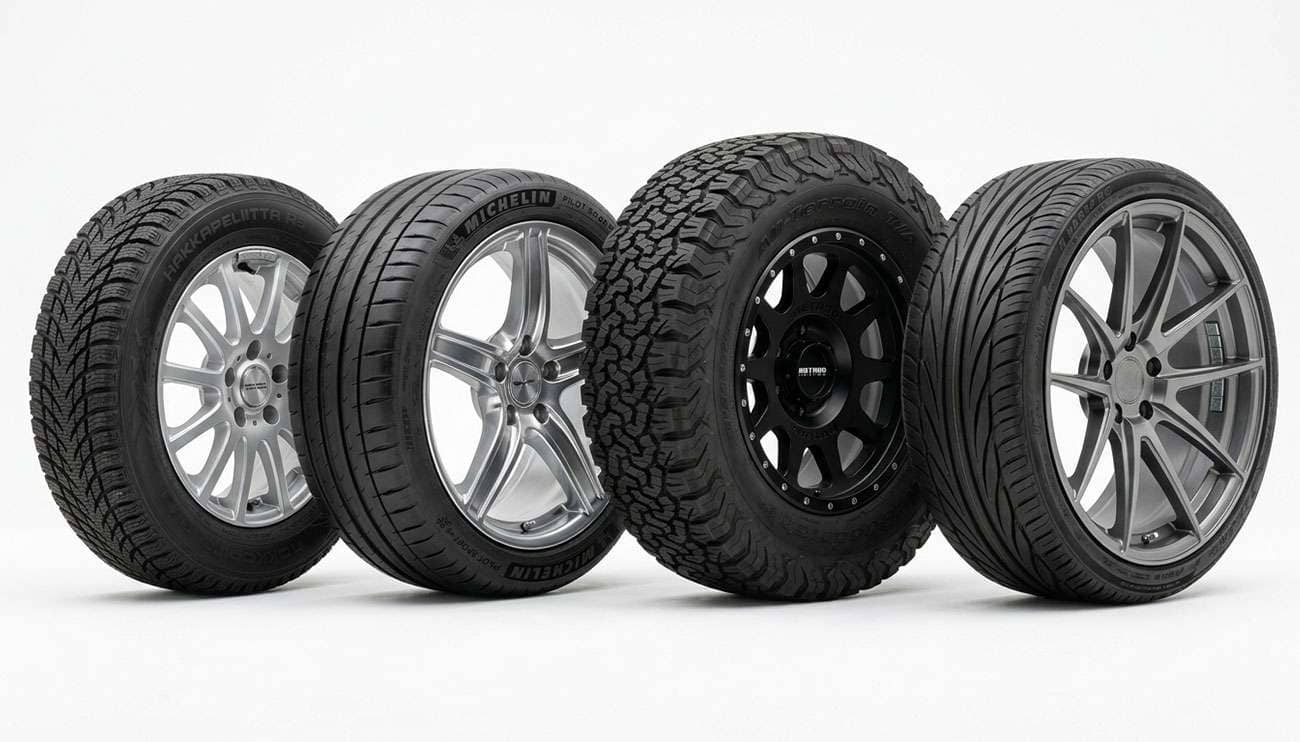
A wheel and tire package is four wheels and four tires sold as one assembly, mounted and balanced before it ships. But a wheel package is not one product. It is five different builds, and which one you need is decided entirely by why you are replacing. Most guides skip that and stop at "it saves you money." Purpose is the variable that sets your diameter, your offset, your load rating, and your hardware list. Get purpose right and the specs follow. Get it wrong and the box still shows up - it just will not work on your car.
Ask five people what a wheel package is and you get five answers, because they are each describing a different build. In the fitment department we sort every incoming package order into one of five categories before we touch a single spec. The category decides everything downstream.
Package Type |
You Need This When |
The Spec That Rules It |
|---|---|---|
OE-size replacement |
Factory wheels are bent, cracked, curbed, or corroding and you want stock ride quality back |
Offset within roughly 5mm of factory, load index equal to or above the door placard |
Plus-size upgrade (+1 or +2) |
You want a larger wheel and shorter sidewall without changing ride height |
Overall tire diameter held within about 3 percent of the original |
Winter or second set |
You swap seasonally and do not want to pay to dismount tires twice a year |
Often a minus-size; narrower section width cuts through snow better |
Truck, lifted, or off-road |
You have added a lift or leveling kit, or you want a wider stance and taller tire |
Wheel load capacity and tire load range, plus clearance at full steering lock |
Staggered performance |
Rear-wheel drive car where you want a wider rear wheel and tire than front |
Front and rear are different part numbers; tires cannot be rotated front to back |
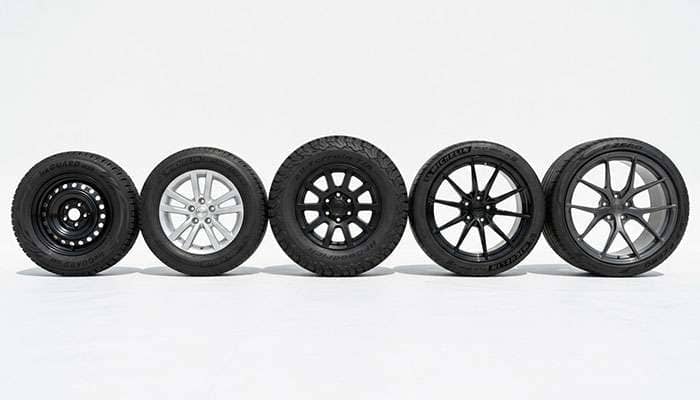
Notice that only one of those five is about looks. The other four are driven by a mechanical requirement - ride height, seasonal traction, load, or drivetrain layout. That is why a generic "best wheel package" list is close to useless. It is answering a question you did not ask.
Work backward from the problem that made you start shopping. Each of the five cases below has a different set of hard constraints, and the constraints are not interchangeable.
This is the OE-size replacement. You are not trying to change anything - you are trying to put the car back the way it was. Match the factory diameter and width, keep offset within about 5mm of stock, and hold the tire load index at or above what the vehicle placard specifies. Federal Motor Vehicle Safety Standard 110 requires that placard on every passenger vehicle, and it is the authoritative source for your original size and load requirement, not the tire that happens to be on the car now. Somebody may have already put the wrong thing on it.
This is plus-sizing. You go up in wheel diameter and down in sidewall height so the overall diameter of the assembly stays the same. Hold it within roughly 3 percent of original and your speedometer, odometer, ABS, and traction control keep reading correctly. Push past that and the sensors start reporting a wheel speed that does not match reality, which shows up first as a speedometer that reads low and an odometer that quietly undercounts your mileage.
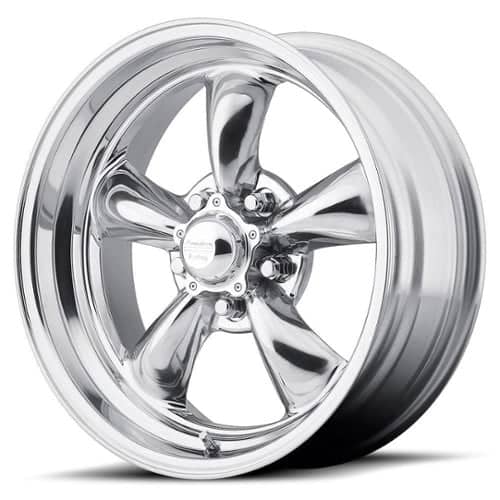
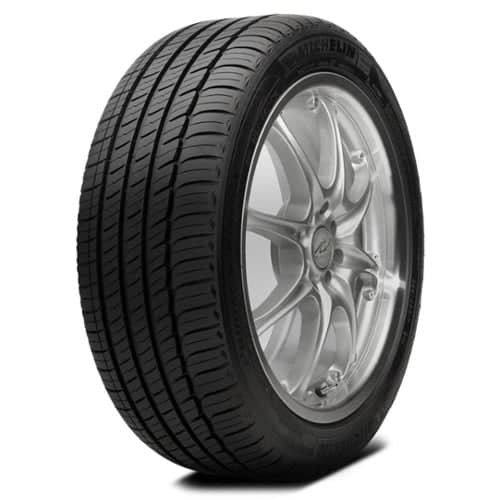
A typical +1 build on a mid-size car pairs an 18-inch wheel with a 45-series tire. The American Racing VN505 Torq Thrust II in 18x9.5, 5x120.65 bolt pattern, +6 ET, 72.56mm bore runs $561.23 per wheel, and a Michelin Primacy MXM4 in 245/45R18 XL 100H at $309.74 gives you the sidewall to carry it without beating up the ride.
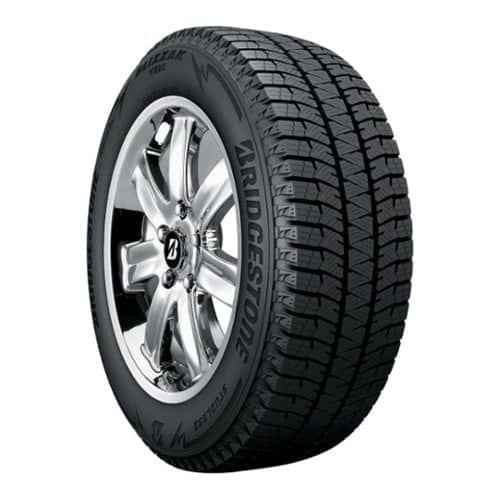
Here the logic inverts. Most people go down a size, not up. A narrower tire on a smaller wheel puts more weight per square inch on the contact patch and cuts through slush instead of floating on it. You also stop paying a shop to dismount and remount rubber twice a year, and you keep your good wheels out of road salt. A Bridgestone Blizzak WS90 in 225/65R17 at $184.42 on an inexpensive alloy is a far better winter answer than a wide summer-biased setup on your nice wheels.
Load is the constraint that outranks everything else on a truck package, and it is the one people skip because it is not visible. Every wheel carries a stamped or documented load rating, and four of them together have to exceed your gross vehicle weight rating. A wheel that looks identical to another can be rated hundreds of pounds lower. We break the numbers down in our wheel load rating guide, and it is worth reading before you order anything for a half-ton or heavier.
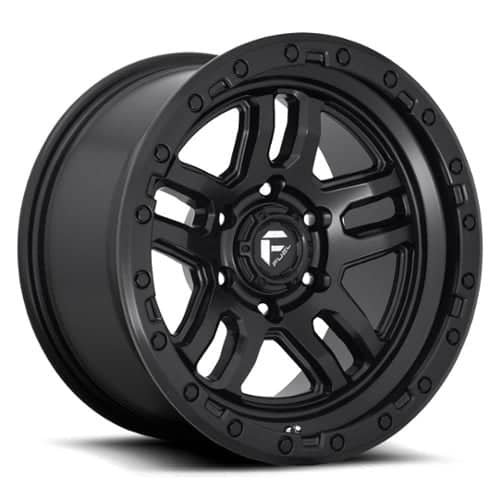
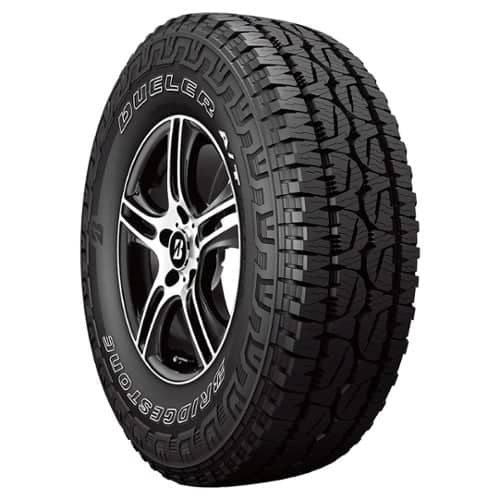
The Fuel Ammo D700 in 17x9, 6x139.7, +1 ET, 93.1mm bore, matte black at $320 is a common starting point for late-model half-tons. Pair it with a Bridgestone Dueler A/T Revo 3 in LT265/70R17, 121S, 10-ply at $291.78 and you have an all-terrain package with the load range to actually tow with.
Staggered means the rear wheels are wider than the fronts. It works on rear-wheel drive because the rear axle is putting power down and wants more contact patch. It comes with a permanent tradeoff: you cannot rotate the tires front to back, so the rears wear out first and you buy them more often. Your spare, if you have one, will not interchange either. The full comparison lives in square versus staggered setups.
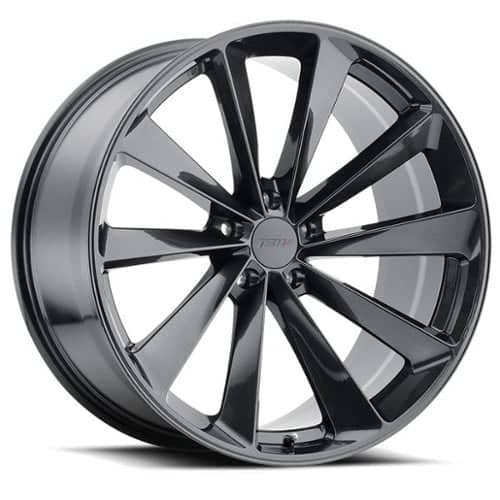
A common staggered build uses the TSW Aileron in 20x8.5, 5x114.3, +30 ET up front and 20x10, 5x114.3, +40 ET at the rear, both $379.10 in gunmetal, with a Bridgestone Potenza RE97 A/S in 245/40R20 at $402.09 handling front duty.
Yes. That is the core of what you are paying for. The tires are pressed onto the wheels, seated, inflated, and spin balanced before the assemblies are boxed. When they arrive you are lifting the vehicle, removing the old wheels, and torquing the new ones on. No tire machine, no second appointment, no shop labor for mounting.
The distinction worth understanding is static and dynamic balancing versus road force balancing. Standard spin balancing corrects for weight distribution - it finds the heavy spot and counters it with weights. Road force balancing goes further by pressing a loaded roller against the tire while it spins, simulating the weight of the car and measuring variation in stiffness around the circumference. A tire can be perfectly weight-balanced and still have a stiff spot that produces a vibration under load. On larger diameters and lower profiles, that difference gets noticeable, which is why road force is worth requesting on anything 19 inches and up.
One thing that is not free: after roughly 50 to 100 miles, retorque your lug nuts. New assemblies settle as the wheel seats fully against the hub face, and clamp load drops. This is not a suggestion from us - it is standard practice taught by the Tire Industry Association and printed in most vehicle owner manuals. Skipping it is how wheels come loose on people.
This is where orders go sideways, and it is the part most articles gloss over with a list of items that may or may not apply to you. What ships depends on your specific vehicle, not on a generic package contents list. Find your case in the table below.
Component |
Usually Included When |
You Have to Add It When |
|---|---|---|
TPMS sensors |
Your vehicle uses a direct system and you are not transferring the originals |
Your existing sensors are staying on the old wheels, or the set is going on a second vehicle |
Hub-centric rings |
Wheel center bore is larger than your hub diameter |
Rarely - but always confirm, because a missing ring shows up as highway vibration |
Lug nuts or bolts |
The new wheel uses a different seat type than your factory hardware |
Your stock lugs are a conical seat and the wheel wants ball or mag seat, or the reverse |
Center caps |
Most aftermarket wheels ship with them |
Some applications use factory caps, or list caps as a separate accessory |
Alignment |
Never - it is a service, not a part |
Any time you change wheel width or offset from stock |
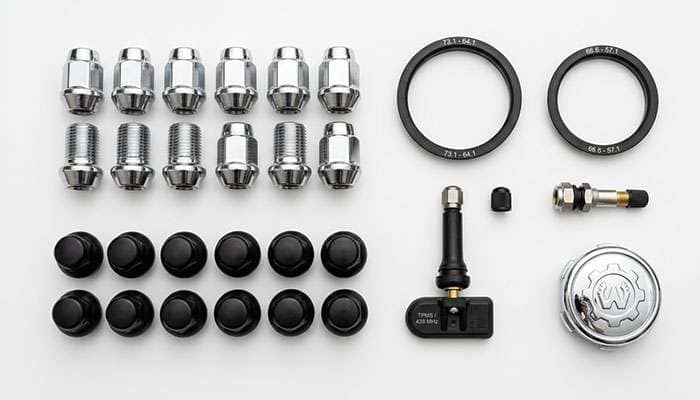
Lug seat type. A lug nut has to match the shape of the seat machined into the wheel. A conical nut in a ball seat contacts on a narrow edge instead of a broad taper, which means it cannot generate proper clamp load no matter how hard you torque it. It will feel tight and then loosen. If you take nothing else from this section, take that - and read lug nut seat types before you reuse factory hardware on aftermarket wheels.
Center bore. A hub-centric wheel is located by the machined hub, with the lugs only providing clamping force. A lug-centric wheel is located by the lugs themselves. Aftermarket wheels are usually made with an oversized bore so one casting fits many vehicles, and a plastic or aluminum ring fills the gap so the wheel still centers on the hub. Leave the ring out and you are relying on the lugs to center a 50-pound assembly spinning at highway speed. It usually shows up as a vibration between 55 and 70 mph. The mechanics are in hub-centric versus lug-centric wheels.
On TPMS specifically: FMVSS 138 has required a tire pressure monitoring system on light vehicles built since the 2008 model year. Direct systems use a sensor in each wheel and need to be installed and relearned to the vehicle. Indirect systems infer pressure from wheel speed sensors and need nothing in the wheel at all. Which one you have determines whether sensors are a line item or a non-issue, and we cover the relearn side in TPMS sensors for aftermarket wheels.
Four numbers decide it, and all four have to be right. Three out of four is a package that does not go on the car.
Bolt pattern. Number of studs and the diameter of the circle they sit on, written as 5x114.3 or 6x139.7. There is no adapting around a mismatch without hardware that introduces its own problems. This is a pass or fail.
Offset. The distance in millimeters from the wheel centerline to its mounting face. Positive offset pulls the wheel inboard toward the suspension, negative pushes it outboard toward the fender. Change it too far in either direction and you get contact - inner strut and control arm on the positive side, fender lip and liner on the negative side. Offset also changes the scrub radius, which alters steering feel and loads the wheel bearing differently than the engineers intended.
Center bore. The hole in the middle. It has to be equal to or larger than your hub, and if it is larger it needs a ring.
Load rating. Both the wheel and the tire carry one. Four wheels together have to exceed the gross vehicle weight rating, and the tire load index has to meet or exceed the door placard. On trucks and SUVs this is the spec most often ignored and the one with the worst failure mode.
Two more that are not on the spec sheet but matter just as much: brake caliper clearance and clearance at full steering lock. A wheel can have a perfect bolt pattern and offset and still contact a caliper because of the spoke profile on the inboard face, particularly on vehicles with upgraded brakes. And a tire that clears going straight can rub the liner when the wheel is turned to the stop and the suspension is compressed - which is exactly the condition you hit pulling into a driveway at an angle. Neither of these is visible on a spec sheet, and both are worth confirming with a fitment specialist before the order goes out.
SAE J2530 is the aftermarket wheel performance standard covering cornering fatigue, radial fatigue, and impact testing. It is voluntary, which is precisely why it is worth asking about. A wheel that has been through it has demonstrated something. A wheel that has not is an unknown.
Using real numbers from the builds above, four wheels plus four tires lands roughly where you would expect once you separate the cases:
Build |
Wheels (set of 4) |
Tires (set of 4) |
Package Total |
|---|---|---|---|
Winter set, 17-inch |
Varies by alloy choice |
About $738 |
Lower end of the range |
Truck all-terrain, 17-inch |
About $1,280 |
About $1,167 |
About $2,447 |
Plus-size car, 18-inch |
About $2,245 |
About $1,239 |
About $3,484 |
Staggered performance, 20-inch |
About $1,516 |
Front pair from about $804 |
Upper end of the range |
The spread is wide because the five build types are genuinely different products. A winter set and a staggered 20-inch performance package have almost nothing in common except the word "package." For a direct comparison against buying the components piecemeal, including the labor math, see are wheel and tire packages cheaper.
A wrong package rarely announces itself on day one. It degrades, and each stage is more expensive than the last.
Week one - noise and vibration. Missing hub rings or a package that never got road force balanced shows up as a steering wheel shimmy at highway speed. Annoying, cheap to fix if you catch it here.
Month one - uneven tire wear. Aggressive offset changes camber and toe behavior. You did not get an alignment because nobody told you to. Now the inner or outer shoulder is wearing at two or three times the rate of the center. A set of tires you expected to get 50,000 miles from is done at 20,000.
Month three - suspension and bearing wear. Offset that pushes the wheel outboard increases the lever arm on the wheel bearing. The bearing was engineered for the factory scrub radius. Run it outside that and it wears early. A bearing job is not a small bill, and it takes the hub assembly with it on many modern vehicles.
Ongoing - rubbing damage. A tire contacting the fender liner at full lock abrades the sidewall a little at a time. Sidewall damage does not heal and it is not repairable, because the sidewall is where the flex happens and where heat builds. That is the failure mode nobody sees coming. If yours is already showing marks, read tire sidewall damage and whether it is safe to drive before your next trip.
The end of the line - load failure. Underrated wheels or tires on a truck that tows do not fail gradually. Sidewall flex generates heat, heat degrades the rubber and the belt package, and the failure arrives at speed under load. NHTSA has tied tire failure to thousands of crashes annually, and load rating is a leading contributor. This is the reason we will not build a package that comes in under placard.
Every one of those outcomes traces back to picking the wrong build type at the start, or to a spec that got skipped because the reader did not know it was a spec.
Step 1 - Name your case. OE replacement, plus-size, winter, truck, or staggered. Write it down. Every decision after this follows from it.
Step 2 - Read the door placard. Driver's door jamb. It gives you the original tire size, the load requirement, and the cold inflation pressure. This is your baseline, and it beats whatever is currently mounted.
Step 3 - Pull your four numbers. Bolt pattern, factory offset, hub diameter, and gross vehicle weight rating. If you are not certain, our fitment team can confirm all four from your year, make, model, and trim.
Step 4 - Set your diameter target. Plus-sizing, hold within about 3 percent of stock. Going taller on a truck, confirm clearance at full lock and full compression, not just sitting still in the driveway.
Step 5 - Settle the hardware before checkout. TPMS sensors, hub rings, and lug seat type. These are the three that turn a smooth install into a second trip, and all three are cheaper to settle before checkout than after the truck arrives.
Step 6 - Torque properly, then retorque. Star pattern, calibrated torque wrench, manufacturer spec. Come back at 50 to 100 miles and do it again.
Step 7 - Get an alignment if you changed width or offset. Not optional. This is what protects the tire investment you just made.
When you are ready to build one, our custom wheel and tire packages are verified for fitment before they ship, mounted, balanced, and sent complete.
The question "what are wheel packages" has a one-sentence answer and a real answer. The one-sentence version is that they are wheels and tires sold together, mounted and balanced. The real version is that there are five distinct builds hiding under that phrase, and the one you need was determined before you started shopping - by whether you are fixing damage, chasing a look, preparing for winter, carrying load, or putting power down through the rear axle.
Name the case first. The specs are not arbitrary once you have done that. They are consequences.
A wheel package is a set of four wheels and four tires sold together and shipped mounted and balanced, ready to bolt on. There are five common build types - OE-size replacement, plus-size upgrade, winter or second set, truck and off-road, and staggered performance - and which one fits your situation depends on why you are replacing your current setup.
It depends on your vehicle. If your vehicle uses a direct TPMS system with a sensor inside each wheel, sensors are typically added to the package unless you are transferring your originals. If your vehicle uses an indirect system that reads wheel speed sensors, no sensors go in the wheels at all. Direct systems also require a relearn procedure after installation.
Only if the seat type matches. Lug nuts come in conical, ball, and mag seat designs, and the nut has to match the seat machined into the wheel. A mismatched seat contacts on a narrow edge instead of a full taper, which prevents proper clamp load. The wheel will feel tight at install and loosen in service, so always confirm seat type before reusing factory hardware.
If you changed wheel width or offset from factory, yes. New offset changes the scrub radius and how the suspension geometry loads under cornering and braking, which affects tire wear patterns. If you are installing an exact OE-size replacement with factory offset, an alignment is good practice but not strictly required.
For a plus-size build on a car, keep the overall assembly diameter within about 3 percent of the original so the speedometer, odometer, ABS, and traction control stay accurate. You accomplish this by going up in wheel diameter and down in tire sidewall height at the same time. On a lifted truck, the limit is physical clearance at full steering lock and full suspension compression, plus load rating.
A staggered setup uses wider wheels and tires at the rear than at the front, so the front and rear assemblies are different sizes and cannot swap positions. Rotation is limited to side-to-side on the same axle, and only if the tires are not directional. The practical effect is that rear tires wear out first and get replaced more often than fronts.



